August 19, 2021

Artifact #85: Letter from Soapy Smith's cousin Edwin to Soapy's son Jefferson, February 25, 1937

Artifact #85
Letter-page 1
Jeff Smith collection

(Click image to enlarge)


 still think we could do well with the projected biography"
(Edwin was working on a biography of Soapy Smith)


An interesting letter from Edwin Benson "Bobo" Smith, the cousin of Soapy Smith, to Soapy's son, Jefferson Randolph Smith III. Those that have read the book Alias Soapy Smith: The Life and Death of a Scoundrel might recall that Edwin and Soapy grew up together in Georgia, traveled the state hunting, and started working the cheap John (jam auction) sales racket in Texas together. Edwin was ready to join his cousin full time but credits witnessing the shootout between the outlaw Sam Bass gang and Texas Rangers, resulting in the death of Sam Bass, with his choosing not to follow Soapy's career path.
     When reading the transcription of the letter below keep in mind that it was written February 25, 1937, so Edwin is 78 years old and Jefferson is 49. Edwin and Jefferson wrote to one another since Jefferson was young, wishing to learn as much as he could about his father. Who better to ask than a family member who grew up with his father?

Artifact #85
Envelope-front
Jeff Smith collection

(Click image to enlarge) 
 
     The above envelope is part of the Fort Sumter Hotel stationary. Note that the stamp is upside down. Was this intentional or an oversight? Perhaps a sign that Edwin's eyesight was not as it once was? Also note that the address for "Mr. Jeff Smith" is listed as "City Hall." Jefferson was very involved in St. Louis politics, choosing to work behind the scenes. One of his fears was that his political rivals would find out that his father was the infamous crime figure "Soapy" Smith, thus ending his political career. He was very cautious that anyone would find out about his father, even going to the effort of hiding his father's large collection of letters and documents behind a false wall in the family basement.

Artifact #85
Envelope-rear
Jeff Smith collection

(Click image to enlarge)
 
     The hand-written letter and envelope is in my personal collection (item #85). Following is the transcription for ease of reading.

1201 M St. nw [M Street, northwest]
Washington D.C.

Feb 25, 1937

      Dear Jeff: From the porch of the Hotel you can see Fort Sumter where all the trouble began between the North and the South; Charleston is really a most interesting old town and quaint beyond description. I stayed there awhile after leaving Savannah.
     Wherever I go I get myself interviewed as you will see by clipping – Native modesty, eh? Needless to say I interview myself.
     Now I am back home I feel improved after my sojourn down the line but am pretty shaky yet! It would have been fine had I been able to prolong the stay in that soft climate.
     By this time I trust you have caught on to something worth while. Outside of government employment Washington affords scant hope and even Uncle Sam is a poor prospect unless there is some big influence back of an applicant.
     The situation here is confusing but it seems to me that Roosevelt is destined to slip; he made a bonehead play in his Supreme Court proposal, regardless of any good intent.
     I still think we could do well with the projected biography [Edwin was working on a biography of Soapy], yet am assailed with fears as to my strength not being up to the mark, I truthfully can not dictate, never could.
     Just as soon as I can get up the nerve to tackle the job I’ll let you know. Meanwhile write me fully. My best love to you and your wife and it would be a great pleasure to see her.
     When in Ga. [Georgia] I thought of going to the old home town but that section has just about as bad winters as Washington or St. Louis and I was dodging the cold.

Write soon
E. B. Smith
 
Artifact #85
Letter-page 2
Jeff Smith collection

 (Click image to enlarge)


Artifact #85
Letter-page 3
Jeff Smith collection

 (Click image to enlarge)
 
 
     Edwin B. Smith passed away just over three years later on November 1, 1941, never publishing his biography on Soapy, titled Boyhood Days of Jefferson Randolph Smith II and Edwin Bobo Smith, which resides in my personal collection. Edwin's writings are the best accounts of Soapy as a youth and young man, and were used extensively in telling the story of Soapy in the early days.

* Special thanks to my publisher, Alaskan historian, and longtime friend, Art Petersen of Klondike Research for his help in deciphering the handwriting of 78 year old Edwin Smith.


Edwin Benson "Bobo" Smith:
 
Jefferson Randolph Smith III
May 04, 2021  


Edwin Benson "Bobo" Smith: pages, 20, 22-30, 32, 35-36, 333, 425, 428, 444-49, 589.
Jefferson Randolph Smith III: pages, 7, 107-08,167, 417-18, 546, 584, 587-89.


"Every crowd has a silver lining"
—P. T. Barnum


August 15, 2021

William Deutsch, Alias "Henry Dutch," Tivoli Club manager, property owner

William Deutsch
Palace Theater's Tivoli gambling den
Denver Republican
June 13, 1882

(Click image to enlarge)


 illiam Deutsch

 Alias "Henry Dutch"


(Much of the information comes from the book Alias Soapy Smith: The Life and Death of a Scoundrel)


Tivoli Beer Hall
Managed by William Deutsch

(Click image to enlarge)

     William "Henry Dutch" Deutsch was a Denver business property owner and business manager in the 1880s-90s. His early story is currently unknown, everything known thus far beginning in 1881-82, when he managed Ed "Big Ed" Chase’s Palace Theatre’s saloon and gaming annex, the Tivoli Beer Hall.(1) For ejecting a John Burns from the Theatre in March 1881, Deutsch is arrested for assault and battery.(2) The Denver Republican for June 13, 1882 (see top of post) states that Deutsch left (or is fired) the Beer Hall, opening the Lyceum Vaudeville Theater in South Pueblo, Colorado, while the Rocky Mountain News writes on June 3, 1883 that he is proprietor of the Tivoli Variety Theatre in Pueblo. At the same time the News states that he is the proprietor of the Tivoli Beer Hall in Denver.(3) In 1887-1888 he is listed in the city directory as proprietor of the Alhambra Beer Hall at 1321 Seventeenth Street(4) and as its manager in 1889.(5)


The Deutsch Block
Tivoli Club at far left

(Click image to enlarge)

     Deutsch obtains property in Denver
on Seventeenth and Holladay streets (later named Market) in 1886.(6) He builds the Deutsch Block, where in February 1888 he receives permission to open a saloon at that location. The north corner of that Block houses Soapy Smith's and Ed Chase’s Tivoli Club.
     In city directories for 1890-91 and 1893-95, Deutsch is listed as proprietor of the Tivoli Club,(7) but it is Soapy who controls it. In June 1892 the Rocky Mountain News mentions him as proprietor.(8) The city directory in 1897 lists the Tivoli Sample Room at the same location.(9) Soapy left in 1895-96 so the Tivoli is under Deutsch's control now.


Tivoli Sample Room
"WM. DEUTSCH, PROP."
Courtesy, Geri Murphy collection


A business card lists his name for the “Tivoli Sample Room” located on the “corner 17th and Market streets.”(10) A “sample room” was a step above a saloon in class, some of which served only wines.


Whiskey flask
for William Deutsch
Courtesy of
the Jerry Hazalet collection


Deutsch’s name also appears on a personalized glass whiskey flask, the label reading, “Fine Old Monogram whiskey, Bottled expressly for Wm. Deutsch, Tivoli Seventeenth and Market Street, Denver Colo.”(11)


"Tivoli"
Denver map
1908
Note "TIVOLI" circled in red

(Click image to enlarge)

It is believed that William Deutsch kept Soapy's Tivoli saloon going until at least 1908, according to a Denver map. At some point he opened a hotel in the Deutsch building as well.

SOURCES:
(1) Rocky Mountain News 03/06/1881
(2) Rocky Mountain News 03/12/1881
(3) Rocky Mountain News 03/06/1883.
(4) Denver City Directory 1887 and 1888.
(5) Denver City Directory 1889.
(6)
Rocky Mountain News 8/12/1886
(7) Denver City Directory 1890-1891, 1893-1895.
(8) Rocky Mountain News 06/19/1892.
(9) Denver City Directory 1897.
(10) Tivoli Sample Room business card, Geri Murphy col.
(11) Whiskey bottle, Jerry Hazalet col.


William Deutsch
January 2, 2009


William Deutsch: pages 80, 131-32, 248.


"By gaming we lose both our time and treasure - two things most precious to the life of man."
—Owen Felltham


August 13, 2021

Luther Woods: Soapy Smith Gang Member


LUTHER WOODS
Soap gangster
Denver Republican
October 12, 1882

(Click image to enlarge)


hat about Luther Woods?
Member of the Soap Gang


―
Luther Woods, David Rice and Miner Smoot, proprietors of the gambling rooms over the Collender billiard hall, were arrested for keeping a gambling house, the complaining witness being William Shedd, who claimed to have lost $800 in the house. On their trial before Justice Sopris, yesterday, the defendants were discharged. They then had Shedd arrested for frequenting gambling halls.
―
      Not a lot is known about Soap Gang member Luther Woods except an incident in 1898 involving a joke that turned sour and made Soapy look bad. This latest newspaper find shows that Woods had an early history in Denver, Colorado, apparently as a proprietor of gaming rooms. I love the account of having the victim arrested, "for frequenting gambling halls." If Woods remained in Denver then it is very possible that Soapy knew him for a longer period than previously known. 
     It was in April 1898 that Soap Gang member Harry Green got on Soapy's bad side when he orchestrated a joke upon a newspaper reporter that involved Luther Woods and other gang members, pretending to be other people. Green pretended to be Soapy himself. The ruse was discovered by Soapy who sent off an angry letter to Green.
     Harry Green again pretended to be Soapy when arrested on May 1, 1898 in Tacoma, Washington. Although not actually Soapy, the newspaper account only added to the growing negative stories about Soapy. It is unknown if the real Soapy ever saw Luther Woods, let alone Harry Green, again.

SOURCE:
Denver Republican, October 12, 1882.


Luther Woods:
June 21, 2020


Luther Woods: page 497.


"Luck never gives; it only lends."
—Swedish Proverb


July 21, 2021

Comparing Soapy Smith's Leadville sterioviews

Harrison Ave.
Leadville, Colorado
July 21, 1880
Luke and Wheeler photographers

(Click image to enlarge)


S THAT SOAPY'S PARTNER IN CRIME?

Those who have read Alias Soapy Smith: The Life and Death of a Scoundrel, you may recall seeing the photograph (#6A) below, in the first photograph section of the book.
 
 
Soapy Smith and his partner in crime
Harrison Ave.
Leadville, Colorado
July 21, 1880
Luke and Wheeler photographers
Kyle Rosene collection
 
 (Click image to enlarge)
 
Soapy sent the above sterioview card to his sister. He wrote on the back
 
This is a crew of freighters we met in Leadville on the 21st of July 1880 in the morning on the day that Gen Grant arrived. You can see my photo by looking between the two wagons next to the man with the apron and his sleeves rolled up. (Soapy is between the two men, or in the rear, 3rd from the left) JRS. In other writing Soapy tells his sister Eva that the former president (1869-1877) is on horseback in the background. If you look closely you can see Grant on a very blurry horse.  

It is Leadville, Colorado, July 21, 1880, the day ex-president U. S. Grant arrived in the city. There is a parade in his honor and a photographer(s) Luke and Wheeler set up a sterioview camera to take some photographic mementos of the day's celebration.
     Notice the similarities to the photograph at the top of the post? This is because they were both taken by the same photographer, on the same day, close to the same location, one picture being taken before Grant passed by, and one taken afterwards. It is believed that the photo with Soapy was taken first, and the photographer quickly moved his equipment out of the street, for the passing of the parade, and then set up his equipment in the street once again, for another photograph, in which a large crowd took up their place in front of the camera. It is guessed that much of the crowd paid in advance for a copy of the sterioview. 
 
 
Soapy Smith and his partner in crime
Close-up
Harrison Ave.
Leadville, Colorado
July 21, 1880
Luke and Wheeler photographers
Kyle Rosene collection

 
     So, is Soapy possibly in both sterioviews? Below is a closeup of the latest Leadville sterioview card. It shows Harrison Avenue looking south. The Tabor Building, Clarendon Hotel building are seen on the left, and the Union Restaurant is across the street on the right.
 
Harrison Ave.
Leadville, Colorado
July 21, 1880
Luke and Wheeler photographers

  (Click image to enlarge)

     The close-up below appears to show Soapy's unnamed partner in crime, but I do not see Soapy himself. My guess is that now that Grant has passed by, Soapy is back to working the crowd for profit.
 
 
Close-up of crowd
Soapy's Partner?
Harrison Ave.
Leadville, Colorado
July 21, 1880
Luke and Wheeler photographers


Soapy Smith in Leadville


Leadville, Colorado: pages 10, 36-37, 75, 77-78, 116, 123, 134-35, 144, 152, 176, 189, 192, 219, 225, 292, 297, 347, 349, 420, 509, 594. 


"There are very few honest people up in that country," Said Bascomb last night. "I was told that my brother had $80 in cash in his clothes when he died, also that he owned several lots in Skaguay, a half-interest in Clancy’s saloon which was taking in probably $200 a day and an interest in the White Pass Trail.

The widow never got anything out of the estate. The money was gone and there was no trace of the lots, as they had never been recorded. Even a letter of thanks from the secretary of war could not be found and nearly everything in Jeff’s room had been stolen."
—Bascomb Smith


July 7, 2021

Frank Reid's revolver

Frank Reid's revolver
Smith and Wesson Safety Hammerless
Or New Departure
aka "Lemon Squeezer"
Courtesy of
Margaret Tibbets and
Mike McLucas

(Click image to enlarge)


 s this Frank Reid's revolver?
One key point in favor of it being Reid's is that Leslie Butler, as executor of Reid's estate, held legal claim to it.


     When it comes to Soapy Smith I am very cautious in believing what I hear. It's even worse when it comes to Soapy's guns. Over the last 40 years I have seen so many "this is Soapy's gun," and very few make any sense. In those decades I do not recall seeing one of Reid's pistols. This one has worthiness. As an honest historian I cannot, in good faith, say that "this gun is positively Frank Reid's gun," as that would be presumptuous of me. However, I am more inclined to believe that this gun is indeed Reid's.
     Some time ago I received an exciting comment on one of my posts, from Margaret Tibbets.
      I’m so excited to find your site. Can’t wait to buy your book. I’ve been researching Soapy for an article about Leslie Butler, a friend of Frank Reid who was an important early Oregonian. Leslie managed Frank’s estate and owned the gun Frank used purportedly to kill Soapy Smith. Leslie’s daughter wrote an account of her summer in Skagway and included her account of Soapy’s death. I have a copy of this unpublished document written in 1925. She and her sister sat at Frank’s bedside singing hymns to him for the 10 days before he died at the Hospital.
     Leslies’s great-grandson, Mike McLucas, is an old family friend. I got interested in this story while researching Leslie Butler and his contributions to Oregon history.
     I would love to be in touch. I enjoyed finding your website.

Regards
Margaret Tibbets
     Leslie Butler is listed twice in my book, Alias Soapy Smith: The Life and Death of a Scoundrel, as being Frank Reid's executor of his estate, appointed by Reid himself, but this is the first account that the two men were friends. The following is from Alias Soapy Smith.
     Four days before his death, Reid made a will dated July 16, 1898. It directed, first, that his “body be decently buried” and that when his executor, Leslie Butler, had “sufficient funds in hand, [he] pay all funeral expenses and the expenses of my last sickness.” And “Second, I give and bequeath unto my brother, D. U. S. Reid, now in Eugene, State of Oregon, the sum of One (1) Dollar.” Third, his executor was directed to manage his “rights, title and interest” in a one-sixth interest in and to a 39-acre tract of land “fronting on Skaguay Bay” and to “sell and dispose of [it] in trust for the presiding Pastor or Board of church Directors of the Presbyterian Church Society. And fourth, he directed that his “personal estate … be sold” and that the proceeds “given to the president of the Women’s Relief Corps of the Town of Skaguay” for its “use and benefit.” The 27 items left by Reid, including the real estate, were valued at $487.40, and Commissioner Sehlbrede ordered them sold for cash on August 3, 1898. Disbursements do not appear in the Skaguay Probate record, but presumably they were distributed as requested. Reid’s possessions were listed in detail, down to one pair of shoes and a clothes brush. However, his pistol is not mentioned. Apparently Tanner, who picked it up the night of the shootout on the wharf, still had it.
Note that Reid's pistol is not mentioned in the estate. As Tanner (Josias Martin "Si") took possession of Soapy's rifle, and that Tanner picked up Reid's revolver moments after the shootout on Juneau Wharf had taken place, I guessed that Tanner retained possession of Reid's gun. Tanner did hand over Soapy's rifle to Soapy's son and widow, so, perhaps, as there were no relatives of Reid's coming to Skagway, and that
Leslie Butler was the executor of the estate, Butler was legally entitled to Reid's revolver, which is pretty good evidence towards any provenance that the revolver shown in this post did indeed belong to Frank Reid.
     The story of ladies singing at Reid's bedside is recorded in Mabel Pearce Reed's book, Skagway Memories:1897-1901 (1988). However Mabel, a Skagway pioneer, inserts her mother into the story as one of the singers.
Reid had been known to have a very colorful vocabulary, he did a lot of swearing and using foul language, so Mama was surprised when he asked for the ladies quartet from the church to sing for him as he lay dying. Mama sang alto in the quartet and said they sang every afternoon until his death.It is not unrealistic to believe that there may have been numerous ladies volunteering their vocal services.
     Margaret Tibbets added more to Leslie Butler's personal history, previously unknown and unpublished.
      I first became interested in Leslie Butler after talking to Mike one spring after I made a trip to Maupin, Oregon to speak at the funeral of one of my favorite teachers. I spent a wonderful spring afternoon relaxing along the Deschutes River talking with Mike and his wife Gloria. Mike is the most wonderful conversationist and story teller.
     During our conversation we began discussing the history of the area... I was amazed to hear about Leslie Butler and the important things he did in early Oregon. From starting the first Bank in the Columbia Gorge to sitting on the first State Highway Commission... his work to help establish the Dornbecker Hospital for Children and in establishing the State Tuberculosis Hospital in Salem, and his patronage of the Boys Farm Home in Corvallis, Mr. Butler was at the center of some of the most important initiatives in Oregon between 1900 and 1940. As a child growing up in Indiana, he even saw Abraham Lincoln speak. And then there was this tale of the Klondike Gold Rush, Soapy Smith, and Frank Reid! As you can imagine, as an amateur historian and a banker, I was mesmerized!
     Further research revealed Leslie had been one of the first Chairmen of the Oregon Banker’s Association, an organization I belong to. I spoke to Linda Navarro, the current President of the association, and she shared that they still have a portrait of Leslie Butler on display in their office! Leslie was one of the most well thought of men during the early 1900s in Oregon.

All the Best
Margaret Tibbets

Mike McLucas
Leslie Butler’s great-grandson
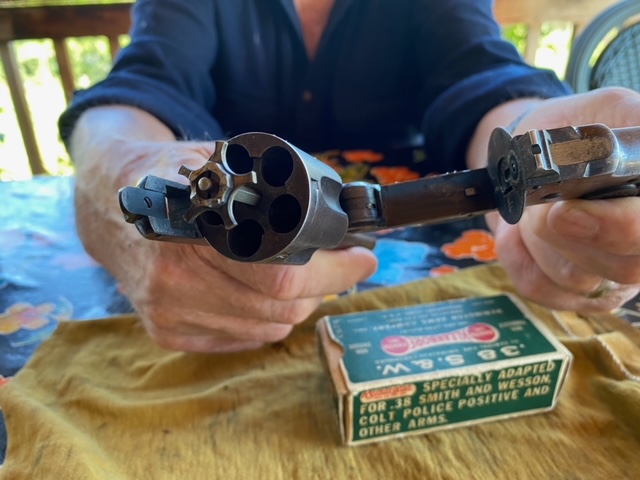
showing Reid's revolver (open position, ready to load, unload, or clean)
Smith and Wesson Safety Hammerless
Courtesy of Margaret Tibbets and
Mike McLucas
     Mike McLucas, the great-grandson of Leslie Butler, has the revolver Frank Reid used to wound Soapy Smith (pictured). Margaret continues 
The gun is a 5 shooter, called a lemon squeezer because of the way safety is on the end of the gun and must be squeezed to pull the trigger. You have to have a strong grip and hand to squeeze the safety and pull the trigger.

Margaret adds

What Mike learned as a child supports what you say…. Frank Reid had trouble getting off his shot and his was not the fatal wound. Mike had no idea who shot him. But he was told a 45 wax the fatal bullet wound.

     Previously, the only known information on Reid's revolver came from Matthew M. Sundeen and Clarence L. Andrews whose versions were published in The Alaska Sportsman (November 1947), under the title, The Real Soapy Smith, by Andrews. 
     Three of the four men on guard were reportedly unarmed. Clarence L. Andrews, writing in a 1947 article, identified himself as a Skaguay resident who knew Commissioner Sehlbrede and Tanner as a deputy US marshal and who listened to the stories of the men of Skaguay for five years. Andrews wrote that Reid’s weapon “was a .38 Smith & Wesson,” and the newspapers reported that it was a .38. Years later Matthew M. Sundeen, age 33 in 1898, wrote that, 
 
Reid carted an old Smith and Wesson six-shooter, an ancient gun he had used in the rip-roaring days of the west and which he considered the best gun in Skagway. He said it never failed him but its failure finally cost his life.

Mike McLucas
Leslie Butler’s great-grandson
Reid's revolver
Smith and Wesson Safety Hammerless
Courtesy of Margaret Tibbets and
Mike McLucas


The Smith and Wesson Safety Hammerless
     The Smith and Wesson .38 Safety Hammerless models were produced from 1887 (1888 for the 32) to just before World War II. They were chambered in either .32 S and W or .38 S and W with a five-shot cylinder. They were most often produced with a 2-inch, 3-inch, or 3.5-inch barrels; but some 6" barrelled versions are known to exist.
     These top-break revolvers were designed for fast reloading and concealed carry as the hammer was internal and would not snag on drawing the revolver from a pocket. They were known as "The New Departure" to reflect the company's new approach to designing revolvers.
     Minor design changes were made to these revolvers over the years, resulting in several different design models, as termed by collectors. The first model was manufactured from 1887 to 1902. The .38 was based on S and W's medium frame, while the .32 was based on the smaller sized "1½" frame. [Wikipedia: Smith and Wesson Safety Hammerless]
Shooting the Smith and Wesson Safety Hammerless


Frank H. Reid: 
May 1, 2017 


Leslie Butler: pages 577, 585. 
Frank H. Reid: pages 10, 439-41, 447, 477, 529-42, 544, 547-53, 555, 574, 576-77, 579, 585.


"Casinos and prostitutes have the same thing in common; they are both trying to screw you out of your money and send you home with a smile on your face."
—V. P. Pappy


July 2, 2021

WANT TO RECEIVE NOTICE WHEN NEW POSTS ARE PUBLISHED?


ANT TO RECEIVE NOTICE WHEN NEW POSTS ARE PUBLISHED?


The old feedburner Google originally installed when I first created this blog in 2008 is being removed, and I had to insert another one. If you were receiving previous emails, or would like to start receiving them, then please add your email in the white box below and then click subscribe.

Get new post notifications by email:


"A dollar picked up in the road is more satisfaction to us than the 99 which we had to work for, and the money won at Faro or in the stock market snuggles into our hearts in the same way."
—Samuel Clemens ("Mark Twain")


June 30, 2021

Possibly Soapy Smith and John Taylor operating in Denver September 1882

SUCKERS
Denver Republican
September 24, 1882

(Click image to enlarge)


he crime is surrounded with mystery and the police have striven desperately to keep the affair quiet."


     The newspaper article describing two separate swindles, is believed to be chronicling the early Soapy Smith - John "Old-Man" Taylor bunko gang who periodically operated in Denver, Colorado in the early 1880s. The article is one of the earliest hints that the Denver police were in league with the cities bunko gangs.
     The end of August 1882 there were two bunko gangs working Denver, the Charles L. "Doc" gang and another unnamed one, believed to be the Soapy Smith - John Taylor gang. John "Old-Man" Taylor was Soapy's criminal mentor. According to the newspapers the police were successful in removing the Baggs gang from the city, but the other gang is not mentioned as they were never caught and arrested. That other gang may have never left the city. For a short couple of weeks all seemed well, according to newspaper reports. Then all hell broke loose.


Following is the transcribed text of the newspaper article, Denver Republican, September 24, 1882.


SUCKERS.
―
A New Game for Their Edification Introduced in Denver Lately.
―
A Miner Swindled by It and a Wealthy Banker Swindled by Bunko Men.
―
      A "sucker" is an animal that was in the old days very rare in Colorado, but of late he has become very numerous. For the benefit of that class of respectable citizens unacquainted with the meaning of the term “ sucker,” THE REPUBLICAN offers the information that it applies to men who are not well up in the ways of the world; in other words, the term is synonymous with greenhorn," "gray," "gull," "Injun," etc. For this class of people a tender solicitude is constantly being manifested by another class of men known as "confidence men," and the latter invent a great many very pleasing and instructive games for them. After the departure of that great teacher of experience, Doc Baggs, the suckers were left without a single friend to entertain them until a few days ago, when they were

OVERWHELMED WITH AMUSEMENT.

      The first friend who struck them was John Fitchett, of the Turf Exchange, and he showed a game entirely new. So pleased was the “sucker” with it that he paid $1,650 for the privilege of learning all about it. So novel is this game that THE REPUBLICAN will devote several lines of space in explaining it. THE REPUBLICAN was very fortunate in obtaining possession of it without paying anything, by the kindness of General Dave Cook, who explained it theoretically and is now thrown in free to subscribers.
Keep in mind that this accounting by the newspaper is not necessarily accurate. The facts from the bunko men themselves is missing, as they were not caught and arrested. Much of this is based on assumption and guessing.
      To play the game three persons are required, just as in dummy whist. The other implements required are a hotel and a safe. It is also necessary that one of the players should be the landlord of the hotel, another a very intimate friend of the landlord, sometimes called "a capper, or steerer," and the third man must be a "sucker." The "sucker" is absolutely necessary, or the game is no good. When all the factors are properly placed the game opens by the "capper" steering the man into the hotel and introducing him to the landlord, who receives him with open arms, and impresses upon him the fact that he is particularly welcome, because he is brought in by such

A PARTICULAR FRIEND,
As the "capper," is represented to be. The bar is thrown open, and the "Sucker" is treated time and again, until he is in a proper condition when the "Capper" proposes that the party take in the town. Before going, however, the party informs the "Sucker" that there are many robbers in town, and they had better leave their pocket books behind. The landlord is represented to be a very wealthy man, just keeping hotel for fun, and finally the "Sucker" and "Capper" deposit their wallets in the safe. After having a good time they retire. Next morning "Sucker" asks for his pocketbook. The landlord goes to the safe and hands out a wallet. The victim opens it and finds only a five dollar bill stead of $1,650. He makes a great noise, and says it is not his pocketbook, but the landlord insists upon it that the pocketbook is the same one deposited in the safe the night before. The victim makes a great outcry, and the landlord appears much distressed. Finally he pleads with the "sucker," and says he would not have the good name of his house injured for anything. Then comes the final play. He writes out a note payable in five days, and handing it to the victim, says: "Take that and I will pay it in five days." The "sucker" believing the landlord to be a responsible man, accept the note.

THAT INSTANT THE LANDLORD IS SAFE,
For the note distinctly States value received, no law can touch him,
     Such is the new racket. Fitchett was the landlord, Edward Smith, of Butte, Montana, a miner, was the "sucker," and the "capper" is unknown. Fitchett also played the note racket on Brasher Bros. for nearly $1,000, and is supposed to be out of town. His wife purchased two tickets for California, but as far as known Fitchett did not go with her. It is certain that he did not leave Denver with her, although he may have preceded her a few hours and met her down the road. The racket is a new one to “fly” men, and will probably in time become very popular, although it requires some capital and time to work it successfully. When all the factors are in conjunction the game is sure to work.

Was the "capper" Soapy Smith or John Taylor?
BUNKO RACKET.

      It was believed by all that after Doc Baggs had been driven out of Denver no more bunko rackets would be worked, but the imbecile police force allowed another racket to be played last week. It was a plain game and the victim, who is a prominent and wealthy man, was swindled out of $900 in a manner which, while often told, contains this time some
NEW AND STARTLING POINTS.

The newspaper begins to figure out that the police are in league with the current bunko gang.
The crime is surrounded with mystery and the police have striven desperately to keep the affair quiet. Owing to the efforts of Chief Lomery, who is more energetic in concealing crime than in discovering it, only a few facts could be learned, but they are sufficient to present case in detail.
     About two weeks ago a man named Miller came to Denver from New Haven, Connecticut. He is the father of a fine family, and has always stood high in the community in which he has lived. He has been, as far as is known, engaged in banking, and came to Denver to go into business. About three days ago a nice-appearing man met him on the street, and greeting him very heartily as Mr. John Taylor, or John Smith, or something else, from Podunk, obtained his true name.
Could "Mr. John Taylor, or John Smith" be just a mere coincidence for being con men John Taylor and Jeff Smith ("Soapy")?
Soon afterwards another man met him and calling him by his right name entered into a conversation, in which he mentioned the names of several cashiers in New Haven, and invited Mr. Miller to go down to a picture store, where Mr. Miller's newly-found friend had drawn a fine painting in a raffle. Mr. Miller went with the stranger and was roped into a bunko game. In a very few minutes he had lost $400 in money, but the spirit of gambling was on him and he put up a $500 draft. This also went, and he walked out, looking for some one to advise him. He ran across a prominent young merchant and told him a few of the facts, and by him was introduced to Chief Lomery who sent Sergeant John Phillips out on the case. He soon arrested a man from pueblo and
THE POLICE SCARED THE PRISONER
So that he returned all the money and the draft, upon condition, however, that he should be released. This condition was carried out and thus Lomery deliberately compounded a felony.
The fact that the police do not name the swindler, and then allow him to be released, clues the newspaper reporter that the police are in league with the bunko men, so he paid the police chief a visit.
     A REPUBLICAN reporter, learning some of the facts, went the Chief for further information. He at first professed ignorance and said he did not know the name of the victim or that of the confidence man. Upon being pressed closely he said he was under promise not to reveal the name of the victim; that he was a responsible man and did not desire publicity, and he was under promise not to reveal the name. The reporter started for the store of the merchant who first met Miller, but the Chief of Police, not satisfied with refusing information himself, sent Officer Moll out on a run to warn the merchant not to give any information. The reporter arrived while the officer was doing his Chief's bidding, and, disgusted with this evidence of venality and corruption shown in concealing the existence of crime from the people, left the store without seeking further information.
     Thus it will be seen that within a week two confidence games for large amounts have been played in the city, and in each case the police have kept the facts from the people. Such venality in the work of the guardians the city's morals and peace has never been seen before, and is a warning to citizens who desire some information regarding the work done by their servants.
―


"You cannot beat a roulette table unless you steal money from it."
—Albert Einstein