Showing posts with label John R. Smith. Show all posts

January 12, 2023

Soapy Smith's roulette table up for auction.

Soapy Smith's roulette table
Courtesy of Potter and Potter Auctions

(Click image to enlarge)


OAPY SMITH'S ROULETTE TABLE UP FOR AUCTION!
Potter and Potter Auctions the Ricky Jay Collection.


Auction Description: Lot 318

SMITH, “Soapy” (Jefferson Randolph Smith, 1860 – 98). “Soapy” Smith’s Roulette Table and Wheel. Denver: George Mason and Co., ca. 1890. Handsome full-size roulette layout, table, and wheel manufactured by the noted gambling supply house and owned and used by notorious con man “Soapy” Smith. 95 ½ x 40 x 31”, outer wheel diameter (cradle) 31 ½”. Hub bears the manufacturer’s name. Wheel spins freely. Sold with a Mason and Co. check rack (stencil-marked by the maker underneath), and a later set of chips, likely manufactured by H.C. Evans of Chicago. Layout rubbed and worn, but in good condition overall; finish of table and legs also worn, but overall, a sturdy and impressive relic not only of the American west, but one of its most notorious figures, and among the most prominent makers of gambling equipment of the era. Accompanied by a letter of provenance from Smith’s descendant to Ricky Jay attesting to the provenance of the wheel and table, the family’s ownership of same, as well as a catalog from the sale of the Pullen Alaska Museum collection by Greenfield Galleries of Seattle, featuring the roulette wheel on its cover. One of the more notorious denizens of Skagway, Alaska, Smith’s reputation was as a con man, gambler, and criminal of considerable renown. After his family fortune was lost in the aftermath of the Civil War, Smith prospered by becoming a criminal kingpin in Texas, operating rigged games of Three Card Monte, poker, and the venerable Three Shell Game. Later, he lived and conned in Colorado for years, in both Creede (a mining boom town), and Denver. It was in the latter city where this wheel was manufactured by the famous firm of Mason and Co., one of the best-known gaming supply houses of the era. The sobriquet of “Soapy” was conferred on Smith thanks to a sleight-of-hand swindle devised to sell bars of soap. Smith demonstrated to a crowd how valuable cash prizes were hidden in the paper wrappers of a select number of bars, and when some customers ripped open the paper packaging to discover the hidden loot, business boomed. But these winners were “Soapy’s” accomplices – the laymen in the crowd never stood a chance of finding hidden greenbacks. A simple dexterous dodge made certain the bars of soap with the extra bills went straight to those in cahoots with the con man. Smith died in a gunfight in Juneau, Alaska on July 8, 1898. A dispute over a game of Three Card Monte led to the shootout that cost him his life.

Minimum Bid: $5,000
Estimate: $10,000 - $20,000
Number of Bids: 0
Time Left: [As of this post (01/12/2023) there are 43 days left]


Soapy Smith's roulette table
Courtesy of Potter and Potter Auctions

(Click image to enlarge)


     The roulette table belonged to my great-grandfather Jefferson Randolph Smith II, alias "Soapy" Smith. It is very possible that he used the table in one or more of his gambling houses in Denver and Creede, Colorado, etc., each location mentioning "roulette" being offered. He knew the George Mason Company of Denver well, as their store was only about two blocks from Soapy's Tivoli Club saloon and gaming house.  
     In 1897-98, during the Klondike gold rush Soapy shipped the table to Skagway, Alaska. As shipping to the new camp was at a premium, it is believed that the equipment, wheel, layout, etc., minus the table and legs, were shipped at a cost of $1,000 (according to Harriet Pullen). The table and legs are believed to have been made in Skagway, but it is equally possible that the entire setup was shipped. Either way, the items were likely crated because if
the ship company saw illegal gambling equipment, the charge might have been
even more.
An enormous price, but Soapy knew he would make his money back very quickly.
     After Soapy's death and the gold rush subsided, the table eventually made it's way to the Pullen House hotel operated by gold rush pioneer Harriet Pullen, who claimed to have known Soapy. The roulette table and other Skagway artifacts were placed in her hotel as a private museum of the Days of '98. The museum and hotel remained open until Pullen's death in 1947.

Soapy Smith's roulette table
Harriet Pullen age 80
standing with Soapy's roulette table
Pullen House, Skagway.
Jeff Smith collection

(Click image to enlarge)


Soapy Smith's roulette table
Harriet Pullen spins Soapy
Smith's roulette table
Pullen House, Skagway.
Jeff Smith collection

(Click image to enlarge)


     In 1959 Harriet Pullen's granddaughter Mary Kopanski moved the Pullen museum to the Food Circus Balcony at the Seattle Center in Seattle, Washington. In the 1970s the Seattle Center announced that they were tearing down the building and thus evicting the museum. Mary Kopanski decided to sell the collection at auction in 1975.
 
 
Pullen House Museum advertisement roulette table
Soapy's roulette table is mentioned
Pullen House, Skagway.
Jeff Smith collection
 
(Click image to enlarge)
 
      In 1973 My father, mother and I went to the Pullen collection auction in Seattle, Washington, where my father purchased the roulette table, Soapy's grave marker and other artifacts. Considering Soapy was a confidence man, my father believed that the table might be gaffed (rigged for cheating) and so when it arrived from the auction house he proceeded to carefully take it apart to examine it but no gaffing could be found. It's a square (honest) table. We built a saloon and gambling hall in a back building to display the roulette table and my father's gambling collection. I inherited the roulette table upon my father's passing in 1987.
     In the 2000s I sold the roulette table to magician/actor Ricky Jay, a big fan of Soapy's.
 

Soapy Smith's roulette table - Seattle Center museum 
Magazine article on Pullen Museum
Seattle Center, Seattle, Washington
Jeff Smith collection
 
(Click image to enlarge)
 
 
     Ricky Jay, an absolute master of slight of hand and card tricks passed away in 2018.
          Ideally, I would like to see the table sell for an enormous amount. High enough that the media might notice and report on it. One of my primary goals since the 1980s has been to see Soapy Smith become a very well-known character of the old west. All Soapy needs is a major motion picture or series about his life and death! 
     For more photographs of the roulette table see the "Potter and Potter Auctions" link below.

SOURCES


Soapy's roulette table: pages 74, 124-25, 126-27, 419-20, 451, 456, 471, 480. 


"He made fortune after fortune and spent it all in riotous living and in good deeds, for it must be ever said of "Soapy" that no hungry man ever asked aid of him and was refused."
——San Francisco Examiner, February 25, 1898


December 21, 2021

Artifact #90: A postcard from Emmie Lu Gardner to Jeff R. Smith III, 1912

Artifact #90
Postcard text area
Jeff Smith collection

(Click image to enlarge)


 mma Lu "Emmie" Smith [Gardner]


Artifact #90 is a postcard sent from Soapy Smith's sister, Emma Lu "Emmie" Smith [Gardner] in Waco, Texas, to Jefferson R. Smith III, in St. Louis, Missouri, September 25, 1912. Emma is about age 45, her date of birth believed to have been in 1867. She will pass away in 1915. Jefferson R. Smith is her nephew, aged 25, and working for the St. Louis Times.
 
Postmarked from Waco, Texas, on September 25, 1912 at 2 pm., the stamp is missing, appearing to be torn off. My father, John Randolph Smith, admitted once that as a young and avid stamp collector, he did remove some stamps when the opportunity arose.

The following is the text of the written portions.

Waco Tex
Sept 25, 1912.
Dear Jeff.

I wrote you a letter and a card about 2 months ago. Did you get them? Write me at 927 Franklin Street 
Waco Texas
Love to all
Your loving Aunt
Emmie Lu Gardner
 
[addressed]
Mr. Jeff Smith
St. Louis
Mo
Care St. Louis Times
 
 
Artifact #90-front photo
Waco, Texas court house
Jeff Smith collection

(Click image to enlarge)
Emma Lu "Emmie" Smith
May 4, 2021 


Emma Lu "Emmie" Smith: pages 22, 121, 377, 397, 403-04, 589. 201.


"he [Soapy Smith] was really known more as a Robin Hood. who helped the poor and unfortunate, than as a gangster."
—Frances Lebby Stanton [Peniston] (Smith family)


November 30, 2021

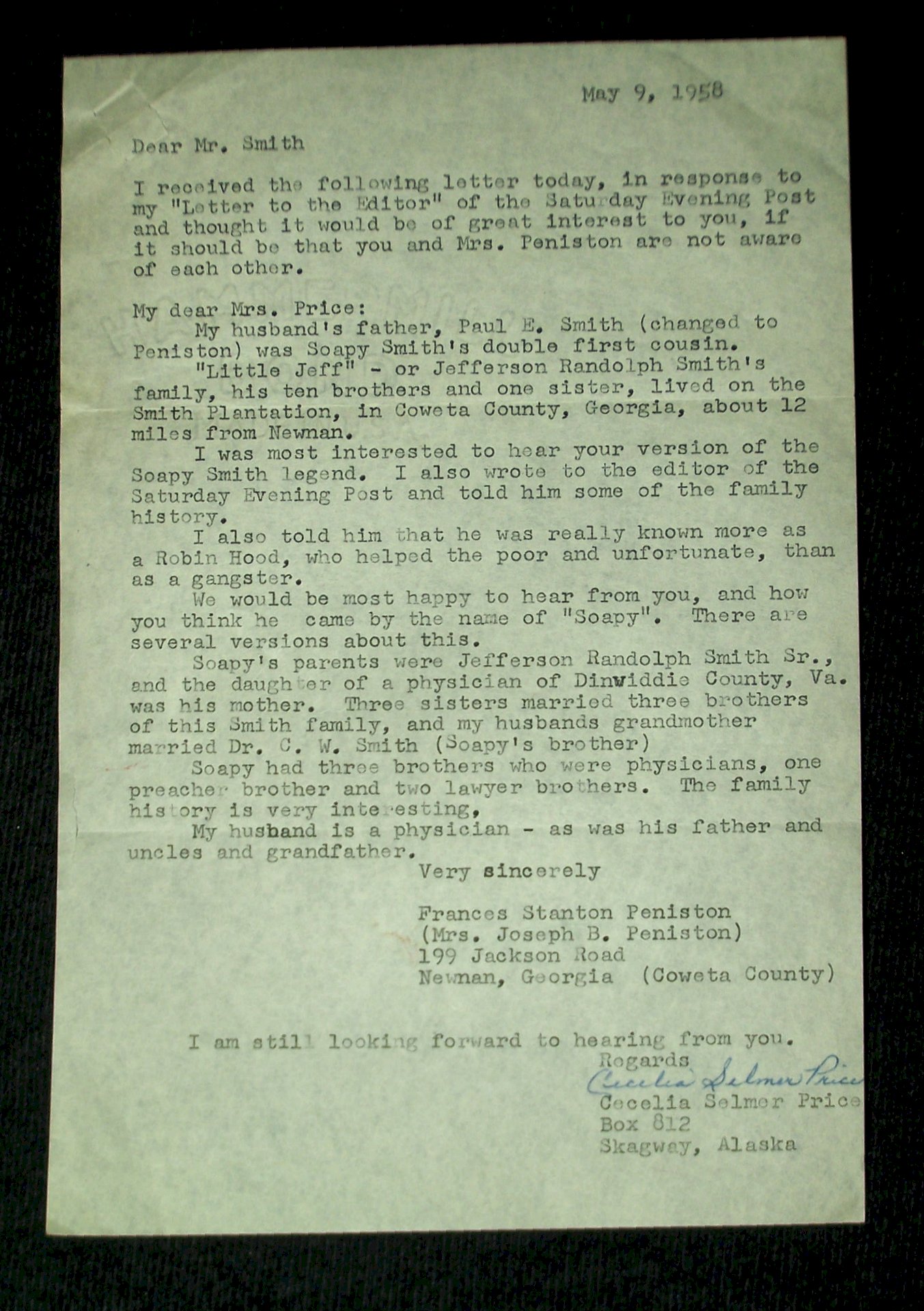
Artifact #89: Letters to and from Skagway historian Cecelia Selmer Price, 1958-1963

Artifact #89
Letter to Justin M. Smith
From Cecelia Selmer Price
May 9, 1958
Courtesy of
Jeff Smith collection

(Click image to enlarge)


also told him that he was really known more as a Robin Hood, who helped the poor and unfortunate, than as a gangster."

Artifact #89 contains the first communication with Skagway resident and historian, Cecelia Selmer Price, a typed letter to Justin M. Smith (my uncle), May 9, 1958. I would not be born for another five months.
     It all started with a small piece written by Harold Helfer published in the Saturday Evening Post, May 10, 1958. 
 
So We Commemorate
A PIONEER GANGSTER

Saturday Evening Post
March 22, 1958
Jeff Smith Collection

 (Click image to enlarge)
 
Below is the context of the article.
 
So We Commemorate
A PIONEER GANGSTER
 
Leering down from all comers from a cliff above the harbor of Skagway, Alaska, is a white-painted skull twenty-five feet high, shaped of natural stone. It serves as a reminder of the abrupt end of Skagway's leading bad man, Jefferson R. (Soapy) Smith, and is lettered: Soapy Smith's Skull.
     Soapy Smith, a lanky, sardonic saloonkeeper with a long black beard, ruled Skagway ruthlessly during the hectic 1898 gold rush. Hijacking, shakedowns and the stealthy technique of taking rivals "for a ride" were among his specialties long before Chicago and New York gangsters used them.
     If his crooked gambling tables failed to part a flush prospector from hard-earned gold, Soapy resorted to holdup at pistol point. When he publicly robbed grizzled old Alexander Steward of $3500 in nuggets, however, it was too much even for wide-open Skagway to stomach.
     Frank Reid, a railroad construction boss for the White Pass and Yukon Railway, organized vigilantes. Soapy and his gang overawed them without a shot. Then Reid called a law-and-order meeting on a harbor pier. Sneering, Soapy stalked down the pier to break up the meeting. Reid, . 45 in hand, warned- then fired. Soapy shot back.
     Soapy died almost instantly. Reid passed away in agony twelve days later. The two were buried nearly side by side. But where Soapy's wooden slab bore only his name, age and death date, Reid's marble monument is inscribed: FRANK REID-THE MAN WHO GAVE HIS LIFE FOR THE HONOR OF SKAGWAY.

NOTE: The blue pen ink notes that don't make sense. Who wrote this, and why, is unknown.
      Price wrote a "letter to the editor," responding to the article, and the Saturday Evening Post published it. Below is the page cut from the issue, and the content of that letter.
 
 
The Legend of Soapy Smith
Cecelia Selmer Price
The Saturday Evening Post
May 10, 1958
Jeff Smith collection

 (Click image to enlarge)
 
 Below is the content of Cecelia Price's "letter to the editor."

Dear Sirs:
     I have just finished reading several paragraphs on page 78 of your March 22 issue, written by a Harold Helfer, entitled, SO WE COMMEMORATE: A PIONEER GANGSTER. There's been a lot of tripe published about Soapy Smith in the last sixty years, but this is the living end....
     The "grizzled old Alex Steward" that Mr. Helfer says was robbed of %3500 was a young man in his early twenties named John Stewart who lost a poke consisting of $2500 in Soapy's saloon.
     Frank Reid (who killed Soapy) was never at any time employed by the White Pass & Yukon Railway. He had been a schoolteacher in Oregon, but his main occupation was that of bartending, both in Oregon and Alaska, and he was a bigger crook than Soapy Smith ever dreamed of being.
     Now we come to the picture of the four dubious-looking men. None of them is Soapy Smith.... The bearded man identified as Soapy was a gambler named Turner Jackson....
     I have lived in Skagway all my life, and my family has been here since the gold rush. For the past eleven years I have made a thorough study of the life of Soapy Smith.
 
CECELIA SELMER PRICE
Skagway, Alaska  
   
In April 1958 Alaska Sportsman forwarded a letter written by my uncle Justin M. Smith, a grandson of Soapy, to Cecelia Price, and on April 10, 1958 she typed out a letter to Justin.
 
Typed letter from Cecelia Selmer Price
To Justin M. Smith
April 10, 1958
Jeff Smith collection

 (Click image to enlarge)
 
 Below is the content of the letter to Justin Smith.

April 10, 1958
Mr. Justin M. Smith
5618 Vecina Drive
Corina, California

Dear Mr. Smith:

     Mr. Tobin of the Alaska Sportsman has forwarded your letter to me, and I must say that I'm utterly speechless to learn that there really are living decendents[sic] of Soapy Smith. I knew he was married and had a son, but I always felt that any living members of his family would have stepped forward long ago and claimed relationship to my "Gentleman Outlaw."
     I say "my" because, as a Skagway-ite, and a writer, I have devoted the past eleven years to serious research on your grandfather's life - so seriously in fact, that I feel I knew him personally, and in all probability - know more about him than anyone else now.
     As a result, I wrote a book - "Gentleman Outlaw" - which I have condenced[sic] for SAGA Magazine. Since your letter states that you have his papers and letter, would it be asking too much to be allowed copies of them for reference? I will gladly reimburse you in anyway, and you have no idea how they would help my work. Knowing now that they exist, and may be available, I will hold off on sending the manuscript to SAGA, until I have heard from you.
     As you may be interested in my past research, I am sending, under separate cover, my story "The Green Farm Kid" which will appear in the Sportsman, The story was certainly not of any effort to write, as it's word for word they[sic] way I took it down in shorthand, while Fletcher talked. I consider it to be an excellent example of the real Soapy.
     You will also be pleased to know that I sent the Saturday Evening Post a nasty letter in reply to that stupid "So We Commemorate" in their last issue. As you know - the man the identify as Soapy was not him at all. Frank Reid never worked for the White Pass, and never was anything but a crooked bartender.
     Enclosed with this letter are a few excerpts from "Gentleman Outlaw" which I will not change, even in view of the fact that you have Soapy's papers, etc., since I can prove the events to be correct. Believe me - Jesse James has nothing on Soapy, and I certainly hope my efforts will bring him into his own, and I hope you will allow me the use of copies of his papers.
 
Most sincerely
Cecelia Selmer Price
Box 8L2
Skagway, Alaska  

I could not find Cecelia's stories, "Gentleman Outlaw" and "The Green Farm Kid" online. It is unknown if they were ever published.    
     Upon seeing Price's "letter to the editor," Smith family member, Frances Stanton Peniston of Newnan, Coweta County, Georgia obtain Price's mailing address from the Saturday Evening Post and wrote to Price. Upon receiving the letter, Price wrote to Justin M. Smith again. Following is the transcribed letter artifact #89, for ease of reading.
 
May 9, 1958
Dear Mr. Smith
 
I received the following letter today, in response to my "Letter to the Editor" of the Saturday Evening Post and thought it would be of great interest to you, if it should be that you and Mrs. Peniston are not aware of each other.
 
My dear Mr. Price:
     My husband's father, Paul E. Smith (changed to Peniston) was Soapy Smith's double first cousin.
     "Little Jeff" - or Jefferson Randolph Smith's [Jeff Sr., Soapy's father] family, his ten brothers and one sister, lived on the Smith Plantation, in Coweta County, Georgia, about 12 miles from Noonan.
     I was most interested to hear your version of the Soapy Smith legend. I also wrote to the editor of the Saturday Evening Post and told him some of the family history.
     I also told him that he was really known more as a Robin Hood. who helped the poor and unfortunate, than as a gangster.
     We would be most happy to hear from you, and how you think he came by the name of "Soapy". There are several versions about this.
     Soapy's parents were Jefferson Randolph Smith Sr., and the daughter of a physician of Dinwiddie County, Va. was his mother. Three sisters married three brothers of this Smith family, and my husbands grandmother married Dr. C. W. Smith (Soapy's brother)
     Soapy had three brother and two lawyer brothers. The family history is very interesting.
     My husband is a physician - as was his father and uncles and grandfather.
 
Very sincerely
Frances Stanton Peniston
(Mrs. Joseph B. Peniston)
199 Jackson Road
Newnan, Georgia (Coweta County)
 
I am sill looking forward to hearing from you.
Regards
Cecelia Selmer Price
Box 812
Skagway, Alaska
 
Frances Lebby Stanton
Married Joseph Bowdoin Peniston
1898-1994


Frances Stanton Peniston made some major errors in her description of her husbands family.
     All correspondence written by Justin to Cecelia is missing or non-existent. Above her signature is the message, "I am still looking forward to hearing from you," which indicates that Justin may not have contacted her. At some point Justin did give his portion of the Soapy Smith collection to his brother (my father) John Randolph ("Randy") Smith. Within Justin's portion of the collection were the letters sent to him by Cecelia Price, and this appears to have been when John learned of Cecelia and began communicating with her.
 
Typed letter from John Randolph ("Randy") Smith
To Cecelia Selmer Price
September 13, 1963
Jeff Smith collection

 (Click image to enlarge)
 
 Below is the context of the letter.

FROM THE DESK OF
RANDY SMITH
9-13-63
Dear Cecelia,
     The Soapy Smith clan is a very peculiar bunch!
     There was originally nine of us children born to my late father, Jefferson R. Smith (Soapy's son). Two of the girls have passed away; three boys and four girls remain. We are not as close as we should be and are living all over the country.
     I have just run across a letter that you wrote to my younger brother Jesse in 1958. I do hope you are still active along these lines!
     We all have an extremely deep affection for Soapy, perhaps in a different way than you say you have in your letter, for we have lived with Soapy's wife and also feel we knew him personally..... nothing was hidden from us kids, both good and bad.
     To get to the point.....I do not know to what extent you have communicated with Jesse, however my older brother Joe has in his care, outside of a few odds and ends, everything that was handed down belonging to Soapy. He is now in the process of having copies of letters etc. distributed to all members of the family. Perhaps we can exchange copies of interesting articles.
     You sound more like a Smith then most of us!
     Why not join our family!
 
Sincerely,
 
Randolph J. Smith
618 Elmwood Street
Anaheim, California
 
To introduce myself:
 
     I was born in St. Louis Missouri in 1917, the son of Jefferson R. Smith and Grandson of Soapy.
     Enclosed is a copy of two newspaper clippings.
     My father was involved in politics, in one way or another, most of his life and for reasons of his own kept much of his past to himself. Some however did get out.
 
The fact that John ("Randy") wrote, "I do hope you are still active along these lines" indicates that this is the first correspondence he had written to Cecelia. 
     

Typed letter from John Randolph ("Randy") Smith
To Cecelia Selmer Price
September 30, 1963
Jeff Smith collection

 (Click image to enlarge)
 
     At some point between September 13 and September 30, 1963 John R. and Dorothy Smith (my father & mother), Joseph J. and Thelma A. Smith (my uncle and aunt), Justin M. and Ester Smith (my uncle and aunt) and Cecelia Selmer Price, met with Royal Pullen, son of Harriet Pullen of Skagway, both being pioneers of that town. My father recorded the interview. That interview reel-to-reel tape and a recorded cd of the tape is in my collection and the information was used and credited on several pages throughout my book, Alias Soapy Smith: The Life and Death of a Scoundrel.
     Below is the context of the letter.
 
FROM THE DESK OF
RANDY SMITH
9-30-63
 
Cec,
     
     I wish to sincerely thank you for making it possible for us to obtain the tape recording of Mr. Pollen[sic]. Upon returning to Anaheim we replayed the tape and the results were excellent. As soon as possible I will make copies and will forward one to you if you so desire.
     As I do not know Mr. Pullens[sic] address, will you please convey our deepest appreciation to him and his wife. They are certainly wonderful folks. ...and by the way, so are you.
     Perhaps some of the differences that arose came about because of the DINNER we had.
     My wife Dotti and I both thank you again for the time you spent with us, and perhaps when you are in Anaheim we might get together for LUNCH.

Randy Smith
618 Elmwood Street
Anaheim, California

This is the last communication with Cecelia Selmer Price that I have in my files. 
     I remember learning about Cecelia Price from my father, and how she believed that Soapy was a "gentleman outlaw" and was not the only criminal in Skagway. That the vigilantes that killed Soapy had criminals and "not so innocent" citizens within it's ranks. She said that "Reid [Frank H. Reid, shot Soapy at least twice during the shootout on Juneau Company wharf, before being shot and mortally wounded by Soapy] was a crooked bartender at best." I am not making any judgement calls here, but rather I am simply letting the reader know who Price was and what she told my father. I wish I had been old enough to meet her.


Cecelia Selmer Price: page 531.


"[Frank Reid] was a bigger crook than Soapy Smith ever dreamed of being."
—Cecelia Selmer Price
1958 letter to Justin M. Smith (Soapy’s grandson)


May 6, 2014

Soapy Smith's shoulder holster

SOAPY SMITH'S SHOULDER HOLSTER
Jeff Smith Collection
(Click image to enlarge)


oapy Smith's shoulder holster is another artifact that I plan to take to the Wild West History Association Denver roundup in July. The story of this holster and how I came to possess it, is a story in of itself.
      After the Klondike gold rush had passed and Skagway settled down, some of the residents started collecting up some of the early artifacts. Hotel entrepreneur, Harriet Pullen, collected and displayed artifacts in her Pullen House. When there were enough people lodged in the hotel she would give a talk in the hotel parlor amongst some of her treasured artifacts and tell the story of Skagway, Soapy Smith, and the gold rush.

Shoulder holster close-up
Note the nice stamp-work
Jeff Smith Collection
(Click image to enlarge)

      The pictured holster was most likely given to Harriet Pullen. for her gold rush museum, by J. M. Tanner, one of the vigilantes who was on the wharf the night Soapy was shot dead. Tanner became a deputy U.S. marshal, handling Soapy's belongings so it makes sense that he would have this, although he was supposed to have logged it with Soapy's estate for auction. He also donated other artifacts to the Pullen collection which will be discussed at a later date.


Shoulder holster close-up
Note the inked signature (center) "HSP" [Harriet S. Pullen]
Jeff Smith Collection
(Click image to enlarge)
      In 1954 the threat of losing an important historic jewel galvanized the community as residents rallied together to save the endangered Pullen Collection. Harriet Pullen had run her grand hotel until her death in 1947, and in more than 40 years of operation she had collected an enormous treasure trove of gold rush artifacts. Pullen's granddaughter reopened the hotel in 1950 but the collection had already begun to deteriorate. Bruce Black, park naturalist at Glacier Bay National Monument (GLBA), visited the Pullen House and found the hotel in a state of disrepair - he was particularly concerned with the artifact collection. Since the NPS had no official role in the city, all he could do was urge the Territory of Alaska or some other entity to take possession of the collection and care for it properly. His plea and those of many other concerned citizens were unheeded - the Pullen House closed for the last time in 1959 and the collection went to Lynnwood, Washington with its owner. Pullen's treasures were eventually sold piecemeal at auction, and the collection was lost to posterity.
- Legacy of the Gold Rush pages 53-55.


      From 1959 until the early 1970s, the Pullen collection was on display in a building adjacent to a food pavilion. The owners of the property wanted to do some improvements and so evicted the Pullen collection. The owner of the collection at this time was Mary Kopanski, a great-niece of Harriet Pullen. Knowing the importance of the collection to Alaska, she gave the state the first option to purchase it for $200,000. They turned down the offer, which upset a whole lot of people in Alaska. The price was very fair. In fact, Mary made more than the $200,000 she offered to sell it for. In July 1973 a five day auction in Seattle, Washington sold off the collection piece-by-piece.


Shoulder holster
Jeff Smith Collection
(Click image to enlarge)

      My uncle Joseph Jefferson Smith, was the first in my family to learn of the action plans. He contacted his brother, my father, John Randolph ("Randy") Smith about it, and my father, my mother, and I made the trip to Seattle and attended all five days. The adventures I had attending that auction are a story in itself. My father passed on the shoulder holster as he had spent $6,000 already, just for the roulette table and there was the grave marker still awaiting sale. The holster, handcuffs, saps, and a few other Soapy Smith related items went to one high bidder, and that was the last time anyone had seen those items since. Who would guess that these items would once again surface for auction, and that the Smith family would be given a second chance to obtain them? In case the thought may have crossed your mind, yes, these items are the very same items that sold in 1973. The auction house tags and catalog numbers all match up with the ones I have in my collection.   

Shoulder holster
Jeff Smith Collection
(Click image to enlarge)


      I still need donations to cover the costs of my trip to Denver to put this item, and many other items, on display. You can read the story of this planned trip, as well as donate if you choose.


At scheduled intervals the Guards would exercise a neat maneuver and fire a volley into the air as Jeff would lift his hat and acknowledge the plaudits of the crowd. It was Soapy’s greatest hour.
— Rev. John Sinclair (Alias Soapy Smith), p. 522


MAY 6


1835: James Bennett begins publishing the New York Herald.
1851: The mechanical refrigerator is patented by Dr. John Gorrie.
1851: Linus Yale patents the clock-type lock.
1856: The Army from Fort Tejon and Fort Miller ride out to protect Keyesville, California from attacks by Yokut Indians.
1859: John Gregory discovers gold (Gregory's Gulch), “the richest square mile on earth,” near the city of Denver, Colorado.
1861: Arkansas is the ninth state to secede from the Union during the Civil War.
1868: The U.S. begins paying annuities to the Crow Indian tribes of Montana Territory.
1877: After defeating General Custer’s 7th Cavalry at the Battle of the Little Bighorn, Indian Chief Crazy Horse surrenders his people to the U.S. at Fort Robinson, Nebraska, whereas, Sioux Chief Sitting Bull leads 1,500 of his followers into Saskatchewan, Canada to ask protection from the Queen.
1882: Congress passes the Chinese Exclusion Act, which bars Chinese immigrants from the U.S. for 10 years.