Showing posts with label Misc. Soapy. Show all posts

March 12, 2023

Possible victim of the Soapy Smith gang, Denver, 1884.

Roped-in
Omaha Daily Bee
June 25, 1884

(Click image to enlarge)


OSSIBLE VICTIM OF THE JEFFERSON R. SMITH GANG.


Omaha Daily Bee
June 25, 1884

COLORADO.

Col. Fletcher, a tourist from Boston, was roped-in by the bunko men of Denver and relieved of $1,000.


The story of Soapy Smith can be had in the book, Alias Soapy Smith: The Life and Death of a Scoundrel.

NOTES:

  1. $1,000.00 in 1884 is the equivalent of $33,472.95 in 2023. 
  2. According to the Rocky Mountain News there were at least two, possibly three bunko gangs operating in Denver at this time. For certain "Doc" Charles Baggs and Jeff R. Smith were operating in Denver at this time. 
  3. Jeff R. Smith was not known as "Soapy" Smith until May 1885, neither was the gang known as the soap gang.


"In many cases the bunko sharp is compelled to return a portion of the money to avoid such trouble, and sometimes comes to grief at the hands of the law. In such cases the matter is compromised with the man, his money is returned and he is induced to leave, so that when the case comes up for trial the sharp escapes for lack of prosecution."
Evening Post (San Francisco)
May 6, 1876


March 10, 2023

BUNKO THIEVES of San Francisco in 1876, and their comparison to the Soapy Smith gang.

BUNKO THIEVES.
Evening Post
(San Francisco)
May 6, 1876

(Click image to enlarge)


unko thieves of San Francisco in 1876
and their comparison to the Soapy Smith gang.

Though the article is written well before Soapy’s criminal reign in Denver, it gives a number of comparison clues to how the soap gang in Denver operated. I will add my thoughts and notes within the article. These were not written down rules, but rather common sense in the art of manipulating human nature for the most profit without being arrested.

Evening Post
(San Francisco)
May 6, 1876

BUNKO THIEVES.

The Shrewd Swindlers with Whom San Francisco is Infested.

Their Haunts and Ways of Taking In the Unwary—Some of the More Notable Characters—How Railway Travel is Injured by Their Operations—Fleecing Tourists from Australia.

“Will you walk into my parlor?” said the spider to the fly,
It’s the prettiest little parlor that ever you did spy.
The way into my parlor is up a winding stair,
And I have many pretty things to show you when you’re there.”

[Soapy Smith appreciated the poem, "The Spider and the Fly" by Mary Howitt (1829) and it's unintended comparison to the bunko man and the victim. In the mid-1890s he picked up a print of The Web of Arachne by Fernand Le Quesne and is believed to have hung it inside the Tivoli Club in Denver. When he opened his saloon in Skagway, Alaska, he hung the print on the wall and fittingly named the saloon, Jeff Smith's Parlor.]

The Web of Arachne
by Fernand Le Quesne


(Click image to enlarge)
Had the author of the composition from which the above lines are taken chosen to set forth the preliminaries to the invitation, she would, no doubt, have presented an interesting detail of the measures taken by the sagacious spider to insure an acceptance of his invitation by his intended victim. Externally, the appearance of Monsieur Spider was such as to inspire confidence and respect. Natural defects were overcome by artfulness, and the ordinary ungainly appearance improved as much as possible. The natural ugliness of the arachnidan visage was concealed by an open, winning smile. The hairy legs were brushed into glossy smoothness, and though rather thin, seemed the perfection of gentility. The rasping voice of ordinary occasions was softened into one more seductive in tone, and, in short, the tout ensemble of the tempter was as much altered for the better as the necessities of the occasion demanded and the funds at his command, and the furnishing of his toilet-table, would allow. Not only in this direction but in others was his sagacity manifested. (much of next sentenced missing) … crack in the wall, where the potent attraction of a ray of sunshine, or some other equally strong inducement, caused the congregation of an unusual number of flies at that point. His sagacity was further manifested in the selection of one fly in particular to whom he should extend the invitation. It was not offered to flies in general, but to a single individual, and we are led to believe that as the spider, concealed in the darkness of his inner den, looked out upon the passersby, he let one after another pass unheeded, and paid no special attention until he caught sight of one whose particular fatness excited his appetite or whose unsophisticated appearance promised an easy victory. Then
THE TEMPTER SIDLED FORTH.
Clambered gently over the meshes of the net until the outer one was reached, and dangled there in suave composure waiting the coming of his victim, who upon arriving was gracefully saluted with the compliments of the day. The advances being pleasantly received the conversation took a more confidential turn, and soon the fly could not fail to see what a great impression his shapeliness and talents had produced upon his particular friend the spider. No doubt it curiously happened, according to the statement of the spider, that before taking up his present location he had dwelt near the family of his young friend the fly, knew his father and mother well and all the family. All this, however, was but preliminary to the gentle invitation couched in the nicest language and offered in the softest tones. “Will you walk into my parlor?” The fly confiding and flattered, willingly consents, is ceremoniously assisted inside by the spider, who can hardly restrain himself from satisfying at once his appetite, is taken up the dark pathway, beyond the light of day and the reach of his friends and adds one more to the list of the latter’s victims, while he diminishes the number of fools in the world by one. This occurrence is a common one, and takes place more frequently, perhaps, in our city than anywhere else. The spiders are human beings—the term men would flatter them too much—who, having in the great process of evolution descended direct from the tarantula, display all the villainy, treachery and lack of principle characteristic of that animal, with a corresponding amount of knavery and cowardice. Their dens are scattered about the city, hidden from all eyes, save those of the sharper, his victim and the police. The webs, invisible though they are, await the traveler on every corner, though they are most numerous on Montgomery street, on and near the corner of Bush, and from there up to Kearny. Here, also, the spiders may be seen in full force every day, dressed shabbily or fashionably, as suits their purse or the object they have in view. Gamblers, pickpockets, ropers-in, confidence men, monte men and blacklegs of high and low degree, throng the principal thoroughfares with nothing, save in the lower grades, to indicate their trade, and
UNDISTINGUISHABLE FROM MEN OF RESPECTABILITY,
Except by those “fly” enough themselves to know them and their doings. In this “profession,” as in all others, there are different grades of “honor,” according as the work performed is difficult or easy. The burglar who skillfully breaks into your house at night looks down with contempt upon him who merely snatches your watch in a crowd, and quite as contemptuously does the latter, proud of his own skill, look upon the sneak thief who creeps through an opened front door, takes an overcoat and umbrella from the hat-rack and stealthily crawls off to his pawnbroker. The majority, however, prefer swindling to stealing. It is more genteel in the first place, is much less precarious and there are more avenues of escape in case of arrest. The only stock in trade required for the business is a knowledge of human nature, a glib tongue, a thorough lack of principle and a previous acquaintance with some branch of swindling. These qualities make up the sharper, and as they are possessed in a greater or less degree determine his status among his brethren. As the capabilities of the members of the gang vary, so do the means by which their, or rather his, mind as to the method of approach and the way in which to work. It is a matter of often-expressed wonder how the gentlemen who “toil not” managed to keep well dressed and well fed, and yet the swindling business offers as great, if not greater field for individual enterprise than any other. From a “hogging” faro game, bunko and the more aristocratic methods of swindling, down through the intermediate stages of three card monte, the strap game, card and billiard games generally, loaded dice, etc., to the humbler practices of “standing in” with clothing dealers, the ways of turning a dishonest penny are varied and numerous. The sharpers live at the expense of travelers, either from the outside country, from the East or more distant localities, who, unacquainted with the city and its denizens, fall an easy prey. This city, owning to the number of people who are constantly coming and going, the immigrants and travelers from the East and from Australia and China, is
A CHOSEN SPOT
For the fraternity, and the number of them is something startling. Then, in addition, their ranks are receiving constant accession from the hoodlums of the city, the greatest ambition of many of them being to be successful card throwers, or sharpers of some sort. The one department of “bunko” swindling claims the attention of a large number, who working methodically and carefully, are successful to a far greater extent than the few complaints and tales of distress that are told at the Police Office would lead one to imagine.
[The number of known successes is few as they were not published or written down, minus a few examples of profits Soapy noted in his private notebooks and writings as he traveled from town to town in the early days as a nomad bunko man and his operations in Denver and the Tivoli Club. In Denver he was able to pay his gang, his debts, and afford a good life for his wife, Mary and their children, purchased properties, at least one home, and charity to the needy. According to his Mary, at the time of his death Soapy had made near 40 million dollars (stolen).]
The “bunko” men are divided into two distinct gangs, one “going for” the more aristocratic passengers from the East and Australia, and the other for the immigrants and steerage passengers, called “stinkers” in the elegant parlance of the gang. Though well known to each other, the bunko men usually hang together in gangs of three or four, that number being all that is needed to operate at one time. Their loafing places are, as stated before, around the corners of Bush and Montgomery and Bush and Kearney streets. They are also scattered along Kearney, and at the corner of Kearny and Commercial streets there is a saloon which forms their general headquarters.
[Not much different years later within the soap gang organization. Unlike the article, the soap gang in Denver was often divided into numerous groups in numerous locations on and around Seventeenth street, between the Union Depot and Larimer street. There were big mit (fake poker) games, the auction house, the gaming rooms of the Tivoli Club, etc. They also hung together in groups of three or four. When Soapy went to Skagway, Alaska for the very first time in 1897, he went with two other bunko operators, and it was three of the gang that robbed John Stewart in July 1898.]
It is a small, shabby place on the northeast corner, and is kept by a little old man familiarly called “Uncle” by the bunkoists. “Uncle” is a short, fat man with a bald head, who may usually be seen, for all the world like a bloated spider, standing near the door of his “dive.” His head is bald with the exception of a few locks around the sides, his face is red and bloated; his nose so swollen by toddy efflorescence as to have become shapeless and spread over a large part of his face; his eyes are deep-set and small, with a villainous twinkle; a long tobacco-stained gray beard partly conceals a dirty shirt; and altogether he seems fitly named when designated as the elder relative of so promising a family. Around his place and in it may usually be seen a number of sharps and bunko men; those who gather there are as a general thing members of the plebeian division of the gang. This plebeian division is presided over by one "Blewy,” who makes periodic trips out into the country, gets acquainted in various towns, and is therefore prepared, when the harvest season is over, and the “hands” have come to town for a good time, to show them around, exhibit the elephant and the “lively flea” to them, and
TEACH THEM THE WAYS OF THE CITY.
Such tuition, however, is slightly more expensive to those that have money than would be lessons on the best method of swaying a nation from Queen Victoria. One of “Blewy’s” right hand men is a man who may be seen every day around the saloon above mentioned. He is a man about five feet ten inches high, wears a dark gray suit of clothes, a flat black felt hat, such as is usually sported by hoodlums, and has a red, wrinkled face, with sandy mustache and short chin whiskers. His face has a hardened, “tough” look, and his expression invariably causes the observer to wonder when he got out of San Quentin. The aristocratic division is run by “Slim Jim’s Brother,” a brother of the notorious monte man. Chicago Jack. Boston Charley and Tibbetts have already been hauled up before the Police Court on charges of bunko swindling, and Tibbetts is now spending a term in the County Jail. Slim Jim’s brother, “Chicago Jack,” and Harris are about the same hight[sic], five feet eight, or a little below it. They dress on ordinary occasions somewhat alike, in dark suits, usually wearing short sack or frock coats. Harris wears a soft, dark felt hat—has black hair, slightly curling, a black mustache, and an incipient beard on his chin. He dresses to be seen around the corner.
[Likely that the moniker of "Slim-Jim" was pretty common, but then again, it's hard not to imagine that it could be referring to "Slim-Jim" Foster of the Skagway, Alaska, soap gang who assisted in the robbery of miner John Douglas Stewart, that also involved the game of three-card monte.]
These men and their associates are expert cardsharpers, and are up in
ALL KINDS OF SWINDLING.

But their attention has been of late devoted principally to bunko. Whenever an Australian steamer gets in they are on the alert. Around the railroad offices on Montgomery street can be counted any number of them, and their adroitness is a matter of astonishment even to those who know their skill and mode of acting. Two Englishmen run with the gang who are evidently Sydney birds, and these make themselves especially useful. Among the number are men who have traveled in many parts of the world, through the East, in Europe, and in Australia, and are sufficiently conversant with the various cities to make themselves appear to have many acquaintances and to be well known there.

It is the custom for one or more of the gang to go down to the steamer on its arrival, “spot” the newcomers that look most promising either for greenies or money, and note to what hotel they go. A glance at the hotel register afterward tells the place from which they came, and so the sharper is able to inform his confederates of the name of the selected person and where he hails from, together with such other information as might be gained from a confederate on board the steamer or from any other source.
[No need to "glance at the hotel register for the soap gang in Denver as the local newspapers published who was at which hotel, giving their name and where they hail from and sometimes their occupation and why they are in Denver, whether it be business or pleasure. This made obtaining victims from the hotels much easier than those in 1876 San Francisco gangs could.]
That member of the gang who is best acquainted with the place in question then makes it his business to become acquainted with the man and gain his confidence. He may impose upon some acquaintance of his intended victim and obtain an introduction, or he may follow the latter until some very natural way of making his acquaintance presents itself. Nearly every one of the sports has some “gal” in some one of the low concert saloons who introduces him as Mr. Smith, of the London and San Francisco Bank, or Mr. Brown, of the Bank of California, and the greenhorn usually takes it all in and is gratified at forming so aristocratic an acquaintance. Very commonly, however, no circumlocution is used, and the bunko sharp walks up to the man on the street, claiming his acquaintance at once. A gentleman who has seen this done several times says: “It is perfectly astounding how they impose upon a man when they have once settled upon him. They walk up with the most perfect air of gratified surprise, grasp the man’s hand warmly and shake it vigorously. The man is astonished at first, but time after time, after a short conversation I have seen them
WALK OFF ARM IN ARM,
The victim seeming quite [rest of sentence missing]. An invariable accompaniment of the unexpected meeting is an invitation to drink, usually given by the latter, and the two go off to a saloon “kept by a friend of mine” to get the libation that renews the acquaintance. The first meeting usually takes place on Montgomery street, and the drinking saloon selected is a little den on the south side of Sutter, between Montgomery and Sansome near the middle of the block. It is a small, dark place in the rear which is a small board patrician through the door of which a green-baize covered poker-table is visible, and where a small game is usually going on. The two go to this place and get a drink, and the liquor is usually “snuffed” to such an extent that whatever the victim selects for a drink is sure to go to his head and intoxicate him in very short order. Having got him partly or wholly drunk, he is in a fit condition to understand the beauties and mysteries of “bunko.” The sharper confidentially informs him that he has

JUST DRAWN A PRIZE IN A LOTTERY.


And invites him to accompany him to the office and get the money. To the office then they go. These offices are situated in various places, each gang having its own. No one of them remains long in the same building, owing to the precarious nature of the business, but moves, as soon as a good haul has been made, to some other locality. The office is fitted up with ledgers, advertisements of lotteries, and is represented as an agency. A doctored copy of the statutes concerning lotteries, and the rules governing them, lies where it will be likely to seen. The successful candidate receives his prize in bona fide gold coin, and is usually given another ticket which he generously offers to his newly-found friend, or by drawing with it and winning so excites the latter’s cupidity that he is anxious to try his hand, and a “special drawing,” as provided for in the rules, is inaugurated for his benefit. There is really no game at all to it, but it is so explained to the victim that there seems to be

EVERY CHANCE OF WINNING

And none of losing. The cards are drawn from a box and are twenty-six in number, twenty-five being blanks and one entitling him to a prize. When the cards are drawn, the rule is that when a blank comes out the player must “represent” or double-up, or lose what he has already put up. Inspired by the fact that the prize card is sure to come in time, and feeling confident in the game, inasmuch as the man who is conducting it puts up an amount equal to his every time, he keeps on doubling till his funds are exhausted and he cannot come to time, when the “Cashier” coolly sweeps the board and informs the victim that he has lost. A great deal of discretion has to be exercised by the sharpers in picking out men who will not “squeal.” That is, after losing their money, raise a row about it, have the men arrested, and so on. In many cases the bunko sharp is compelled to return a portion of the money to avoid such trouble, and sometimes comes to grief at the hands of the law. In such cases the matter is compromised with the man, his money is returned and he is induced to leave, so that when the case comes up for trial the sharp escapes for lack of prosecution.
[Very little difference in the operations between the San Francisco gangs of 1876 and Soapy Smith's gang in Denver of the 1880s-90s, where there are many examples in which the newspapers report that the victim did not show up to court and the prosecution had no choice but to drop its case. In Denver and later in Skagway, Alaska, this developed into the unconventional procedure of arresting the victim, as well as the con man, in order to make sure they appear in court]
One of the most pernicious modes of gaining the confidence of the travelers, adopted by the sharp, is to represent himself as a railroad agent for some of the Eastern routes. This has really hurt the travel here, the railroad men say, and given

A VERY BAD REPUTATION TO SAN FRANCISCO


Among the foreign traveling public. The Englishmen coming here from Australia are the best game for the sharpers, partly on account of their being usually well supplied with money and partly on account of their ignorance of this city and “its ways that are dark.” Besides this they are not in the habit of squealing, unless they are severely bitten. One of them who came up two steamers ago related his experience. He met a man who was going east on the same train with him, at least that was his statement, and they went around to see the sights together. They wound up, both comfortably “full,” in a saloon on Merchant street, almost in the shadow of the City Hall. Here the Englishman was shown a magnificent gold quartz specimen by his friend, and they and some others raffled for it. Shaking dice for this led on to shaking for money, and, as the Englishman phrased it, “Buggah, the fellahs if they didn’t cozen me out of twenty-five souvrins.”


THE HAULS MADE BY THE SHARPS


Are sometimes very large. Slim Jim’s brother made one haul of £1,400 sterling from one man, £500 of it being sovereigns and the rest £5 notes. The sovereigns he exchanged for United States money in a broker’s office on Montgomery street. The sharps frequently go into the broker’s offices with English gold and notes in smaller amounts. How it happens that they are allowed to carry on their game when from “Nibsy,” the curly-haired “snide jewelry” man, to “Liz,” the bunko apprentice they are all well known to the police is a problem which “no feller can find out. Every day some one is swindled, and the sharpers grow fat while the police smoke good cigars on the street corners. There has been of late among the railroad offices some talk of a vigilance committee to clean the fellows out, as they are all well known, and if no other remedy can be had it certainly would be a good thing for them and for the city.
[Although not confirmed via the newspapers, it is likely that "every day some one is swindled" in Soapy's Denver kingdom as well. It is circumstantial evidence that Soapy worked almost every day, including New Year's Day, etc. In Denver there was little to fear of vigilantes, but it was vigilantes that ended Soapy's life in Skagway, Alaska. Read the whole story in my book, Alias Soapy Smith: The Life and Death of a Scoundrel]


"I never cheated an honest man, only rascals. They wanted something for nothing, I gave them nothing for something."
—Joseph "Yellow Kid" Weil


March 3, 2023

Did Soapy Smith operate in Benson, Arizona in 1885?

Soapy Smith in Benson?
Daily Tombstone
September 2, 1885

(Click image to enlarge)


id Soapy Smith operate in Benson, Arizona in 1885?


Daily Tombstone
September 2, 1885

Went Broke.

Tim and Brigham, two well known Johns, went to Benson Tuesday to take in the circus and among other sights they saw there was a man selling soap, wrapped around which was greenbacks of various denominations, among others, a $50 note. Our two knights of the lines watched the soap vendor unwrap the bill and show it, and then placed it in the box again for over half an hour, and both had their eyes upon what they thought to be the package containing the $50 bill. They then pooled their issue and forfeited a dollar for a package, picking out the right one, as they supposed. After they had got the package they walked up the track for a distance of half a mile, so that nobody would know of their good fortune, and opened the package, when lo, there was nothing there but a piece of soap worth possibly a quarter of a cent. This so enraged our two friends that they returned and kept buying soap until they went broke, and as a consequence, we learn that the Bisbee stage will only run every other day hereafter.
 
     The timing is right, but without the identification of the man selling prize package soap in Benson it remains a question to answer. It is known that Jefferson Randolph "Soapy" Smith operated in numerous locations in Arizona between 1882-1883, but what about September 1885? Soapy was not the only prize package soap man working the West.
     It is known that in 1885 Soapy was rising as a criminal and political force in Denver, Colorado. Soapy's name was absent from the Denver newspapers for much of 1884 and for the first five months of 1885. He seems to have kept an extremely low profile as he established himself in the city. During this period, he might still have been traveling. The absence of Soapy's name from the newspapers ended in May 1885 when J. Brockman, a Denver resident, had Soapy arrested for swindling him. Soapy was able to continue his street business for a solid month before the city council adopted a resolution on June 23, 1885, to rescind his peddler’s license.
     Thus Soapy left Denver for an extended cooling off period. For forty-two days, from June 23 to August 1, 1885, there is no sign of him. Then his name appeared in an August 2, 1885, news account of a boxing match in Rawlins, Wyoming. Soapy was the timekeeper.
     Soapy's name does not appear in Denver newspapers again until October 3, 1885, when he and another bunco man named Mike Rainey were arrested for assaulting John Koch, a probable victim. Koch failed to identify his attackers as Jeff and Rainey, so they were discharged. This means that the time window (August 2 - October 3, 1885) opens the possibility that the soap man in Benson may very well have been Soapy. 
     Read the entire story of Soapy Smith in, Alias Soapy Smith: The Life and Death of a Scoundrel.


"It can be argued that man's instinct to gamble is the only reason he is still not a monkey up in the trees."
—Mario Puzo, Inside Las Vegas


February 2, 2023

The Bunco Steerer: A Detailed “Modus Operandi” in 1885.

THE “BUNCO STEERER.
Abilene Reflector
May 14, 1885

(Click image to enlarge)


HE “BUNCO STEERER.”
His “Modus Operandi” as Described by a Recent Victim.


The following publication from the Abilene Reflector, May 14, 1885, is about a typical account from the victim's view of an encounter with a bunco gang. The interesting difference in this particular article is that it is told in great detail, from start to finish. Though this bunco gang was based in New York, its "modus operandi" is nearly identical to the theatrical performances used by con man "Soapy" Smith and the soap gang in Denver, Colorado, in 1885-1895.

THE “BUNCO STEERER.”

His “Modus Operandi” as Described by a Recent Victim.

Remember, then, what, when a boy, I’ve
      Heard my grandma tell:
“Be warned in time by others’ harm, and you
     shall do full well!”
Don’t link yourself with vulgar folks, who’ve
      Got no fixed abode,
“Tell lies, use naughty words, and say “they
     Wish they may be blowed.”
                                                           —Ingoldsby Legends.[1]


      Since the time of the benevolent old gentleman of Margate who was so shamefully robbed by “the little vulgar boy,” other benevolent old gentlemen—and young ones, too—have been made the victims of the smooth-tongued gentry.
     It is wonderful how slow we are to learn by the sad experience of others. Although numberless cases of misplaced confidence have been duly exposed in the public press, yet several travelers from the rural districts, who pay occasional visits on business or pleasure to the large cities, always prove themselves sure game for the various types of cheats who eke out a perilous livelihood by trading upon their credulity.
     The world never will hear the complete details of all the tricks played on the unwary. Many who have come to grief reason philosophically that they have bought their sad experience at the price of the amount out of which they have been cheated, and so will not by recourse to the aid of the authorities, and its consequent publicity, allow themselves to be the butt or laughing stock of their friends.

     Foremost among the many cheats of all varieties who are always sure to infest thickly populated localities, are the “bunco” men. Their methods are very simple, and are unfortunately too often attended with success. A “bunco steerer” must, however, bring some brains into his nefarious calling, and it is sometimes wonderful to see what keen perception and persuasive faculties, which, if honestly applied, would win distinction for their possessor, are brought into play by the “bunco sharpers.”

     It takes a little ring of confederates to carry on this game successfully. There is first the “spotter,” who scouts out, as it were, the game, and then quickly apprises the “beaters,” who, if they succeed in hooking their man, pilot him into the hands of the lottery man and his confederates, who “play the greeny” for all he is worth, and then instantly vanish to meet again at some pre-arranged trysting-place, where the “swag” is honorably (?) “divied up.”
     The reader is familiar with the oft-recited details of the “bunco” man’s method: how the victim is accosted by a stranger in mistake and his name and address are secured, and then, armed with this valuable information, some young friend whom he has forgotten addresses him by his name and with an insinuating manner, of which the “bunco steerer” is complete master, wiles him into a saloon or a lottery shop, where the coup de grace is given, and, a sadder, wiser and poorer man laments over his misadventure.
     A too-confiding old gentleman, who does not give his real name, has furnished us with that portion of his diary which relates to a “bunco” trick. As it is eminently graphic and quite comprehensive, we think it unnecessary to indulge in further comment, so give it to our readers in his own exact words:
     SANDUSKY, O., April —. 1885. —To the Editor of — Sir: I send you herewith, according to promise, the leaves from my diary bearing upon the little trouble I got into in New York. As I do not wish my charitable neighbors in this locality should have the pleasure of commiserating with me, you will please withhold my proper name and for all purposes of identity and in this narrative call me yours truly.  
JOHN SMITH.
THE DIARY.

      I am at home, safe and sound in Sandusky, thank God for that! And save that I am a little poorer in pocket and somewhat crestfallen in spirit, I am none the worse for my adventure. I had a little business to transact in New York, which could have been, perhaps, as well done by letter, but then a bachelor of my time of life often like to run away from the dull routine of home surroundings to experience for a while the bustle and unrest of a great city.
     I never travel without money. Some people tell me it is dangerous to carry about with me as much as I do on these occasions. Perhaps it is, but having had a sad experience in my youth of a journey I undertook without being burdened with the circulating medium, I have arrived at the conclusion that a fair allowance of money in one’s pocket is an essential ingredient to one’s enjoyment when out in the pursuit of health or happiness.
      I did not encumber myself with much luggage, but merely filled my pocket-book with moderate sized bills, took a little hand valise with a necessary change of clothing, and full of good spirits and philanthropy duly installed myself at the Astor House.
     I like lounging about the Astor House rotunda and steps. One can pick one’s teeth, meet an occasional acquaintance, and delight one’s gaze with the motley collection of human beings to be met there upon any day in the year.

     It was old Dr. Johnson, I think, who said, when asked for material for thought and description: ”Let us take a walk down Fleet Street.” Now, if the old doctor were alive in these days, and on a lecturing tour in America, and if asked what public promenade he would suggest to engender food for mental reflection he would, in my opinion, certainly reply, “Let us take a walk on Broadway.”
     I don’t exactly know whether I was thinking of the learned Doctor or not, or whether I was allowing my mind to wander fancy free, as I strolled up Broadway to make a call upon a friend. For convenience, I had placed a lot of papers and other matters in my hand valise, and, having plenty of time at my disposal, I lounged along, gaping from one side to the other and reflecting meditatively on the babel of sounds and the immense throng of people who surged and rushed in all directions.
The first bunco man
gathers the needed information.
Abilene Reflector
May 14, 1885

(Click image to enlarge)
     I think I had just passed Canal Street, when I was accosted by a rather genteel kind of man, who timidly stretched his hand out as if to greet me, and then, gazing at me with deep intent, said: “How d’ye do, Senator?”
     “You mistake, my good fellow,” said I, elevating one hand and warding off his advances. “I have not the honor of being a member of the Legislature, but am only a plain citizen and a mere visitor in this city.”
     “Well, well, well,” repeated the shabby-genteel party, “’tis really extraordinary. I could take my oath you were Senator Spoonbill; the same height, side-whiskers, long hair and dignified, gentlemanly appearance. Excuse me, sir, but you are not really joking?”

     “I assure you, on my honor,” said I, impressively, as I withdrew out the throng of passers-by, “that I was never more serious in my life. I am not Senator Spoonbill, but plain John Smith, of Sandusky, O.”
     “Dear me!” ejaculated the rather genteel party, “I should never have thought so. Besides, one of the Senator’s eccentricities is always to carry in his hand a black traveling bag with many of his valuables inclosed in it, just such a one as you have in your hand at present.”
     “My friend,” said I, “I know nothing of the Senator’s peculiarities, and furthermore I am not the man to carry my money or valuables in a hand bag, which might be snatched from me by the first desperado I should meet. No, sir; whatever money I carry about me is safely inclosed[sic] in my pocket-book, where the thief or designing rascal can not even see or lay a hand on it.”
     “You do quite right, sir,” meekly replied my new acquaintance, and I hope you will excuse me for the mistake I made in stopping you.”

     “Don’t mention it, my friend,” I replied, encouragingly. “The likeness, as you said, was so striking that you are not to blame, but before I leave you let me give you what we call down in Sandusaky ‘a pointer.’ Never carry your valuables in a hand-bag like your acquaintance, the Senator. Keep your money safely rolled up in your inside vest pocket, and then you can laugh at the thieves, ha! ha! ha!”
     With a chuckle of satisfaction at my own humor and a bow of respectful recognition at parting, I continued my walk up Broadway.
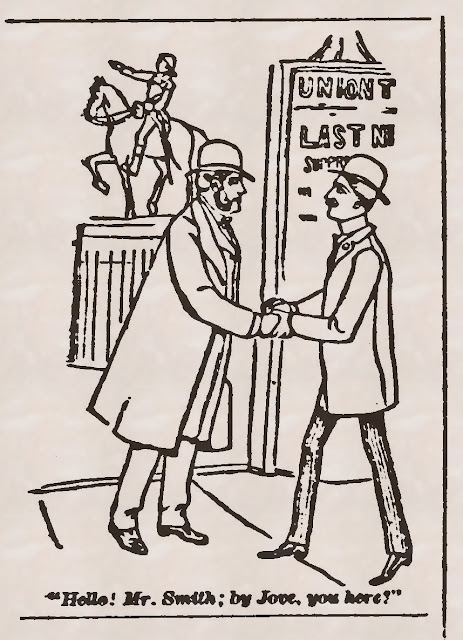
The second bunco man
moves in and introduces himself.
Abilene Reflector
May 14, 1885

 (Click image to enlarge)

     I can’t exactly say how I ever cultivated the taste for looking into shop windows. I know that every window I passed during the next half hour was scanned by me with such attention that I almost seemed to myself to be indulging in the process of appraising the value of goods set out for show. As I was turning the corner of Fourteenth Street, entering into Union Square, a foreign-looking young man, somewhat dudeishly attired, recognized me, and rushing over, grasped me firmly by the hand saying: “Hello, Mr. Smith: by Jove, you here? What in the name of wonder brought you down from Sandusky?”
     I was a little nonplussed at this warm greeting from a stranger, but as he knew me I thought it wiser to await developments, and said, with some politeness:
     “O, just ran down on a little business, and hope to be back home in a few days; but, you will excuse me, I cannot exactly place you, although you seem to know me very well.”
     “Know you,” said my friend, with evident delight. “I should smile!” Why, Mr. Smith, I knew you when I was a mere child. How long have you been living in your present residence?”
     “Well,” said I, “ever since my brother and myself dissolved partnership, and I retired from business.”
     “And how is your brother now?” he inquired.
     “How?” I said, in some surprise. “How the deuce can I tell? He was the first man incinerated in the new crematory. I guess what’s left of him is all right at home on the mantle-piece.”
     “Poor fellow,” said my young friend, with some sadness in his tone, “it was so sad, his taking off.”
     “Yes,“ said I, “You seem to have known him well. He was too fond, unfortunately, of taking rum at unseasonable hours, and that’s how he got so quickly incinerated. But might I ask your name?
     “Come, now,” he replied, “look me straight in the face and give a guess. Mind, though, I have been out of Sandusky a long time, knocking about Europe, and I am on my way home now, not like the prodigal son, either, as I have been in luck of late, and only this morning drew a prize of a thousand dollars, which I am this moment on my way to get cashed. But that is another matter. Now, as to my identity, I wish to please you with a surprise. Do you know the manager of the First National Bank?"

     “Do I! I should think so. He is my own banker, and as decent a fellow as ever I met. There’s not another man in the state of Ohio I have a greater regard for than Joe Hawley.”
     “Did you ever know that Joe had a son who went away to Europe?”
     “No; not as I’ve heard, young fellow. Joe is, like myself, an older bachelor, and all the boys he ever took an interest in were his nephews, Jim’s son’s. I guess one of them, Egbert, or Eggy, as they used to call him, did run away, but I always heard that he kinder got his blood up agin the Indians.”

     “No, sir; you are on the correct trail, but we must leave the Indian war-path. I gave it out that I was going West, but, by Jove! I did better and went East, made money in England, and now I am on my way back with lots of money to see dear old Sandusky.”
     “My dear boy,” said I. “I am delighted to meet you, and if you are not in a particular hurry to go home, guess you ought to wait for me. I am stopping, for the present, at the Astor House, and I am now on my way up to Sixteenth Street to meet an old Sandusky friend, D. Tobias Earwig.”
     “Friends again, by Jove!” ejaculated my companion. “Do you know Dr. Earwig? The second man I called on after leaving the landing-pier a short time ago. I promised to call on him, too, this very afternoon. In fact, he placed it upon me as an obligation. But there’s no use your going there now if you wish to see him.”
     “Why? May I ask.”

     “Because he is at this moment giving a demonstration at the Clinical in Harlem Hospital. You must have patience like myself, until four o’clock, and we can call on him together.”
     “Very good,” said I, resignedly; “I confess I am not in any great hurry, but I don’t relish the idea of walking about here carrying this confounded bag.”
     “Then I’ll settle that. I don’t mind confessing to you that the joy of getting home again has made me do a little too much in going round to see the Elephant, you know; and I guess a glass of good wine—Yellow Label, old man—won’t at all be out of place in my stomach. In fact, Dr. Earwig, our mutual friend, ordered me to take it. Come on.”
Enjoying the Yellow Label wine
getting the victim drunk.
Abilene Reflector
May 14, 1885

 (Click image to enlarge)

     I don’t know now why I yielded to the invitation of this stranger; but there was something in his easy manner which must have prepossessed me in his favor, and as I had a couple of hours’ lounging to do I easily fell a victim to his toils.
     My newly-found friend beckoned to a cabman, and before I could fully make up my mind, or even utter one word of expostulation, I was seated alongside him, and we were whisked up town at a rattling pace, until our conveyance stopped up with a sudden jerk at the door of a quiet-looking restaurant.
     We had the Yellow Label, as my friend called it, and as it was really good wine I felt bound to order a second bottle, when an acquaintance of my friend joined us, and I was duly introduced to him. This friend would insist upon a third bottle of the Yellow Label, and all the time kept wishing my young Sandusky acquaintance joy over his good fortune in winning such a large prize in some lottery.

     “Eggy,” said he, “I guess I’ll have another go at fortune. I have a few dollars which I can spare, and maybe I should have luck if you will only favor me with your—and your friend’s company.”
     “I don’t mind, old fellow,” was the reply. “Guess I want to get cash for my check, anyhow, but I won’t play any more, as I am going home to Sandusky as soon as possible.”
     “Come on, then,” said the other, “here’s a cab at the door. I am in a hurry, and can’t stay more than half an hour, play or not play.”

     I suppose it was the wine—Yellow Label—which rose in my head, but once more I found myself in a cab, and in a short time was ushered into a small apartment fitted up in office style, and my young Sandusky friend presented his check for payment.

     The party in charge was very polite, and begged my Sandusky friend to wait a few moments until he procured a counter signature of some other official before handing out the cash. Meanwhile the other friend said he would try his luck, and depositing a ten-dollar bill on the desk drew a ticket out of a little revolving mahogany box. He won. I saw him paid out fifty dollars, and I then began to take an interest in the game. My Sandusky friend asked the man in charge if he would give him credit pending the arrival of his winnings from his check, and he was prepared to play he beckoned me aside and confidentially informed me that if I followed his example, and invested the same amount as he did, we could win as much as would pay all our expenses and leave us a nice balance in our hands on landing at Sandusky. Perhaps it was the effect of the Yellow Label stuff, or perhaps the fellow mesmerized me, but I unfortunately accepted his advice and drew out a ten-dollar bill, and we won fifty dollars each. One of the party then suggested that a bottle of wine should be opened to our good fortune, and after partaking of a glass, my Sandusky friend whispered me that he was going now for a thousand, which he would add to the thousand already owed him. Again I am forced to make the sad confession that I resigned myself blindly to his advice; but luck did not seem to cling to him, as he won and lost by turns until he commenced, as he called it, to plunge. Of course, I plunged too, and my big roll of bills, amounting to over $300, soon dwindled down to a very small sum, until to my surprise I found myself compelled to borrow from my friend. His finances were drained out as well as my own, so he whispered me to take a chair and wait for him for a few minutes until he should return with the cash requisite for us to take out our revenge.
The False Alarm
getting rid of the victim.
Abilene Reflector
May 14, 1885

(Click image to enlarge)
     So I sat down and saw my young Sandusky friend politely bowing to me as he took his departure. I think I pulled nervously at my whiskers, and it began to dawn upon me that all was not as straight as it might be. I was thus engaged when a colored man rushed into the room and breathlessly informed me that he feared the police were at the front door, and I had better get out quickly by the back way, and take a cab to a place where my young Sandusky friend awaited me.
     I yielded automatically, and after a half-hour’s drive in the up-town portion of the city, my cabby pulled up and handed me my small hand valise and said I was to wait at this spot until he went for Mr. Hawley, whom he had instructions to drive back and join me at this particular place.
     I hadn’t even the presence of mind to take the number of that cab, my mind was in such a disturbed state; so I patiently waited for Hawley, who never turned up, although the shades of evening were approaching and the lamplighters were beginning to illuminate the district.
     I suppose it must have been that Yellow Label business which so obfuscated my intellectual faculties. It was quite dark and I was beginning to attract the attention of the passers-by before it fully dawned upon me that I had been cruelly swindled. Seeing a colored lamp in the distance which told me I was in the vicinity of a police precinct, I instantly rushed toward it to state my grievances.
Lodging a useless complaint
at the police station.
Abilene Reflector
May 14, 1885

(Click image to enlarge)
     I have a very great respect for the police force, but with all due respect for that highly intelligent body, the officer in charge smiled at me when I recounted my adventure, and, as he seemed to throw some doubts upon my sanity and jocularly remarked that, in his opinion, a good square sleep might take down the swelling in my head, I produced the only evidence of the swindle in my possession—a numbered ticket.
     This seemed to have little effect, as this very incompetent officer only folded his arms on the desk, and smiled at me more and more.

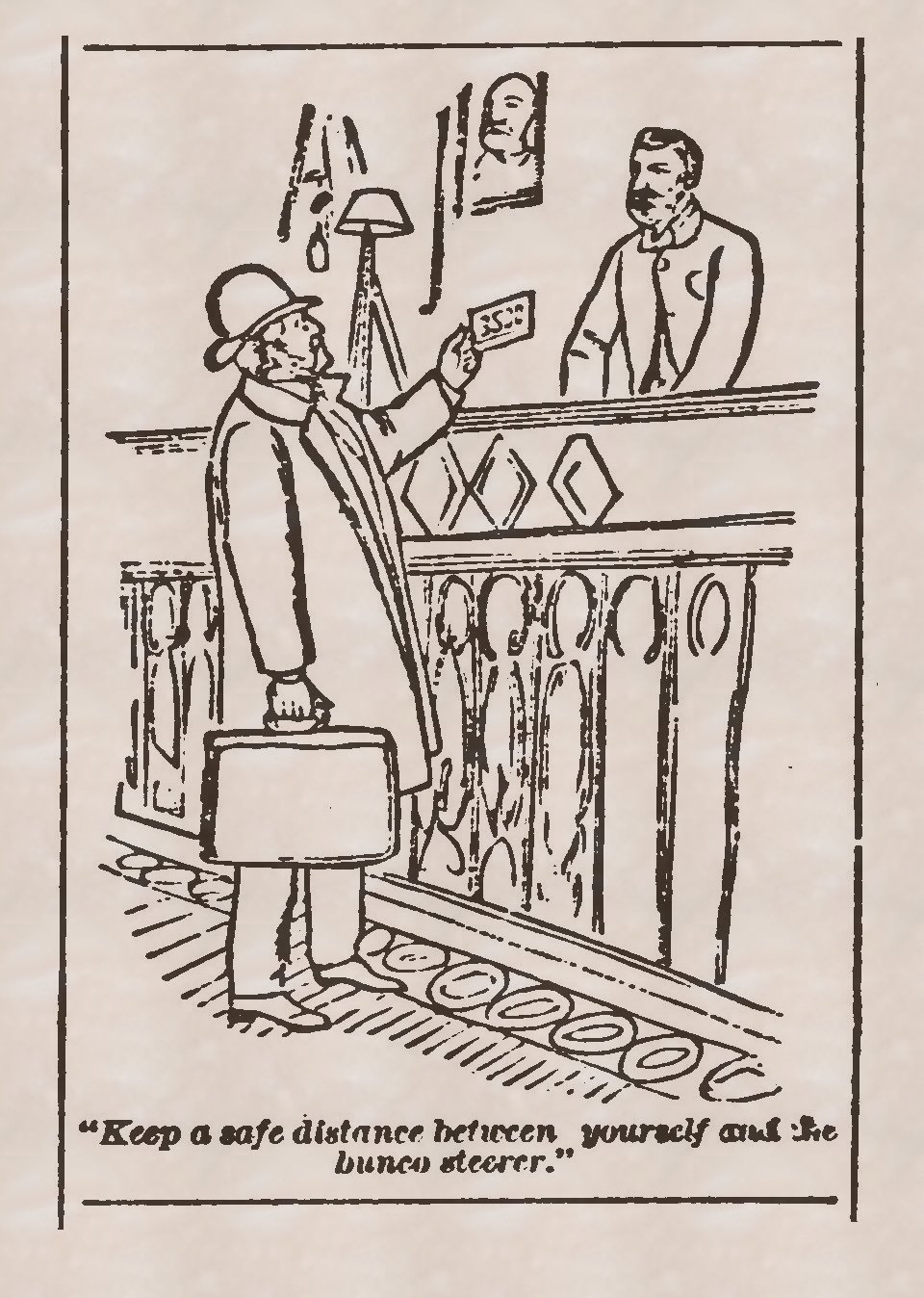
     “Go home, boss,” said he, “and when you next take a trip here from Sandusky, learn that it isn’t safe to stop and chin [to talk, chatter, gossip] in the streets with every one who says he knows you, and, above all things, keep a safe distance between yourself and the bunco steerer.”
—N.Y. Cor. Louisville Courier Journal.

NOTES:
[1]: The poem section comes from Misadventures at Margate. A Legend of Jarvis's Jetty. Mr. Simpkinson loquitur. page 315


"The surest of all “sure things” is a game operated with three little shells. It is one of the oldest bunko games in existence. The newspapers have published columns about it, and the names if its victims are as the sands of the sea."
Aspen Daily Chronicle, July 30, 1889



December 19, 2022

Mock Auctions: How Cheap Watches are “Worked Off” on Countrymen.

MOCK AUCTIONS
San Francisco Chronicle
June 22, 1879

(Click image to enlarge)


ock auction houses were a very successful addition to "Soapy" Smith's swindle businesses in Denver, Colorado. 
 
The mock auction is a swindle in which a victim bids on and purchases what he is made to believe is a high quality gold watch, but in fact, he is paying good money for a very low quality one. Past research and articles I have published on Soapy's mock auction houses were based on period newspaper articles, which gave some great information, while leaving open-ended questions, as to the details of where and how the watches were obtained. Based on letters in the family collection, I believed that Soapy purchased the cheap watches. One letter in family hands comes from C. C. Lamos, a retail and supply company from Chicago, dated December 4, 1883.
Friend Jeff

      Am dam [sic] sorry the watches did not pan out all ok.… You must always send them back at my expense as I hate like the duce [sic] to have any of the old boys kick on me. I had rather pay the difference myself. 6 oz white watches nice ones 4.25 each, is the best anyone can do. They are nice ones. Just got in a fine lot today. The Silver watches I have just [illegible] up to the Waltham agency here and will see what they say. He sends this reply and you can’t get any made I don’t think this season as they are very busy at the factory for holidays.
     [John] Waller is still in Oregon doing well as usual he is making big money this year. Wishing you the best of good luck.

I am yours only
Lamos [1]
The fact that the letter is an apology for poor quality watches had me wondering how Soapy kept a constant supply of watches coming in as any break in the supply would shut down the auction house until more watches were received.
     I came across a good answer from a newspaper article published in the San Francisco Chronicle, June 22, 1879.


MOCK AUCTIONS.
How Cheap Watches are “Worked Off” on Countrymen.

      The CHRONICLE has repeatedly shown up in its columns the snares and nefarious methods adopted by bunko and cheater “steerers” to entrap country visitors and rob them of their hard-earned money. There is yet another class of swindlers, whose victims are numbered by the legion, who nightly ply their thieving art, and from the peculiar manner with which their operations are conducted they are seldom or never caught and consequently but little publicity is ever given to their transactions. The swindlers referred to are certain Cheap John establishments on Kearny street and their game is so ingeniously played that frequently city people and bucolic visitors whose wisdom teeth have been cut by experience with bunko and cheater men, readily fall into the trap and are swindled. For the benefit of those who do not know the game alluded to or the history of it.
 
$75 WATCH AND HEIRLOOM

From the time the Cheap John gets it until it is disposed of to some victim looking for a bargain, the following will be of interest. The proprietors of these Cheap John stores will, during the day, when they are short of material, visit the various pawn-broker establishments in the city and buy up the unredeemed cheap silver and white metal case watches at an average price of $2.70 apiece. The watches, with a sufficient number of steel chains, are then taken to a gold plater, who soon after turns them out with bright gold cases. The plating is done with 18-carat gold, and a white metal or brass case watch is sold as an 18-carat gold watch. If it is a silver case watch it is sold with the guarantee that it is on a “coin basis.” In the employ of these Cheap John stores are some six or eight cappers. During the night they are given a watch to “work off,” and if successful they receive for their services a dollar a piece. The chronometer, the brand of which is generally Swiss, is “worked off” as follows: Capper No. 1, having received the watch before the evening’s business has opened, waits until the store is filled by a crowd of the curious when he approaches the auctioneer and intimates to him that he would like to sell his watch, which is either an “heirloom” or one that cost him $75. The auctioneer takes the watch and tells the “owner” he will charge him one dollar for selling it. The watch is offered for sale and Capper No. 2 bids $5 for it, which is quickly followed by bids from the other cappers until it is run up to say $10, and at that price it is knocked down to the bidder.

THE “OWNER”

Then speaks up, and says he will not allow the watch to go for such a low figure. He is informed by the auctioneer that he can make one bid for the watch, which he does, $16, and at that figure it is sold to him. The auctioneer claims his dollar for selling it, and, of course, as the “owner” has not that amount, the watch is then auctioned off again. It is now, the victim takes his first bite. The watch is started at $2, and the countryman maybe bids $5. The cappers crowd around him and explain its mechanism, the solidness of the case and the clearness of the crystal, etc. Greeny is caught; and the bids are run up on him until he bids $35 or $40, when it is knocked down to him at that price. He is then taken to the back of the store and charged one dollar for buying the watch, and if he asks for a guarantee, he is given the following: “Received of John Doe, $40, for a watch. —.” The countryman no sooner reaches the sidewalk with his presumed prize when he is roosted by another capper, who tells him that if the watch is gold he will give him $50 for it. They go to a jewelry store near-by where the watch is tested with water contained in a gold bottle. The jeweler demands one dollar before he will give the result of the test, and the money is handed over, and the victim is told that the watch is not gold, and he is advised to take it back to the auction-house and have it sold. He does so and the auctioneer again puts it up for sale and knocks it down to one of the cappers, who bids $2.50 for it. The seller retains one dollar as his commission, and hands over the balance, $1.50 to the countryman, who is

OUT JUST $38.50

On his bargain. It frequently happens that among the watches purchased by the Cheap John there is a small one. A satin-lined case is made for it, and it is then given to one of the cappers, who presents it at the mock-auction counter with the story that it was a wedding-present to his wife and that he is compelled by reduced circumstances to thus part with it. It is at once offered for sale, and “worked off” on some victim whose sympathies are interested by the tale of domestic affliction which caused the sacrifice of the marital memento, and who imagines that he is purchasing a first-class watch at a price far below its actual value.
     I found the details of how the mock auction houses operate to be of great interest, as Soapy's mock auctions in Denver likely utilized many of the same methods. Some of the information is new to me, such as
  • the purchase of "cheap silver and white metal case watches" from local pawn brokers, cheaply gold-plated, and then auctioned as being high quality gold watches.
  • The detail of the set-up and how the cappers lure-in the victims to bid.
  • The elaborate play of the capper offering to purchase the victim's new watch at a nice profit, with the condition of visiting a local jeweler for an appraisal, only to find out that the watch is not worth the price the victim paid for it.
  • Most notable for me is how the victim is lured back to the auction house, allows the watch to be auctioned off again, resulting in the loss of the bulk of the amount originally paid as well as the loss of the watch itself, thus allowing the swindlers to auction off the same watch to another victim.  


Click to enlarge

NOTES:
[1] Letter from C. C. Lamos to Jeff R. Smith, December 4, 1883. 


Mock Auctions: pages 15, 30, 43, 45, 47-48, 51, 58, 75-76, 88, 90, 92, 120, 129-32, 138, 159, 162.63, 180, 188, 190-91, 202-05.


"A sucker has no business with money in the first place."
—"Canada Bill" Jones