Showing posts with label Jeff R. Smith III. Show all posts

October 13, 2025

Artifact #93: Soapy's son, hires attorney to stop the slurring of his father's name.

"As his son I am proud of his
efforts to succeed in life"
Jefferson Randolph Smith III
Artifact #93-2
Jeff Smith collection

(Click image to enlarge)


oapy's son hires a legal firm to stop the defamation of his father's name.

At age 30, Jefferson Randolph Smith III, Soapy and Mary's oldest son, was protecting his father's legacy and his mother's reputation from "libel" and scandal. He was also protecting himself as he worked behind the scenes in St. Louis city politics and couldn't afford his rivals finding out that his father was a notorious old west confidence man and crime figure.

The six typed documents are rough draft/copies for Jefferson's files. The first one is dated July 20, 1917, reading as follows

St. Louis, July 20 1917.

Lord Shaughnessy, K.C.V.O.
President, Canadian Pacific Railway Co.,
Montreal, Canada.
My dear Lord Shaughnessy:-
In the most recent issue of your booklet "Alaska" you devote considerable space to an arraignment of my father who lost his life in Skagway nearly twenty years ago. There is considerable in his life that probably appeals to many persons as romantic but probably you yourself recall those days of the making of Alaska when the great Klondike gold rush was on. He was only one of thousands who led a life more or less rugged.

Of all the thousands of stories that have appeared in the newspapers and magazines in the United States not one of them ever referred to him as an outlaw. It was evident to these writers and publishers that although he had figured in the upbuilding of a new country he was far from being other than a man who could be trusted [Jeff adds in pencil: "solider of fortune."]
As his son I am proud of his efforts to succeed in life because circumstances had forced upon him early in life the responsibility of caring for a large family, thus robbing him of the education that he made possible for his brothers and sisters.
Letters from the Presidents, statesmen and recognized men of affairs addressed to him in confidential terms and which are in my possession show that irrespective of all that was said and published of him he was well-thought of, trusted and respected. These men know he was not an outlaw or "part outlaw."
Scores and scores of persons not only in St. Louis but elsewhere throughout the country, especially in the great Northwest know me as the son of the man you so unfairly arraign and I cannot let this go unchallenged.
I am enclosing a copy of your booklet in which you[r] attack him and his people appears.
It is fascinating how Jefferson, my grandfather, defended his father's career choice in writing, how proud he is "... of his efforts to succeed in life because circumstances had forced upon him early in life the responsibility of caring for a large family, thus robbing him of the education that he made possible for his brothers and sisters."

Four days later Jeff received a reply.

"Let me assure you that we are very sorry"
Artifact #93-3
Jeff Smith collection

(Click image to enlarge)

The reply reads as follows.

CANADIAN PACFIC RAILWAY COMPANY
J. M. GIBBON,
GENERAL PUBLICTY AGENT.

J. C. S. BENNETT,
OFFICIAL PHOTOGRAPHER
MONTREAL, July 24, 1917.
IN YOUR REPLY PLEASE REFER TO FILE NO. B 10951

Reference to Mr. Smith in "Alaska" Folder.

Jefferson Smith, Esq.
5348 North Market Street,
St. Louis, Mo.

Dear Mr. Smith,

Lord Shaughnessy has referred to this Department your letter July 20th. regarding reference in our "Alaska" folder to your late father.

Let me assure you that we are very sorry that this reference has caused you any pain. The person who compiled the booklet in question cannot have taken a great deal of care to verify his statements, although he is one upon whom we usually place great reliance.

I shall see that the statement is not repeated in any further issue of the booklet.

Yours truly,

CS Stokes [signed]
Asst. General Publicity Agent.

Jeff didn't let it go. Some time later Jeff hired an attorney from the firm of Morris and Zachritz, who after several months contacted the company via a two page letter.

Soapy Smith
Artifact #93-1A
"Half outlaw - half political heeler"
Jeff Smith collection

 (Click image to enlarge)


"Insisting on immediate action"
Artifact 93-1D
Jeff Smith collection

(Click image to enlarge)


This two page letter is dated January 10, 1917. As Jeff had written his first letter to the publishing company on July 20, 1917, it is believed that this first letter to the same company, by Jeff's attorney is actually January 10, 1918.

January the 10th
Nineteen - seventeen.

Dear Sir:-

In re:- FILE NO. B-10951

In your publicity folder, entitled "ALASKA", widely circulated throughout North America during the summer months, your company published of and concerning the deceased father of Mr. Jefferson Smith, of this city, certain false and defamatory statements, which we quote as follows:-
"To-day Skagway boasts scarcely a thousand souls, but in the eighteen years of its life it has crowded in enough incident to provide volumes for the historian. All have read of the famous gambling hells with which the town was once infested, and none should fail to make the four-mile journey out to the old cemetery where lies the body of "Soapy Smith", the famous Boss of the town, half outlaw, half political heeler. The Sylvester Wharf still stands, half a ruin now, to mark the place where "Soapy" Smith was shot, and the day when the sober citizens of Skagway decided to reform the town, which was suffering from its evil reputation.
Skagway, once the wildest, wickedest town in the world, in now a model of  propriety."
This drew from our client a vigorous protest, in the form of a letter to Lord Shaughnessy, under date of July 20th, 1917, also briefly setting forth his father's real status in the community. Under the date of  July 24th a reply was written by your Mr. C. S. Stokes, Ass't General Publicity Agent, (File No. B-10951) which although conciliatory in tone, did not offer a plausible excuse for the appearance of the above statements and was not followed by a retraction.

 On the authority of:- "HUOT -vs- NOISEAUX 2 Quebec Q. B. 521 and under the Revised Statutes of Missouri, Section No. 4818, our client's rights in the premises seem clear. The decision fully sustains the right of a son to maintain an action for the defamation of his deceased father and the statute provides as follows:-

"A libel is the malicious defamation of a person made public by any writings, sign, picture, representation of effigy tending to provoke him to wrath or expose him to ridicule or to deprive him of the benefits of public confidence and social intercourse, or ANY MALICIOUS DEFEMATION MADE PUBLIC AS AFORESAID,  DESIGNED TO BLACKEN AND VILIFY THE MEMORY OF ONE WHO IS DEAD AND TENDING TO SCANDALIZE HIS SURVIVING RELATIVES AND FRIENDS."

The appellate courts of this State have repeatedly cited and applied the above statute to both civil and criminal cases. See the following decisions:-
Kenworthy -vs- Journal Co. 117 App 327
Julian -vs- Kansas City Star 209 Mo 35
Spurlock -vs- Investment Co. 59 App 225
Houston -vs- Wooley 37 App 16
McCloskey -vs- Pub Co. 152 Mo 339

Our client is insisting on immediate action on our part, to the end that the memory of his father may be vindicated and the stigma on his own name and that of his family may be removed. However, before taking action in the premises, we deem it advisable to communicate the above facts to you.

Awaiting your early advice, we are
Very truly,

MORRIS AND ZACHRITZ

Hon. E. W. Beatty, K. C.,
General Counsel,
Canadian Pacific Railway Co.,
Montreal, Canada.

Seven days later, on January 17, 1918, the Canadian Pacific Railway Company responds to Jefferson's attorneys. 


"I will communicate with you later"
Artifact 93-4
Jeff Smith collection

(Click image to enlarge)


Canadian Pacific Railway Company
Law Department
L-32612

E.W. BEATTY, K.C.
Vice President and General Counsel.

W.H. CURLE, K.C.
General Solicitor.

E.P. FLINTOFT
Assistant General Solicitor.
MONTREAL 17th, Jan'y 1918

Messrs Morris and Zachritz,
Attorneys and Counsellors,
506 Times Building,
St. Louis, Mo.

Dear Sirs:-

The Vice-President and General Counsel has asked me to acknowledge receipt of your letter to him of 10th instant, on behalf of Mr. Jefferson Smith.

I will communicate with you later after enquiring into the matter.

Yours Truly,

W. H. Curle
General Solicitor

WHC/MLR

On February 2, 1918 W.H. Curle responds with Jefferson's attorney's for the last time.


Canadian Pacific Railway Company

Law Department
L-32612

E.W. BEATTY, K.C.
Vice President and General Counsel.

W.H. CURLE, K.C.
General Solicitor.

E.P. FLINTOFT
Assistant General Solicitor.
MONTREAL 17th, Jan'y 1918

Messrs Morris and Zachritz,
Attorneys and Counsellors,
506 Times Building,
St. Louis, Mo.

Dear Sirs:- Re Jefferson Smith 

Referring to your letter of 10th ultimo to the Vice President and General Counsel.

I am instructed to decline the suggested claim of your client.

Yours truly,

W. H. Curle
General Solicitor.

WHC/MLR      
At this point Jefferson opted to end the legal suit as he knew the next step, his only recourse, was to go to court trial. Records show that in his lifetime, Jefferson attempted to force corrections in the telling of his father's life, numerous times, including films, books and other published works. What is not surprising is that he never took his legal complaints to the court room, as there was always a good possibility that any research by the defense attorneys would uncover and expose to Jeff's political rivals, the fact that his father was a known confidence man, using that fact against any candidates Jeff worked for, thus ending his political career.  



Jefferson R. Smith III
APR 27, 2021
JAN 14, 2022


"With spots quadrangular of diamond form, Ensanguined hearts, clubs typical of strife, And spades, the emblems of untimely graves."
—William Cowper






January 14, 2022

Artifact #92: The Girl Alaska and Soapy's son's legal suit correspondence.

First letter sent out
Part 1
From Jefferson Randolph Smith III
To Mr. Ricord Gradwell
Jeff Smith collection

(Click image to enlarge)
 
 
First letter sent out
Part 2
From Jefferson Randolph Smith III
To
Mr. Ricord Gradwell
Jeff Smith collection

(Click image to enlarge)


n a sneering manner and loud enough to be overheard by others, repeated what he had seen on the screen.
 
 
Artifact #92
 
ABOUT THE FILM

Title: The Girl Alaska
Release: August 18, 1919
Producer: World Pictures


     American black and white silent film. Believed to be the first motion picture that portrayed a mention of Soapy on film. The film caused the widow Mary Eva Noonan and Jefferson Randolph Smith III, Soapy's son, a newspaper man and political power in St. Louis, Missouri, personal anguish and supposed loss of respect when the film was viewed in his home town theater. In 1919 the son hired the legal firm of McCarthy, Morris and Sachritz to take up a legal battle of written letters meant to eliminate objectionable parts from the film. Jefferson felt the film had injured his personal and political standing in the community and wished to sue for malicious libel. At first the film company, George Kleine Motion Pictures was willing to cut offensive scenes out but later reneged on the offer. The one copy of the film that exists at the Library of Congress does not appear to be that offensive and may have had the objectionable scenes deleted.

Paul Quinzi saw the film during a visit to the Library of Congress and wrote;

      The film is the story of a girl called Molly McCrea, 'daughter of one of the lost gold seekers of Alaska.' After having been abandoned by her father at a young age, Molly decides to travel to Alaska herself after reading in the newspaper of 'great opportunities for young men in the north.' Disguised by a pair of overalls and a cap, Molly passes herself off as a boy, stows away on a ship and adopts the slightly more masculine name 'Alaska.' On the ship, Alaska meets Phil Hadley, who is also seeking his fortune, and the two 'boys' become best buds.
     The two arrive in Skagway and meet an 'old sourdough' who shows them around the town. They soon hook up with a native who offers to lead them to a good stake. On the way, a huge ice cliff falls on their canoe, killing their guide, leaving Phil and Alaska to their own devices. (No CGI of course; the prelude to the film alludes to the actors 'missing death by a narrow margin' in this scene). They eventually find the stake, but there's no gold to be found. They wander around some more and Phil becomes ill. Alaska saves him by discovering, luckily within a few hundred yards, an old prospector's cabin. Lo and behold, it's the old sourdough from Skagway! He takes them in and offers to let them stay and help work his claim.
     Alaska seems to be slowly falling for Phil, who constantly pines for Lorraine, his sweetie back home, a socialite who writes him occasionally. Of course, thinking Alaska is a dude, Phil is totally oblivious to her feelings. One day Alaska, Phil and the sourdough go into Fairbanks, the nearest town, for supplies. Alaska and Phil go into a saloon, where someone tries to rob Phil at the faro table. A great bar fight ensues, in which Phil is roundly beaten and falls out into the street. Alaska rushes to his side, whispers 'I love you' and kisses the unconscious Phil. Then the sourdough collects them and they make a swift exit from Fairbanks. They continue to work the stake, Phil missing Lorraine, Alaska lamenting her unrequited love for Phil. The old sourdough falls ill, and on his death bed asks Alaska to take his share of the claim back to the States and give it to his little girl, Molly! Alaska removes her cap, revealing her curls, and no sooner are father and daughter reunited than they are separated by death.
     Phil decides it's time to head back home to Lorraine, and leaves his buddy Alaska to work the claim. He is thrown from his sled and is left alone in the wintry wilderness. The next morning, Alaska wakes to the jingling bells of the returning pilotless dogsled, and goes out to save Phil, which she does, although admittedly still bitter about his having left her for Lorraine.
     Spring comes, and one day Phil spies Alaska secretly frolicking by the lake, naked as the day she was born, highlighting the fact that she's a she (no CGI here, either, but shot from far away). Later that day, some prospectors happen by the cabin and leave off some newspapers from the States. Phil picks up one only to read, 'Prominent socialite Lorraine Dower weds New York millionaire.' Next morning, Phil takes Alaska to Fairbanks, ostensibly to file a new claim. Instead, he takes her directly to the chapel (pastored by the Rev. U.R. Blest), whereupon he announces that they want to be married, to which Alaska coyly consents.
Soapy in the film?

      Soapy's son was so offended by the film that he threatened to sue the producer for libel if he did not remove the objectionable scenes. From watching the film it is not clear whether Soapy's son was successful or not.
     The only mention of Soapy is an approximately 15-second scene when Phil and Alaska arrive in Skagway. The entire part plays as follows:
     Slide: The old sourdough takes Alaska and Phil to the grave of the notorious gunman, Soapy Smith.
     Screen: [Shows Soapy's tombstone, circa 1919, tattooed with graffiti] Jefferson R. Smith, died July 8, 1898, aged 38 years.
     Slide: 'This fellow tried to shoot up Skagway. They buried him with his boots on.'
     Of course, it's possible that some original version had a somehow more sinister depiction of Soapy and after being threatened with a lawsuit, the director removed it, leaving only the cut I saw. It may be that not every copy of the film was edited and the Library of Congress has one of the uncorrected versions, or, none of the versions were corrected, and Jefferson Randolph Smith III was not successful in his legal attempt to have the offending portion removed. 

Soapy's son, Jeff sees the film.
The letter campaign and legal suit begins.

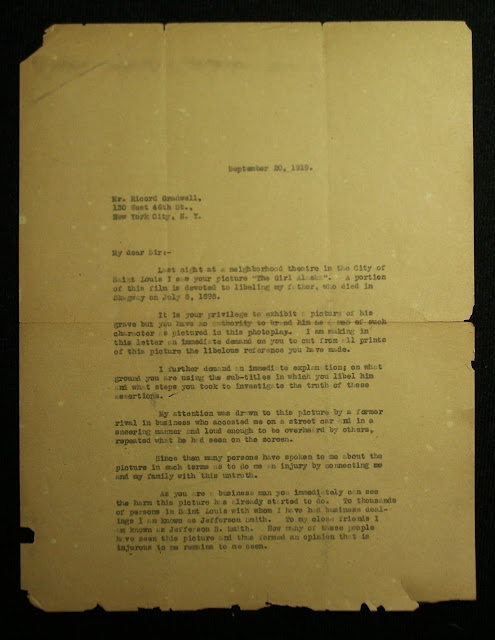
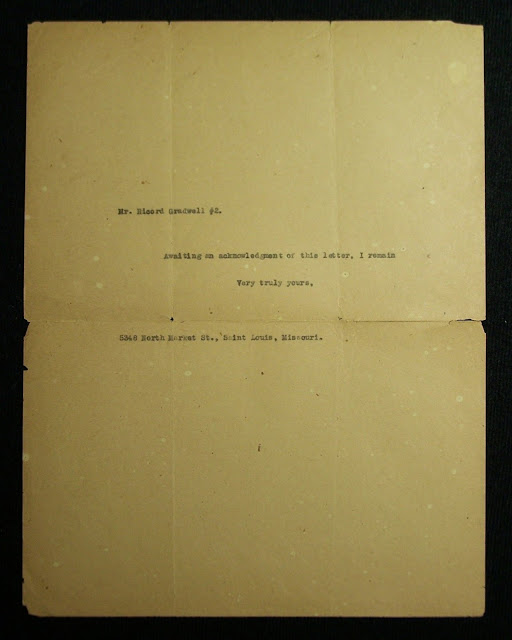
     The film is released to theaters on August 18, 1919. One month later, on September 19, 1919 Soapy's son, Jefferson Randolph Smith III, goes to a neighborhood theater in St. Louis, Missouri to watch The Girl Alaska. The following day Jefferson types a letter to Ricord Gradwell. Thankfully, Jefferson made copies of his correspondence so we have both sides of this episode in Jefferson's life. Ricord Gradwell was an employee, possibly some sort of secretary for World Film Corporation.
     Jefferson accuses the company of libeling his father, stating that there was no authority to brand his father "of such character as pictured in this photoplay." Jefferson demands that the libelous reference be cut from all print of the film. He also demands an "immediate explanation on what grounds you are using the sub-titles in which you libel him and what steps you took to investigate the truth of these assertions." Jefferson goes on to explain the damage done to him.
     My attention was drawn to this picture by a former rival in business who accosted me on a street car and in a sneering manner and loud enough to be overheard by others, repeated what he had seen on the screen.
     As you are a business man you immediately can see the harm this picture has already started to do. To thousands of persons in Saint Louis with whom I have had business dealings I am known as Jefferson Smith. To my close friends I am known as Jefferson R. Smith. How many of these people have seen this picture and thus formed an opinion that is injurous to me remains to be seen.


Second letter sent out
From Jefferson Randolph Smith III
To Mr. Ricord Gradwell
Jeff Smith collection
(Click image to enlarge)


     Keep in mind that Jefferson's father had been deceased 21 years, and that this was perhaps the first time that he had ever heard someone speak ill of his father, to the world audience of movie goers. His pain is real. He is not seeking money, at first, but rather only seeks a removal of the hurtful words, even if true to modern readers. 
     Jefferson waits two weeks and writes again, on October 6, 1919.
     Two weeks ago I wrote you regarding your film "The Girl Alaska." You have ignored my letter, disregarded my plea and have continued to flaunt in the faces of people, I come in contact with, an untruth and libel.
     There is but one course left for me and that is to ask my attorney to act. I will place this matter in his hands immediately and you will hear from him.


1st reply letter
From William A. Brady
To
Jefferson Randolph Smith III
Jeff Smith collection

(Click image to enlarge)

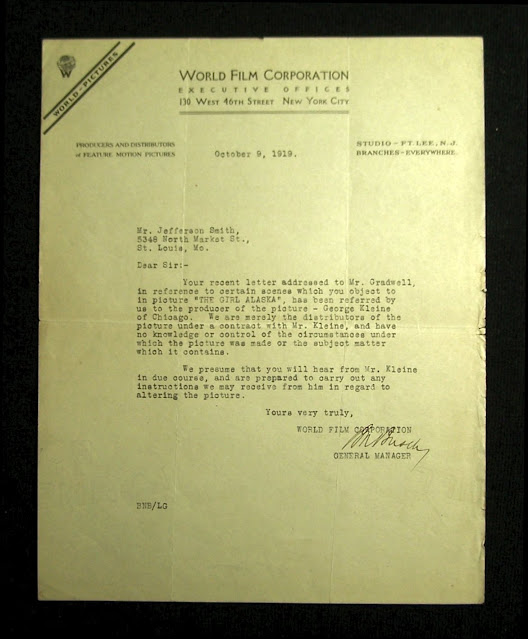
     Three days later, October 9, 1919, Jefferson received a letter from William A. Brady, general manager of the World Film Corporation, producers and distributors of motion pictures. Brady referred Jefferson to George Kleine, the producer of, "The Girl Alaska."
     Brady and World Film Corporation did not produce the film, but acted as the distributor. Brady wrote
     We presume that you will hear from Mr. Kleine in due course, and are prepared to carry out any instructions we may receive from him in regard to altering the picture.


2nd reply letter
From George Kleine
To Jefferson R. Smith III
Jeff Smith collection

(Click image to enlarge)

     George Kleine of George Kleine Motion Pictures writes Jefferson on October 17, 1919 placing any alleged blame on others and places the burden of proof back on Jefferson. Jefferson realizes that it's time to procure an attorney. He selects the firm of McCarthy, Morris and Zachritz.
 
3rd letter sent out
From McCarthy, Morris and Zachritz
To George Kleine
Jeff Smith collection

 (Click image to enlarge)
 
 
     Jefferson's attorney's, McCarthy, Morris and Zachritz, sent George Kleine a letter introducing themselves and their intentions on behalf of Jefferson R. Smith III, on November 4, 1919. The first paragraph is a summary of the correspondence thus far. The second paragraph introduces "... damage repaired insofar as legally possible."

     However, this film is still being shown in this City in its original form and has undoubtedly done great damage to our client's status in this community. As a matter of course, it has caused Mr. Smith and his family considerable annoyance and irritation, and he is insisting on immediate action on our part to the end that the objectionable features of this film may be suppressed and the damage repaired insofar as legally possible.
 
3rd reply letter
Part 1
From George Kleine
To McCarthy, Morris and Zachritz
Jeff Smith collection

 (Click image to enlarge)


3rd reply letter
Part 2
From George Kleine
To McCarthy, Morris and Zachritz
Jeff Smith collection

(Click image to enlarge)
 
     George Kleine appears to want to resolve the issue in this letter dated November 5, 1919. As we proceed, I can't help wonder something. The film was released to theaters around the country on August 18, 1919. As of this letter it has been 79 days (11 weeks) since the films release. In 1919 how long did films stay in theaters? Could Mr. Kleine have been stalling? If his company could drag this suit out for the entire theater run he would not have to spend the money to edit the film and replace it in every theater showing the film, which no doubt would be at enormous cost. 
 
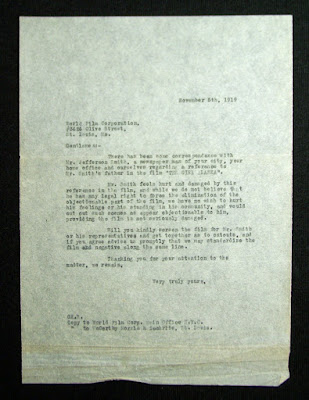
     We enclose with this copy of a letter to the St. Louis office of the World Film Corporation asking them to show the film to Mr. Smith or his representative, after which we would like him to write us definitely what section he would ask us to eliminate. If it can be done without seriously damaging the continuity of the story, we will meet his wishes entirely in the matter; if the proposed eliminations are too drastic as we will discuss the matter further with you and cut out as much as may be practical.
     We trust that Mr. Smith being a newspaper man is equally considerate of the feelings of the present generation when writing about their ancestors. Our own observation of the practice of the press in general shows no such refinements of feeling.
 
     As a possible stall tactic, or simply the ongoing investigation of justifying their film, George Kleine writes
 
     Since that day we have heard from Mr. Albert I. Smith, present address Beaux Art Features Inc./, #329 Citizen's National Bank Bldg. Los Angeles, Cal., and have written to the World Film Corporation which is distributing the film for us. They were authorized to cut out the title, which seems to be the cause of complaint, if it did not break the continuity of the film.
 
     Interesting to note that in my extensive family tree I have several Ira Albert Smith's but no Albert I. Smith's. Only one Ira Albert Smith fits the time frame, but he never lived in California, living the span of his life in Georgia. This does not mean that the company did not have a family member named "Albert I. Smith." Though not detailed as to why this family member is important, it could be that someone contacted him and he aided the companies film project. 
 
Addendum, 01/16/2022: "Photoplay by Albert I. Smith," meaning that he is not a family member like I assumed, but rather an employee of one of the companies. By "photoplay" they may mean that he is the one who created the photos with the text, the same text that upset Jefferson R. Smith III. "Photoplay" is also a play for theatre that has been filmed as a movie.
 
 
4th reply letter
From (not certain)
To
George Kleine, World Film Corp., and Jeff's attorneys.
Jeff Smith collection

 (Click image to enlarge)
 
 
     On November 5, 1919 Jefferson received a copy of a letter from an unknown source, sent out to George Kleine, World Film Corporation and Jeff's attorneys, basically repeating the offer to view the film with Mr. Smith, pin-pointing the offensive portion of the film and deciding if an edit is possible. The letter also adds that 
 
... while we do not believe that he has any legal right to force the elimination of the objectionable part of the film, we have no wish to hurt his feelings or his standing in his community, ...

 
4th letter sent out
Part 1
From McCarthy, Morris and Zachritz
To George Kleine
Jeff Smith collection

 (Click image to enlarge)


4th letter sent out
Part 2
From McCarthy, Morris and Zachritz
To George Kleine
Jeff Smith collection
 
(Click image to enlarge)
 
 
     On November 8, 1919 Jeff's attorneys (McCarthy, Morris and Zachritzx) wrote to George Kleine about their viewing of the film.
 
     In accordance with yours of the 5th inst., in reference to the above matter, in company with Mr. Smith, I called on Mr. W. G. Carter, local representative of the World Film Corporation, this morning and inspected the film in question. We find that the matter complained of commences with sub-title 40 and ends with last frame of sub-title 77, which has been cut-out of the local films by Mr. Carter, who informed us that he would write you immediately suggesting the elimination of this section from all prints in circulation as well as the negative in your possession.
     While the suggestion of Mr. Carter, if carried out, is satisfactory insofar as the future distribution of this film is concerned, the outstanding fact of this matter is that a very serious injury has been done to our client's reputation in this community, and this suggestion does not take into consideration, the matter of "retraction," published to the same extent as the original libel, to which our client is entitled as a matter of law.
 
The letter describes Missouri's Libel and Slander laws, and adds
     Mr. Smith suggests that your observation regarding the attitude of the press, must be the result of seeing it "through jaundiced eyes .." 
 
Final reply
From
George Kleine
To
McCarthy, Morris and Zachritz
Jeff Smith collection

(Click image to enlarge)
 
     On November 28, 1919 George Kleine writes his final letter regarding this case. He writes
 
     We did not in the remotest degree recognize any legal liability in this matter, and do not now.
     Although it is unwise for a layman to argue a legal question with an attorney, we cannot avoid pointing out in the case which you quote, the repeated use of the word "malicious." We did not and do not now know Mr. Smith, have no cause to like to dislike or injure him, we did not photograph the film, nor did we write the titles. It would stretch the imagination of any fairminded man to write a malicious element into the matter.
     If there are to be legal proceedings in the case, we beg to refer you to Mr. Henry Melville, #45 Cedar Street, New York City.
 
Mr. Melville is likely the attorney for George Kleine and George Kleine Motion Pictures. The use of "malicious" bothers Mr. Kleine greatly. The term is only used in quoting an excerpt from a legal case, "Orchard -vs- Globe-Democrat (240) MO 588 Lc).
 
Final reply
Possibly never sent
From McCarthy, Morris and Zachritz
To George Kleine
Jeff Smith collection

 
(Click image to enlarge)
 
     Jeff's attorneys draft a letter on December 18, 1919. Note that it is in need of editing and has been crossed out with pencil, indicating that it was never completed and sent out. It reads
 
     You will note from the following authorities that but scant comfort can be drawn from the position you have taken that your conduct has not been "malicious."
 
(AUTHORITIES)
 
     However our client does not even concede that you have not been "malicious" even in the sense in which you use that word as to date you have never volunteered to drop the portions of the film complained of, much less to make the retraction to which he is entitled as a matter of law. We have closely investigated the history of this film and while the expense of marshalling our evidence in the form of depositions will be considerable our client is determined to fight this matter to a finish.
     We still feel that our client's rights in this matter are so clear that he would not be compelled to go into Court to enforce them, hence an amicable adjustment would be to the interest of all parties concerned, but if you feel otherwise we will have no alternative but to use force without stint regardless of where the chips may fall.

 
This is the final document in my collection of a letter writing campaign that lasted three month's (September 20, 1919 - December 18, 1919). Highly unlikely the film was still in theaters. Did Jeff decide to drop the case? Were the offending items Jeff complained about (commencing with sub-title 40 and ends with last frame of sub-title 77) ever removed? Does the existing film copy in the Library of Congress contain the items Jeff was trying to have removed, or is the copy an edited version? No evidence of a settlement is known to exist.


"The only sure thing about luck is that it will change."
—Wilson Mizner