Showing posts with label Idaho. Show all posts

January 25, 2023

Soapy Smith and Deputy U.S. Marshal Sylvester S. Taylor, Skagway, Alaska

Sylvester Slade Taylor
Four months after Soapy's death
San Francisco Chronicle
November 3, 1898

(Click image to enlarge)


EPUTY U.S. MARSHAL SYLVESTER SLADE TAYLOR
(04/03/1867 – 05/12/1958)


The Latest On A Forgotten Lawman.


Deputy U.S. Marshal Sylvester Slade Taylor, known as "Vess" to his family, has a black mark upon his record as a lawman which appears to be one of the reasons he remains largely unknown. In Skagway, Alaska, 1898, he was under the pay of bad man Jefferson Randolph "Soapy" Smith. After Soapy's death, via vigilantes, Deputy U.S. Marshal Taylor was "arrested" by the vigilantes along with members of the soap gang, charged with negligence of duty for his lack of performance after the robbery of miner John Douglas Stewart, and held until his boss, U.S. Marshal James McCain Shoup, arrived to relieve him of his duty. Historically, this is what Taylor is most famous for.
     Other than his involvement with Soapy Smith in Skagway, not much was known of Sylvester S. Taylor previous to 2010. In that year I had the pleasure of corresponding with a descendant of Taylor (second cousin twice removed) a family historian connected with the Ancestry.com profile for the Taylor family. This descendant wished to remain anonymous for privacy reasons and I still respect her wishes to this day. At the time, the Taylor family was not certain that their Sylvester Taylor was the same Deputy U.S. Marshal Taylor of Skagway, Alaska, fame. Even today the Ancestry profile mentions neither the lawman's profession nor his connection to Soapy Smith, however, there are solid links between the two that prove the two Taylors are one and the same.
     In every empire Soapy constructed, one of the first hurdles to jump was bounding the courts and the law under his control. Large graft payments were a common necessity in order for Soapy and his men to operate in newly arrived camps and towns. In Skagway, Alaska, 1898, one of the hurdles was 31-year old Deputy U.S. Marshal Sylvester Slade Taylor, who replaced Deputy U.S. Marshal James Rowan after he was killed on January 31, 1898. There are no details of how or when Taylor was lured into the criminal side of the law and placed on Soapy’s payroll as it was kept secret until early June 1898 when Mattie Silks publicly accused Taylor of being involved with the murder and robbery of Ella Wilson as well as being instrumental in a plan to murder of Silks. All of this was according to Silks herself and is questionable. Details of her accusations and story are equally interesting and can be found in my book, Alias Soapy Smith: The Life and Death of a Scoundrel.

Sylvester Slade Taylor
Taylor and Maddox family reunion
Palo Alto, Texas, August 6, 1922
From Taylor and Bevers Pioneer Families of Palo Pinto County, Texas
by Bobbie Ross, 1996
 
     Taylor’s final fall occurred after three of the soap gang swindled some funds and then outright robbed miner John Stewart’s gold in Skagway, Alaska, on July 8, 1898, which directly led to Soapy's death at the shootout on the Juneau Company Wharf. With the collapse of soap gang rule in Skagway, the vigilantes rounded up the gang and accused Taylor of being directly involved with Soapy, of silencing the news of the robbery, and of failing to arrest the culprits in the case. Vigilantes went to the home of Taylor to arrest him, only to find him sitting in a chair holding a baby (probably Stephan Alaska Taylor, born two months prior). Taylor was ordered to stay inside his home or risk death. Later he was accused of offering the return $600 of Stewart’s gold to Alaska’s Governor Brady if allowed to leave Skagway a free man. This request was denied and Taylor was charged with “willful neglect of duty.” [1][2] 
     U.S. Marshal Shoup arrived on Thursday, July 14, and within hours fired Taylor from his position and appointed vigilante J. M. Tanner in his place. The Daily Alaskan reported “ex-Deputy Marshal Taylor” was charged with "attempted extortion from a stampeder," but as the complainant left Skaguay for the interior, that charge was set aside, leaving only the charge of “willful neglect of duty, laid by Mr. Stewart.” Taylor was brought before the Committee of Safety to answer to the charges against him on July 15, 1898. “He waived examination” and was ordered held pending posting of $5,000 bond until his trial at Sitka, Alaska. Deputy U.S. Marshal Tanner took Taylor into custody.[3] Marshal Shoup later defended his hiring of Taylor, stating that when he appointed the man, he came “with exceptionally strong recommendations, having served in a similar capacity in Idaho …, where his reputation as an officer was unassailable.”[4] From Taylor's hearing in Skagway, it was discovered that from 1891 to 1896, Taylor had been constable and deputy sheriff in Nanpa, Idaho, and during a portion of that time, he was a deputy US marshal, and from May 1896 to January 30, 1898, he had been city marshal of Nanpa.[5]
     Reverend R. M. Dickey wrote that he associated with Taylor in Skagway, had dinner with him “and his friendly wife in their snug home.” In the fictional account of his time in Skaguay, Dickey characterized Taylor as “Strange and puzzling…,” “clever,” acting “With great courage,” a man of feeling who “completely broke down” in telling of a little girl who had died some ten years before.
And yet some people in Skaguay suspected that he was in fraternity with Soapy Smith and his league of cutthroats. We never believed that. And yet…. … Our conclusion was that he was a big-hearted man who fully determined to do right but who had in some way come under the power of Soapy and that he writhed under it. … There was something there, but whatever power Soapy had over him we never knew. It may be that he found himself powerless to enforce the law strictly and decided to follow a mediating path with the law breakers to amend their effect as best he could. Having submitted to appeasement once, perhaps he was in Soapy’s power.[6]
     On November 3, 1898, while awaiting the final results of his trial, a reporter from the San Francisco Chronicle had Taylor's likeness published (see top picture). On December 10, 1898, Taylor was acquitted of negligence. Evidence of his wrongdoing as a lawman was ample, but none of it was evidenced in court.[7] Though acquitted of negligence, Taylor’s career as a lawman was over. His name was now manacled to the legendary Soapy Smith, and no key could unlock it.
     Once able to leave Skagway, Taylor took his wife, Maud Ellen Stewart, and their five young children, including Stephen Alaska "Lou" Taylor, born in Skagway on May, 13, 1898, back to Idaho. In 1900, with the help of family member Pleasant John Taylor and an older brother or cousin, who was a "showman" and “movey projectionist,” Sylvester became manager of the show. In 1910 his occupation was still listed as “showman, vaudeville and movey projectionist." In 1919 Taylor's occupation is listed as working at the Isis Theater in Idaho.
      In the following from a Texas newspaper article from August 1922, Sylvester reminisces his early days in Texas, which includes a strong link to a career in law enforcement, considering his three older brothers were Texas Rangers.
      Early settlers will remember the three brothers of this family, who were Texas Rangers, known from border to border of the state of Texas as Ham [Hannibal Giddings Taylor], Eph [Ephraim Kelly Taylor] and Pleas [Pleasant John Taylor] (Doctor Stephen Slade Taylor’s sons). They lived in the days of Indians, and became Rangers to protect their homes, according to Sylvester Slade Taylor, of Reno, Nevada, who is in Fort Worth, visiting his son, S. J. Taylor, 1312 College Avenue. This is the second visit to Texas in thirty-five (35) years and the first time he had seen his sister, Mrs. Sarah Susan Taylor Click for thirty (30) years.
     "I went back home and went swimmin’ in the old swimming’ hole, in the nature way,’ the Texan said. ‘But the most exciting of the whole trip was when we went out to the Hart Ranch and saw a oil well brought in. They seem to bring ‘em in while you wait out there. It was the first one I’ve ever seen brought in and believe me it was some sight to these old Nevada eyes." He recounted many interesting things about the early days and the Indian raids. Remember the killing of the elder Dalton, father of Robert Dalton, owner of the Dalton Oil Tract. He saw his first train in Fort Worth, Texas.[8]
     In 1930, at age 63, Taylor is listed as a cigar salesman in Reno, Nevada. At age 73 in 1940 he is listed as an attendant at a local college in Spokane, Washington. Eighteen years later, on May 12, 1958, Sylvester Slade "Vess" Taylor passed away at age 91.
     At the time I published Alias Soapy Smith in 2009 I depended on the Taylor family tree on Ancestry.com complete with the inevitable mistakes that come with creating such a tree, for the pre and post-Skagway history of Sylvester Taylor. Thus, I was made to believe that Taylor "died comparatively young, though, in 1916 at age 49.” Since then, the information found on Ancestry.com has been updated and his actual death date, as shown in the death certificate below, is May 12, 1958, in Portland, Oregon.[9]
 
Death Certificate
Sylvester Slade Taylor
Courtesy of Ancestry.com

(Click image to enlarge)


NOTES:

  1. US v. Sylvester S. Taylor. Whiting wrote that Taylor was found "with a baby on each knee, for protection and also, sympathy." 
  2. Distant Justice: Policing the Alaskan Frontier, by William Hunt, 1987, p. 64. 
  3. Daily Alaskan 07/15/1898, p. 1. 
  4. Skaguay News, 07/15/1898. 
  5. Criminal case 1028-US v. Sylvester S. Taylor. Record Group 21 – US District Courts. Box 16 – 01/01/05 (2). National Archives and Records Administration, Pacific Alaska Region, Anchorage, Alaska. 
  6. Gold Fever: A Narrative of the Great Klondike Gold Rush, 1897-1899, by R. M. Dickey, Ed, Art Petersen, Klondike Research. pp. 84-85. 
  7. Distant Justice: Policing the Alaskan Frontier, by William Hunt, 1987, p. 65. 
  8. 1880, 1900, 1910 US Census, Taylor/Holloway Family Tree, accessed through Ancestry.com. 
  9. 1880, 1900, 1910 US Census, Taylor/Holloway Family Tree, accessed through Ancestry.com.


Sylvester Slade Taylor
Dec 24, 2010
Mar 23, 2014
Aug 13, 2017
Aug 18, 2017
Aug 24, 2017
Jan 14, 2020


Taylor, Sylvester S.: pages 508-12, 520, 527, 562, 575-78, 580-81.



"The Reverand Porter was fascinated with the game and firm in his belief that he could pick out the shell under which nestled the little black ball, but when the shell was lifted up the little black ball had mysteriously disappeared, as had also $52 of his hard earned wealth."
Boulder Daily Camera, June 29, 1893


March 1, 2021

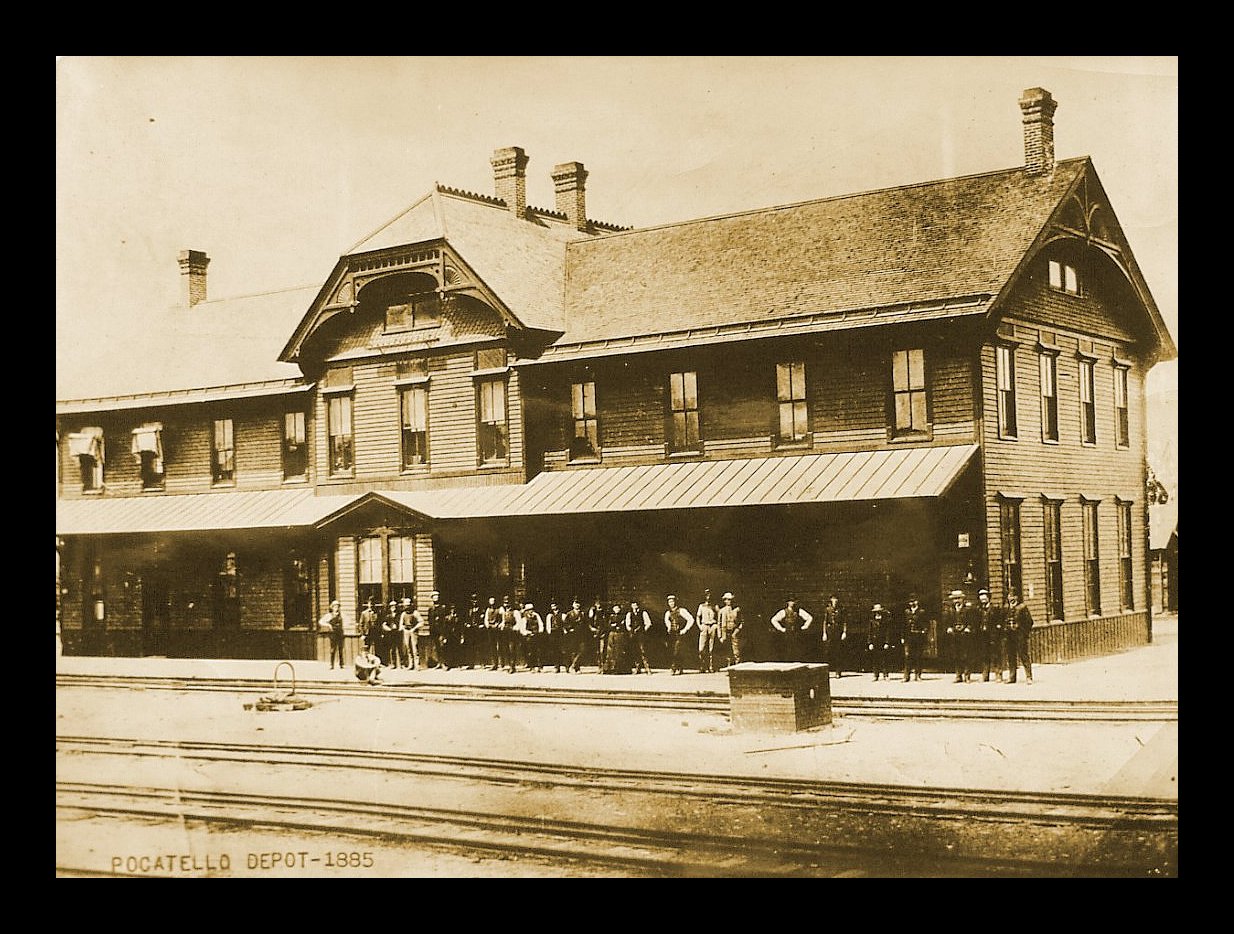
Artifact #77: Soapy Smith Gunfight at the Pocatello, Idaho train depot

Artifact #77-A
Jeff Smith collection

(Click image to enlarge)


he smoke of the pistol blinded me for a moment, but I returned the fire and shot both my assailants"
 
 
The gunfight at the Pocatello, Idaho train depot, August 30, 1889, is one of several moments in which Soapy Smith came very near of losing his life. The is the fire-fight in which Soapy had famed Earp gunman, John O. "Texas Jack" Vermillion at his side, as a member of the Soap Gang. Also there John "Fatty Gray" Morris, G. E. "Auctioneer" Roberts, J. W. Allen, and Soapy's younger, hot headed brother, Bascomb. This is my favorite letter in my collection. It is the original letter Soapy wrote to his wife telling her some of the details of the shootout. The letter is transcribed below.

September 2, 1889
Dear wife,
      I am all safe and with friends. I had a narrow escape but came out all right. Was sitting in the car at the depot at Pocatello and a man came up and shot at me without any warning through the car window. The smoke of the pistol blinded me for a moment, but I returned the fire and shot both my assailants, one through the thigh, and the other through the calf of the leg and the heel. Five shots were fired at me in all and how I was missed I can’t tell. It looks like providence helped me out. I fired three shots, all of which took effect. The men shot were switchmen and were working for the railroad. The railroaders tried to mob me but we stood them off and got a few good citizens to help and escaped to Blackfoot. We returned the next day. I had my trial and was acquitted. Write to me at Spokan Falls, Washington, Territory.
      Bascomb is in Dillon, Montana. Kiss little Jeff & Eva for me. Give all my friends my best wishes and don’t be afraid. Will let you know about other things in my next. I rode 25 miles on a horse in 45 minutes and I am very sore on my sitter. I also lost my mustache as one of the bullets cut half of it off (say nothing about that!) Write me who were my friends. I had to use the money in Pocatello or I would have been there yet.

God bless you my dear wife,
Jeff
p.s. address plain
Jeff R. Smith
Spokan Falls, Washington Terr.

The man that shot at me was one of the men who got licked at Logan Park.


Pocatello, Idaho train depot

(Click image to enlarge)


Artifact #77-B
Jeff Smith collection

(Click image to enlarge)
 
In 1889 Soapy was entrenched in the underworld and back-room politics of Denver, Colorado. There was no getting rid of him. However, occasionally he had skip town for a short time in order to let legal troubles subside. So what caused the gunfight? There's quite a back-story. 
     In July 1889 an outdoor picnic excursion that was attended by Soapy and the Soap Gang, there to swindle guests, turned into a brawl. The Rocky Mountain News reported on the affair and decided to continue reporting on Soapy and the Soap Gang. Managing editor of the newspaper, John Arkins, made the mistake of mentioning Soapy's wife and children and how it's not so good to be a Smith. Soapy went ballistic, ending with the physical assault on Arkins. Previously, the RMN had declared war on all bunko men working within Denver city limits, but now it centered on Soapy himself, and it was decidedly time for Soapy to "skip town" for a spell, until the attacks subsided. 
     "Moving on" was a normal hazard in Soapy's line of work, so he was always prepared to move to another town and start over. On August 4, 1889, Spokane Falls lost thirty-two blocks of the main business district in a horrific fire. Conceivably, in this prime location Jeff saw special opportunity in the aftermath of the fire. Further, there were all the towns between Cheyenne and Spokane to look over and operate in until it was safe to return to Denver, so Soapy grabbed a few of his gang and set off for the north. 
      On Friday, August 30, 1889, Soapy’s train made a scheduled stop at the Pocatello depot. During the wait, a man in railroad switchman clothes came up to the window of the railroad car where Soapy sat and fired at him five times, point blank. All but one bullet missed injuring him. It came so close that it mutilated half Soapy’s mustache as it whizzed by. Soapy drew his pistol and returned three shots, all striking their targets, two in one fleeing assailant and one in another. Next, railroad personnel “tried to mob” him, as Soapy put it, but “we stood them off,” and Soapy and his party, with the aid of “a few good citizens,” fled Pocatello on a hasty, twenty-five-mile horseback ride north to Blackfoot, Idaho. The newspaper there gave the shootout only two sentences:
――
"Pocatello had a shooting scrape last week. Nobody killed however."

――

It appears that the group rode as far as Blackfoot, before splitting up. Some of them, including younger brother, Bascomb, kept riding north to Dillion, Montana, while Soapy and some of his men returned to Pocatello to defend his "good name," declaring that the shooting was in self-defense, which worked. It was one less "bridge burnt." Once exonerated on September 1, Soapy and the others left. The Idaho News noted the departure: “The smell of gunpowder has been wafted away and the fightists are all gone.” It appears that Soapy and the group went back to Dillion, Montana and picked-up Bascomb and those with him, and traveled north to Butte, Montana where three days after the affray, on September 2, using stationary imprinted with the design and address of the St. Nicholas Hotel in Butte, Montana, Soapy made time to record in a four-page letter to Mary, the details of the event and assurances of his well being. It is very likely that Soapy stayed the night at the St. Nicholas Hotel, I could find little on the Hotel. It advertised a dining room that could seat 100. It was on East Broadway, straight across from the site of the 1890 City Hall, and bragged that it was the largest hotel in Butte. It was gone, possibly destroyed by fire, by 1891.


Butte, Montana
1887

(Click image to enlarge)


Artifact #77-C
Jeff Smith collection

(Click image to enlarge)
 
The Denver News printed the following on the evening of August 30:
Arrested in Idaho.

The following dispatch was received at police headquarters last evening:
POCATELLO, Idaho., Aug. 30.—Police Headquarters, Denver, Colo.: Is Soapy Smith and gang wanted there? All arrested here. SIMPSON.

      According to
Soapy, though, in his letter to Mary, he and the men with him returned to Pocatello the next day, August 31, 1889. The police put them in jail while figuring out just what had happened and while waiting for a reply to a wire to Denver about whether Soapy was wanted there. Denver declined the offer to have Soapy returned.
Drawing by Jeff Smith
circa 1985

(Click image to enlarge)
Details of the shootout reached The Denver Times the day after the event, and the story appeared the next day. It was based on a dispatch from Pocatello.

JEFF SMITH SHOOTS A MAN
The Result of a Feud Between Rival Gangs

“SOAPY” PROVES TO BE GAME
From All Accounts the Shooting Was Justifiable Pocatello Toughs Attempt to Drive Denver Experts Out of Idaho.


      Jeff Smith, accompanied by “shoot-your-eye-out Jack,” Fatty Gray and others, left Denver last Monday night [August 26], ostensibly for the mountains. It appears now, however, that they did not intend going on a pleasure trip, as they stated, but that they were going to Ogden and other cities to “work.” It will be seen by the following dispatch that the party has not had smooth sailing since leaving Denver:
      Special to The Times. POCATELLO, IDAHO, August 31. On the arrival of yesterday’s train from Ogden a shooting affray occurred, in which Samuel Belcher of Ogden was shot through the left leg and right ankle. Jeff Smith of Denver has been arrested as the party who did the shooting. From all facts that can be learned it seems that Smith was justified. A notorious gang at Pocatello, who have been “working” Ogden and other cities, attempted to kill Smith and his companions, but Smith was game and refused to quit the territory which the other gang claimed….
     Three guns were drawn on Smith, but he, instead of running, pulled his own gun, shot Belcher and put the others to flight. He was immediately afterwards arrested and will be given a hearing to-day. Another statement as to the effect that the affair grew out of an old feud in which the gang headed by Smith was opposed to a gang being led by “the Rincon Kid.”
     It has been well known among “fly” people that an attempt to kill Smith would be made as soon as he left Denver. The “Kid” and his gang are especially bitter against the smooth soap man and in frequent letters to people in Denver the “Kid” has expressed himself as determined to “do” any member of the Smith gang that he might meet.
     A number of dispatches were received to-day by friends of Smith’s in which “Soapy” declares that he was justified in shooting Belcher. However, one dispatch from another source states that Belcher was an innocent man whom “Soapy” did not know and did not intend to shoot.
     The following dispatch was received this afternoon by a citizen:
    "I was honorably acquitted. Show this to my wife. Will write particulars. Jeff Smith.”

 
Artifact #77-D
Jeff Smith collection

(Click image to enlarge)
 
     Major discrepancies occur between Soapy’s version and the Denver dispatch. Soapy wrote that two men attacked him while the dispatch reported three guns (three men?) drawn against him. Soapy claimed Belcher was a beaten man at the Logan Park brawl, yet the dispatch wrote that Belcher was a member of a rival bunco gang attempting to rid his turf of encroachers. (Both reports could be true. Keep in mind that few of these men were obliged to tell the truth to the police and newspaper reporters) The dispatch reported that Soapy had been arrested immediately following the gunfight while Soapy wrote that he and his men escaped and returned the following day to sort out what had happened with authorities. The money he spent in Pocatello likely went to attorney and enhanced fees to ensure his freedom. The local paper did not publish statements from Soapy about the attack because probably Soapy was gone, immediately having resumed his journey.

Pocatello Depot
(red "X" marks the location)

 (Click image to enlarge)
 
     The man Belcher is not listed in the 1889 Denver City Directory, but perhaps he and some of the others “who got licked” at Logan Park had been part of a Utah bunco gang that had come over to “work” the well-publicized event. Word was out that Soapy and some of his men were leaving Denver, on holiday. Belcher and the man or men with him could have been waiting for Soapy to come through Pocatello. On the other hand, they might have been from the environs of Denver and as disgruntled victims of Logan Park, were riding the same train, shadowing Soapy, gotten off in Pocatello, changed into railroad work clothes, and closed in on Soapy from outside to gun him down. Still another scenario is that Soapy and the men with him were “working” Utah towns and were being tracked by a rival local gang. If Soapy were going directly to Spokane from Denver, it would not have taken from Monday, August 26 (per the Times story), to Friday, August 30, to reach Pocatello. Moreover, the Denver Times reported Soapy had been on a train arriving in Pocatello from Ogden, which is south of the route from Denver to Spokane. However the true circumstances, clear is that a person or persons wanted Soapy dead.
      Soapy also wrote that he could be reached in Spokane. He did not, however, travel northwest from Butte to Spokane, at least not by rail. The Great Northern would not have a railway through the Cascades until 1892. Traveling the steep Cascades in 1889 would have been arduous. Clear, though, is that Soapy intended on going to Spokane. In his letter to Mary, he asked her to address her letters “plain Jeff R. Smith, Spokan Falls, Washington Terr.” This means of address was not uncommon, at least for Soapy. A number of letters in the Smith family collections are addressed in a similar manner. It was not wise to advertise a specific place of residence, even on an envelope in the US mails. That would be to invite another Pocatello-like threat to Soapy's life! Soapy suspected someone in Denver, perhaps even a friend, had given out his itinerary and destination. Near the close of his September 2 letter to Mary appears this cryptic sentence “Write me who were my friends.” It seems likely that in an off-hand way, Jeff is asking who might have been told of his whereabouts and/or route, who might have been inquiring after him, or who might have been inquiring about what had happened in Pocatello. After all, for the attack to be so direct, it must have been known that he was a passenger on that train.
      Mary left the children with her mother and hurried to be with her husband, probably at Spokane Falls. While with him, she tried to fix his perforated mustache but without success. Soapy may have resorted to shaving his face smooth and regrowing the beard and mustache that are known in all post 1889 photographs.


Pocatello, Idaho


Pocatello, Idaho: pages 75, 88-89, 92, 166-70, 172, 366.


"The racetrack is a place where windows clean people."
—V. P. Pappy


May 2, 2013

Is this "Jeff Smith," Soapy Smith?


A fantasy piece showing Soapy Smith running the
prize package soap sell racket on a city street
(created by Jeff Smith)
(Click image to enlarge)


ne might think that a common name like Jeff Smith would be a researchers nightmare. In using the newspaper archives I do run into numerous Jeff Smith's but seemingly few criminal ones. That does make my search a little easier but none-the-less there are many instances in which I have no provenance that a Jeff Smith mentioned in a newspaper article is our Smith. I give you two examples.


__________

Jeff and Charles Smith were fined yesterday for carrying concealed weapons, the former $25 and the latter $20.
 Idaho Statesman (Boise, Idaho), May 13, 1896
__________


This first one is not really the best example but I decided to keep it in my files along with a clear note that it may not be Soapy Smith. There has been a previous clue that Soapy went to Boise several times, including July 3, 1895 when the Statesman reported a Jeff Smith being arrested, but still, the Jeff Smith mentioned may very well be another bad man of the same name. The name Charles Smith caught my eye. It is simply a guess that this could be Soapy's younger brother, Bascomb Smith, or even gang member, John Bowers, who some historians believe went by the name of Charles at times.
__________

Alleged White Cappers Acquitted.

Special to the Kansas City Times.
Marshall, Mo., Feb. 9.—Jeff Smith, Hary [probably Harry] Hight, Hardin Baily, John Dickerson, John Harbolt and John Simms were tried today for white-capping the McGinnis brothers of this county ten nights since, but were turned loose on account of insufficient evidence. The men who did the deed were masked.
Kansas City Times, February 10, 1895
__________


Once again I want to make sure you understand that this may not be Soapy. Times were tough for him in 1895 but would he have turned to outright masked robbery if he and the boys were desperate? Another interesting "maybe" for the files.


Soapy possibly in Boise, Idaho: April 3, 2013


"The day I stop making mistakes is the day I stop learning."
—Miley Cyrus


MAY 2

1776: France and Spain agree to donate arms to American rebels fighting against the British during the American Revolution.
1853: Franconi’s Hippodrome opens at Broadway and 23rd Street in New York City.
1863: Confederate General "Stonewall" Jackson is wounded by his own men in the Battle of Chancellorsville, Virginia. He dies 8 days later.
1865: President Andrew Johnson offers a $100,000 reward for the capture of Confederate President Jefferson Davis.
1873: The first legal hanging takes place across from the schoolhouse in Yuma, Arizona Territory.
1875: Isaac “Hanging Judge” Parker arrives in Fort Smith, Arkansas as the new judge.
1885: Good Housekeeping magazine begins publication.
1887: Hannibal W. Goodwin applies for the patent for celluloid photographic film, which later will be used for making movies.
1890: The territory of Oklahoma is created.
1902: A Trip to the Moon, the first science fiction film is released. It was created by magician, George Melies.


April 3, 2013

Soapy Smith arrested in Boise, Idaho, 1895

Fantasy rendition of Soapy Smith waking up in jail
(Click image to enlarge)


irst, I would like to apologize for the lack of posts. It is certainly not for lack of content as I am surrounded by literally thousands of stories waiting to be told, most never having been published before. My problem is simple procrastination mixed with a big load of overwhelmingness. The good news is that I have a drive growing within me to get my life together, especially my paper life and by that I mean filing and putting everything where it belongs. I guess you could call it spring cleaning.
      Today's post involves a "Jeff Smith" arrested in Boise, Idaho for being drunk and carrying a concealed weapon. There is no certainty that this is our Jeff Smith but the time table is correct. In June 1895 Soapy was traveling around the country, staying on the move, waiting and hoping to hear from his attorney in Denver that a case against him for attempted murder was to be dropped down to a lesser charge. In late June Soapy took on the fists of two St. Louis detectives and came out pretty bruised up. On July 1 he returned to Denver for a court date only to get a needed one week delay and once again he was on the road (Alias Soapy Smith, p. 383). Texas, Mexico, St. Louis and back to other parts of Colorado were on Soapy's agenda, never staying in one location for more than a few days at most. It is known that he traveled to Spokane Falls at least once in 1895 so he could have very well stopped off in Boise, Idaho. Until such a time that there is better provenance the following newspaper article may or may not be talking about our Jeff, but will be filed under the realm of possibility.
LOCAL BREVITIES
_______

Police Magistrate Randall had Jeff Smith before him yesterday on a charge of being drunk and disorderly, using vulgar and obscene language in the presence of women and children and carrying a concealed weapon. Smith was arrested Monday, and when confronted with the multitudinous charges pleaded not guilty. Yesterday he withdrew that plea and substituted a plea of guilty. In view of Smith's inebriation and other considerations, the court touched him up for a very light fine-$28.
Idaho Statesman, July 3, 1895  


"Hi Jeff! Just got my April 2013 edition of 'Wild West' magazine, and I immediately sat down and read your article, 'Soapy Smith's Showdown with the Vigilantes,' from beginning to end. As always when I read your work, I'm totally impressed with your research and just excellent writing. Thank you, and it was fun to revisit the historic tale about your great granddaddy's shootout."
— Roscoe Tarwater Beaumont


APRIL 3

1513: Spanish explorer Juan Ponce de Leon lands in what would later be named as the state of Florida.
1776: George Washington receives an honorary Doctor of Laws degree from Harvard College.
1817: Famed Texas Ranger William “Big Foot” Wallace is born. In 1842 Wallace was one of 159 prisoners ordered shot by General Santa Anna. The officer held a raffle of sorts by putting 144 white beans and 16 black ones into a gourd and shot only those who drew a black bean. Wallace survived, dying at age 82 in 1899.
1829: James Carrington patents the coffee mill.
1860: The first Pony Express rider leaves St. Joseph, Missouri towards Sacramento, California. The riders were paid $125 a month and were expected to ride 30 to 70 miles a day with the total ride taking nine days. Despite numerous dangers from Indians and robbers only one mail rider was killed (by Indians) during the Express's 19 months existence.
1861: Cadet George Custer receives three demerits for throwing snowballs near the West Point barracks, New York.
1865: Union forces occupy the Confederate capital of Richmond, Virginia.
1866: Rudolph Eickemeyer and G. Osterheld patent a blocking and shaping machine for hats.
1868: A wood chopping party is attacked by Indians in Rock Creek, Wyoming. One woodcutter is killed.
1882: Outlaw Jesse James, age 34, is shot in the back of the head and killed in his home in St. Joseph, Missouri by Robert Ford for a $5,000 reward.
1885: 2.75 million acres of land in Kansas, Oklahoma, and Dakota Territory are opened for settlement.
1898: An avalanche at Sheep Camp on the Chilkoot Pass, Alaska, kills approximately 70 men.
1910: Mt. McKinley in Alaska, the highest mountain in North America, is successfully climbed.


December 24, 2010

Skagway's Deputy U.S. Marshal Sylvester S. Taylor

THE LATEST UPDATED INFORMATION ON SYLVESTER SLADE TAYLOR CAN BE SEEN AT THE FOLLOWING LINK.

JANUARY 25, 2023


     In every empire Soapy constructed one of the first hurdles to jump was roping the courts and the law under his control. Large graft payments were a common necessity in order for Soapy and his men to be able to operate in newly arrived camps and towns. In Skagway, Alaska 1898 one of the hurdles was 31-year old Deputy U.S. Marshal Sylvester Slade Taylor. There are no details of how or when he was lured into the criminal side of the law and placed on Soapy’s payroll as it was pretty much kept secret until early June 1898 when Mattie Silks publicly accused Taylor of being involved with the murder and robbery of Ella Wilson as well as being instrumental in the planned murder of Silks herself. All of this was according to Silks herself and is questionable. Details of her accusations and story are equally interesting and can be found in my book, Alias Soapy Smith.
     Taylor’s fall happened after the robbery of John Stewart’s gold on July 8, 1898 in which he was accused of silencing the news of the robbery and failed to arrest the culprits in the case.
     Not much has been known of Sylvester S. Taylor beyond his involvement with Soapy Smith, that is until about a year or so ago when I had the pleasure of corresponding with a descendant of Taylor (second cousin twice removed). This descendant wishes to remain anonymous for privacy reasons and I will respect that. At the time the Taylor family was not certain that their Sylvester Taylor was the same Taylor in Skagway. That link was recently confirmed during a renewed investigation and email exchanges between the family and various historians, including Marlene McCluskey at the Skagway Historical Society blog who did a superb job of assisting the descendant. Any questions or comments regarding Taylor and the family can be placed in the comment section and I will see to it that the family gets it.
     After Soapy’s death and the collapse of Soap Gang rule in Skagway, the vigilantes accused Taylor of being involved with Soapy. Vigilante’s went to the home of Taylor to arrest him, only to find Taylor sitting in a chair holding a baby (probably Stephan Alaska Taylor, born two months prior). Taylor was ordered to stay inside his home or risk death. Later he was accused of offering the return $600 of Stewart’s gold to Alaska’s Governor Brady if allowed to leave Skagway a free man. This request was denied and Taylor was charged with “willful neglect of duty,” in which he was acquitted.
Taylor took his wife Maud [Maud Ellen Stewart] and four young children back to Idaho, and with the help a person named Pleasant Taylor [Pleasant John Taylor, and older brother of Sylvester’s], perhaps a cousin, who was a Showman and “Movey Projectionist,” Sylvester became a “Manager of Show.” That profession must have worked out for him because in 1910, living with Maude and two more children in the family, Sylvester’s occupation was that of “Showman, Vaudeville and Movey Projectionist.  Alias Soapy Smith

In 1898 Taylor’s children were
  • Stewart S. I. Taylor (1892 – unknown)
  • John Elenor Taylor (1894 – 1971)
  • Ruby Linda Taylor (1896 – 1943)
  • Stephan Alaska “Lou” Taylor (May 13, 1898 – 1990)
It is known that Taylor had married several times, including once before Maud that included the birth of a child, and had three other children born after 1900. Those interested are welcome to continue researching the Taylor family with the sources listed at the end of this post.

My Taylor descendant source writes,
     His occupation on all the census’ of his adult years is listed as having to do with the entertainment industry except the 1930 and then he was listed as a Cigar Salesman. If I remember correctly his years in Alaska were in between the census years of 1890 and 1900; therefore his occupation of US Marshal is not listed on a census. I have some info I received from the Idaho US Marshal Office but I did not follow up [yet]….
     (from NARA 30 June 2010 Textual Archives Services Division- WREjr) I searched Record Group 217, Records of the Accounting Officers of the Department of Treasury, Entry 316, Emolument Returns for district Attorneys, Clerks of Courts, and Marshals, July 1842 - March 1907, and located a S. F. Taylor as deputy marshal under Marshall J.I. Crutchen during the years 1891 - 1896. The documents do not mention the first and middle name of Taylor. There were no entries for Alaska. There are no files for Alaska in Entry 316.
I was able to find the following on Taylor’s past as a lawman.
     “Ex-Deputy US Marshal Taylor’s case was special. Marshal Shoup said that when he appointed the man, he came “with exceptionally strong recommendations, having served in a similar capacity in Idaho…, where his reputation as an officer was unassailable.” Skaguay News, 07/15/1898.
     When Rev. Dickey was in Skaguay (October 8, 1897 to April 1, 1898), he associated with Taylor, had dinner with him “and his friendly wife in their snug home.” In the fictional account of his time in Skaguay, Dickey characterized Taylor as “Strange and puzzling…,” “clever,” acting “With great courage,” a man of feeling who “completely broke down” in telling of a little girl who had died some ten years before.

And yet some people in Skaguay suspected that he was in fraternity with Soapy Smith and his league of cutthroats. We never believed that. And yet…. … Our conclusion was that he was a big-hearted man who fully determined to do right but who had in some way come under the power of Soapy and that he writhed under it. … There was something there, but whatever power Soapy had over him we never knew. It may be that he found himself powerless to enforce the law strictly and decided to follow a mediating path with the law breakers to amend their effect as best he could. Having submitted to appeasement once, perhaps he was in Soapy’s power…Alias Soapy Smith.
     In the following Texas newspaper article from August 1922 Sylvester reminisces his early days in Texas, which includes a strong link to a career in law enforcement, considering his three older brothers were Texas Rangers.
     Early settlers will remember the three brothers of this family, who were Texas Rangers, known from border to border of the state of Texas as Ham [Hannibal Giddings Taylor], Eph [Ephraim Kelly Taylor] and Pleas [Pleasant John Taylor] (Doctor Stephen Slade Taylor’s sons). They lived in the days of Indians, and became Rangers to protect their homes, according to Sylvester Slade Taylor, of Reno, Nevada, who is in Fort Worth, visiting his son, S. J. Taylor, 1312 College Avenue.
      This is the second visit to Texas in thirty-five (35) years and the first time he had seen his sister, Mrs. Sarah Susan Taylor Click for thirty (30) years.
"I went back home and went swimmin’ in the old swimming’ hole, in the nature way,’ the Texan said. ‘But the most exciting of the whole trip was when we went out to the Hart Ranch and saw a oil well brought in. They seem to bring ‘em in while you wait out there. It was the first one I’ve ever seen brought in and believe me it was some sight to these old Nevada eyes."
He recounted many interesting things about the early days and the Indian raids. Remember the killing of the elder Dalton, father of Robert Dalton, owner of the Dalton Oil Tract. He saw his first train in Fort Worth, Texas.


     New information is always forthcoming and welcome, such as the fact that Sylvester’s middle initial “S” stands for Slade. With new information also come the inevitable mistakes published in my book that need to be addressed. In my book I have “He died comparatively young, though, in 1916 at age 49.” This information was found on Ancestry.com but since publication the information has been updated and his actual death date is believed to possibly be May 23, 1931.


Sources:
  • Photograph: Taylor and Maddox Reunion August 6, 1922 Palo Alto, Texas. Taylor and Bevers Pioneer Families of Palo Pinto County, Texas, by Bobbie Ross, 1996.
  • Anonymous Taylor descendant.
  • Dickey, R. M. Gold Fever: A Narrative of the Great Klondike Gold Rush, 1897-1899. Ed, Art Petersen. Juneau: Klondike Research, 1997.
  • Alias Soapy Smith: The Life and Death of a Scoundrel.


Taylor, Sylvester S.: pages 508-12, 520, 527, 562, 575-78, 580-81.


.