March 4, 2016

Did Soapy Smith make a political speech in Montana in 1889?

"Soapy Smith" gives a speech in Montana
Helena Independent
September 13, 1889


OAPY SMITH IN HELENA, MONTANA? 
MAKING A POLITICAL SPEECH?
September 13, 1889


I received a very interesting email from author Jane Haigh.

Hello Friend Jeff,
      An academic contact doing research on Scandinavian Republican politics discovered this Helena newspaper article from 1889, and forwarded it to me. I see from your book that Soapy was in Montana around that time, but I never heard of him making public political speeches before, and he mentions he was active in Minnesota Republican politics, also new to me. Just thought you would be interested, and perhaps you have some more information or thoughts?
      Congratulations on the opening of Jeff Smith's Parlor in Skagway!

Cheers
Jane Haigh, Phd
Alaskan Author

Following is my response.

Hello, friend Jane.
      Thank you very much for thinking of me, and sending this very interesting newspaper article!
      It very well could be him. The dating is right. The first few days of September 1889 the Soap Gang is fleeing in several directions after the gunfight at the Pocatello train depot. Bascomb flees into Dillon, Montana, which is good enough reason for Soapy to venture into the state. He is still on trial for the attack on John Arkins and Denver is at the beginning of one of its numerous reforms. Soapy could very well have been looking for a new home, or at least making plans for one if the empire in Denver collapsed.
      The pros for this being our Soapy is good, however, there is one snag. That is the use of the name of "Soapy." As you know he did not like that alias. Only his enemies called him "Soapy." He used the alias when making threats. There is one good possibility; perhaps the editor of the Helena Independent was on to Jeff Smith's real identity and used the article to expose him? This is just over a month after the Arkins assault, which made newspaper headlines all-across the U.S. Surely the Independent could have recognized the name but forgot the details to give its readers a biography of "Soapy." Perhaps they refrained from outright accusing "Jeff Smith" of any involvement in crime, just to protect themselves from a libel case.
A day later I received some information from my favorite genealogist researcher, Linda Gay Mathis. Linda writes,
This "Soapy Smith" mentioned in your article, previously, may have been Cyrus Little Smith (C. L. Smith). See these 2 newspaper clips from Friday, September 13, 1889 Paper: Helena Daily Herald (Helena, Montana) Page: 8. Also, will post a bio of Cyrus Little Smith.
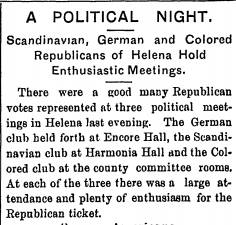

Helena Daily Herald
September 13, 1889


_________________________________________________


Helena Daily Herald
September 13, 1889
"C. L. Smith"


A biography of Cyrus Little Smith


      C. L. Smith was born at Dover, Wayne County, Ohio, January 22, 1845. John R. Smith, his father, was a farmer, and while Cyrus was still a small child his parents removed to Southern Michigan, settling in an unbroken wilderness. There were no schools on the Michigan frontier in those early days, and Cyrus was taught to read by his mother. As the country settled up, schools of a poor quality began to be established, and at the age of eleven the boy secured his first four months' schooling. This was in a little log school house, where presided a Baptist preacher. The seats were oak slabs with stout wooden pins for legs. He attended this school for two winter, learning the rudiments of reading, spelling and arithmetic. During these two terms he had but one book of his own, the arithmetic. In 1858 he went to Southern Indiana and worked in a nursery for the next years. When the war broke out in 1861, Mr. Smith enlisted, though only sixteen years of age. He became a member of Company E, Eleventh Michigan Infantry, and served three years and two months, principally in Kentucky, Tennessee and Georgia. Among the noted battles in which the participated were those of Stone River, Chickamauga, Lookout Mountain, Mission Ridge and the battles before Atlanta. Soon after being mustered out of the service he came to Minnesota, in October, 1845, and engaged in selling trees and shrubbery for an Eastern nursery company. At the same time he began planting and experimenting on his own account, and in this way proved his inborn taste for horticultural affairs. Mr. Smith frankly admits a financial failure at the nursery business, the principal cause being poor health. He suffered from diseases contracted in the army, which prevented him from working out doors a large part of each year, but he acquired considerable practical experience in nursery and gardening matters which he turned to account in newspaper and literary work. For all this time he has been largely engaged with horticultural and agricultural papers, and addressing farmers at institutes and other gatherings throughout the state. At the same time he has not abandoned farming and gardening, but has cultivated a tract of forty acres, where he raises various trees and a variety of crops, largely for experimental purposes. As a Republican Mr. Smith has been especially active since 1885. During these later years he has done much aggressive work for the Republican party. His observation of the condition of the farming classes and the common people for many years have convinced him that, notwithstanding all the mistakes made by the party of his choice, its principles and policies have been for the best interests of the people. During the Fish-Donnelly regime of the Populist party, Mr. Smith was state organizer of Republican League Clubs, and made an aggressive campaign against the Populistic influences. He frequently met the enemy on the stump and was active and successful in joint debates. Mr. Smith was one of the organizers of the Minnesota State Horticultural Society in 1866. He served as secretary of the State Forestry Association for four years and a member of the executive committee for six years. He has been a member of the State Dairymen's Association since its organization, and on January 25, 1895, was appointed assistant dairy commissioner of the State Dairy and Food Commission of Minnesota. Mr. Smith rendered valued service in preparing the Minnesota forestry exhibit for the World's Fair in 1893. He took an active part in the first farmers' institute held in the state, and aided in securing their establishment as a permanent state institution. Since 1891 he has been agricultural editor of the Farmers' Tribune.

Source: Progressive men of Minnesota. Published by The Minneapolis Journal, 1897.
      Talk about a mystery for the ages! There is no denying that Linda may be right. The Helena Independent may have politically opposed C. L. Smith, thus calling him "Soapy Smith" in derision may have been the latest trendy insult in Montana as it was in Colorado. All this information will be included in the file with the original newspaper article for future use, and to keep from making the same automatic assumption. 
      Thank you very much Jane Haigh and Linda Mathis for sharing your fine detective work with us! I've known both Jane and Linda for a number of years, and am happy to call them "friends."


"A bunch of con men opposed to Smith were trying to horn in and get the pull with the big bugs. Stopping to exchange a few words with a vigilance committee, contrary to his usual custom of ‘firing first and talking afterwards,’ caused his death."
— Henry “Yank Fewclothes” Edwards
Alias Soapy Smith, p. 589.


March 4


1634: Samuel Cole opens the first tavern in Boston, Massachusetts.
1681: England's King Charles II grants a charter to William Penn for an area that later becomes the state of Pennsylvania.
1766: The British Parliament repeals the Stamp Act, which had caused bitter and violent opposition in the American colonies.
1778: The Continental Congress votes to ratify the Treaty of Amity and Commerce and the Treaty of Alliance. The two treaties are the first entered into by the new government.
1789: The first Congress of the United States meets in New York and declares that the Constitution is in effect.
1791: Vermont is admitted as the 14th state. It is the first addition to the original 13 American colonies turned states.
1794: The 11th Amendment to the U.S. Constitution is passed by Congress. The Amendment limits the jurisdiction of the federal courts to automatically hear cases brought against a state by citizens of another state. Later interpretations expanded this to include citizens of the state being sued, as well.
1826: The first railroad in the U.S., the Granite Railway in Quincy, Massachusetts, is chartered.
1837: Chicago, Illinois is granted a city charter.
1861: The Confederate States of America adopts the "Stars and Bars" flag.
1868: John Chisholm, trailblazer of the Chisholm Trail dies in Oklahoma before the trail is named in his honor.
1877: Emile Berliner invents the microphone.
1880: Halftone engraving is used for the first time in the Daily Graphic, published in New York City.
1881: Eliza Ballou Garfield becomes the first mother of a U.S. President to live in the executive mansion.
1881: Outlaw Billy the Kid writes and sends a letter to Governor Lew Wallace, asking for a meeting to discuss the situation in regards to the Lincoln County War, as well as a pardon for himself.
1886: The University of Wyoming in Laramie is chartered.
1902: The American Automobile Association is founded in Chicago, Illinois.
1908: The New York board of education bans the act of whipping students in school.


March 3, 2016

Skagway, Alaska, post 1916

Skagway, Alaska
post 1916
hand-colored
Jeff Smith collection
(Click image to enlarge)


kagway, Alaska
post 1916


      A recent hand-colored postcard I obtained showing Skagway after 1916. I base this date on the location of Soapy Smith saloon on Holly Street (now Sixth). The photo below is large and copied in black and white for ease of viewing, but detail is lacking in some places due to the painting.


Same postcard
Grey scale and enlarged
Jeff Smith collection
(Click image to enlarge)

      If you go to Skagway today, and stand in the parking lot of the bank of Alaska on 6th and Broadway, you will be standing where Jeff Smith's Parlor originally stood in 1898. It was moved across the street in 1916 by Martin Itjen, as shown in this postcard. May 6, 2016 is the grand opening of Jeff Smith's Parlor!


"An enterprising showman in Denver is advertising a wax impression of the face of Soapy Smith, the late, who was killed in the boots he wore at Skaguay, Alaska. Great paper signs on the windows of the place where the exhibition is given announce in flaring headlines “Jefferson Randolph Smith, the hero of many encounters.” The show is being given on the ground which Smith himself traversed almost daily previous to getting into his fatal trouble."
Denver Evening Post
Alias Soapy Smith, p. 557.


MARCH 3


1791: Congress passes a resolution that creates the U.S. Mint.
1803: The first impeachment trial of a U.S. Judge, John Pickering, begins.
1812: The U.S. Congress passes the first foreign aid bill.
1817: The first commercial steamboat route from Louisville to New Orleans is opened.
1837: US president Andrew Jackson and Congress recognize Republic of Texas. Texas will later become a state, and home to the (“Soapy”) Smith family.
1845: Florida becomes the 27th state.
1845: Congress passes legislation that for the first time overrides a U.S. President’s veto.
1849: The U.S. Department of the Interior is established.
1849: The Gold Coinage Act, which allows the minting of gold coins, is passed by Congress.
1849: Congress creates the territory of Minnesota.
1851: Congress authorizes the 3-cent piece, the smallest U.S. silver coin.
1855: Congress approves $30,000 to test camels for military use.
1857: Congress authorizes the postmaster general to seek bids for an overland stagecoach service to carry mail between the Missouri River and San Francisco.
1857: Fort Abercrombie is established on the west bank of the Red River south of where present day Fargo, North Dakota is. It was named for the commander of the founding party, Lieutenant Colonel John Abercrombie.
1863: Congress authorizes a US mint at Carson City, Nevada.
1863: Idaho Territory is created by Congress. Over 20,000 miners had already arrived to gold fields there.
1863: Free city delivery of mail is authorized by the U.S. Postal Service.
1875: The U.S. Congress authorizes the 20-cent piece. It is only used for 3 years.
1877: Camp Huachuca, Arizona Territory is established to protect the border.
1885: The American Telephone and Telegraph (AT and T) is incorporated in New York as a subsidiary of the American Bell Telephone Company.
1885: The U.S. Post Office offers special delivery for first-class mail.
1894: The Atlantis, the first Greek newspaper in America, is published.
1903: Barney Gilmore, of St. Louis, Missouri, is arrested for spitting.
1903: The U.S. imposes a $2 head tax on immigrants.


January 22, 2016

Who are these cute Smith kids - REVEALED

(Click image to enlarge)


ack on May 18, 2010 I posted a couple of photographs from the Mike Moriarty collection. I asked about the kids in one of the photographs (see above) but received no replies.


Fast-forward five years, 8 months:

      I received a response from family member Jim Lynch, a great grandson of Soapy Smith's via Soapy's daughter, Mary Eva Smith II.

Hello, Jeff:
      You and I are distant relatives as I, too, am a great grandson of Soapy Smith. His daughter, Mary Eva, was my grandmother (my mom’s mom.) We called her “Nana.” You have the attached pic on your website with the words “Who are these cute kids?” They are my Soapy’s grandchildren; Mary Eva’s children; my Aunt Geraldine and Uncle Greg Moriarty. The picture was taken in the back yard of the family’s home on Oakland Ave., in Milwaukee, WI. Aunt Gerl grew up to become a Catholic nun (died 1980), and Uncle Greg a police officer and firefighter (died 2011.)
      If interested in additional photos, I have several of Mammy, Mary Eva, and a few of Mary Eva’s brother, Jeff. I’m guessing he would be Soapy Jr., and perhaps your grandfather??

Regards,
Jim Lynch

      Jim and I are talking family history and he sent along some fantastic early photographs, of which I plan to share in an upcoming post.


"The boys who had the money won it in a fair game and they should keep it." He also said he, "had a hundred men who would stand behind him and see that they were protected." The judge finally told him he [Smith] could not afford to stand up for a gang of thieves; but he [Smith] almost screamed—"Well, Judge, declare me in with the thieves. I’ll stay with them," and with that he passionately beat the table with his fist and left the room.
Daily Alaskan
Alias Soapy Smith, p. 529.


JANUARY 22


1864: Christopher Lower, David Renton alias "Doc Howard," and James Romain are found guilty in Lewiston, Idaho Territory for the murder of Lloyd Magruder. Billy Page, who was not involved in the murder plot but did help the murderers flee, turned state's evidence and was acquitted and released.
1872: Grand Duke Alexis of Russia arrives in Topeka, Kansas.
1872: The Society of Colorado Pioneers Association is founded in Denver, Colorado Territory.
1876: 125 miles east of Camp Supply the 5th Cavalry battles with Indians, killing 3 and wounding 4 on the Cimarron River, Indian Territory.
1877: Merritt Horrell is shot to death by John Higgins in the Matador Saloon, Lampasas, Texas, during the Horrell-Higgins Feud.
1879: James Shields begins a term as a U.S. Senator from Missouri. He had previously served Illinois and Minnesota. He was the first Senator to serve three states.
1882: Marshal George Brown is murdered in Caldwell, Kansas. He is replaced with Ben “Bat” Carr and his assistant Henry Brown.
1883: The Fifty Cent Act of Texas is repealed due to fraudulent speculation. The Fifty Cent Act, advocated in July 14 1879 provided for selling public land at fifty cents an acre. Proceeds were to be used to pay debts and establish a school fund. About fifty-two Texas counties were created from the sale of 3,201,283 acres for $1,600,641.55.
1884: The Northern Pacific Railroad completes the Bozeman Pass tunnel in Montana Territory.
1889: The Columbia Phonograph Company is formed in Washington, D.C.
1890: Montana pioneer and vigilante John “X” Beidler, 58, dies in Helena. His funeral draws 1,200 mourners to the Ming Opera House.
1891: Bad man Dick Hawkins, an ex-faro dealer for Soapy Smith, robbed the faro table at the Arcade club rooms in Denver, Colorado. He then did the same at the Nickle Plate, and successfully escaped.
1895: The National Association of Manufacturers is organized in Cincinnati, Ohio.


January 21, 2016

Soapy Smith's saloon; Jeff Smith's Parlor to re-open.

SOAPY SMITH MUSEUM
Skagway, Alaska
Circa 1940
Courtesy of Klondike Gold Rush National Historic Park
(Click image to enlarge)


pening May 6, 2016


      Since December 2008 Soapy Smith fans have awaited the restoration and reopening of one of Skagway, Alaska's most famous buildings. the date is May 6, 2016. KHNS Radio interviewed Karl Gurke, a historian with the Klondike Gold Rush National Historic Park.
      Jeff Smith’s Parlor is set to open in Skagway on May 6. The museum will feature thousands of Klondike Gold Rush-era artifacts, bringing visitors and locals back to the wild days in the Gateway to the Klondike.
      Jefferson Randolph ‘Soapy’ Smith was perhaps the most notorious character in the motley crew that dominates history books about the Klondike Gold Rush.
      “So, he was involved in prostitution, gambling and he was involved in a several saloons, but he was also involved in some interesting cons.”
      That’s Karl Gurcke, a historian with the Klondike Gold Rush National Historic Park. Gurcke says Soapy Smith came to Skagway in 1897 with no intention of staking a claim in Dawson City. He simply saw a chance to make a fast buck off hopeful, gold-seeking Cheekchakos.
     Gurcke says one of his most famous scams was his telegraph company. Weary would-be gold miners could send messages and, if needed, money home. Smith would charge for each message out and each message received.
     “Of course, as it turns out, that the telegraph wires just went a little bit beyond the house. They never went down to Seattle, so it was all a con.”
     His nickname ‘Soapy’ also came from a con. He sold soap with the lure of a $10-bill wrapped inside, causing a frenzy. Of course, there was no money, and Smith’s soap stand was long gone when the mob came to protest. Remnants from those days and much more are set to be housed in the renovated museum, opening in May.
     Ben Hayes is chief of interpretation and education at the Klondike Gold Rush Historic Park. The Park Service has been working since 2008 to restore the old parlor and refurbish a large collection of artifacts.The building dates back to 1897 when it was built to house the Bank of Skagway.
     “In 1898, it was leased to Jefferson Randolph ‘Soapy’ Smith, who ran his con artist … his gang of nefarious people who were fleecing some of the stampeders from that very building until he was killed in a gun fight on July 8, 1898,” says Hayes.
     The building served several different purposes over the decades, including as a bar, a French restaurant, and the Skagway Volunteer Fire Department’s Hook and Ladder Co. garage. Long after the death of Skagway’s top con man, the building was acquired by a German tour promoter. It became Jeff Smith’s Parlor museum in the late ‘30s and, back then, was even complete with working robots.
     “Like robotic Jefferson Smith who would stand at the bar and greet you when you came in,” says Hayes. “He had a gun in one hand and a beer in the other. There’s this guy in the corner sitting, his name is Dangerous Dan McGrew, he kind of looks like Slash from Guns ‘n’ Roses. He would greet you as well and then there was Lady Lou in the restroom, who, when you open the door would scream at you.”
     When the overhauled museum opens in the spring it will include those old robots, though they’re past their gun-waving, bathroom-screaming primes.
    “Unfortunately, at over 80 years old, we can’t operate them, but we did some interesting work with the community to figure out how they once worked, including we took them over to the Dahl Memorial Clinic and had the m X-rayed to figure out, without taking apart these handmade, delicate machines, how they functioned,” says Hayes.
     The building was moved in 1963 to its current location on 2nd Avenue, across from the Red Onion Saloon. Hayes says refurbishing it has been a painstaking process.
     “This building helped preserve that legacy and build a legend.”
     The collection that came with the building includes 450,000 items. It was acquired, along with the building, by George and Edna Rapuzzi after the original museum proprietor died in the ‘40s. The Rapuzzis ran the museum in the ’60s and ‘70s. It then went to the Rasmuson Foundation, which transferred it to the Park Service and the Borough of Skagway in 2008.
     Tours of the museum will be guided and cost $5. The fee to enter helps with cost recovery, Hayes says. The Park Service held a community forum last month in Skagway so people could weigh in on the decision to charge for a tour. The comment period is open until the end of January. But, Hayes adds that 19 free days are planned over the summer, including the entire first week of May and a week in mid-August when the Park Service celebrates its centennial.
     Hayes and Gurcke agree that the rough and tumble Gold Rush history is still very much alive in Skagway, and with the opening of the revamped museum, visitors and locals will be able to experience it for themselves, without the menacing con men, of course.
Source: Legend of Soapy Smith lives on in Skagway


Restoration of Jeff Smith's Parlor
(This link contains posts since 2009, be sure to scroll) 


Kindhearted, generous Soapy Smith is known to many men. Many know him, too, as a man who would stand by his friends to the end. Many others know him as a bitter enemy. When he thinks he is right, he stands by it, and when it is the other way, he stands by that, too.
Denver Republican
Alias Soapy Smith, p. 213.


JANUARY 21


1789: W. H. Brown's Power of Sympathy also known as the Triumph of Nature Founded in Truth is the first American novel to be published.
1812: The Y-bridge in Zanesville, Ohio is approved for construction.
1846: The first issue of the Daily News, edited by Charles Dickens, is published.
1853: Dr. Russell L. Hawes obtains the patent the envelope folding machine.
1861: Jefferson Davis of Mississippi resigns from the U.S. Senate. Four other southern senators also resign. Davis goes on to become president of the Confederacy.
1865: An oil well is drilled by torpedoes (dynamite) for the first time.
1872: In the excitement of his first kill of the day in Kit Carson, Colorado Territory, Russian Grand Duke Alexis kisses George Custer.
1874: Alfred Packer leads a group of prospectors from Utah to the valley of the Uncompahgre River in Colorado Territory. They arrive starving and out of food. Ute Indians find them and take them to Chief Ouray, who replenished their supplies.
1891: Bob Ford, killer of outlaw Jesse James, is shot and wounded in the foot during a shootout in Walsenburg, Colorado by J. D. Harden, who was shot twice, the should and the hand, by Ford. The two men were standing at a saloon bar when they started arguing. The two men were so close that Ford received powder burns on his face. Sixteen months later Ford will be shot and killed in Creede, Colorado. It is believed that bad man Soapy Smith had a hand in Ford’s death.
1908: The Sullivan Ordinance is passed in New York City making smoking by women illegal. The measure is vetoed by Mayor George B. McClellan Jr.


January 12, 2016

Soapy Smith vs Frank Reid: American Heroes Channel documentary


Scroll down just a bit to see the video.


IRS JANUARY 13, 2016


"All this about 'Soapy' Smith being alive, as wired to the newspapers from San Diego, and that he is in San Diego, is moonshine, said Arch Bodine, who has a restaurant at 1327 Fifteenth Street. Bodine was in Skagway last October [sic] when 'Soapy' was killed, and did not leave for several months afterwards. I was near him when he was shot, and I helped to put him in the wagon. After he was carried from the wharf to the morgue, he lay there for two days under a sheet, and hundreds of people saw him. There are lots of men in the west who look like 'Soapy,' but just paste it in your hat that Smith is as dead as a doornail. They didn’t take any chances on his coming back to life in Skagway."
—Arch Bodine
Alias Soapy Smith, p. 587.


JANUARY 12


1773: The first U.S. public museum opens in Charleston, South Carolina.
1872: Russia's Grand Duke Alexis departs St. Louis, Missouri for Omaha, Nebraska on a buffalo hunting expedition with General Phil Sheridan and Lieutenant Colonel George Armstrong Custer.
1880: Bat Masterson resigns his position as Ford County Sheriff, as well as deputy U.S. Marshal of Kansas.
1883: Cheyenne, Wyoming turns on electric lights for the first time.
1889: The fight between two cities to become the county seat ends in violence, known as the Battle of Cimarron. A wagon of men from Ingalls, Kansas attempt to steal the official court records from the Gray County courthouse in Cimarron, Kansas, but are discovered and shooting breaks out. One resident of Cimarron is killed and several persons are wounded on both sides. The invaders climbed into their wagon with the records and speed off, leaving four men trapped inside the courthouse, including Jim Masterson, brother of Bat Masterson. The shooting concentrated on the building. After six hours of fierce fighting, a truce was made, which included allowing the four men to be able to leave the city unharmed. In 1893 Cimarron becomes the county seat.
1896: At Davidson College, several students take x-ray photographs, the first made in the U.S.


December 26, 2015

Soapy Smith sells soap in Phoenix, Arizona, 1883

Soapy's vendors license
Jefferson Smith collection
(Click image to enlarge)


ODAY IN SOAPY SMITH HISTORY: December 26th

      December 26, 1883 Soapy Smith purchases a street vendors license in Phoenix, Arizona to hawk his prize package soap to the unwary.
      In my collection is a xerox copy of the receipt (photo at top) from the city of Phoenix, Arizona allowing Soapy to work as a soap selling vendor for the period of one month beginning December 26, 1883 and ending January 27, 1884 for the sum of $4.00. The document is signed by Mayor De Forest Porter, Recorder Knapp and Marshal Henry Garfia.
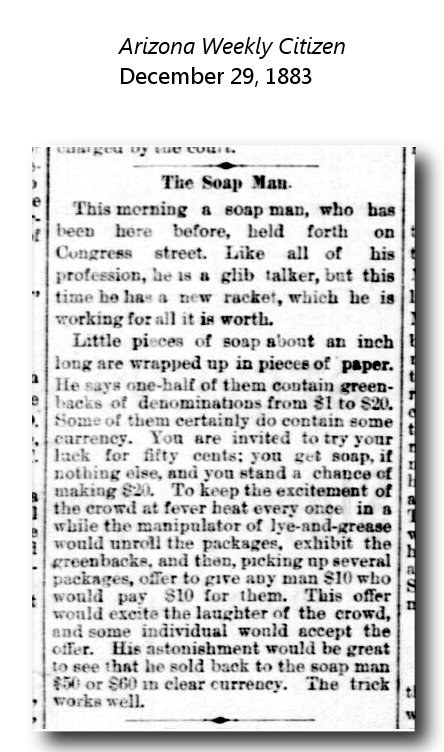
      The information and the receipt showing that Soapy was in Phoenix is not new. The newspaper clipping below, is.

So why didn't I find this before?

      When doing research for the book Alias Soapy Smith the amount of newspapers online, along with the quality of the search capabilities were poor. Over the years more newspapers have been added and the search editors have greatly improved. What will never change is the content of the newspaper themselves. In looking at the article below you will notice that "Soapy" or "Jeff Smith" are absent. this means getting creative. I type in words that such articles might include, such as "soap." While this is a good key word, it also means searching through a ton of soap ads, etc. It's time consuming and most of the time I come up empty handed, but not today. I hit the jackpot.
      The following clipping from Tucson, Arizona was published just three-days into the one month time span of the license. This article is also one of the very few in which the reporter did not publish that the prize package soap sell was a swindle. Did this reporter not realize it was a scam, or was he/she paid off to stay quiet. From what I can tell, Soapy was not arrested during this trip to Phoenix. However, the article does make mention that this is not Soapy's first trip to the city.  

The Soap Man.

Transcription of the clipping: 
Arizona Weekly Citizen
(Tucson, Arizona)
December 29, 1883

The Soap Man.

      This morning a soap man, who has been here before, held forth on Congress Street. Like all of his profession, he is a glib talker, but this time he has a new racket, which he is working for all it is worth.
      Little pieces of soap about an inch long are wrapped up in pieces of paper. He says one-half of them contain greenbacks denominations from $1 to $20. Some of them certainly do contain some currency. You are invited to try your luck for fifty cents; you get soap, if nothing else, and you stand a chance of making $20. To keep the excitement of the crowd at fever heat every once in a while the manipulator of lye-and-grease would unroll the packages, exhibit the greenbacks, and then, picking up several packages, offer to give any man $10 who would pay $10 for them. This offer would excite the laughter of the crowd, and some individual would accept the offer. His astonishment would be great to see that he sold back to the soap man $50 or $60 in clear currency. The trick works well.


Soapy in Phoenix


Phoenix: pages 40-41.


"I was at Circle City when a Skaguay newspaper brought the news…. Though we were almost one thousand miles from the scene of the tragedy, the news came like an electric shock. The single copy of the newspaper was carried off to a big gambling hall, and everybody in town was packed into the place listening eagerly while the story was read aloud. A deep sigh of relief went up when the audience learned that 'Soapy' had 'cashed in.'"
—Harry Suydam
Alias Soapy Smith, p. 583.


DECEMBER 26


1620: The Mayflower, with 102 passengers, arrives at New Plymouth, Massachusetts to create the Plymouth Colony, with John Carver as Governor.
1776: The British suffer a major defeat against the Colonial Army in the Battle of Trenton during the American Revolution.
1859: 173 Texas Rangers and 165 U.S. regulars attack the outlaw position held by Juan Cortina in Rio Grande City. Hand-to-hand combat forces Cortina's retreat.
1861: Confederate irregulars defeat pro-Union Indians at Chustenahlah, Indian Territory.
1862: 38 Dakota Indians are hung in Mankato, Minnesota for their part in an uprising. The mass execution is the largest in U.S. history.
1863: A Denver brothel, the Highland “Aunt Betsy’s” House, is burnt down by a mob of soldiers. Bill Duffield, a soldier is shot and killed by Joseph Kittery when told they could not enter. The following day a mob of soldiers obtained the deceased from inside and then burnt down the brothel.
1865: The coffee percolator is patented by James H. Mason.
1866: Lieutenant Colonel George Crook leads a company of the 1st Cavalry against Indians at Owyhee Creek, Idaho Territory, killing 30 and taking 7 prisoners while losing only one soldier.
1867: A detachment of Company K, 9th Cavalry, near Ft Lancaster, Texas, is attacked by Indians. Three soldiers are killed during the two days of fighting.
1869: Lieutenant Howard B. Cushing with Company F, 3rd Cavalry, from Ft Stanton, New Mexico, along with 28 citizen volunteers, attack a Mescalero Apache Indian village at the old stage stop of Pine Spring in the Guadalupe Mountains of Texas. One officer is severely wounded.
1874: The first commercial buffalo hunt is conducted in Texas by Joe McComb.
1880: Lincoln County Sheriff Pat Garret deposits his prisoners, including Billy the Kid, in the Las Vegas, New Mexico, Territory jail.
1883: Soapy Smith purchases a street vendors license in Phoenix, Arizona for selling his prize package soap.
1909: Western artist Frederic Remington dies at age 48 in Connecticut.


December 22, 2015

Joe Simmons shoots W. M. Shuck...or did he?

Taking care of the problem.
(Click image to enlarge)


ambler Joe Simmons

      Not a whole lot known about Joe Simmons. He is mentioned on twelve pages of Alias Soapy Smith. This blog covers post about Joe (link below), including information on his son, directly from his descendants.


      In the book The Reign of Soapy Smith (William Ross Collier and Edwin Victor Westrate, 1935) there is mention of Joe Simmons taking a glancing shot at a man. No source, no details, just a glancing mention! After Alias was published I found this mention in the "local brevities" of the Rocky Mountain News, November 9, 1890.

      W. M. Shuck of Lyons was not struck by Dick Hawkins, as was at first supposed. Mr. Hawkins was not anywhere in that vicinity. Shuck was shot by Simmons, supposed to be proprietor of Soapy Smith's place [Tivoli Club]. The revolver was a 45 Colt. Glancing shot.

      I just found this newspaper clipping below. This is the first mention of the shooting, published in the Rocky Mountain News on the previous day, November 8, 1890. I actually found this by accident. I never found it in past searches using a "search engine" as "Dick Hawkins" is the only name mentioned in the article and I looked under everything but "Hawkins." 


Hawkins and His Gun.

      Last night at about 7:30 the notorious Dick Hawkins, the shell worker who deals faro at the Texas house on Seventeenth and Market streets, got into a dispute with a drunken bobo over a poker game in the house, and to keep up his dead tough game he hit his opponent over the head with a loaded pistol, which went off and the bullet flattened itself against the wall, and caused a stampede in the house. The fellow he hit ran out of the house more frightened than hurt.

Here is the details from these two clippings:

      W. M. Shuck of Lyons, Colorado walked, or was led, into the Tivoli Club and got swindled in a "big hand" (rigged) poker game. When he complained, Simmons hit the man over the head with his pistol. The weapon discharged, but the bullet hit no one, nor went outside the room, becoming a threat to any innocents outside.
      The following day's revamp of the article states that "Shuck was shot by Simmons" in a "glancing shot." This is a far cry from being hit on the head and remaining uninjured.

What's going on?

      Great! In finding the latest clipping I solved a few mysteries, only to open a couple more. It seems pretty obvious to me that the first newspaper reporter was paid off to make the victim out to be a "drunken hobo," in an attempt to belittle the severity of the crime and accompanying violence.
      In the first report the bullet hits no one and even "flattened itself against a wall." Sounds to me like the reporter wanted the weapon discharge to sound like 'just an accident" and that no harm had been done. The victim is said to have run in fright, but not injury. I have read plenty of accounts in which someone is hit over the head with a revolver and do not recall any of them escaping injury. 
      Did Dick Hawkins hit the man with his revolver, or was he getting the blame, to keep Simmons, the manager of the Tivoli Club, from being arrested? Hawkins did deal faro for Soapy but was let go for insubordination. According to what I have read, Hawkins was not a particularly popular person. He ended up robbing the faro table at the Arcade and the Silver Plate club rooms in Denver, and then the Mint club room in Creede.  


Joe "Gambler Joe" Simmons?
Unidentified tin-type
Believed to be Joe Simmons and Joe Palmer
Jeff Smith collection


JEFF AND JOE
signed, "from Jeff Smith" and was sent to his daughter Eva around 1892.
Kyle Rosene collection
(Click image to enlarge)

      The Poem, Jeff and Joe was written in 1892 in Creede, Colorado and is based on the death of Joe "Gambler" Simmons and how hard Soapy Smith took it. It is this poem that is responsible for the fallacy that Jeff and Joe were cowboys together when they were young. There can be no doubt that Jeff valued the poem for after his death in 1898 in Skagway, Alaska, a copy of the poem was found in his trunk.


Joe Simmons (there are numerous posts, scroll)


Joe Simmons: pages 33, 89, 131, 210, 214, 225-29, 273, 594.


There is not a man on the Denver police force who did not breath a sigh of relief when he read that “Soapy” was dead. It was bound to come, and all realized that, but the question bothering the police officials was how long “Soapy” was to go about killing other men.
Rocky Mountain News
Alias Soapy Smith, p. 584.


DECEMBER 22


1775: The Continental naval fleet is organized in the American colonies under the command of Ezek Hopkins.
1807: The U.S. Congress passes the Embargo Act, designed to force peace between Britain and France by cutting off all trade with Europe.
1856: Captain Richard W. Johnson and Company F, 2nd Cavalry, from Camp Colorado attacks a Comanche Indian camp along the Concho River in Texas. Two soldiers are killed and two wounded. Three Indians are killed and three wounded. Thirty-four horses are captured and a Mexican captive is recovered.
1864: During the Civil War Union General William T. Sherman sends a message to President Lincoln from Georgia, which reads, "I beg to present you as a Christmas gift the city of Savannah."
1872: Texas Jack Omohundro, who is appearing with Buffalo Bill in a stage show, The Scouts of the Prairie, in Chicago, Illinois, falls in love with Giuseppina Morlacchi, an Italian dancer in the show.
1877: The American Bicycling Journal is published.
1877: The Sam Bass gang robs a stagecoach heading towards Fort Worth, Texas. Soapy Smith would later witness the shooting death of Sam Bass in Round Rock, Texas.
1878: Outlaw Billy the Kid surrenders to sheriff George Kimball in Lincoln County, New Mexico Territory, but escapes a short time later and heads for Las Vegas, New Mexico Territory.
1887: “Big Ed” Burns is the defendant in the first recorded court case of the shell game in Los Angeles, California. He soon leaves for Colorado where he joins the Soapy Smith gang.
1888: Annie Oakley appears in the stage show Deadwood Dick: or the Sunbeam of the Sierras.
1890: 294 members of Sitting Bull's Indian tribe surrender in Cherry Creek, South Dakota.
1894: The U.S. Golf Association is formed in New York City.
1900: The Sherman Tunnel in Wyoming, on the Union Pacific line is completed.


December 18, 2015

Blood Feud: Soapy Smith vs the vigilantes.

Rewarding moments as a "talking head"
(Click image to enlarge)


LOOD FEUDS
Soapy Smith vs the vigilantes.


      My "talking head" Soapy Smith episode airs January 13, 2015 on the American Heroes Channel (formerly known as The Military Channel).

      Yukon GOLD RUSH War Premieres Wednesday, January 13 at 10/9c This epic GOLD RUSH showdown pits legendary conman Jefferson "Soapy" Smith and his loyal "Soap Gang" against town organizer-turned-vigilante Frank Reid and the Committee of 101, in a battle to bring justice to the lawless Alaskan Frontier.


      Bill the Butcher vs. John Morrisey. The Hatfields vs. the McCoys. Soapy Smith vs. Frank Reid. These are the rivalries that defined American history, as foes became fatalities in the ultimate street fight for honor, power, and pride. AMERICAN HEROES CHANNEL (AHC) digs deep into these epic vendettas and more in BLOOD FEUDS, an all-new, original series centered around our nation's most iconic rivalries. Premiering Wednesday, January 6 at 10/9c on AHC, BLOOD FEUDS features six action-packed stories chock-full of simmering tensions, brutal struggles and bitter hatred - from racist street gangs battling for territory to former friends turned mortal enemies.
      Brought to life using dramatic recreations, expert interviews, and heart-pumping storytelling, each 60-minute episode of BLOOD FEUDS features some of the most compelling characters, action-packed conflict, and adrenaline-fueled showdowns from our nation's past.


The first night they slept near the lake and remained in hiding all the next day. Saturday night, almost famished with hunger, they hit the trail again and came down to the slaughterhouse with the hope of escaping by boat or of getting back to friendly cabins. It seemed too risky to attempt to pass the lines of armed patrolmen, however, and shortly after 2 o’clock they started back up the trail. Tripp, who is an old man, was tired out and refused to go back. His companions expostulated with him for an hour, but he stuck to his declaration that he “would rather be hung on a full stomach than die of starvation in the ____ ____ mountains.” So he was at length permitted to return.
Daily Alaskan
Alias Soapy Smith, p. 564.


DECEMBER 18


1787: New Jersey becomes the third state to ratify the U.S. Constitution.
1796: The Monitor of Baltimore, Maryland is published as the first Sunday newspaper.
1856: Lieutenant James Witherell of Company C, 2nd Cavalry, and two officers from the 8th Infantry, battle with a party of Apache Indians while scouting by the Rio Grande from Ft. Clark, Texas. 
1862: The first orthopedic hospital, the Hospital for Ruptured and Crippled, is organized in New York City.
1865: Slavery is abolished in the United States with the ratification of the 13th Amendment to the U.S. Constitution.
1894: Soapy Smith and John Bowers are arrested in Denver on complaint from Thomas Moody. Soapy pays a $300 bond to get them out of jail.
1898: A new automobile speed record is set at 39 mph.
1899: President McKinley commutes the sentence of Soap Gang member “Slim Jim” Foster in the robbery of John D. Stewart in Skagway, Alaska, after one year due to his having contracted consumption.
1903: The Panama Canal Zone is acquired 'in perpetuity' by the U.S. for an annual rent.
1912: The discovery of the Piltdown man in East Sussex is announced. It will be proved a hoax in 1953. Bad man Soapy Smith had a petrified man found in Creede, Colorado 1892. It was not proven to be a hoax until 2012, when it was determined that the corpse was intentionally mummified.