July 28, 2023

Soapy Smith's "STAR" notebook, 1882-83: Part #2 - page 2

Soapy Smith's "star" notebook
page 2 - original
1882
Courtesy of Geri Murphy

(Click image to enlarge)


THIS POST UPDATED
August 23, 2023


OAPY SMITH'S "STAR" NOTEBOOK
Part #2 - page 2

     This is part 2 - page 2 continuation of deciphering Soapy Smith's "star" notebook in Geri Murphy's collection.
A complete introduction to this notebook can be seen on page 1.

     The notebook(s) are in Soapy's handwriting, and often times hard to decipher. The goal is to transcribe the pages and receive help from readers on identifying words I am having trouble with. I will include the original copy of the page, an enhanced copy, a copy in negative, and then one with my deciphering, as tools to aid in deciphering the notes. There are 24 pages which means that there may be upwards of 24 individual posts for this notebook. Links to all the pages will be added at the bottom of each post for ease of research. When completed there will be a sourced record of Soapy's activities and whereabouts for portions of 1882-1883.
     Unlike page 1 this page has text written on the back of page 1, which is seen when page 1 is turned to page 2. As with page 1, we can see the pencil "staining" sediment from resting on-top of the writings on the bottom page. The deciphering will be separated into two sections ["rear of page #_ (top")] and ["page #_ (bottom)]."
     Important to note that the pages of the notebook do not appear to be in chronological order, with Soapy making additional notes on a town and topic several pages later.


Soapy Smith's "star" notebook
page 2 - enhanced
1882
Courtesy of Geri Murphy

 (Click image to enlarge)


Soapy Smith's "star" notebook
page 2 - negative
1882
Courtesy of Geri Murphy

(Click image to enlarge)
 
 
     Here is what I believe to be the correct deciphering of the text. Do you agree, or do you see something else? All comments, suggestions and ideas are welcome! I will update the new information to this post.


Soapy Smith's "star" notebook
page 2 - deciphered
1882
Courtesy of Geri Murphy

(Click image to enlarge)

Rear of page 1 (top).
  • Line 1: "Tournament"
  • Line 2: "Hollister Cal" [California].
  • Line 3: "Oct 23 + 24th"
Interpretation: These are planning notes. Soapy made plans and then later (in this case on page 5) he wrote the actual dates he was in the location as well as the amounts he made. He had initially planned to be in Hollister, California, on October 23-24, but he writes on page 5 that he was there October 22-23, "2 days work" and making $235.00. The year, determined on page 5, is 1882. The remainder of markings on this top portion is pencil residue from the bottom portion.

Page 2 (bottom).

  • Line 1: "Sherman Circus"
  • Line 2: "Moscow 15th" [Idaho Territory]
  • Line 3: "Colfax 16th" [Washington Territory]
  • Line 4: "Palouse 17" [Washington Terr.]
  • Line 5: "Farmington 18" [Washington Terr.]
  • Line 6: "Spangle 19" [Washington Terr.]
  • Line 7: "Spokane 21st" [Washington Terr.]
  • Line 8: "Sprague 23d" [Washington Terr.]
  • Line 9: "Dalles 25 + 26th" [Dalles City, Oregon]
  • Line 10: "Vancouver 28th" [Washington Terr.]
  • Line 11: "Oregon City 29th" [Oregon]
  • Line 12: "John Taylor" [Soapy's mentor?]
  • Line 13: "216 Wharton St"
  • Line 14: "Phila. Pa." [Philadelphia, Pennsylvania]
  • Interpretation: The month is probably October of 1882. Soapy planned to follow the Sherman Circus spanning through Idaho Territory, Washington Territory and Oregon, but at some point crossed out everything except for "John Taylor" and his address. This is most likely Soapy's mentor talked about in my book, Alias Soapy Smith: The Life and Death of a Scoundrel. These are planning notes. Did he go? There are no other mentions of these plans elsewhere in the notebook.
         All I could find online about the "Sherman Circus" was the newspaper ad below, and a mention that “Educated horses were a highlight of the Sherman Circus, which appeared in San Diego, California in 1881 and 1883."

Great Sherman Circus
The Oregonian
September 12, 1882


April 24, 2017
Part #1

Part #3

Part #4
Part #5 

Part #6
Part #7

Part #8
Part #9

Part #10
Part #11

Part #12
Part #13



Old card players never die, they just shuffle away.
~Author Unknown


July 24, 2023

Soapy Smith's "STAR" notebook, 1882-83: Part #1 - page 1

Soapy Smith's "star" notebook
1882-1883
Courtesy of the Geri Murphy collection

(Click image to enlarge)


THIS POST UPDATED
August 23, 2023


OAPY SMITH'S "STAR" NOTEBOOK


     There are several notebooks in the Smith family collection in which Jefferson Randolph Smith II kept personal and business jottings. This one was shared to me by my cousin, Geri Murphy. Naturally, these are a treasure-trove of information as to what city and state (or territory) he was traveling to, the date, his profits, expenditures and the names of some of the individuals he met, while operating his prize package soap sell racket and other bunko games.
     This notebook is identified by the large star on the cover, hence the name "star" notebook. It spans the years 1882 and 1883, when Soapy was still a nomad confidence man traveling around the American West.  
     The notebook pages are written in pencil, in Soapy's handwriting, and sometimes hard to decipher. The goal is to transcribe the pages and to receive help from readers in identifying words I am have trouble reading. I will include the original copy of each page, an enhanced copy, and a copy in negative, as tools to aid with deciphering the notes. There are 24 pages which means that there will be 24 individual posts for this one notebook. Links to the next page will be added at the bottom of each post for ease of research. When completed there will be a sourced record of Soapy's activities for parts of 1882-1883.
     Important to note that the pages of the notebook do not appear to be in chronological order, with Soapy making additional notes on a town and topic several pages later.

"star" notebook cover
1882-1883
Courtesy of the Geri Murphy collection

(Click image to enlarge)


     Let's begin. Note that the top appears to have faint text. A pencil was used in the notebook and throughout the notebook he periodically wrote on the rear of the previous page, as well as on the front of each page. The deciphering will be separated into two sections ["rear of page #_ (top")] when utilized, and ["page #_ (bottom)]." 
     What is seen on the back of the cover is pencil sediment or residue "stain" from the pages resting on-top of one another. There appears to be a dollar sign ($) and some artwork that appears to be two fancy letters, perhaps "JS." Was Soapy playing around making a fancy abbreviation to his name? 
     The next three pictures are page #1: Enhanced, page #1: Negative, and page #1: deciphered. These were made to aid in deciphering the text, and this process will be used in the next 23 pages to come.


Page #1
Enhanced
Courtesy of the Geri Murphy collection

(Click image to enlarge)


Page #1
Negative
Courtesy of the Geri Murphy collection

(Click image to enlarge)


Soapy Smith's "star" notebook
Page 1 - deciphered
1882

Courtesy of Geri Murphy

Click image to enlarge

     Here is what I believe to be the correct deciphering of the text. Do you agree, or do you see something else? All comments, suggestions and ideas are welcome! I will update the new information to this post.

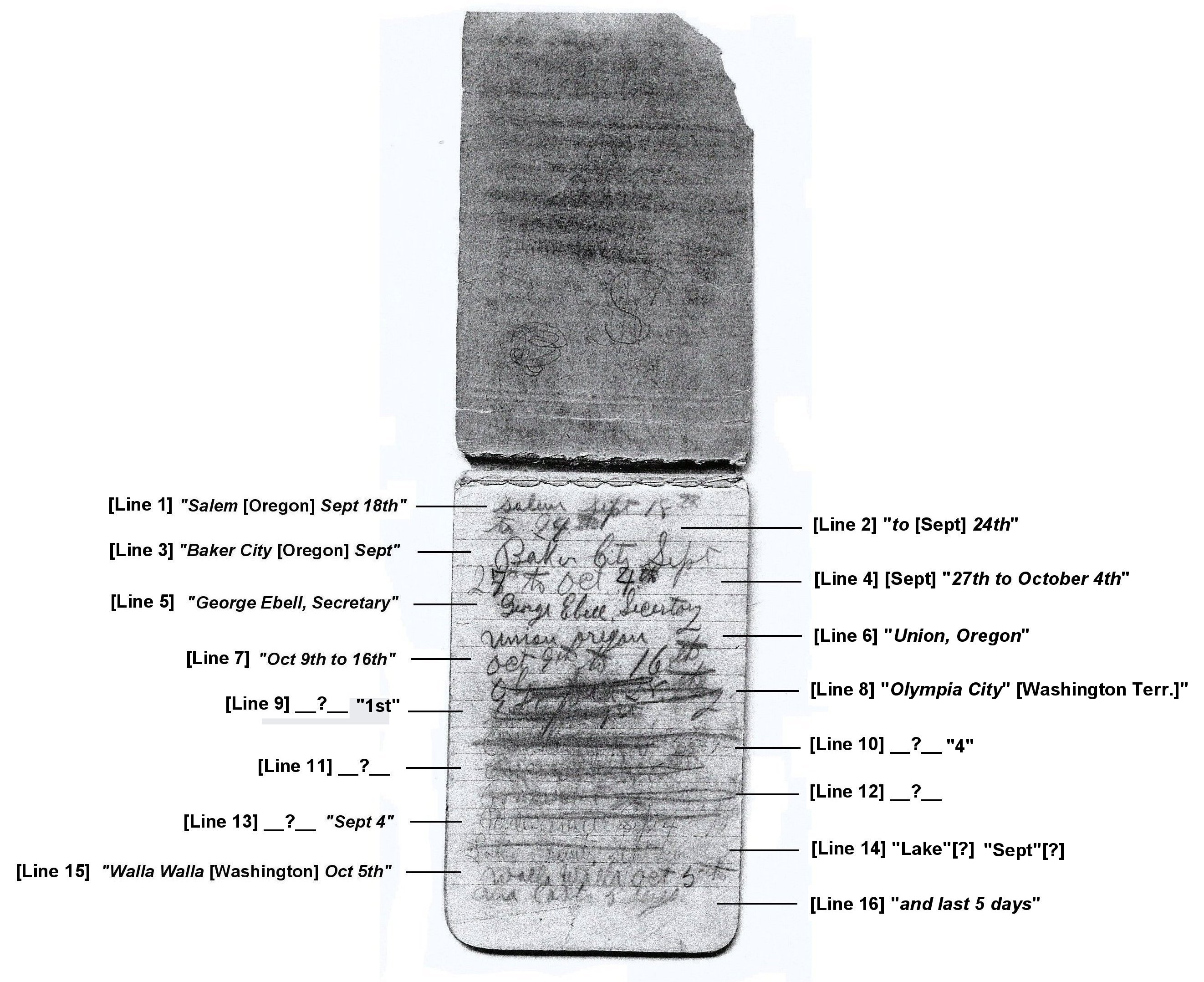
  • Line 1: "Salem [Oregon] Sept 18th"
  • Line 2: "to [Sept] 24th"
Interpretation: These are planning notes. Soapy made plans and then later (in this case on page 5) he wrote the actual dates he was in the location as well as the amounts he made. He had initially planned to be in Salem, Oregon, from September 18 to September 24, but actually operated from September 18 to September 22. the year is 1882, which was determined on page 5.
  • Line 3: "Baker City [Oregon] Sept"
  • Line 4: "27th to Oct 4th"
Interpretation: Though Baker City, Oregon, from September 27 to October 4 is listed, it does not appear in the notebook again. I found no city or county fair in 1882, it may be that Soapy decided to skip Baker City, or upon arrival he did no work.
  • Line 5: "George Ebell, Secretary" [Maybe a fair or city secretary that Soapy met? Online and newspaper search came up with only one reference to a "George Ebell" in regards to water rights in an ongoing court case since 1888.]
  • Line 6: "Union, Oregon"
  • Line 7: "Oct 9th to 16th"
Interpretation: Soapy lists Union, Oregon, as a possible stop. The County of Union did have a fair, but "Union, Oregon is not mentioned again in the notebook, thus it is unknown if Soapy stopped or operated there.
  • Line 8: Appears to be "Olympia City" [Washington Territory]. I cannot read this clearly as Soapy scratched it out. Page 5 does not list "Olympia," but page 8 does. It is not known if he went there. He may have scratched it out as a planned stop.
  • Line 9: [Scratched out] Do I see "1st" on the far right end?
  • Line 10: [Scratched out] I see a "4" on the far right end.
  • Line 11: [Scratched out] Can't decipher.
  • Line 12: [Scratched out] Can't decipher.
  • Line 13: [Scratched out] There is a town name "[Wilsonville? Milwaukie? Winston? Willamina? Williamette?]. Looks like "Sept 4" on the right.
  • Line 14: [Scratched out] "L?" Perhaps "Lake?" [can't decipher the rest, maybe "Falls City?"] I see "Sept" at the end.
  • Line 15:  "Walla Walla [Washington Territory] Oct 5th"
  • Line 16: "and last 5 days" [?]


April 24, 2017
Part #2

Part #3

Part #4
Part #5

Part #6
Part #7

Part #8
Part #9

Part #10
Part #11

Part #12
Part #13

Part #14
Part #15

Part #16


"...but in my humble opinion, I'm no hustler. You see, neighbor, I never go looking for a sucker. I look for a champion and make a sucker out of him."
—Amarillo Slim


July 6, 2023

Soapy Smith shoots up 14th and Glenarm streets in Denver, 1894.


he colonel swore he thought the cartridges were blanks and went laughingly on his way.

      An unknown Denver newspaper, dated "July 1893," clipped out and saved by Soapy Smith himself. This comes from my cousin, Jefferson R. “Little Randy” Smith collection.

WAS SURGEON’S DAY

The Red Fire Cracker Cut Many Red Tricks.

KEPT THINGS GOING WARMLY

Disasters Began Long Before the Fourth Dawned Luridly.

NUMEROUS SERIOUS ACCIDENTS

Colonel Jefferson Randolph Smith Turned Loose for Old Glory at 1 O’Clock A. M. —An Acrobat From Illinois Was Next Heard From—A Plumber at the Gumry and a Boy on Blake Street Patched Up by the Surgeon—The Worst Accident of the Day Happened at Rocky Mountain Lake—A Seven-Year-Old Boy Shot—Cannon, Crackers, Pistols, Explosives of All Description Get in Their Work.

      It was surgeon’s day at police headquarters. Unreliable toy cannons, stray bullets, erratic powder crackers, the booze of patriotism and other things incidental to a proper celebration of “The Fourth” furnished cases in plenty to Drs. Mack and Jarecki. The nation’s birthday anniversary began prematurely, so far as casualties marked it, by the sad death of John D. Mannix on Larimer street, soon after 10 o’clock Wednesday night. From that on the ambulance and …[sentence indecipherable]… to gather rust on their wheels and at midnight they were still making arbitraries. Not many arrests were recorded, owing to the tradition obtaining among police officials that the liberty of American citizens, particularly embryonic citizens, may verge toward license without much check on fire cracker day.
      About 1:15 o’clock a.m. notification that the [?] had been formally opened was telephoned to police headquarters from Fourteenth and Glenarm streets. It was a startling report that a man with black whiskers, a soft hat, a big revolver and a publicspirited jag, who looked like [words indecipherable] insurgent, had turned himself and his armament loose on the residents there.

It Was Only Jeff.

      An officer who went to investigate discovered that the author of the scare was Senor Colonel Jefferson Randolph Smith, amusing himself by shooting 45-caliber bullets through the windows of the Glenarm bar. The colonel swore he thought the cartridges were blanks and went laughingly on his way.

Fantasy depiction of Soapy shooting up the town
 
Apparently, Soapy was not arrested for the offense. Probably drunk, he had disturbed the peace, endangered public safety, and destroyed private property, and yet was seemingly allowed to go on his way. Did he privately recompense the owners of the Glenarm? Probably—unless Soapy thought he owed them the damage.


Shooting up Denver: page 276.


"We must never forget that we are human, and as humans we dream, and when we dream we dream of money."
—"George Lang"
played by Ricky Jay, The Spanish Prisoner


June 15, 2023

FINDING SOAPY SMITH’S BIRTHPLACE

Same style home, by same builder
What Dr. Ira E. Smith's home may have looked like about 1840
Newnan Historical Society says homes were not painted

(Click image to enlarge)


INDING SOAPY SMITH’S BIRTH PLACE
The Latest regarding the home of Dr. Ira Ellis Smith and Ellen Stimpson Peniston.

     In researching my family history for the book, Alias Soapy Smith: The Life and Death of a Scoundrel, I learned that my great-grandfather, confidence man Jefferson Randolph “Soapy” Smith II was born in the home of his grandfather, Dr. Ira Ellis Smith.

 
Dr. Ira Ellis Smith home
Circa 1970-80s.
Photo by Joseph Jefferson Smith and James Rothmund Smith

(Click image to enlarge)
 
     On March 25, 1828, the state of Georgia held a land grant lottery for the sale of land ceded to the state in a treaty with the Creek Indians. Dr. Ira Ellis Smith (1794-1869) won the right to purchase land in the Sixth district of Coweta County, named for the large Coweta Indian population in the region. The land Dr. Smith purchased was thirty-nine miles southwest of the future city of Atlanta and seven miles beyond the settlement of Newnan. On April 1st, five days after the auction, Dr. Smith bought land in nearby Fayette County. It appears that he may have moved closer to his new property in Coweta, moving from Oglethorpe County, Georgia until the house could be constructed (Coweta Co., deed book A, p. 102. “John Houston of Fayette to Ira E. Smith of Oglethorpe Co. for $500 land in Dist 6.”)

 
Possibly the oldest known photo of Dr. Smith's home
Circa: 1960s-70s
Photo by Joseph Jefferson Smith

(Click image to enlarge)
 
     The Smith’s are said to be one of the first families to reside there. Ira was well-liked and succeeded as a physician and planter. His popularity gained him a seat in the House of Representatives for the Sixth District in the Georgia Legislature; he served from 1832 to 1837 and again in 1851. He was elected a state senator in 1839, 1841-42, 1849, and 1853. According to Edwin Smith, a grandson of Ira, “the Smith family was equal in standing to any in Georgia, … claiming descent from long lines of well-known people.”

 
Dr. Smith home
1983
Courtesy of Vintage Aerial

(Click image to enlarge)
 
     Ira Ellis Smith’s wife, Ellen Stimpson Peniston (1802-1860), in a letter from her sister to a niece, is described as the “Belle of Virginia” and “the Flower of Georgia.” Another family letter boldly states that she was the most educated lady in Georgia. Another letter by Ellen’s brother John Gilbert Peniston tells of a duel fought in September 1820 over the sixteen-year-old Ellen. It took place in St. Petersburg, Virginia, between R. C. Adams and James B. Boisseau. She was “Educated in Baltimore,” and
her accomplishments equaled her personal charm, so it was no wonder that she should have many lovers. Admiring friends gave her a party in her honor. During the evening one man showed her such marked attention that her escort became jealous and challenged his rival to fight a duel. The next day the word came to Ellen that both men had been killed. A sad shock to her, though she loved neither of them. … In old Blandford churchyard both men, Adams and Boisseau, were buried.
Ironically, the attending physician at the duel was Dr. Ira Ellis Smith. Between 1830 and 1835, Ira had a plantation mansion built on the land he bought in Coweta County, christening the home “Shoal Creek.” It was located “seven miles east of Newnan, close to Thomas’ crossroads on the Old Wynn’s Pond Road.” From the outside, the house is imposing, appearing larger than it is on the inside. A large center hall is flanked by two spacious rooms, a small kitchen, and a sitting room. Upstairs are two large bedrooms, each with fireplace. Some of the original furnishings and family heirlooms are on permanent display in Newnan at the Male Academy Museum, where young Jefferson “Soapy” Smith obtained his education.

 
Dr. Smith home
1983
Courtesy of Vintage Aerial

(Click image to enlarge)
  
     Cotton and corn were grown on the Smith Plantation, supplementing the income from Dr. Smith’s medical practice. In 1844 Moses P. Kellogg came to Coweta county to be a teacher. With a large family to educate, Ira offered Kellogg a teaching job and a place to live in the Smith home. There he would teach eight of the Smith children. School was held in a small room added to the rear of the house. Arrangements were made to open a school on Fayetteville Road for children from the surrounding area. One of Kellogg’s brightest students was Ira’s son Luther, who went on to become president of Emory College.

 
Where the land is believed to have been
Posey Road and Hwy 34
Courtesy of Google

(Click image to enlarge)
 
     Of Dr. Smith’s eleven children, the fifth was Jefferson Randolph Smith Sr. (1831-1902), a lawyer who married Emily Dawson Edmondson (1837-1877). Around 1859 Jefferson Randolph and Emily moved in with Dr. Smith at Shoal Creek to help care for his ailing wife, Ellen. Another Ellen, the daughter of Columbus Darwin Smith and the granddaughter of Ira, named Ellen Smith Faver, also moved to Shoal Creek. She moved in after her mother, Nancy Edmondson, died on October 21, 1860. Two days later Ira’s wife Ellen also died. Ten days later, November 2, 1860, Jefferson Randolph Smith II (1860-1898) was born. Edwin Bobo Smith, a cousin of Jefferson R. Smith II (Soapy), also came to live in the home for a time.
 
Soapy Smith's birth place as it looked in 2007
486 Pete Davis Rd, Coweta County, Georgia

(Click image to enlarge)

      Dr. Smith soon moved to the home of his son, Ira Ellis Caspar Wistar Smith. Dr. Smith died in 1869. Jefferson and his parents moved out of the house around 1875-76, moving to Texas to escape Reconstruction. The owners of the Smith house for the next 118 years is currently unknown. I was introduced to Jannar Davis and his wife, the owners of the house in 2007.
     The house was set to be razed in 1994 to make room for a parking lot when Jannar Davis and his wife purchased it and moved it to property the Davis’ owned.
     In 2007 I gave a presentation on Soapy Smith to the Newnan Historical Society. I was able to see the Ira Ellis Smith house at the new location, but due to time constraints only drove by the original land location.
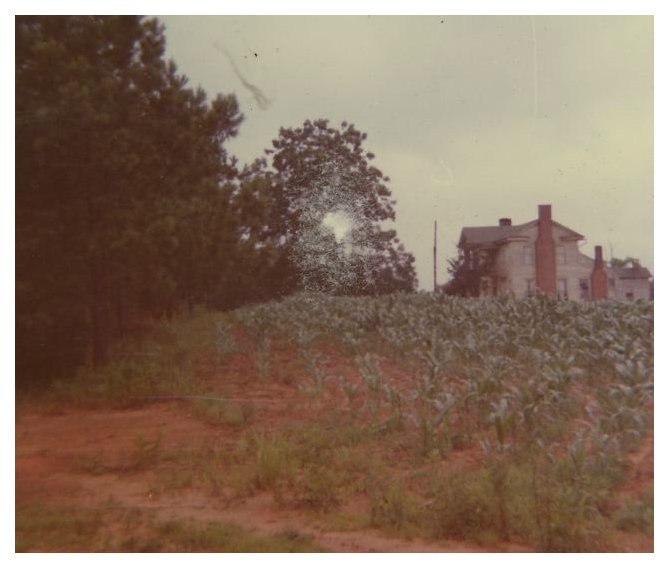
Soapy Smith's birth place as it looked in 1968
Original location-side view
Corn can be seen growing in the field
Photo by Joseph Jefferson Smith and James Rothmund Smith

(Click image to enlarge)
     
     After returning home I realized I did not have the needed addresses or contact information for neither the original land location or the address and contact information for the Davis’, and could not obtain any assistance from anyone in Coweta County.
     In early 2014 the Davis’ were able to get the house listed on the National Register of Historic Places, and in December they sold the home and moved to Seminole, Florida. Letters addressed to them have been returned so for now their contacts are once again missing.


Soapy Smith's birth place as it looks in 2023
486 Pete Davis Rd, Coweta County, Georgia
Courtesy of Google

(Click image to enlarge)
 
     Sixteen years would pass before I met Sid Brown, a retired law enforcement detective, and his wife, a genealogy researcher, who told me that between them, “if we can't locate the Davis’, then he's left the country.” They were able to find the location of the house’s current location (486 Pete Davis Rd, Coweta County), and the general location of where the original lot was located (Hwy 34 East and Posey Rd.). Eve Graybeal Olsen from the Coweta County Georgia Genealogy group on Facebook added in her findings, maps and photographs, and together we all narrowed the location of the land where the house originally stood, but as the land has been built upon since 1994, including the introduction of a side-street, the exact placement of the Smith house is still a mystery, But, photographs taken from the air in 1983 show farmland on both sides of the house, leading to the assumption that both sides of the land on each side of the side-street belonged to the Smith home, perhaps the house sitting directly in the center, perhaps in the center of the side-street itself.

SOURCES
  • Sid Brown (Sid helped greatly. Without Sid Brown I would still not know the address of the house or the location of the land where the home originally stood. Thank you, Sid!).
  • Eve Graybeal Olsen
  • Vintage Aerial
    Photo #1
    Photo #2


Sep 10, 2009
Aug 16, 2011
Aug 18, 2011


Dr. Ira Ellis Smith house: pp 20-23.


"A rich man is either a scoundrel or the heir of a scoundrel."
—Spanish Proverb


June 2, 2023

Soapy Smith's Childhood Education

"Male Seminary and Normal School,"
Independent Blade
Newnan, Georgia
November 2, 1860,

(Click image to enlarge)


OAPY SMITH'S CHILDHOOD EDUCATION

     The Smith family passed down the history that young Jefferson Randolph Smith II had enrolled in "a Sabbath school, and was able to continue his education throughout the war, after the war’s end and on into Reconstruction." I believe the ad from the Independent Blade, a Newnan, Georgia newspaper dated November 2, 1860, is for the school Jefferson may have attended. In researching Soapy all these decades I found that a major portion of the family history turned out to be true. There is no provenance regarding this particular school but Newnan was not that large of a community, and the heading of the ad, "Male Seminary and Normal School," caught my eye.
      A Christmas speech written for the Sabbath school play in 1871 shows clear evidence of a good education and signs of wit.

Newnan, GA. Dec. 24 1871

Friends and Patrons. Ladies and Gentleman, we heartily welcome you on this festive occasion. With buoyant and grateful hearts we commemorate the nativity of Him at whose birth the morning stars sang together and the sons of God shouted for joy. Let the community for its blessings, rejoice, and especially should we as a Sabbath school rejoice, that we have been blessed with such kind patrons and efficient teachers. And how can we express our gratitude (and admiration) for this beautiful tree? A tree is known by its fruits, and this one is one that speaks for itself. It must have sprung from a generous soil in a genial clime. Leaden with such rich and luscious fruit, its bending boughs are more persuasive than speech; and the masich[1] it bears would puzzle Linnaeus[2] to classify or name it. Ladies, in our hearts we thank you for it. Again a hearty welcome and a joyous festive Christmas eve to all.[3]

NOTES:

[1] masich: may be mastic, “1. A gum or resin which exudes from the bark…. 2. An evergreen shrub yielding mastic gum….” It fits with the following named botanist who was challenged to name its origin. (OED)

[2] Linnaeus: Carolus Linnaeus (1707-1778), famed Swedish naturalist and botanist, established system of nomenclature for taxonomy of plants. His published works number 180. (Encyclopedia Britannica, 1892)

[3] Copy of original sent to John R. Smith by Joseph J. Smith, 12/08/1969. The original (location currently unknown) is nicely hand written in cursive and very readable. Someone, in different script, perhaps his mother, wrote at the top, “Jeffies Christmas Welcome, Sabbath School play.”


Sabbath School: pages 23-4.


"Never play cards with a guy nicknamed after a city."
—Unknown


May 31, 2023

Soapy Smith's father and maternal grandfather, Georgia, 1861.

Jefferson R. Smith, Adm'r.
Georgia Banner and Sentinel
Newnan, Georgia
February 1, 1861

(Click image to enlarge)


oapy Smith's father and maternal grandfather.

     Jefferson Randolph Smith, Sr., (1831-1902) is my great-great-grandfather, father of Jefferson Randolph Smith, II (alias "Soapy"). Jeff Sr., was an attorney in Newnan, Georgia. The newspaper clipping is from the Georgia Banner and Sentinel, of Newnan, dated February 1, 1861 just about two months before the start of the Civil War. The clipping shows that Jeff Sr., is administrator for the estate of Joseph Henry Edmondson (often spelled Edmundson).
     Joseph Henry Edmondson (1792-1858) is my 3rd great-grandfather. Joseph is the father-in-law of Jeff Sr., as Jeff Sr., married Joseph's daughter, Emily Dawson Edmondson, who would give birth to Jefferson Randolph Smith, II (alias "Soapy"), making Joseph, Soapy's maternal grandfather. At the date of this clipping, Jeff II ("Soapy") is age four months. 
     There are very few known samples of the two newspapers in Newnan, Georgia in existence so I am lucky to find my ancestors named.
 
Joseph Henry Edmondson
 Oak Hill Cemetery
Newnan, Coweta County, Georgia

 (Click image to enlarge)
 
 
Joseph Henry Edmondson
 Oak Hill Cemetery
Newnan, Coweta County, Georgia

(Click image to enlarge)
 
 
Joseph Henry Edmondson
 Oak Hill Cemetery
Newnan, Coweta County, Georgia

(Click image to enlarge) 
 
SOURCES
  • Find-A-Grave
  • A History of Coweta County from 1825 to 1880, by W. U. Anderson, p. 19.

Joseph Henry Edmondson


"Win if you can, lose is you must, but ALWAYS cheat!"
—Jesse Ventura


May 3, 2023

Soapy Smith and the quote: "Charity covers a multitude of sin."


(Click image to enlarge)


harity covers a multitude of sin."
 
     I posted the above quote image on my Facebook group, Soapy Smith's Old West, and friend Markie Whalen asked if "the ends justify the means?" I occasionally hear from people who believe that because I am a descendant of Jefferson Randolph "Soapy" Smith, that I am guilty of defending his crimes. Below is my response to that allegation.
     No, I do not believe that the "ends justify the means." Nonetheless, "Soapy" was indeed known for his charity around the west, as well as his crimes. In turn, I ask the question, If Soapy's crimes are not lessened because of his charity, should Soapy's charities be lessened because of his crimes?
    Personally, I don't believe that charity reduces the severity of the criminal act, but there are many who do believe this. Just ask anyone who follows Democratic and Republican politicians!
     "Charity covers a multitude of sin." This expression above originated in the New Testament (I Peter 4:8): “And above all things have fervent charity among yourselves: for charity shall cover the multitude of sins.”


"The bunko sharp walks up to the man on the street, claiming his acquaintance at once. A gentleman who has seen this done several times says: “It is perfectly astounding how they impose upon a man when they have once settled upon him. They walk up with the most perfect air of gratified surprise, grasp the man’s hand warmly and shake it vigorously. The man is astonished at first, but time after time, after a short conversation I have seen them walk off arm in arm."
Evening Post (San Francisco), May 6, 1876