November 29, 2010

Soapy Smith and Mollie Walsh?


The Juneau Empire published an article that states Soapy personally knew famed Skagway resident, Mollie Walsh. The author (Jack Marshall) of the article listed a source, but clearly added an exaggerated version of the content published within his source, which just so happens to have been co-written by Art. Petersen, my publisher. A good lesson is to be had for historians. Just because a writer lists a source, does not mean the writer followed and quoted the source's information factually. Following is the whole story as it was published online.

Juneau Empire.com
Sunday, November 14, 2010
Accumulated Fragments - Bartlett: the stories behind the name
By Jack Marshall | For the Juneau Empire

Bartlett Regional Hospital carries a famous name. It was named after E. L. "Battling Bob" Bartlett, who was Alaska's territorial delegate from 1945-1958, and in 1959 became our first U.S. Senator. He died in office in 1968, but the name Bartlett goes even further back in Alaska history than that.

In Iowa in 1872, an Irish girl named Mollie Walsh was born. In 1881, she moved with her family to St. Paul, Minn. Then on Thanksgiving Day in 1890, the 18-year-old young woman ran away with her girlfriend to see the world. It didn't take long before they were in deep trouble, having most of their luggage and money stolen. But, as luck would have it, the two young ladies met Jefferson Randolph Smith, who took pity on them and became their protector and benefactor. This relationship continued for a lifetime. Smith's nickname was "Soapy," and at the time he was the head of organized crime in Denver, Colo.

From 1892 to 1897, the United States went into a serious recession. Jobs were hard to find and people were having a tough time. However, crime was doing well and Smith and his gang had expanded to the towns of Creed, Colo. and Butte, Mont. In 1897, the sailing ship Portland stopped in San Francisco with two tons of gold from the Yukon. It didn't take long before Soapy, his gang and the two young ladies were off to Skagway.

Crime in Skagway became vicious, with murder a common event. Smith quickly became the "Godfather of Skagway." He set up every dishonest enterprise possible. Mollie had learned how to make pie tins by pounding out cans and tasty pies from a successful entrepreneur named Harriet "Ma" Pullens. Because of the protection afforded her from Soapy, her ability to make friends with community leaders and her beauty, many a young man wanted to court her.

Three of these young men were Mike Bartlett, part owner of the Bartlett Brothers packing Company, Jack Newman, also an independent packer, and a faro dealer. A romantic rivalry began to develop between Jack and Mike. To relieve the tension, Mollie encouraged the attention of the faro dealer. Adding the third suitor only made matters worse, so in the spring of 1898 Mollie left Skagway and opened her grub tent on the trail at Shallow Lake, between White Pass and Lake Bennett. It was a place for weary prospectors to buy a good hot meal and enjoy Mollie's spirited conversation. All three of her suitors stopped by to visit with her at the grub tent as time went on. However, the faro dealer began a rumor that he had done more than just visit with Mollie. Shortly thereafter, a gun battle occurred between the faro dealer and Jack, in which the faro dealer was killed. Mollie was extremely upset with Jack and decided to marry Mike Bartlett.

There were three Bartlett brothers about one year apart in age. The oldest was Al, then Ed, and the youngest was Mike. The Bartlett brothers decided to move their packing operation to Dawson because the White Pass railroad to Lake Bennett was almost finished. Mike and Mollie were married Dec. 11, 1898. Mike decided to build a hotel/saloon in Dawson, but just as he was finishing, gold was discovered in the beach sands of Nome and a mad stampede ensued that drained most of his potential patrons from the Dawson area. Mike was in serious financial trouble and began drinking heavily. He decided to try and make it in Nome, but there was no need for pack horses. Realizing that, he decided to buy gold claims, but his purchases turned out badly. Mike sent for Mollie and when she got there she wasn't apprised of the full financial disaster. By the end of eight months, they were completely broke and Mollie was pregnant. Finally, Mike called his brother Ed and asked him to come and bring their horses back. Mike and Mollie boarded the ship Seattle No. 3 to return to Dawson. Mollie delivered her son 73 miles above Rampart while the boat was taking on wood from a large wood pile on the Yukon River. Mike spent the last of their money on a drunken party soon after the birth. After the party, Mike, in a drunken haze, told Mollie that the people on board had named their son Leon Edward Seattle No. 3 Yukon Woodpile Bartlett. This news ended their marriage.

Al Bartlett sold his shares of the business to his brothers and left. In 1901, Ed left for Seattle and decided not to return, sending Mike his power of attorney. In 1902, Mollie left for the west coast with a man called John Lynch. Mike, in a rage, followed them until finally catching up with them in Seattle. Mike shot Mollie to death and then tried unsuccessfully to commit suicide.

The newspapers billed it as the trial of the century. The trial began in November of 1903 and concluded Dec. 2 of the same year. Mike was acquitted based on insanity. He spent two years in a mental facility and was released. Six months later, he killed himself. Al Bartlett left for the gold fields of Tibet and was never heard from again. Ed Bartlett married Ida, who in 1904 gave birth to E.L. "Battling Bob" Bartlett. Ed and Ida moved to Fairbanks and remained there until Ed died in August of 1935. Mike and Mollie's son was a veteran of World War I and died in the Old Soldier's home in Washington D.C. in the 1950s. Finally, on July 21, 1930, Jack Newman dedicated a monument to Mollie Walsh Bartlett in Skagway. It stands there to this day.

Jack Marshall is a 32-year Alaska resident who has been in Juneau for 26 years. His parents, grandparents and great-grandparents were pioneers of Oregon and Washington, leaving Alaska for him to discover. Much of the historical information in this column came from "Murder, Madness, and Mystery," a historical narrative of Mollie Walsh Bartlett by Art Peterson and D. Scott Williams.

I posted the following response on that site link for the story.


Hello, Jack.

I am a great-grandson of Jefferson Randolph Smith II, alias "Soapy" Smith. I am author of the book, ALIAS SOAPY SMITH: THE LIFE AND DEATH OF A SCOUNDREL (2009).

I am most interested in your sources as there is no documentation at all that I know of to show that Soapy ever even knew Mollie Walsh or the other way around. My publisher, Art Petersen, and his co-writer, the authors of your source for your story, in 1991 did suggest a connection because they both lived in Skagway, but nothing of the sort that you suggest. In taking literary license your exaggerated story telling clouds the waters of time, making it harder to see clearly into times past. Of course, you are not alone in this kind of fanciful story telling, which can hardly be considered history. I invite you to cruise my website and blog (links below), and perhaps even purchase my book if you are so inclined.

And how would Soapy respond to a story of this kind? My guess is that he'd smile, shrug, and turn to his affairs. ... Come to think of it, that's what I'm now doing.

Jeff Smith

November 28, 2010

Soapy's son and grandchild.


Above is a very nice photograph from the Sarah Moriarty Collection of Jefferson Randolph Smith III and one of his daughters taken at the family home in St. Louis. The date the photo was taken depends on which of the six daughters is shown above. It can safely be stated that the photographs dates after 1911, the birth-year of Joan Wanda Smith, the first born daughter. This may not be true if the child is one of the boys.
Do you know which of the children this is?

_________________

On other topics - I am updating the blog as fast as I can, adding the apps that are missing when I changed templates. I apologize to all.


.

November 25, 2010

Soapy Smith's Thanksgiving


I wish all of you a very pleasant Thanksgiving.

Soapy had his own annual days of thanks. One of his customs, as reported in the Denver Evening Post (see above) was to hand out turkeys to the down trodden. This may very well have been one of the public relations ploys, or it could have come from the heart, or perhaps both. The reason(s) mattered little to the desperate needy in hard times during the Panic of 1893 and other economic bombs that flattened the buying power of the common people. May we all be blessed with good health, wealth and happiness.

Shades of Soapy Smith!
The following recent newspaper article from the New York Times held a reminder of the shady side of Soapy.

N.Y./Region| The New York Times
November 24, 2010
By DAVID M. HALBFINGER

Thanksgiving Ritual Gives Rangel a Respite

Last week, he stormed out of a crucial hearing in Washington and nearly broke down when he was found guilty of ethical violations involving his finances and fund-raising.

On Monday, he apologized to his supporters for “the embarrassment I have brought upon you.” Next week, the full United States House of Representatives will decide whether to censure him — the toughest punishment short of expulsion.

But on Tuesday, Representative Charles B. Rangel seemed almost willfully upbeat as he strode into his old Harlem political club to hand out turkeys to needy constituents, a Thanksgiving ritual that allowed him to speak publicly about something other than his political future. If only for a moment.

“I’m putting today in front of me,” Mr. Rangel told reporters curbside at 128th Street and Adam Clayton Powell Jr. Boulevard, as dozens of bundled-up and mostly elderly women — the lucky holders of about 120 tickets that were given out by several community groups — waited inside for the congressman to start loading their grocery carts.

“These people here are not the least bit concerned about anything but how they’re going to get their families together on Thanksgiving,” Mr. Rangel said. “It just seems to me that I have a moral obligation to take care of them — and then, when I get to Washington, take care of me.”

Inside the political club, as photographers captured his forced smiles, Mr. Rangel loudly took charge, herding recipients toward the free groceries and whistling with two fingers to clear a path to the door. For about 20 minutes, he handed out 18-pound Butterballs — donated by the nearby Fairway supermarket, a club member said — and bags of fixings, accepting heartfelt thank-yous, handshakes and expressions of loyalty in return.

“He’s good; I don’t care what they say,” said Mary Reed, who was given a ticket for a turkey because of her participation in the tenant patrol in the Manhattanville Houses, a city housing project. “He does help the people. That’s the important thing.”

Dressed nattily in a brown leather blazer, brightly colored striped tie and a gold, personalized House of Representatives tie clip, Mr. Rangel briefly thanked supporters like City Councilwoman Inez E. Dickens, who, he said, have “been out there since this nightmare all started.”

He also showed flashes of bitter humor.

The Rev. James E. Booker Jr. of St. John A.M.E. Church offered a prayer, asking that all within earshot receive “spiritual, physical and financial blessings.”

Mr. Rangel kept mum during the amens, then quietly asked the pastor: “Does that include the press?”

The political club, named for the Rev. Dr. Martin Luther King Jr., has been distributing turkeys for years, but the giveaway on Tuesday was overshadowed by Mr. Rangel’s problems.

Aides choreographed it to look like a spontaneous show of support; Mr. Rangel called the turnout “a very pleasant surprise.” But the stagecraft suggested a calling-in of debts.

A campaign worker and former House aide, holding a bullhorn scrawled with Mr. Rangel’s initials, got onlookers to chant the congressman’s name as he arrived.

The onlookers and volunteers, too, consisted largely of people who owed something to Mr. Rangel, including more than a dozen loudly chanting construction workers in hard hats from a job-training group called Positive Workforce.

Mr. Rangel, who was the chairman of the powerful House Ways and Means Committee before relinquishing that post during the ethics investigation, earmarked $240,000 for Positive Workforce to buy and renovate an East Harlem building this year. The group received $250,000.

Late Monday, Mr. Rangel e-mailed a list of supporters an apology, emphasizing that he had done nothing for his own personal gain, but conceding that “all of this has been brought upon me as a result of my own mistakes.”

But on Tuesday, when asked about the apology, and whether he now regretted having pushed the ethics case as far as it had gone, Mr. Rangel sidestepped.

“Any awkwardness that they feel about this, I feel they’re owed an apology,” he said, referring to his constituents and supporters. “I had really hoped I would have a chance to have witnesses to have an exchange with. That didn’t happen, so this is where we are. I can’t change that. We have to deal with Monday, and I’m prepared to do that.”

At that, a middle-age man walked up and edged his way into the media scrum next to Mr. Rangel. “Keep the faith!” the man said, his hands shaking as he spoke. “Y’all should all look at all the goodness that this man has been doing.”

Mr. Rangel, grinning broadly, turned back to the cameras, saying, “He makes a lot of sense.”


.

November 24, 2010

Template issues


I apologize for the look of the blog. Somehow the template html code has been altered and I have lost sections of the back ground. Luckily no content was lost but as this template is a custom third party item I may have to change the template to a stock one from Blogger.

Addendum: I have changed over to a stock template.


.

November 21, 2010

Cathy Spude, Slotkin and Soapy Smith


I made the above piece and just couldn't wait to use it!


But the logo below which I also made, is the real way I feel right now.


It seems Cathy Spude, in writing her own Soapy Smith book, has chosen to ignore the most detailed and complete biography on Soapy written to date, which needless to say is mine. Anyone who has read my book and ventures over to Cathy's webpage (as of 11/16/2010) devoted to her book on Soapy will absolutely have to agree that what I'm saying is true. I'd like to get some of this off my chest as this angers me to no end. I invite you to follow along and see if you agree or disagree with my issues. My plan here is to quote sections of Cathy's page and comment on each one.

"With reference to Richard Slotkin’s discussion of the American Frontier Myth and his theme of “regeneration through violence,” Catherine Spude discusses how journalists and popular writers interpreted the death of Jefferson Randolph Smith in 1898 as a morality play. From the moment it happened, this petty con man was elevated to the status of an arch villain in order to create another legend of the frontier west in which elite Anglo males redeem their communities through a cleansing bath of blood."

Cathy has admitted several times that she has only read the second half of my book. Her interest deals with Soapy in Skagway, Alaska, however if she would read the first half of the book dealing with Soapy's rise to power numerous times in Colorado and other parts of the western United States she would see that Soapy was already "elevated to the status of an arch villain." There was no creating a legend as I have shown in my book and recently on this blog that Soapy was as well known, if not more so, than Wyatt Earp (see here) perhaps the most well known old west character in history.

"To date, very little scholarly treatment of Soapy Smith exists. While over a hundred publications on his life exist, less than a handful were written by scholars, and only one has treated the event of his death with any serious study (William R. Hunt, Distant Justice: Policing the Alaska Frontier, Norman, OK: University of Oklahoma, 1987)."

Are you kidding me? Now I could understand this statement if Cathy had never seen or read my book but this is not the case at all. She personally purchased a copy from my publisher and recently wrote a review of my book for the Alaska Historical Society (see here). Considering my book covers the death of Soapy in extreme detail in several chapters Distant Justice covers Soapy's entire time in Skagway in a mere 15 pages ( pp. 52-67). As for the sequence of events on July 8, 1898, Hunt is not very accurate or detailed, and as for what happened on the Juneau Wharf, Hunt doesn't even try to parse that. This only proves my point, which is that Cathy is ignoring my book, not to mention that I find her comments very insulting.

It is not meant to compete with recent biographies of Smith such as Jefferson Randolph Smith, IV, Alias Soapy Smith: The Life and Death of a Scoundrel. The Biography of Jefferson Randolph Smith II, (Juneau, AK: Klondike Research, 2009) or Jane G. Haigh, King Con: The Story of Soapy Smith (Whitehorse, YT: Friday 501, 2006), which are full length biographies and compile the vast literature of the con man’s life. Instead, Spude's book focuses on his few months in Alaska and the way his death contributes to popular literature, folklore and American mythology.

To say she does not wish to compete with my book is one thing, but Cathy is choosing to ignore my research, as if my facts that I have spent 25-years researching do not exist. This is not  very professional  on her part.

Cathy lists a 'table of contents' for her future publication that I'd like to comment on. I have been told that I am actually doing her a favor by leading her to her own mistakes but considering she has supposedly read my book already,  I am confident that she won't change her beliefs anyway. Following are some of  the larger more enjoyable (for me) mistakes. I won't go into great detail but anyone who has read my book will easily be able to follow along. I look forward to see how she attempts to disprove what actually took place.

CHAPTER 2. DOUBLE MURDER. The first event of any significance in the Smith legend was that of the murders of Ed McGrath and James Rowan, in which it is believed that Smith stopped the lynching of bartender Ed Fay. Using court records, contemporary newspaper reports, and early twentieth century interviews, it is shown that this portion of the legend is a later invention of journalists and friends of Soapy Smith, interested in giving him a larger role in the incident than he actually played (16 pages; 4589 words).

Soapy's clear role in the incident was recorded at the time it took place by the people involved. I look forward to Cathy's explanation that it was a "future invention."


CHAPTER 3. THE COMMITTEE OF 101. The author explores the origins of Skagway’s Committee of 101, a citizen’s committee established to adjudicate lands claims and establish a city government in the absence of a code of laws that could incorporate communities in Alaska. The Smith legend has long held that this organization arose in response to Smith, but it existed long before Smith became entrenched in the community, and had little to do with anything Smith and his colleagues were interested in. The author discusses similar committees and their functions throughout the west (11 pages; 3085 words).

Soapy was "entrenched in the community" within weeks of the founding of the camp. Read my book.


CHAPTER 4. DEEDS AND RIGHTS. Two issues were of paramount importance to the more permanent residents of Skagway in the winter of 1897-1898: obtaining clear deed to their property and the rights-of-way to the railroad and Brackett Wagon Road. The author demonstrates how these issues dominated both the news and the politics of the time and that no one could be said to be “king” of Skagway without being intimately involved in these issues (7 pages; 1808 words).

My book clearly shows Soapy was involved in land and the Brackett Wagon Road. Another clue Cathy did not read my book closely enough.


CHAPTER 6. THE FOURTH OF JULY, 1898. Using diaries and newspaper articles, this chapter corrects many of the exaggerated and incorrect facts about Smith’s place in the festivities of July 4, 1898 and discusses why his role became so important in retrospect (4 pages; 889 words).

Can't wait to see her 'facts.'


CHAPTER 9. ON JUNEAU WHARF. A recapitulation of the shoot-out on Juneau Wharf, in which J. R. Smith and Frank Reid are each shot, as well as a dissection of the theory that there was a third shooter on the wharf (9 pages; 2588 words).

Cathy does not believe Murphy shot and killed Soapy although there is plenty of evidence showing otherwise. My theory on her belief is that if Murphy did kill Soapy then it would not only disprove other theories of hers regarding the vigilantes, but would also show her hero, J. M. Tanner as a liar as he was the one who wrote the note to Steele that shows Murphy killed Soapy.


CHAPTER 10. A LIE AGREED UPON. A discussion of why, in the minds of the middle-class merchants who made up the coroner’s jury, the Irish laborer Jesse Murphy could not have killed Soapy Smith. This is where the legend began (9 pages; 2614 words).

Can't wait. Hope she has some facts to back up her theory as I do in my book.


CHAPTER 14. POLITICAL SATIRE. The first publication of the Smith legend was in 1907, by Chris Shea, running for Skagway mayor. He evoked the time of political chaos and lawlessness with his tongue-in-cheek satire, which is today taken for a history. It is in this cartoonish political statement that most of the elements of the legend first appear (15 pages; 4283 words).

This is a fun one for me as this is strictly Cathy's invention. There is no hint of fact that Chris Shea's book was written as a "tongue-in-cheek satire." You can read the invention in Cathy's fictional novel, The Unterrified on her site here.


.

November 19, 2010

John "Prairie Dog" O'Byrne


I have been having some interesting and fun correspondence with Jan Collins, Director of the Cripple Creek District Museum in Colorado. One of her emails contained the lines I used in the 'artwork' above. I'll let her explain the story.


...I will leave you with one other thing, it's a quote from a book by John "Prairie Dog" O'Byrne who used to run a hack service in (Old) Colorado City. The book is called Pikes Peak or Bust and Historical Sketches of the West. I believe I found a copy of it at the Denver Public Library.

Anyway, O'Byrne had a reputation as being friends with everyone and anyone in the Colorado City region. Being that he kept two pet prairie dogs in a cage on the back of his wagon, which was pulled by two tame elk, O'Byrne appears to have been quite a character himself. It has been many years since I saw the book, but I did quote one of his poems in one of my books (Brothels, Bordellos & Bad Girls: Prostitution in Colorado 1860-1930). Here it is:

In Old Town I cut quite a dash.
I took many pains to sell all my cash, and
I drove through the street with Laura Bell by my side -
A span of elk, how fine we did ride.
We drove down to Byron Hames' old place,
And says I, "Let's go in and see what's the muss,
For I feel just at present like having a fuss..."
And there stood Soapy Smith with three cards in his hand,
And each word he uttered he spoke with command:
"Now gents," he would say, there is the ace and it is plain to be seen."
And that's how I lost all my money on the Ace and the Queen.

Byron Hames was a saloon owner in Colorado City. Laura Bell was Laura Bell McDaniel, my all time favorite madam in the West. It is an established rumor that Soapy spent time in Colorado City and dealt cards there.

Enjoy your day, we will look forward to receiving your books for the shop.

Best regards,

Jan Collins
Director
Cripple Creek District Museum
P.O. Box 1210 ~ 500 East Bennett Avenue
Cripple Creek, Colorado 80813

CCDMuseum@aol
www.cripple-creek.org.com

Thank you very much Jan. I don't recall ever seeing that poem before! I hope you like what I did with the four lines at the top? My publisher Art also contacted Jan and her book and the poem.

Jan,

I have your book on my reference shelf! I acquired it for research on Mattie Silks, which you handle skillfully, accurately, and well, in my opinion. Other books present things about her that can't be true, such as climbing the Chilkoot trail with "her girls" and Cort on the way to Dawson. Jeff treats her time in Alaska quite well, I think (see 507-13).

I look forward to reading about your all-time favorite madam of the West, Laura Bell McDaniel, as well as others.

By the way, if you have room on your hard drive, you can download O'Byrne's book for free in pdf for free from Google books (see: Google Books HERE ). Nice to have at hand in paperless form for reference. Of course it's always on line, too, (probably), and searchable on line as well.

Regards,
Art


.

November 18, 2010

Who are these people?


Another wonderful photograph from family member Sarah Moriarty! The rear reads "Humbolt Park, August 25, 1913" but does not list the names of the people. Does anyone in the family recognize who they are? Who they might be?  Please let us know!


.

November 17, 2010

WWHA review of Alias Soapy Smith

(Click image to enlarge)
Jeff Smith as "Soapy"


I received the October issue of Journal, the bi-monthly magazine of the Wild West History Association. In it is a nice review of my book, Alias Soapy Smith, by Mark Boardman. Here it is in its entirety.


Alias Soapy Smith: The Life and Death of a Scoundrel. The Biography of Jefferson Randolph Smith II, by Jeff Smith, Klondike Research 2009, 628 pp. including illustrations, bibliography, footnotes, index, hardcover $43, softcover $26.


There are innumerable ways a person can “con” somebody else—and Jefferson Randolph “Soapy” Smith II apparently found and used most of them in his 37 years on earth. Soapy would try just about anything that would separate folks from their money or land or other valuables, or would further enhance the power and prestige of the man himself.

The shell game. Card tricks and rigged gambling enterprises. Land scams. A well-preserved corpse that Soapy claimed (lied) was the petrified remains of one of John Fremont’s soldiers—and could be viewed for a price. And of course, the soap game that gave the man his legendary nickname, in which he sold bars of soap, some of which he said included money inside the wrappings.

But as Jeff Smith shows in this tome on his great-great-grandfather, it’s way too simple to label this very complicated man as a mere con artist.

Soapy led his criminal organization (appropriately called the Soap Gang) into numerous enterprises, both legal and illegal, in towns including Denver and Cripple Creek and Creede and Skagway. He tried to grab power in Mexico (a scam that didn’t pan out). He left a major historical footprint at each stop by buying elections, bribing office holders and law enforcement, contributing to development efforts and more. And he swindled a lot of people out of a lot of cash.

And along the way, Smith ran into some notable characters including Wyatt Earp, Bat Masterson, Vendetta Rider Texas Jack Vermillion, and the “dirty little coward” who killed Jesse James, Bob Ford (whom Soapy hated). Smith was even in Round Rock, TX in 1876 when robber Sam Bass got his comeuppance.

Yet Soapy (who could be quite violent when such was called for) was a dedicated family man who kept his family in St. Louis, away from the tumult he helped to create. He frequently gave money to the poor and dispossessed—sometimes doing so quietly and with no public fanfare. He was loyal to his friends to a fault. Smith was extremely intelligent and had a knack for planning and organization, albeit for the wrong side of the law.

Yep, Soapy Smith was a very complicated man.

So his descendant Jeff Smith took on a big task when preparing and writing this autobiography. It took more than 25 years of work, but the author had access to documents, photographs, and even newspaper clippings collected by Soapy himself. The result is easily the most comprehensive and accurate look at the king of the cons. And to his credit, Jeff Smith is very evenhanded in his treatment of family. He doesn’t try to whitewash or absolve Soapy of his bad deeds, but still points out the man’s good points. As a result, the reader is presented with a real flesh and blood person.

And Jeff Smith has come up with some important finds—especially regarding Soapy’s death on an Alaskan wharf in the summer of 1898. Tradition holds that a drunken Soapy and vigilante Frank Reid killed each other in a shootout. Some say that lawman J.M. Tanner, who was present, was the one who fired the fatal bullet. Jeff Smith makes a strong case that a third man (we won’t reveal his identity here) was the shooter, gunning down an unarmed Soapy who was asking for mercy.

On the other hand, the manuscript needed an editor. There are some spelling and grammatical problems. And one finds some glaring historical issues—like referring to the brother of Jesse James as Alexander (sure, that was his real first name…but everyone called him Frank). But the real problem is the size and intricacy of the narrative. Seemingly every con Soapy ever pulled is detailed, and after awhile events tend to blend into one another. And they go on and on and on. The book becomes a tougher read than it need be. And that limits the audience to die-hard historians who are looking for the minute specifics.

And that’s a shame, because this is an important story, one that should reach a broader market. Soapy Smith was a remarkable character who deserves to be better known. Jeff Smith is to be commended for telling his story. If only it had been a bit more concise…

I emailed Mark my thanks, along with a few explanations regarding his concerns about the book. Mark emailed me back the following.

Jeff--Thanks for your kind comments and explanations. I hope you know that I admire your work on this book. In particular, it sets the historical record straight on Soapy, and that is an invaluable contribution to the field.

All best,
Mark


THANK YOU MARK!


.

November 15, 2010

Cathy Spude's book review, part 2.


Cathy Spude and I are discussing her review of my book and my response to it, on the Soapy Smith Discussion Forum. Don't miss the fun! You can even join in if you wish. All are welcome!


.

Cathy Spude book review


A discussion between Cathy Spude and I can be 
read on the Soapy Smith Discussion Forum here.


A review of my book, Alias Soapy Smith has appeared in Alaska History, the magazine of the Alaska Historical Society. My publisher submitted a book there a year ago, when the book first came out. What the Society then did is solicit a person who is thought to be an authority in the field, or at least qualified to review the book. If the person agrees, a book is sent with instructions for how the review should be structured.

Karl Gurke would have been an excellent choice, in my opinion, or Candy Waugaman, or just about anyone except Cathy Spude. But that's who they chose.

Cathy Spude, some of you may recall, is the anti-Soapy author who has made it her mission to  downplay Soapy's extraordinary and illustrious life and career to that of a common crook. Cathy and I have gone back and forth debating Soapy's historical significance for several years now. This blog has several examples of our disagreements on the following dated links, Oct. 8, 2009, Dec. 2, 2009. If you wander over to the Soapy Smith Discussion Forum you will find numerous "debates" on the dates of Nov. 19, 2009, and the big ones between Aug. 3 and October 12, 2009. Then there are the "debates" On the Tombstone History Discussion Forum including the ones on, July 31, 2009, Nov. 18, 2009.

On November 18, 2009 Cathy wrote a poor review about my book on the True West forum in which she admits not reading the first 400 pages.    

Here is Cathy's most recent review in full.


Jeff Smith, Alias Soapy Smith: The Life and Death of a Scoundrel. The Biography of Jefferson Randolph Smith II. Juneau, Alaska: Klondike Research, 2009. 628 pp. Illustrations, footnotes, references, index. $43.00 (cloth), $26.00 (paper).

The great grandson of the legendary Jefferson Randolph "Soapy" Smith brings to press the fifth full-length biography of the master con man and swindler since 1935, when western novelists William Ross Collier and Edwin Victor Westrate first introduced the "Monarch of Misrule" to the national mythology. In doing so, Smith introduces a wealth of personal letters, photographs, and family details not previously known. Thanks to publisher Art Petersen, the book is well-cited, with numerous footnotes and a detailed index.

Soapy Smith, born to landed Southern gentry in Georgia in 1860, grew up in the Midwest and Texas after the Civil War impoverished his family. Most of his grandson's book details the days he spent learning his craft of bilking gullible people of their dollars in the hotels, saloons, and street comers of Missouri and the Colorado gold camps of the 1870s through 1890s. Like the biographies that precede this one, it is a rollicking romp through the days when "caveat emptor" "let the buyer beware" warned gamblers of the hazards of Smith's gambling halls, to little avail. With no apology, Smith ameliorated his con games with generous donations to churches, widows, and men who were down on their luck, making sure the local newspaper heard of these donations. Like most of the biographers who precede him, Smith's descendent[sic] emphasizes this charitable streak, no doubt because Smith himself used the ploy so often to direct attention away from the source of his income.

For the readers of Alaska History, the last two hundred pages of the book are the most interesting, for they detail the time Smith spent in Alaska. By that time, his reputation as a con man and persona non grata were firmly established throughout the mining West. He had little choice but to try a new boomtown, and like the savvy businessman he fancied himself, he explored several Alaska communities ”Wrangell, Juneau, St. Michael, and others” before settling on Skagway. Using family letters and quoting them effectively, Jeff Smith does an admirable job of demonstrating how Soapy conned the early stampeders going through Skagway between late August and late September 1897, placing him in the boomtown during its earliest days.

It came as no surprise to learn that the Smith family believes that Frank Reid was not entirely responsible for the death of Soapy Smith. I'll not reveal the culprit so as to leave the reader in suspense. I found Jeff Smith's explanation for the resulting cover-up unsatisfactory. Conspiracy theories, when they fail to take all of the local political factors and cultural mores into account, leave much to be desired.

I recommend the soft cover edition for anyone interested in Klondike gold rush history, or the legendary figures of the West. The extended Smith family and collectors will no doubt prize the hard cover edition.

Catherine Holder Spude
Santa Fe
(Alaska History, Vol. 25, No. 2, Fall 2010, pp. 57-58)


In my opinion, it's not a bad review. It is, though, a poor one. The assumptions it makes and the unsupported or even unexplained statements it makes are repugnant to me. For instance, why would she think that the footnote and index are thanks to Art Petersen my publisher? I had planned from the very start, decades before meeting Mr. Petersen, to have very comprehensive footnotes and index. Another for instance: why does she assume the Smith family doesn't believe Frank Reid killed Soapy? I am the author of the biography, not the Smith family. I resent her implication that the theory is some sort of Smith clan affair against the Reids and not for an audience interested in a complex person who figured prominently in the history of the last decades of the Old West. Not explaining why she would think so is just plain sloppy. Spude says she finds the explanation for the resulting cover-up unsatisfactory because it is a conspiracy theory that doesn't take all local political factors and cultural mores into account--but I do take them into account, sharing many testimonials and much thoughtful analysis, including the sterling silver testament of Sam Steele in an official report, not just once but twice. I honestly wonder if she has really even read the book. Of the three Alaska communities that she cites Soapy as having visited with the idea of setting up shop (Wrangell, Juneau, St. Michael), none of them appears in my book as places that Soapy actually went to with the idea of settling in. He was just passing through Juneau. He might have stopped over in Wrangell, and there are stories of Soapy's men "working" Wrangell, but my book doesn't mention Wrangell in this connection as there is no hard evidence. And he never visited St. Michael. And of the most important visits in 1896, which I treat interestingly, up Cook Inlet to Homer Spit, perhaps Seldovia, and Sunrise, not a word does she mention. ... Yes, I suppose it could have been a worse review, but it hardly could have been poorer. The last snide little, unwarranted comment about purchasing the soft bound, not the hard, which would be most prized by the extended Smith family, that's the candle on the badly baked cake: just plain unprofessional. What has that to do with what the book is about?


A few days later of the reviews publication Cathy posted the following on the Tombstone History Discussion Forum.


Cathy Spude
Myth, Legend, Slotkin and Soapy
Fri Nov 12, 2010 15:14

Thanks to comments from Gary Roberts and historians in Alaska, I have much revised and retitled my work on the last days of Soapy Smith as MYTH, LEGEND AND SOAPY SMITH. Today I put a proposal in the mail to the editor of a renown academic press and we'll see what happens. The reason I mention all this to this forum is because much of the new material discusses the Smith Legend in the context of Slotkin's American Frontier Myth and his theme of "regeneration through violence." I intend to end my discussion with a comparison with the Earp Brothers, Jesse James, Billy the Kid, Wild Bill Hickok and George Armstrong Custer legends.

(Big Breath, here). This chapter has only been drafted out, and I'd be interested in what you all have to say. What does this forum think of Slotkin? Is he passe? Do you think Smith has the hero/anti-hero status of these latter characters and deserves the Big League discussion?

By the way, ALASKA HISTORY just published my review of Jeff Smith's biography of Soapy. I hope I did it justice.

The academic press she has submitted her manuscript to is apparently of such secret renown that its name cannot even be revealed. Same for the historians in Alaska. Further, all this myth and legend stuff she's peddling is, in my opinion, without merit. ... I don't know the work of Richard Slotkin (retired from Wesleyan University in 2008). He apparently was a respected and well-like professor of film and American literature who wrote penetratingly about the American West and its violence, legends, and regeneration in myth. For Cathy Spude to wonder if his work has become "passe" strongly suggests that she sees historical scholarship as some sort of fashion activity in which the latest thing to wear or not to wear in terms of theory and thought needs careful scrutiny before embracing it. Well, how about choosing the TRUTH? Wearing that the best that one can is never passe. Something tells me Slotkin probably did a good job of it.

In my opinion Cathy's last question (Do you think Smith has the hero/anti-hero status of these latter characters and deserves the Big League discussion?) only proves her agenda of attempting to minimize Soapy's roll in history.  

I received a forwarded email regarding the post on the Tombstone History Discussion Forum a day later. Apparently someone wishing to remain anonymous, but seeking 'justice' sent the editor of the Alaska History magazine an email (see below). They then sent at least one email to someone on the forum. I can only assume that they wanted me and others to know the contents.


Jeff,

This letter to the Alaska History editor was forwarded to me by e-mail third hand or more.  I don't know who wrote it as the name was left out.  Cathy Spude has apparently created a bit of a stir though no one is posting about it.

--------------------------------------------------------------------------------------

Dear Editor:

I noticed that Cathy Spude made a November 12, 2010 post on BJ’s Tombstone History Discussion Forum indicating that she wrote a review in “Alaska History” of Jeff Smith’s book, “Alias Soapy Smith – The Life and Death of a Scoundrel.” 

http://disc.yourwebapps.com/discussion.cgi?disc=39627;article=150096;title=B.J.%27s%20%20Tombstone%20History%20Discussion%20Form

I don’t know Spude or Smith and have no real interest in the life of Soapy Smith.  However, Spude and Smith engaged in a very public feud on Tombstone during July-Aug 2009 and I was quite surprised that Spude considered it appropriate or professional to write a book review by an author she obviously personally dislikes.

http://disc.yourwebapps.com/discussion.cgi?disc=39627;article=141386

I have no idea what Spude’s review of the book says as I don’t see it online but she remarked in her post of November 12, 2010 that:  “I hope I did it justice.”
It is difficult for me to believe that Spude could possibly do your readers or the book justice based on her very publicly displayed dislike of Smith.  I was quite incredulous that Spude would even make such a post on Tombstone since her tit for tat posts with Smith were well known to anyone who kept up with the forum.  Now it appears Spude is proudly announcing that she has been able to use your publication essentially as a venue to get even with Smith.  Spude’s actions are quite unfortunate and certainly do not reflect well on her or your publication.

Yours truly,
[anonymous]


.

November 12, 2010

November 11, 2010

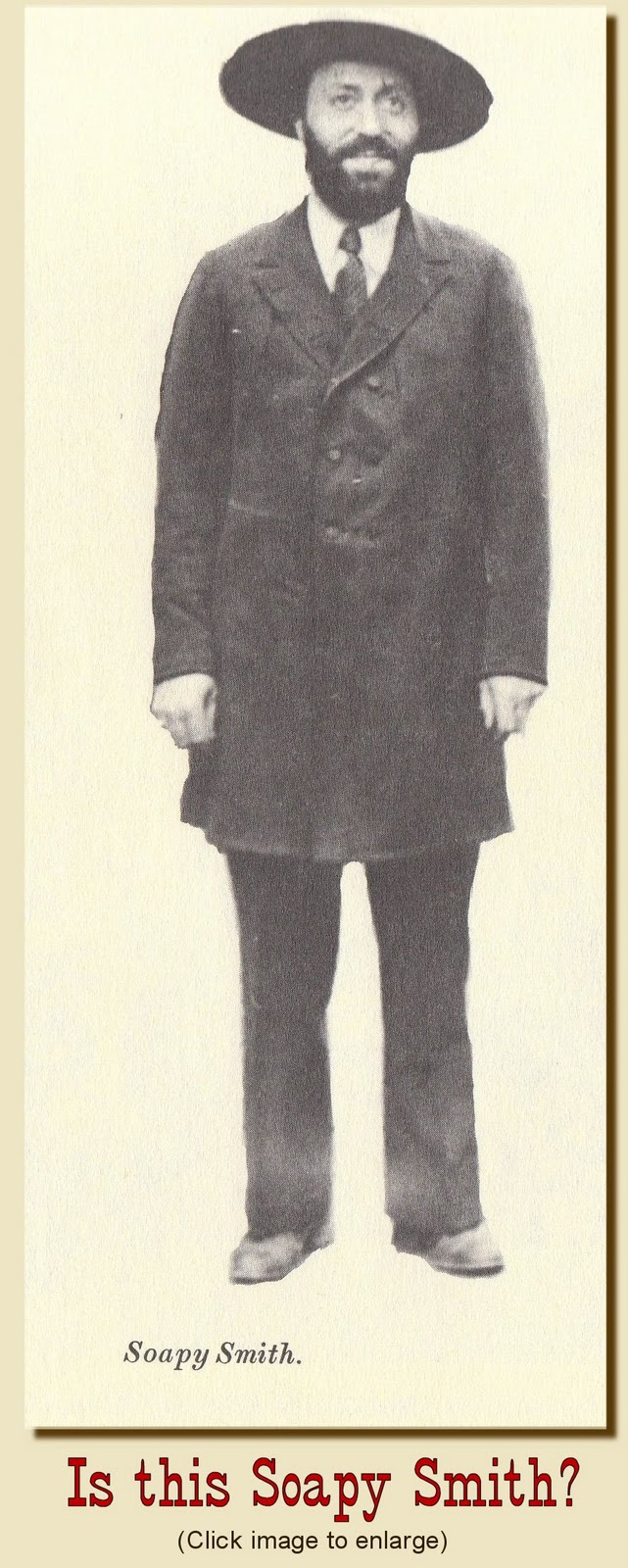
Is this a photograph of Soapy Smith?


I received the above photograph and question from an unnamed source at the Skagway Convention and Visitors Bureau in Alaska.


Jeff, is this really Soapy? It is on page 78 of "Gold Rush: the Yukon Stampede of 1898" by Margaret Poynter, 1979. She does not give credit for this photo.

My first response would be "no," however, I might say the very same thing if asked the same question about some of the known photographs of Soapy had I never seen them before. What do you, the reader think?


.

November 8, 2010

Soapy Smith and the Wild West Murder Mystery


Soapy (and "Unsinkable" Molly Brown) showed up at the 2010 Wild West Murder Mystery event held at the Colorado Center for the Blind. I hope Soapy was able to raise money for this charity as he had done in the latter part of the nineteenth century.


.

More on Soap Gang prison time.

(Click image to enlarge)


My good friend, Marlene, over on the Skagway Historical Society blog sent me some additional information on the prison sentences of the Soap Gang after Soapy was killed.

Jeff, below here is my somewhat questionable source on the death of Tripp in Chicago....Also, in Mission Klondike by Sinclair which I cannot right now put my hands on I think he said that Tripp never went to MacNeil Island but instead to Sitka for one year.

I also have that Foster was at MacNeil Island but was pardoned by President McKinley Dec 10, 1899, because he had consumption so he may have died around 1899-1900. I think that also was from Mission Klondike by Sinclair.

Also, I do not have much on Bowers but will continue to look.... - Marlene

Regular visitors know that I enjoy and post almost everything I find on Soapy even when the information seems questionable. Marlene is correct when she writes "somewhat questionable source..." thus the following warning...


 Calgary Herald 28 Feb 1907

“SOAPY” SMITH’S FINISH
How Desperate Skagway Gang was Exterminated
By Long suffering Citizens.
By J.P. Connell Printed


Many versions of the histories killing of Soapy Smith, and the subsequent clean up of his gang in Skagway in July 1898 have been written or told. Recently there was a foregathering of sourdoughs in this city, just a little supper party in a downtown restraunt at which I happened to be present. In the group also was Detective W.H. Welsh superintendent of the Canadian Detective bureau. All those present had been in Skagway in the stirring times of July 1898 and all agreed that the full true story of that time had never been published. Detective Welsh who had made it his business to know all the circumstances in connection with that tragedy, the records of the men Composing Soapy Smith’s gang, its operations in Skagway, the killing of Soapy and Frank H. Reid and the subsequent apprehension and deportation of the gang, was asked to relate what he knew of it. What he said partly for his? The story here set down and is the firs comprehensive and authentic or authoritative narrative of these events which, as far as is known to those gathered together at the supper table has ever been published.

The chief actor in that drama Jeff Smith, universally known as “Soapy” was born in Portland between fifty and fifty-five years ago. At the time of his death he was between forty-five and forty-eight years old.

His record included almost every kind of flim-flam game known from gold-bricking to phony paper, though strange to say, it is not known that he ever was convicted or served a sentence. His graft was to stand in with the police of whatever city he chose to operate in. When his presence proved unwelcome he would depart for new scenes of activity.

He got his pseudonym as an itinerant soap merchant in Denver Col. He was the originator of the well know trick of selling soap wrapped in $5 or $10 bills for a dollar, but when the purchase received the goods they were always lacking the wrapper. He had a trick also of during the soap to make a lather which he rubbed on his eyes apparently to prove some wonderful quality he claimed for it.

Soapy made an ineffectual attempt to corrall Cripple Creek in its boom days, but failed, and was driven out of the town. From one city to another he was invited to move until he landed in Skagway.

Skagway’s reputation though of course, It numbered some honest men in its population, was not very savory. Its authorities had stolen the land which composed the townsite from William Moore, and he has not to this day been paid for one land which he had pre-empted and occupied years before Skagway was ever thought of. So Soapy found the atmosphere congenial and proceeded to set up his kingdom of loot. From all over America crooks and rogues flocked to his standard. They organized themselves into a gang of thieves and sharpers. They grafted the civic administration, they muleted saloons, they pulled down cake off from the women of the town. They buncoed travelers and miners, they operated “fixed” Gambling machines and roulette wheels, they played the three-card game and thimble rigged the innocent chechacos, they flim-flammed the miners who brought in dust and after every other scheme has been worked, they looted the bank’s vaults and held up men at the point of the gun. Pokes of dust disappeared into the Bank’s vaults mysteriously disappeared and the claimants could never get satisfaction. It was the distrust of the local bank engendered by Soapy’s influence with it that made the opening for the Canadian Bank of Commerce of which it availed itself.

The town marshal was a member of the gang and the local newspaper of the little town was edited by another member, Doc Hornby. They levied toll on every man who came to the town or passed through it. If a man carried his grip across the wharf they controlled, it cost him two bits. If he set it down it cost him four bits for storage. To land a trunk costs a dollar.

Soaply’s Saloon the Headquarters.

Soapy’s saloon was the headquarters of the gang. There the miners and checaco’s were rolled. There too the famous came eagle was kept. The place was arranged with a convenient back door for the escape of the con man when he had secured his plunder. Things had been running with such barefaced boldness, robberies, shootings and holdups had become so frequent that the town’s business was being injured. Threats were made to the business men to go over and resurrect the dying town of Dyen and thus kill Skagway. The business men in addition to paying tribute to Soapy’s gang saw that their business was to be ruined by the men to whom they were forced to pay tribute. Public indignation has reached such a pitch among the honest in the city that it needed only the events of July 7 to fan the sparks into a flame of action.

Such were the conditions in the town when on that morning. R. Stewart, a painer, came into Skagway, over the Dalton trail from Dawson. Stewart had a poke containing $2,800 in dust. This he cached in the safe of Isadore Kauffman, who was a reputable business man running a drygoods store in the town.

First Gold Brick Artist.

Those of Smith’s parners in the loot who took part in the events immediately proceding to the tragedy where landed smith into eternal diquietude that night were Deep Sea Carter, alias Slim Jim, bunco-steerer, con-game operator etc. Another was Tripp who afterwards died in Chicago, Tripp had the distinction of having been the first gold-brick artist in the United States he having imported the idea from Italy, where it originated thus founding an industry that has proved so lucrative to crookdom on this continent.

Then there were Tom O’Brien, and his partner Waddel. O’Brien afterwards killed Waddell in France and is now doing a life sentence in Paris for that crime. Another worthy was Power, who has disappeared from the ken? Of the police in recent years and has therefore probably turned over a new leaf since the haleyon days in Skagway.

City Marshall Taylor took only a negative part in the day’s tragedy but was among the fugitives after the killing that night.

After caching his dust poke. Stewart started out to do the town and encountered Slim Jim, Slim quickly made friends with the lucky miner. Old con man and Bunco artist as he was the unsophisticated man from the hills was an easy victim of the Smith one’s specious talk. The talk of course turned on dust – dust was everything in Skagway in those days and Stewart confided in Slim Jim the fact of his poke, and where it was. Slim told Stewart he could sell his dust for him at $22 an ounce. Had Stewart been a shrewd man this extraordinarily high price – gold at that time being worth about 418 should have caused him to be suspicious. He however fell into the trap and agreed to take his dust from the safe to meet Slim Jim’s friends.

Slim accompanied Stewart to Kauffman’s store and there Stewart received his poke. Kauffman had no opportunity to warn Stewart as he certainly would have done had he been able to elude the vigilance of Slim Jim. He knew that any interference in the game on foot would have been as much as his life was worth.

Slim accompanied Stewart around to Jeff Smith’s saloon, the redoubiable Soap’ys layout on Holly street. There he met Tripp and Soapy and othersof the gang. Each took a turn in handling and appraising the poke.

In the rear of the room the famous tame eagle solemnly blinked at the proceedings. It was frequently an unconscious and often useful partner of the gang in their operations.

At the psychological moment Stewart’s attention was directed to some antics of the tame eagle. In that moment his poke disappeared. A few minutes afterward Tripp was seen running out of the back door with it partly concealed under his coat.

Stewart’s protests availed him nothing and he went to find Town Marshal Taylor, who was busy on a building he was erecting presumably out of his share of the proceeds of just such transactions as he had sent Stewart in search of him. Stewart could get no satisfaction out of the marshal, and returned to the business section of the town.

This was the last straw that broke the patience of the respectable element of the town. Business men had begun to realize that if the bunco card sharking robbery and murder were not summarily stopped that Skagway’s fate was sealed as a miners and others had already begun to give the place a wide berth. The reputation of the town through the operations of Soapy smith and his gang had sank to such an ebb that its effect was ever at that time to be seen in the business of the town.

The owner of the Golden North hotel called a meeting for that night in Sylvesters hall. When the crowd assembled it was found that the hall could not accommodate them so the meeting adjourned to the wharf owned by the same firm. Although it was nearly 9 o’clock at night when they finally gathered on the dock, it was broad daylight, the artic sun lighting up the scene as at midday.

Guards were put out on the wharf sides. It being low tide and in the land approach Frandk Reid was stationed. The chairman. The hotelkeeper who had called the meeting, then began to address the crowd. Whatever interests his remarks may have aroused was overshadowed by the tragedy that took place within a few minutes after he began to speak.

Coming down the trail in the full glare of the Artic sun, drunk, and wagering with a Winchester rifle in the elbow of his arm came Soapy Smith. Word had brought to him of the meeting and its purpose, and with the nerve for which he was noted he had taken his ride to go forth single-handed and cow or kill those who had dared to dispute his domination and despoiling of Skagway. Scores of times in the past both in Skagway and the Western States he had faced death from the other man’s gun.

Once in Skagway a miner had got the drop on him, but he coolly looked his protagonist in the eye and without a tremor pulled his own gun, after having been ordered to throw up his hands. No man in Skagway could shoot quicker or straighter than Soapy.

But that night he was up against a man whose gun play was so fast and sure that given the least bit of luck, it was almost a certainty that if shooting commenced Soapy’s fate was sealed.

That man was Frank H. Reid, surveyor and engineer of Skagway who had roughed it out ant toughed it through out the Western States. Reid was a gun man quick as lightning in action. At least one man had had death pumped into his system from the muzzle of Reid’s 45 caliber Colts, which he carried in a holster at his hips.

Soapy surged on in his reckless in Reid who peremptorily ordered him to stop. His answer was a point-blank shot fired at close range without leveling at Reid.

Overconfidence perhaps at such short range or the fatal atom of luck, which swings the balance one way or another, spelling life or death for him who wins or loses, may account for Soapy’s failure to hit Reid in that first surpised shot.

Soapy made a frantic effort to pump a fresh cartridge into the chamber of his rifle. In that instant Reid’s revolver spun on his hip, clicked and missed fire. Surely was the goddess of luck distributing her favors equally to both antagonists. Reid’s luck had been handed to him when Soapy’s first shot missed him. Soapy’s came when Reid’s revolver missed fire. Then Luck handed Death the loaded dice.

Two shots one from Smith’s 30-30 Winchester, the other form Reid’s 45 caliber colt rang out and the horrified men gathered on the dock saw Smith spin round and pitch forward and lay still while Reid sank slowly to the ground.

The bullet from Reid’s revolver had passed through Soapy’s left coat sleeve into his brest through his heart and lung and lodged in the ribs of his right side. He fell without a groan and as he fell he lay composed as in sleep, one hand crossing his breast. Soppy’s career of crime was ended. A man came along eyed the corpse contemptuously and said. Good enough for you _____ _____ ____ shoving it with his foot. Reid had been hard hit in the hip. The assembled men rushed up to him and immediately carried him to his own office opposite Clayson’s stores. All that medical aid could do for him was done, but in two days he cashed in and the wharf tragedy became a double one.

Word quickly reached the gang at headquarters that Soapy was killed, and that the citizens had organized a vigilante committee to clean out the rest. That was the ignal for a stampede and they all took to the hills.

Meanwhile the citizens had lost no time. Captain Sherry, since dead formerly police captain in Portland ore. Took the leadership and called for volunteers to act as guards and to hunt down the fugitives. Two men were detained to each of the four wharves to see that noen of the gang escaped to sea. The Dyea and White Pass trails camp No 1. The White Pass & Yukon railway were then guarded and searched for the fleeing members of the gang. The mounted police station at White Horse was telephoned to and police guards were set to watch the trail and turned back some of those who tried to cross the summit. A day or so 37 were rounded up the last three being Slim Jim, Bowers of many aliases and old Tripp.

These last three were starved out and came down the trail Sunday evening, where they were observed by E.R. Peebles and his wife and family who were up to the graveyard and saw the trio making their way along the face of the mountain. Word was at once brought to town and the men were captured that night at 9:10.

Of the 40 men captured and tried before Judge Shellberg most of them were allowed to leave the country which they did in bunches of six or seven.

Among them was Dr. Hornby, editor of the Daily Alaskan, who however was lined up and photographed along with the rest. The last three of the gang were convicted of robbery and sent to McNeill’s Island.

And thus was completed the destruction of a gang of organized criminals unique in the north or for that matter perhaps on the continent, yet lacking in the finish and subtlety of the gang which later dominated Nome and despoiled the placer miners of Anvil Creek.

But the troubles of the gang were not over when they were deported from Skagway, Not a town on the coast wanted such men. The police of Seattle, Tacoma, San Francisco and all the other ports refused to allow them to land. Juneau wanted them not, and Nome was only an undiscovered wilderness at that time. One of them committed suicide on board the boat, which had become for him only a floating prison.

Interesting sidelights are thrown on the narrative recalled by the mention of the names of those who took part in the events narrated. For instance the hotelkeeper who had acted as chairman of the citizen’s committee was himself destined to meet death by falling off that identical wharf.

I have made diligent effort to learn his name, but not one man who was in Skagway at the time, with whom I have talked can remember it. Even a contemporary hotelkeeper, and a man who boarded in his hotel, were unable to recall it.

One of the Claysons, a Skagway merchant was subsequently murdered on the Dyes Trail.

Stewart recovered all his dust except about $600 which was never accounted for. The poke, with much other loot was found in a trunk in Tripp’s shack.

Both Soapy Smith and Frank Reid are buried in the little cemetery near the town, Skagway after the tragedy became a safe and normal place and fully recovered from the effects of the evil doings of the gang.

Thank you very much Marlene!


.