Showing posts sorted by relevance for query John Price. Sort by date Show all posts

April 6, 2011

Was Skagway attorney. John G. Price an associate of Soapy Smith's?

Newspaper ad in the Skaguay News.
(Click image to enlarge)


Marlene McCluskey over at the Skagway Historical Society blog posted some previously unknown (at least to me) information on Skagway attorney John G. Price, a possible associate of Soapy's

Marlene writes,

John Garland Price was born on this day, April 4, 1868 in Iowa. He became a lawyer and came to Skagway in August 1898 from Rico, Colorado. He married Maybelle Dent here on February 14, 1899 and later that year had a daughter Alma or Ruth, but she was born in Oregon. They had 4 children altogether: Alma/Ruth, Rachel, John Jr., and William who died in infancy.

John G. Price was a member of the Arctic Brotherhood and wrote "The Arctic Brotherhood" in the Alaska-Yukon Magazine in April 1905. He worked for the Price & Stevens Law firm and was a lobbyist in 1899 to Washington D.C. He retired to Washington state where he died in 1957 on Mercer Island.

According to Ashley at the ArcticBrotherhood blogspot, he was a supporter of "home rule". Seen above is a demonstration in front of the old Elks Hall (which burned) of folks protesting for "home rule".

1902;family chronicles GR part website;
http://arcticbrotherhood.blogspot.com/2011_03_01_archive.html

There is no solid evidence that Price was associated with Soapy, however, he did associate with men who did. In Alias Soapy Smith, The Skaguay Real-Estate & Investment Company on McKinney Street (5th Avenue today) next door to the post office,

... was another operation believed to have been under Jeff’s control. J. Allen Hornsby, Arthur H. Bryant, and John G. Price operated the office. Their advertisement read,

Real estate bought and sold, houses to rent, business chances, investments made for non residents, special attention paid to the care of property placed in our hands. Mining properties bought and sold & examined. Headquarters for quick cash sales. References, all the prominent men in the city.

Both of Price's partners were associates of Soapy's. Skaguay property often illegally changed hands. As in Creede, Jeff made the most of property protection rackets. Hornsby was on Jeff’s payroll, and Price is believed to have been Skaguay’s first attorney. Assumed is that Jeff used his services from the very start. Of special note is the line “investments made for non residents.” The wording suggests that residents should stay clear of this firm, it being an unwritten but often professed practice that the Soap Gang worked principally on out-of-towners.


John Price: page 480, 521.


Jeff Smith


.

November 30, 2021

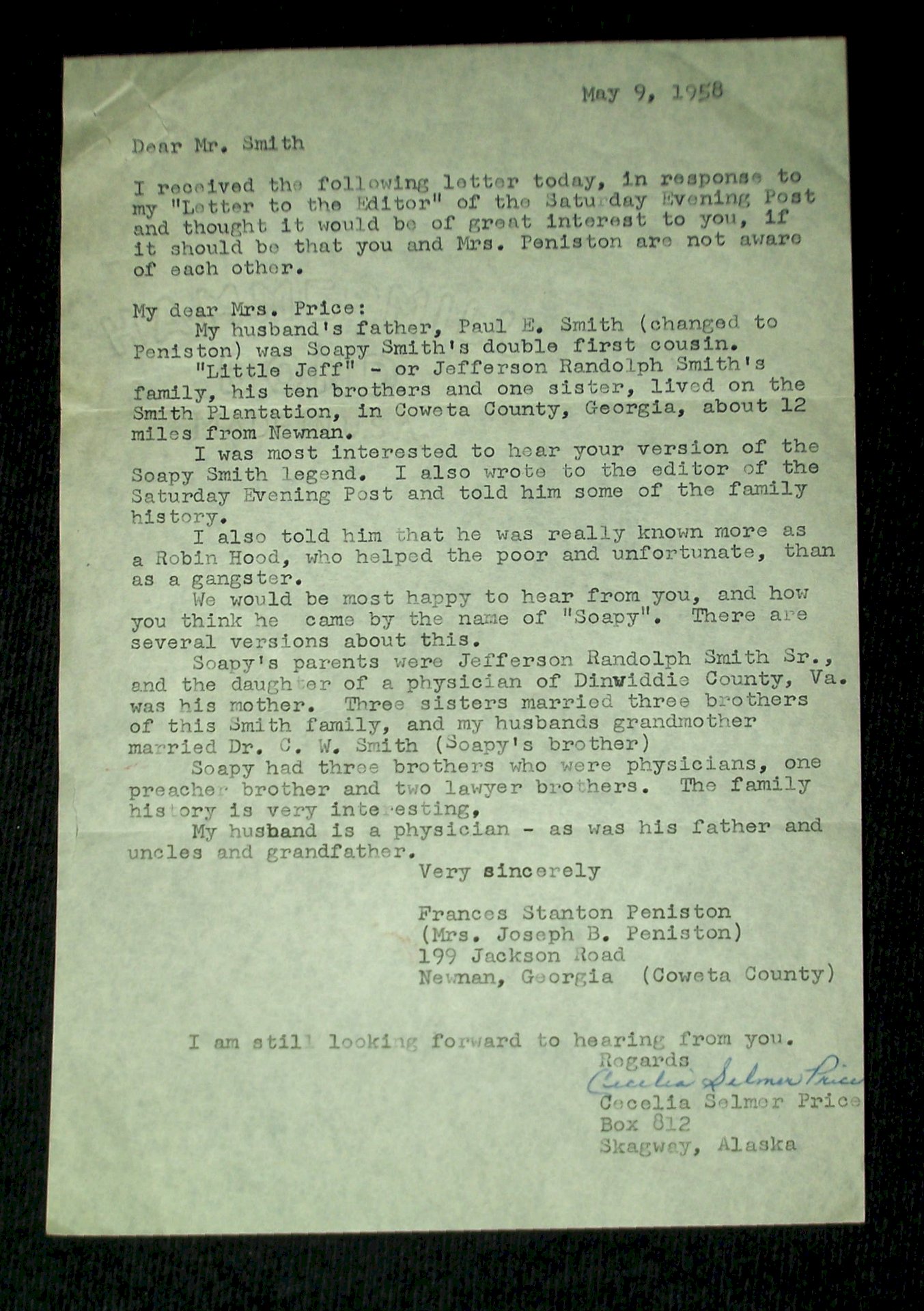
Artifact #89: Letters to and from Skagway historian Cecelia Selmer Price, 1958-1963

Artifact #89
Letter to Justin M. Smith
From Cecelia Selmer Price
May 9, 1958
Courtesy of
Jeff Smith collection

(Click image to enlarge)


also told him that he was really known more as a Robin Hood, who helped the poor and unfortunate, than as a gangster."

Artifact #89 contains the first communication with Skagway resident and historian, Cecelia Selmer Price, a typed letter to Justin M. Smith (my uncle), May 9, 1958. I would not be born for another five months.
     It all started with a small piece written by Harold Helfer published in the Saturday Evening Post, May 10, 1958. 
 
So We Commemorate
A PIONEER GANGSTER

Saturday Evening Post
March 22, 1958
Jeff Smith Collection

 (Click image to enlarge)
 
Below is the context of the article.
 
So We Commemorate
A PIONEER GANGSTER
 
Leering down from all comers from a cliff above the harbor of Skagway, Alaska, is a white-painted skull twenty-five feet high, shaped of natural stone. It serves as a reminder of the abrupt end of Skagway's leading bad man, Jefferson R. (Soapy) Smith, and is lettered: Soapy Smith's Skull.
     Soapy Smith, a lanky, sardonic saloonkeeper with a long black beard, ruled Skagway ruthlessly during the hectic 1898 gold rush. Hijacking, shakedowns and the stealthy technique of taking rivals "for a ride" were among his specialties long before Chicago and New York gangsters used them.
     If his crooked gambling tables failed to part a flush prospector from hard-earned gold, Soapy resorted to holdup at pistol point. When he publicly robbed grizzled old Alexander Steward of $3500 in nuggets, however, it was too much even for wide-open Skagway to stomach.
     Frank Reid, a railroad construction boss for the White Pass and Yukon Railway, organized vigilantes. Soapy and his gang overawed them without a shot. Then Reid called a law-and-order meeting on a harbor pier. Sneering, Soapy stalked down the pier to break up the meeting. Reid, . 45 in hand, warned- then fired. Soapy shot back.
     Soapy died almost instantly. Reid passed away in agony twelve days later. The two were buried nearly side by side. But where Soapy's wooden slab bore only his name, age and death date, Reid's marble monument is inscribed: FRANK REID-THE MAN WHO GAVE HIS LIFE FOR THE HONOR OF SKAGWAY.

NOTE: The blue pen ink notes that don't make sense. Who wrote this, and why, is unknown.
      Price wrote a "letter to the editor," responding to the article, and the Saturday Evening Post published it. Below is the page cut from the issue, and the content of that letter.
 
 
The Legend of Soapy Smith
Cecelia Selmer Price
The Saturday Evening Post
May 10, 1958
Jeff Smith collection

 (Click image to enlarge)
 
 Below is the content of Cecelia Price's "letter to the editor."

Dear Sirs:
     I have just finished reading several paragraphs on page 78 of your March 22 issue, written by a Harold Helfer, entitled, SO WE COMMEMORATE: A PIONEER GANGSTER. There's been a lot of tripe published about Soapy Smith in the last sixty years, but this is the living end....
     The "grizzled old Alex Steward" that Mr. Helfer says was robbed of %3500 was a young man in his early twenties named John Stewart who lost a poke consisting of $2500 in Soapy's saloon.
     Frank Reid (who killed Soapy) was never at any time employed by the White Pass & Yukon Railway. He had been a schoolteacher in Oregon, but his main occupation was that of bartending, both in Oregon and Alaska, and he was a bigger crook than Soapy Smith ever dreamed of being.
     Now we come to the picture of the four dubious-looking men. None of them is Soapy Smith.... The bearded man identified as Soapy was a gambler named Turner Jackson....
     I have lived in Skagway all my life, and my family has been here since the gold rush. For the past eleven years I have made a thorough study of the life of Soapy Smith.
 
CECELIA SELMER PRICE
Skagway, Alaska  
   
In April 1958 Alaska Sportsman forwarded a letter written by my uncle Justin M. Smith, a grandson of Soapy, to Cecelia Price, and on April 10, 1958 she typed out a letter to Justin.
 
Typed letter from Cecelia Selmer Price
To Justin M. Smith
April 10, 1958
Jeff Smith collection

 (Click image to enlarge)
 
 Below is the content of the letter to Justin Smith.

April 10, 1958
Mr. Justin M. Smith
5618 Vecina Drive
Corina, California

Dear Mr. Smith:

     Mr. Tobin of the Alaska Sportsman has forwarded your letter to me, and I must say that I'm utterly speechless to learn that there really are living decendents[sic] of Soapy Smith. I knew he was married and had a son, but I always felt that any living members of his family would have stepped forward long ago and claimed relationship to my "Gentleman Outlaw."
     I say "my" because, as a Skagway-ite, and a writer, I have devoted the past eleven years to serious research on your grandfather's life - so seriously in fact, that I feel I knew him personally, and in all probability - know more about him than anyone else now.
     As a result, I wrote a book - "Gentleman Outlaw" - which I have condenced[sic] for SAGA Magazine. Since your letter states that you have his papers and letter, would it be asking too much to be allowed copies of them for reference? I will gladly reimburse you in anyway, and you have no idea how they would help my work. Knowing now that they exist, and may be available, I will hold off on sending the manuscript to SAGA, until I have heard from you.
     As you may be interested in my past research, I am sending, under separate cover, my story "The Green Farm Kid" which will appear in the Sportsman, The story was certainly not of any effort to write, as it's word for word they[sic] way I took it down in shorthand, while Fletcher talked. I consider it to be an excellent example of the real Soapy.
     You will also be pleased to know that I sent the Saturday Evening Post a nasty letter in reply to that stupid "So We Commemorate" in their last issue. As you know - the man the identify as Soapy was not him at all. Frank Reid never worked for the White Pass, and never was anything but a crooked bartender.
     Enclosed with this letter are a few excerpts from "Gentleman Outlaw" which I will not change, even in view of the fact that you have Soapy's papers, etc., since I can prove the events to be correct. Believe me - Jesse James has nothing on Soapy, and I certainly hope my efforts will bring him into his own, and I hope you will allow me the use of copies of his papers.
 
Most sincerely
Cecelia Selmer Price
Box 8L2
Skagway, Alaska  

I could not find Cecelia's stories, "Gentleman Outlaw" and "The Green Farm Kid" online. It is unknown if they were ever published.    
     Upon seeing Price's "letter to the editor," Smith family member, Frances Stanton Peniston of Newnan, Coweta County, Georgia obtain Price's mailing address from the Saturday Evening Post and wrote to Price. Upon receiving the letter, Price wrote to Justin M. Smith again. Following is the transcribed letter artifact #89, for ease of reading.
 
May 9, 1958
Dear Mr. Smith
 
I received the following letter today, in response to my "Letter to the Editor" of the Saturday Evening Post and thought it would be of great interest to you, if it should be that you and Mrs. Peniston are not aware of each other.
 
My dear Mr. Price:
     My husband's father, Paul E. Smith (changed to Peniston) was Soapy Smith's double first cousin.
     "Little Jeff" - or Jefferson Randolph Smith's [Jeff Sr., Soapy's father] family, his ten brothers and one sister, lived on the Smith Plantation, in Coweta County, Georgia, about 12 miles from Noonan.
     I was most interested to hear your version of the Soapy Smith legend. I also wrote to the editor of the Saturday Evening Post and told him some of the family history.
     I also told him that he was really known more as a Robin Hood. who helped the poor and unfortunate, than as a gangster.
     We would be most happy to hear from you, and how you think he came by the name of "Soapy". There are several versions about this.
     Soapy's parents were Jefferson Randolph Smith Sr., and the daughter of a physician of Dinwiddie County, Va. was his mother. Three sisters married three brothers of this Smith family, and my husbands grandmother married Dr. C. W. Smith (Soapy's brother)
     Soapy had three brother and two lawyer brothers. The family history is very interesting.
     My husband is a physician - as was his father and uncles and grandfather.
 
Very sincerely
Frances Stanton Peniston
(Mrs. Joseph B. Peniston)
199 Jackson Road
Newnan, Georgia (Coweta County)
 
I am sill looking forward to hearing from you.
Regards
Cecelia Selmer Price
Box 812
Skagway, Alaska
 
Frances Lebby Stanton
Married Joseph Bowdoin Peniston
1898-1994


Frances Stanton Peniston made some major errors in her description of her husbands family.
     All correspondence written by Justin to Cecelia is missing or non-existent. Above her signature is the message, "I am still looking forward to hearing from you," which indicates that Justin may not have contacted her. At some point Justin did give his portion of the Soapy Smith collection to his brother (my father) John Randolph ("Randy") Smith. Within Justin's portion of the collection were the letters sent to him by Cecelia Price, and this appears to have been when John learned of Cecelia and began communicating with her.
 
Typed letter from John Randolph ("Randy") Smith
To Cecelia Selmer Price
September 13, 1963
Jeff Smith collection

 (Click image to enlarge)
 
 Below is the context of the letter.

FROM THE DESK OF
RANDY SMITH
9-13-63
Dear Cecelia,
     The Soapy Smith clan is a very peculiar bunch!
     There was originally nine of us children born to my late father, Jefferson R. Smith (Soapy's son). Two of the girls have passed away; three boys and four girls remain. We are not as close as we should be and are living all over the country.
     I have just run across a letter that you wrote to my younger brother Jesse in 1958. I do hope you are still active along these lines!
     We all have an extremely deep affection for Soapy, perhaps in a different way than you say you have in your letter, for we have lived with Soapy's wife and also feel we knew him personally..... nothing was hidden from us kids, both good and bad.
     To get to the point.....I do not know to what extent you have communicated with Jesse, however my older brother Joe has in his care, outside of a few odds and ends, everything that was handed down belonging to Soapy. He is now in the process of having copies of letters etc. distributed to all members of the family. Perhaps we can exchange copies of interesting articles.
     You sound more like a Smith then most of us!
     Why not join our family!
 
Sincerely,
 
Randolph J. Smith
618 Elmwood Street
Anaheim, California
 
To introduce myself:
 
     I was born in St. Louis Missouri in 1917, the son of Jefferson R. Smith and Grandson of Soapy.
     Enclosed is a copy of two newspaper clippings.
     My father was involved in politics, in one way or another, most of his life and for reasons of his own kept much of his past to himself. Some however did get out.
 
The fact that John ("Randy") wrote, "I do hope you are still active along these lines" indicates that this is the first correspondence he had written to Cecelia. 
     

Typed letter from John Randolph ("Randy") Smith
To Cecelia Selmer Price
September 30, 1963
Jeff Smith collection

 (Click image to enlarge)
 
     At some point between September 13 and September 30, 1963 John R. and Dorothy Smith (my father & mother), Joseph J. and Thelma A. Smith (my uncle and aunt), Justin M. and Ester Smith (my uncle and aunt) and Cecelia Selmer Price, met with Royal Pullen, son of Harriet Pullen of Skagway, both being pioneers of that town. My father recorded the interview. That interview reel-to-reel tape and a recorded cd of the tape is in my collection and the information was used and credited on several pages throughout my book, Alias Soapy Smith: The Life and Death of a Scoundrel.
     Below is the context of the letter.
 
FROM THE DESK OF
RANDY SMITH
9-30-63
 
Cec,
     
     I wish to sincerely thank you for making it possible for us to obtain the tape recording of Mr. Pollen[sic]. Upon returning to Anaheim we replayed the tape and the results were excellent. As soon as possible I will make copies and will forward one to you if you so desire.
     As I do not know Mr. Pullens[sic] address, will you please convey our deepest appreciation to him and his wife. They are certainly wonderful folks. ...and by the way, so are you.
     Perhaps some of the differences that arose came about because of the DINNER we had.
     My wife Dotti and I both thank you again for the time you spent with us, and perhaps when you are in Anaheim we might get together for LUNCH.

Randy Smith
618 Elmwood Street
Anaheim, California

This is the last communication with Cecelia Selmer Price that I have in my files. 
     I remember learning about Cecelia Price from my father, and how she believed that Soapy was a "gentleman outlaw" and was not the only criminal in Skagway. That the vigilantes that killed Soapy had criminals and "not so innocent" citizens within it's ranks. She said that "Reid [Frank H. Reid, shot Soapy at least twice during the shootout on Juneau Company wharf, before being shot and mortally wounded by Soapy] was a crooked bartender at best." I am not making any judgement calls here, but rather I am simply letting the reader know who Price was and what she told my father. I wish I had been old enough to meet her.


Cecelia Selmer Price: page 531.


"[Frank Reid] was a bigger crook than Soapy Smith ever dreamed of being."
—Cecelia Selmer Price
1958 letter to Justin M. Smith (Soapy’s grandson)




February 13, 2021

John T. Waller, early bunko partner of Soapy Smith

John T. Waller and Jeff R. Smith
Las Vegas, New Mexico
Daily Gazette
November 8, 1881

(Click image to enlarge)


OHN WALLER
Early bunco partner of Soapy Smith

New research on confidence man John T. Waller leads to new information on Soapy Smith. This is the first clue that Soapy operated in New Mexico. 
 
John T. Waller was one of the few known confidence men who is believed to have retired comfortably wealthy and is not known to have spent much time in jail. The last letter within Soapy's circle of friends and associates states that Waller had moved to Key West, Florida where he successfully operated short cons. Around 1895, according to his obituary, he moved to Dade City, Florida and invested his money in property and perhaps keeping a link to his past, he also invested in several traveling circuses. He still held a sizable estate upon his death in 1915 at age 65. [1]
     According to the 1900 census, Waller was born in August 1850 in Ohio. According to his obituary Waller was an early settler in eastern Pasco County, Florida, created in June 1887, matching his arrival there. As of now, the earliest known connection between Soapy and John Waller was in New Mexico territory, just shy of fours months after the shooting death of Billy the Kid. On November 7, 1881 confidence men Soapy Smith and John T. Waller arrive in Las Vegas, New Mexico. It is certain that the two buncos worked the town for a tidy profit.
 
LAS VEGAS, NEW MEXICO
1882
Courtesy of the Library of Congress

(Click image to enlarge)
 
John Waller gives his residence as "Denver," and Soapy gives his as "Fort Worth, Texas." Eight days later, on November 15, 1881 both gentlemen register at the Exchange Hotel in Santa Fe, New Mexico.
 
Santa Fe Daily
Santa Fe, New Mexico
November 16, 1881
 
(Click image to enlarge)
 
The two newspaper clippings are new but the existence of con man John T. Waller is not new. Up until now, it was known that Soapy and he most likely were close friends, but there was no evidence, until now, that the two operated swindles together. Though it was assumed that Waller and Soapy had a history working together, the two clippings predate what was known.
     
 
The Exchange Hotel
Santa Fe, New Mexico
circa 1890
(Soapy stayed here)

(Click image to enlarge)
 
Previously, the earliest date was December 24, 1881 when Soapy received a letter from John Waller in Tombstone, Arizona, using stationary from Nellie Cashman's Russ House.

Friend Jeff
      I received your card. I shall not stop in El Paso. You never said what you had been doing. Can you not take time to write a letter and give me some news. I am afraid that you will get busted before you get home. If so send me word [–] as long as I have a dollar you can have half of it. I am doing a good business here. I sold $82.75 yesterday. I took in $43.50 last night and it was so cold that I came near freezing. I shall only stay here 2 or three days longer. I got in here last Wednesday. I saw Taylor & his girl on the stage that day going out. I wish you a Merry Christmas & a happy New Year. Address Colorado City, Texas.

Yours truly,
John T. Waller [2]

Below is a copy of the letter.


(Click image to enlarge)
 
 
     On July 5, 1883, a letter to Soapy (in Denver) from C. C. Lamos of Chicago, head of a retail and supply company from which Soapy purchased cheap watches for use in various swindles.

Friend Smith
      Yours came to hand. And I must say I had given you up as gone. I had asked several old boys and they think you are an “angel from Colorado.” Some one said the other day that the Kid died in Colorado. John Waller is doing big work in Montana. I sent him two lots the 3rd. He was in Deer Lodge, Montana, and sent him a big freight order to Portland, Oregon. John has made some big money since he left Chicago.
      Well Jeff I sent catalogs … but you can’t tell much about them. Anything you want let me know and I will make the price all o.k. you know that.
      Hoping you are doing well and catching on good.

I am yours only
C. C. Lamos
Fair lists are not ready yet. [3]

Lamos supplied gambling equipment (known as sporting goods) and spurious personal items such as jewelry and watches for use by “cheap John” men. This letter shows that Soapy had become a well-liked, repeat customer. It also shows that confidence man John Waller was also a well-respected member of the bunco fraternity. The last comment about “Fair lists” refers to schedule dates for state and county fairs throughout the country, vital information for an ambitious traveling bunco man. It probably cost a sizable amount. That this list was important to Soapy indicates that he was not blindly traveling the west but rather to targeted locations.
     Lamos next wrote to Soapy in Denver on December 4, 1883, with an apology and a mention of John Waller.

Friend Jeff
      Am dam [sic] sorry the watches did not pan out all ok.… You must always send them back at my expense as I hate like the duce [sic] to have any of the old boys kick on me. I had rather pay the difference myself. 6 oz white watches nice ones 4.25 each, is the best anyone can do. They are nice ones. Just got in a fine lot today. The Silver watches I have just [illegible] up to the Waltham agency here and will see what they say.
      He sends this reply and you can’t get any made I don’t think this season as they are very busy at the factory for holidays. [John] Waller is still in Oregon doing well as usual he is making big money this year. Wishing you the best of good luck.

I am yours only
Lamos [4]
 
C. C. Lamos writes a response letter to Soapy, on October 20, 1884, mentioning Waller.

Friend Smith
      I got an order today from Waller, was a little surprised to see him in Texas. I have written to Balding [—] also to Wilkinson Hq [Headquarters], and other parties for them to send you their bottom cash prices on roller skates and guess they will attend to it at once.
      Am glad to hear you are still on earth, and catching on. I suppose Waller is worth from 25 to 30,000 by this time and we shall hear of him starting a Bank one of these days.
      I should think Denver was a good place for business and it would be a fine town to stick to. Let me hear from you at any time, whether you want goods in our line or not.

Tom Lamos [5]
 
     A letter from John Taylor in Los Angeles, dated January 25, 1887, arrived in Denver, with a mention of Waller.

Friend Jeff
      I received your letter this morning and was glad to hear from you. I went to a sale yesterday and worked the shells and I turned a party for twenty dollars. There was another party there and they win $90 from a sucker and he caused a great fuss. … There is three or four shell mobs here working besides the body backed [by “protection”]. It is desperate to think it will last very long as the papers are turning loss on them. I have not received a letter from John Waller…. I will now close with my regards to all the boys. I hear from Tom Murphy [that he] was here in Los Angeles last year. I hope these few lines find you and your wife in good health.

From your friend,
John Taylor [6]

Taylor spoke a little too soon about not receiving a letter from Waller. He received Soapy's letter, replied, and enclosed a letter to forward to Taylor. Waller had been traveling the country but had settled in Key West, Florida. Waller and his gang were reported doing well on the island, taking about $300 a night from short cons. In the letter, Waller invited Taylor to Key West, and if he did, Waller would set up a meeting with the marshal so that Taylor could operate. [7] Taylor declined the invitation as he was repenting his ways, turning to religion.
     The known mentions of John T. Waller and his operations end soon after he relocated to Florida. He died in 1915, age 65 with a "sizable estate."
 
John T. Waller's obituary and transcription.
 
John T. Waller's obituary
The Dade City Banner
June 4, 1915

 (Click image to enlarge)

OLD CITIZEN FOUND DEAD IN HIS HOME
Body of John T. Waller Found Dead In His Home Last Sunday

      Mr. John Waller, sixty - six years old, was found dead at his home south of town last Sunday morning, May 30th, by sons of Mr. C. Brunt.
      The boys had called to see about some goats and after knocking on the door and receiving no answer, entered the house to find Mr. Waller lying dead upon the floor. From all appearances the body had been lifeless for several days and decomposition had set in.
      Mr. Waller came here twenty odd years ago and bought valuable property, much of which he still retained up to the time of his death. He owned eleven hundred acres of land near Pasadena, including three orange groves.
      He also had an interest in several traveling carnivals, having a partner said to be a French Count, who looked after these but who is now reported to be sick in a hospital in Oklahoma.
     No funeral services were held. The interment was in Dade City cemetery. The deceased leaves she that was Mrs. Waller, now divorced, and a married daughter, who reside at Pasadena, Cal.

The exact date of death can only be stated as, "a few days previous to May 30, 1915," as Waller was found dead on May 30, 1915, but “from all appearances the body had been lifeless for several days and decomposition had set in.” 
 

Waller's grave marker
Dade City Cemetery
 Pasco County, Florida, USA

Grave marker inscription:

TO
JOHN T. WALLER
Found sleeping at
Pasadena, Fla.
MAY 30, 1915
___
In memory of
His honor and
Character
From his friend
C. BALDASSARRE


SOURCES:
Find-A-Grave, profile for John T. Waller
[1] Dade City Banner 06/04/1915.
[2]: Ltr fr John T. Waller to Jeff R. Smith II, 12/24/1882. Geri Murphy col. The name Taylor in the letter may be that of John Taylor.
[3]: Ltr fr C. C. Lamos to Jeff R. Smith II, 07/05/1883. Jefferson R. “Little Randy” Smith col.
[4]: Ltr fr C. C. Lamos to Jeff R. Smith II, 12/04/1883. Jefferson R. “Little Randy” Smith col.
[5]: Hand-written Ltr on company stationary fr Tom Lamos of Lamos & Company to Jeff R. Smith II, 10/20/1884. Jefferson R. “Little Randy” Smith col.
[6]: Ltr fr John Taylor to Jeff R. Smith II 01/25/1887. Jefferson R. “Little Randy” Smith col.
[7]: Ltr fr John Waller to John Taylor 01/23/1887, Geri Murphy col.


John T. Waller
Sept 25, 2009


John T. Waller: pages 40, 42-43, 110-111, 137-38.


"One of the healthiest ways to gamble is with a spade and a package of garden seeds."
— Dan Bennett


April 24, 2011

More on Skagway attorney John G. Price.


The above photograph shows attorney John G. Price soon after his arrival in 1897. Back on April 6, 2011 I published a post on Price, and at the time I could not locate this photograph. The man in the rear, next to the tent opening holding a cigar is believed to be Price. Comparing with a later photograph is difficult due to the quality of the copy.

John G. Price


John G. Price: page 480, 521.


1896: Soapy arrested in Juneau, Alaska for operating the prize package soap racket. 
1898, Spain declares war on the U.S, two months after the sinking of the USS Maine. The U.S. declares war on Spain the following day and then backdates the declaration two days so that it appears that the U.S. declared war on Spain first.


Jeff Smith


(Click image to enlarge)


.

December 19, 2022

Mock Auctions: How Cheap Watches are “Worked Off” on Countrymen.

MOCK AUCTIONS
San Francisco Chronicle
June 22, 1879

(Click image to enlarge)


ock auction houses were a very successful addition to "Soapy" Smith's swindle businesses in Denver, Colorado. 
 
The mock auction is a swindle in which a victim bids on and purchases what he is made to believe is a high quality gold watch, but in fact, he is paying good money for a very low quality one. Past research and articles I have published on Soapy's mock auction houses were based on period newspaper articles, which gave some great information, while leaving open-ended questions, as to the details of where and how the watches were obtained. Based on letters in the family collection, I believed that Soapy purchased the cheap watches. One letter in family hands comes from C. C. Lamos, a retail and supply company from Chicago, dated December 4, 1883.
Friend Jeff

      Am dam [sic] sorry the watches did not pan out all ok.… You must always send them back at my expense as I hate like the duce [sic] to have any of the old boys kick on me. I had rather pay the difference myself. 6 oz white watches nice ones 4.25 each, is the best anyone can do. They are nice ones. Just got in a fine lot today. The Silver watches I have just [illegible] up to the Waltham agency here and will see what they say. He sends this reply and you can’t get any made I don’t think this season as they are very busy at the factory for holidays.
     [John] Waller is still in Oregon doing well as usual he is making big money this year. Wishing you the best of good luck.

I am yours only
Lamos [1]
The fact that the letter is an apology for poor quality watches had me wondering how Soapy kept a constant supply of watches coming in as any break in the supply would shut down the auction house until more watches were received.
     I came across a good answer from a newspaper article published in the San Francisco Chronicle, June 22, 1879.


MOCK AUCTIONS.
How Cheap Watches are “Worked Off” on Countrymen.

      The CHRONICLE has repeatedly shown up in its columns the snares and nefarious methods adopted by bunko and cheater “steerers” to entrap country visitors and rob them of their hard-earned money. There is yet another class of swindlers, whose victims are numbered by the legion, who nightly ply their thieving art, and from the peculiar manner with which their operations are conducted they are seldom or never caught and consequently but little publicity is ever given to their transactions. The swindlers referred to are certain Cheap John establishments on Kearny street and their game is so ingeniously played that frequently city people and bucolic visitors whose wisdom teeth have been cut by experience with bunko and cheater men, readily fall into the trap and are swindled. For the benefit of those who do not know the game alluded to or the history of it.
 
$75 WATCH AND HEIRLOOM

From the time the Cheap John gets it until it is disposed of to some victim looking for a bargain, the following will be of interest. The proprietors of these Cheap John stores will, during the day, when they are short of material, visit the various pawn-broker establishments in the city and buy up the unredeemed cheap silver and white metal case watches at an average price of $2.70 apiece. The watches, with a sufficient number of steel chains, are then taken to a gold plater, who soon after turns them out with bright gold cases. The plating is done with 18-carat gold, and a white metal or brass case watch is sold as an 18-carat gold watch. If it is a silver case watch it is sold with the guarantee that it is on a “coin basis.” In the employ of these Cheap John stores are some six or eight cappers. During the night they are given a watch to “work off,” and if successful they receive for their services a dollar a piece. The chronometer, the brand of which is generally Swiss, is “worked off” as follows: Capper No. 1, having received the watch before the evening’s business has opened, waits until the store is filled by a crowd of the curious when he approaches the auctioneer and intimates to him that he would like to sell his watch, which is either an “heirloom” or one that cost him $75. The auctioneer takes the watch and tells the “owner” he will charge him one dollar for selling it. The watch is offered for sale and Capper No. 2 bids $5 for it, which is quickly followed by bids from the other cappers until it is run up to say $10, and at that price it is knocked down to the bidder.

THE “OWNER”

Then speaks up, and says he will not allow the watch to go for such a low figure. He is informed by the auctioneer that he can make one bid for the watch, which he does, $16, and at that figure it is sold to him. The auctioneer claims his dollar for selling it, and, of course, as the “owner” has not that amount, the watch is then auctioned off again. It is now, the victim takes his first bite. The watch is started at $2, and the countryman maybe bids $5. The cappers crowd around him and explain its mechanism, the solidness of the case and the clearness of the crystal, etc. Greeny is caught; and the bids are run up on him until he bids $35 or $40, when it is knocked down to him at that price. He is then taken to the back of the store and charged one dollar for buying the watch, and if he asks for a guarantee, he is given the following: “Received of John Doe, $40, for a watch. —.” The countryman no sooner reaches the sidewalk with his presumed prize when he is roosted by another capper, who tells him that if the watch is gold he will give him $50 for it. They go to a jewelry store near-by where the watch is tested with water contained in a gold bottle. The jeweler demands one dollar before he will give the result of the test, and the money is handed over, and the victim is told that the watch is not gold, and he is advised to take it back to the auction-house and have it sold. He does so and the auctioneer again puts it up for sale and knocks it down to one of the cappers, who bids $2.50 for it. The seller retains one dollar as his commission, and hands over the balance, $1.50 to the countryman, who is

OUT JUST $38.50

On his bargain. It frequently happens that among the watches purchased by the Cheap John there is a small one. A satin-lined case is made for it, and it is then given to one of the cappers, who presents it at the mock-auction counter with the story that it was a wedding-present to his wife and that he is compelled by reduced circumstances to thus part with it. It is at once offered for sale, and “worked off” on some victim whose sympathies are interested by the tale of domestic affliction which caused the sacrifice of the marital memento, and who imagines that he is purchasing a first-class watch at a price far below its actual value.
     I found the details of how the mock auction houses operate to be of great interest, as Soapy's mock auctions in Denver likely utilized many of the same methods. Some of the information is new to me, such as
  • the purchase of "cheap silver and white metal case watches" from local pawn brokers, cheaply gold-plated, and then auctioned as being high quality gold watches.
  • The detail of the set-up and how the cappers lure-in the victims to bid.
  • The elaborate play of the capper offering to purchase the victim's new watch at a nice profit, with the condition of visiting a local jeweler for an appraisal, only to find out that the watch is not worth the price the victim paid for it.
  • Most notable for me is how the victim is lured back to the auction house, allows the watch to be auctioned off again, resulting in the loss of the bulk of the amount originally paid as well as the loss of the watch itself, thus allowing the swindlers to auction off the same watch to another victim.  


Click to enlarge

NOTES:
[1] Letter from C. C. Lamos to Jeff R. Smith, December 4, 1883. 


Mock Auctions: pages 15, 30, 43, 45, 47-48, 51, 58, 75-76, 88, 90, 92, 120, 129-32, 138, 159, 162.63, 180, 188, 190-91, 202-05.


"A sucker has no business with money in the first place."
—"Canada Bill" Jones