December 24, 2019

For years Soapy Smith was the only fakir allowed in Phoenix, Arizona.

"SOAPY" SMITH
A Phoenix man’s recollection
Arizona Republic
Phoenix Arizona
Wed., July 20, 1898
page 5

(Click image to enlarge)


or years he was the only fakir allowed in the city, and a more skillful one has never operated anywhere.

      On December 22, 2019 I posted a newspaper clipping that is a precursor to this newspaper clipping here. Published in the Arizona Republic (Phoenix Arizona) on Wed., July 20, 1898.
_______________

“SOAPY” SMITH
_______________

A Phoenix man’s recollection of the dead gambler
_______________

      Late advices from Dawson City give an account of the dead with his boots on of “Soapy” Smith, at one time the best known gambler on the great divide. A former Coloradoan who had known him since the early eighties, told a Republican reporter yesterday that “Soapy” Smith was directly responsible for the permanent closing of gambling in Denver. It came about in this wise: The Rocky Mountain News, under the talented and lamented [sic] John Arkins, took an occasional fall out of the gambling element, not for the purpose of suppressing gambling, but with the idea of showing its influence from time to time and keeping the gamblers from getting proud and arrogant. One morning in 1887 the News rounded up the local sporting world and included “Soapy” Smith. Mr. Smith had been sitting up the night before steadily losing money at faro and drinking bad whiskey as a counter irritant. He was not in a jovial mood when he read the News’ attack upon himself and his profession. Procuring a heavy cane he sought the places where Mr. Arkins was want to congregate. Within a minute after the meeting the editor of the News was bruised and senseless and that day there was an entry made in a book at the News office. “Gambling must cease in Denver.” It did cease, and though Arkins died long ago, antipathy to gambling is still a part of the policy of the News.
      Like all gamblers, “Soapy” Smith was not without a strong generous vein. One day a collector for Daniel and Frazer, a big dry goods firm, encountered Smith. The collector had lost all of his own money and began dipping into a sack which Smith knew contained the firm’s collections. When the collector had lost $100 of his employer’s cash, Smith quit playing. Wrapping a $100 bill within a $5, unobserved by the youth, he offered it to him for $10, then for $8, $5, $4 and $3. Bystanders wanted to buy the wad at the last named figure, but Smith would sell only to the collector. That young man had been disappointed so much within the preceding hour or two that he wouldn’t invest in golden eagles at a dollar apiece. Smith finally put the money in the collector’s vest pocket and lectured him upon the folly and danger of gambling with other people’s money.
      Smith’s last famous exploit in Denver was the defense of the city hall against Governor Waite when that sanguinary executive was trying to subvert police authority by the aid of the state militia. “Soapy” Smith got his name from selling soap on street corners. For years he was the only fakir allowed in the city, and a more skillful one has never operated anywhere.
_______________


The article is filled with errors. It would be interesting to find out if the "collector for  Daniel and Frazer" is true.


December 22, 2019


"Mrs. Smith,
Dear Friend, yours to hand and glad to hear from you. I know they will say that Jeff had nothing when you went up but I think the Saloon must be a part his [—] only way it looks like he would have paid for something and the 2,100 that they claim that they found in his trunk must belong to him for they claimed that the man lost 3,200 so I think you can get that. Did you get Jeff’s personal effects? I suppose they stole everything. I will be here for a week, so write to me here as I will get it. Let me hear all the news.
Yours as Ever
Bascom Smith,
Care of Tom Sanders Saloon"
— Bascomb Smith, Alias Soapy Smith, p. 554.


DECEMBER 24


1814: The War of 1812 between the U.S. and England ends with the signing of the Treaty of Ghent in Belgium.
1851: A fire in the Library of Congress in Washington, DC, devastates 35,000 volumes.
1859: The entire population of Boulder, Colorado Territory equaling 200 men and 17 women attends the Christmas dance at Bill Barney's dance hall.
1864: Boise of Idaho becomes the capitol of the territory.
1865: the Ku Klux Klan is organized by veterans of the Confederate Army in Pulaski, Tennessee.
1866: A detachment of Company C, 4th Cavalry, from Ft Clark, Texas battle with Indians on Mud Creek near the post.
1877: Outlaw Henry Underwood, member of the Sam Bass Gang, is arrested for complicity in the Big Springs, Texas train robbery of September 18, 1877. He is jailed in Kearney, Nebraska, but will escape and be recaptured before being brought to trial.
1877: A. A. McSween and John Chisum are jailed on embezzlement charges in Las Vegas, New Mexico, Territory.
1880: Outlaw Billy the Kid is put in chains at Fort Sumner, New Mexico Territory.
1881: Outlaw Jesse James dresses as Santa Claus in Missouri for his two children, Jesse Jr. Age 6 and Mary age 2. It is Jesse's last Christmas before being killed.
1888: The Solomon-Bowie stage is robbed of its mail in Arizona Territory.
1888: Outlaw brothers Harry and George Gordon rob the Eastern Overland Express train from above, repelling down rope ladders down the side of the train to enter the Express car. They made off with about $5,000. Harry Gordon was captured in February 1889 in Kansas City, tried and convicted. Brother George was never captured, but was killed during an armed robbery in the East.
1889: 23-year-old Robert Leroy “Butch Cassidy” Parker enters the life of an outlaw when he pulls his first holdup of the San Miguel Bank in Telluride, Colorado.
1893: Soapy Smith’s brother-in-law, William S. Light, accidentally shoots and kills himself when the train he is riding home for Christmas on suddenly breaks hard forcing Light’s revolver to the floor where it discharges a bullet into his groin, slicing an artery. He bleeds to death where he sits.
1894: Deputy Sheriff Pike Landusky confronts and attacks outlaw Harvey Logan alias Kid Curry believing Logan was involved romantically with his daughter. Landusky files assault charges against Logan and has him arrested and beaten. A bond is paid by friends of Logan and three days later Logan shoots Pike dead.
1906: Reginald A. Fessenden is the first person to broadcast a music program over radio, from Brant Rock, Massachusetts.


December 23, 2019

Soapy Smith's fake telegraph office in Skagway, Alaska

Soapy Smith's fake telegraph office
Le Klondike
Lucky Luke Productions, 1996

(Click image to enlarge)


oapy Smith's fake telegraph office.

      Back in December 2007 I made one of my first online posts (on my original and now defunct website) regarding Soapy's infamous telegraph office.
      Skagway was just weeks old. Still a camp of tents, there were no newspapers, except for a hand-full of newspaper men who rushed to Skagway to obtain as much information as they could, and make it back to the states to submit their story before the deadline. The nearest law man was five miles away in Dyea, accessible only by boat, so crime was rampant. An early resident of Skagway wrote, "Skaguay was like an ant hill that had been stirred up by a stick welding child." Seeing an opportunity, Soapy opened a telegraph service that would send a message anywhere in the US for $5. There was just one thing missing; the telegraph wires. That little incidental fact didn't stop Soapy Smith from making money at it.


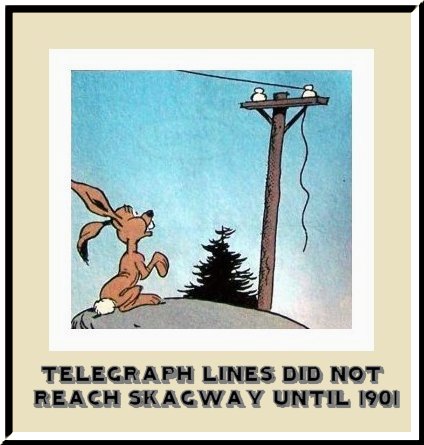
      Soapy's telegraph con was one of the more brazen scams he operated in Skagway. It is also perhaps his most comical one, if one can find humor in it. I say "comical" because the victims were truly unwary and gullible, compared to most that came through that town. The humor can be appreciated when one realizes that this took place in 1897-98 and telegraph lines did not reach Juneau until November 9, 1901 and Skagway at some point after that.
      There is humor in it due to the gullibility and ignorance of the victims, considering that Skagway was a brand new camp of tents at the time. A big part in understanding the humor, requires a little imagination. Getting to Skagway, Alaska in 1897 was not easy. The first ships leaving the docks of Seattle and cities were over-flowing with passengers, and the captains knew only the basics of the route and it's dangers. There were ships that actually got lost, run-aground, and worse. Passengers spent a week or more on a ships, some being nothing more than overloaded junk heaps refitted for service to capitalize on the gold rush, trying to get to Skagway as fast as they could. Once there, passengers and their gear were tossed ashore as quickly as possible, so that the captain could sail back to the states for more paying passengers.

Soapy Smith's fake telegraph office
Le Klondike
Lucky Luke Productions, 1996

(Click image to enlarge)

      A more thorough understanding of the "humor" also requires the experience of sailing through the Lynn Canal towards Skagway today, and seeing that the entire route is still nothing but wilderness. That wilderness keeps the planned building of a modern road along the 99 miles between Juneau and Skagway from becoming a reality. Now, imagine being a stampeder in 1897-98, taking that same route. How ignorant or gullible does one have to be, to not realize that the way needs to be cleared, telegraph poles erected, and lines strung for over a thousand miles of Alaskan wilderness, forest, mountains, and rivers? Construction would take great planning, cost, and years, which was prohibitive in 1897. You have to admit that tricking someone with a fake telegraph office, in the Alaskan wilderness of 1897, is kind of funny.
      Much of the early history of Skagway is based on eyewitnesses and personal accounts, which is all there is in regards to Soapy's telegraph office. That is, until we combine them with Soapy's standard method of operation, which remained consistent throughout his career. This means that there was likely more to the telegraph story than just tricking $5 from a "cheechako" (Chinook Indian jargon for "newcomer;" a tenderfoot, greenhorn).
   
Laying telegraph lines in Alaska
Colliers Weekly
November 9, 1901

(Click image to enlarge)


HOW IT WORKED:

      Imagine your gullible self, disembarking from a horrid five days spent onboard a rusty and overcrowded steamer, not counting the time spent getting to the pacific coast where your ship awaited. So there you are, a weary traveler, soon to be miner, dropped off with your supplies and fellow passengers, in a new, little explored wilderness territory, perhaps, thousands of miles from home, eagerly wishing you could let your loved ones know that you were still unscathed and this far into your journey north. There in front of you is a small sign on a tent, "telegraph office." A message home for $5. It's pricey, but worth every penny.
      Upon entering the “office,” you learn that the key operator has stepped out for a moment but will soon return. Encouraged to wait, you are surrounded by newfound “friends” who chat with you, asking questions, that unbeknownst to you, will be used by the Soap Gang later on. They soon offer you the usual pastime games of chance, three shells and pea or perhaps a little three-card monte. When the key operator appears, if you still have the $5 fee, he will "send" your message, while offering information on the gold region as well as the best places to eat, drink and stay in Skagway. He tells you not to miss out on going to the Klondike Saloon [Soapy's place]. Making sure he answers all your questions, and in between gathering more information about you and your situation. Who are you traveling with? Where are you headed and when? Do you have enough cash to make it through the winter? He seems to genuinely care and at the conclusion, you leave the office satisfied, with new information and hope.
      Once leaving the tent, you don't notice that one of the gang is tailing you. After a time, the man tailing you approaches and informs you that a reply telegram has arrived and awaits you back at the office—for an additional $5. The friendly games of chance might be employed again to obtain even more of your money. Later, while taking in the sites of the new camp, you run into one or two of the new "friends" you had made in the office. He insists on showing you the town. The clerk happens along and invites you all to his hotel room to sample a shipment of cigars and whisky he just received from the ship anchored in the bay.
      Inside the room there are a few men sitting at a card table playing poker. Greetings are made as the clerk is informed by one of the men that his wife needs him at their tent immediately. You are eagerly invited to sit in on the game and play a few hands while you wait for the clerk to return. In conversation, you find out one of these men lives in your hometown, and apparently has met you before. He does, after-all, know a lot about you (information gathered from you earlier). They offer up a toast, and shove a glass of whisky into your hand. A few toasts and your head is swimming. You awaken in the early morning, behind a tent, and cannot remember the previous night, but before too long you realize that you out a large portion of your ready cash. Was it the whisky? Were you robbed? Or was it that because you were certain you held a "sure-thing" poker-hand, but lost to a better one? Even if the thought occurs to you later that you had been swindled, there is no time to complain to the law, if you could even find a lawman, and then wait until justice is served. Every hour you waste not getting on the trail to the gold fields, means more claims being staked out and that means less gold for you. chalking up the loss to experience and hoping you will make up the loss with a new found gold strike, you hit the trail out of Skagway.
      This does not mean I condone the crime, but it sure does make the victims look a little foolish. There are no records or accounts of anyone admitting they had been taken by the telegraph office, but then again, who would be willing to go home and admit that they fell for such a trick?


"It is popularly believed Reid killed Smith, but those claiming to know assert Murphy fired the fatal shots."
—Will Clayson, Alias Soapy Smith, p. 550.


DECEMBER 23


1783: George Washington arrives home to Mount Vernon after the disbanding of the Continental Army following the Revolutionary War.
1788: Maryland cedes a 100-square-mile area for the seat of the national government. Two-thirds of the area becomes the District of Columbia.
1823: The poem A Visit from St. Nicholas by Clement C. Moore is published. It is also known by the names The Night before Christmas and 'Twas the Night before Christmas.
1844: George W. Arrington is born in Greensboro, Alabama. He is best known as a captain in the Texas Rangers in the 1870s. In the early 1880s he was sheriff for Wheeler County, for eight years before retiring. He died on his ranch, March 31, 1923.
1852: The Theatre of Celestial John opens on Telegraph Hill in San Francisco, California. It is the first Chinese theatre in the U.S.
1863: A vigilante organization is formed inside John Lott's store in Bannack, Montana Territory. Their goal is to rid the territory of the outlaws calling themselves “the Innocents.”
1867: A treaty with Indians of the Senacas, Shawnees, Quapaw, and other tribes guarantees their removal from Kansas to Indian Territory.
1872: Bill Brooks, the former marshal of Newton, Kansas kills a man named Brown in a shootout in Dodge City, Kansas.
1874: The Gordon Party, a group of prospectors from Sioux City, Iowa reach the part of the Black Hills, Dakota Territory called Custer's Park, where gold had been discovered four months prior.
1880: Lincoln County Sheriff Pat Garrett and his posse sneak up on Billy the Kid and his outlaw gang holed up in a deserted adobe near Stinking Springs. Inside are Billy, Charlie Bowdre, Dave Rudabaugh, Tom Pickett and Billy Wilson, who are unaware of the lawmen outside. In the morning Bowdre steps outside the door and the lawmen open fire hitting Bowdre in the chest. Bowdre screams out, "I'm killed, Billy, they killed me." Billy supposedly tells Bowdre, "They have murdered you, Charlie, but you can get revenge! Go out there and kill some of the s.o.b.'s before you go!" With that, Bowdre is led out the door to his death when the lawmen shoot him. Bowdre never fires his pistol. The siege lasts for two days before the outlaws surrender.
1880: Thomas Edison incorporates the Edison Electric Light Company of Europe.
1898: Members of Soapy Smith’s gang are sentenced for the robbery of John D. Stewart; John Bowers is given one year in prison for larceny and six months for assault and battery. “Slim Jim” Foster is sentenced to one year and fined $1,000 for larceny, and six months for assault and battery. Van B. “Old Man” Triplett is sentenced to one year for larceny.
1913: The Federal Reserve Bill is signed into law by U.S. President Woodrow Wilson. The act establishes 12 Federal Reserve Banks.


December 22, 2019

Did Soapy Smith take refuge in Phoenix, Az?

Arizona Republic
Phoenix, Arizona
Fri. July 22, 1898
page 4
(Click image to enlarge)


he confidence man sometimes took refuge in Phoenix.


      A news story published in the Arizona Republic (Phoenix Arizona) on July 22, 1898 [seen HERE] begs more answers to new questions than reveals reliable information.

The confidence man sometimes took refuge in Phoenix.

      An article in the Republican a few days ago regarding "Soapy" Smith, the confidence man killed at Dawson City not long ago, has called out many reminiscences of that unique character by men who knew him. He was a comparatively frequent visitor of Phoenix as of all the more important towns and mining camps of this territory. He last visited this city about 18 months ago.
      He was not as he has often been described, a gambler. He was once arrested for gambling and pleaded in his defense the definition of the word gambler as one who plays for a stake taking a chance of losing it. "I take no chances at all." Said Mr. Smith. This suggests that the expression a "sure thing gambler," is erroneous, a contradiction in terms. Smith was a man of imposing front, smooth voice, persuasive language and undoubted courage. He had killed many men generally those who had interfered with his "business." His operations were usually conducted with the aid of a gang to whom there was a standing instruction to never kill if it could be avoided.
      He had one weakness, playing on the outside of a faro game, at which he was so uniformly successful that in the course of his career he lost several fortunes. He played with astonishing recklessness and his roll soon disappeared. He always left the table and went on the street to work is famous "soap" scheme or one of his other various confidence games, and invariably returned with a sum sufficient to renew the excitement at faro. He was as charitable as a prince and as indiscriminate in his giving. He distributed thousands among the worthy and the unworthy.
      When he was last in Phoenix he told an acquaintance that he was ashamed and wary of his performances and resolved to abandon his manner of living. His resolutions were always broken, not because he cheated his dupes for money, but the attendant excitement without which he lived. It is said that he never followed his occupation in Phoenix. He always ran in here because he had turned a trick somewhere else and found it advisable to drop out of sight for a time. It was during his last visit to Phoenix under the name of Williams that the vault of the Western investment bank was broken. Some of those who knew him, but did not know him very well, suspected that Smith had engineered the job. But those who did know him knew better. Burglary was a species of criminality as distinctly out of his line a Sunday school teaching was.

____________

A mistake:
  • Soapy Smith was not killed in Dawson City (Canada). He was killed in Skagway, Alaska.

A Few possibilities:
  • Did Soapy Smith go to Phoenix, Arizona in October 1896? ("18 months ago.") Did he use the name "Williams?"
  • Did Soapy engineer the robbery of the Western Investment bank?


"On the 11th instant, I informed you of a shooting affray which occurred in Skaguay. “Soapy Smith” attempted to murder a Mr. Reed [sic] who was organizing a party to recover money for a returning Klondiker named J. D. Stewart who had been robbed of same by some of Smith’s gang. In the struggle, etc., “Soapy Smith” was shot and killed from his own gun by a man named “Murphy.” Mr. Reed [sic] (who received two bullets from Smith’s gun) died a few days afterwards."
— Major Sam Steele, NWMP, Alias Soapy Smith, p. 547.


DECEMBER 22


1775: The Continental naval fleet is organized in the American colonies under the command of Ezek Hopkins.
1807: The U.S. Congress passes the Embargo Act, designed to force peace between Britain and France by cutting off all trade with Europe.
1856: Captain Richard W. Johnson and Company F, 2nd Cavalry, from Camp Colorado attacks a Comanche Indian camp along the Concho River in Texas. Two soldiers are killed and two wounded. Three Indians are killed and three wounded. Thirty-four horses are captured and a Mexican captive is recovered.
1864: During the Civil War Union General William T. Sherman sends a message to President Lincoln from Georgia, which reads, "I beg to present you as a Christmas gift the city of Savannah."
1872: Texas Jack Omohundro, who is appearing with Buffalo Bill in a stage show, The Scouts of the Prairie, in Chicago, Illinois, falls in love with Giuseppina Morlacchi, an Italian dancer in the show.
1877: The American Bicycling Journal is published.
1877: The Sam Bass gang robs a stagecoach heading towards Fort Worth, Texas. Soapy Smith would later witness the shooting death of Sam Bass in Round Rock, Texas.
1878: Outlaw Billy the Kid surrenders to sheriff George Kimball in Lincoln County, New Mexico Territory, but escapes a short time later and heads for Las Vegas, New Mexico Territory.
1887: “Big Ed” Burns is the defendant in the first recorded court case of the shell game in Los Angeles, California. He soon leaves for Colorado where he joins the Soapy Smith gang.
1888: Annie Oakley appears in the stage show Deadwood Dick: or the Sunbeam of the Sierras.
1888: The Denver crime boss “Soapy” Smith and his younger brother Bascomb donate $50 during subscription to aid orphans in Arapaho County, Colorado.
1890: 294 members of Sitting Bull's Indian tribe surrender in Cherry Creek, South Dakota.
1894: The U.S. Golf Association is formed in New York City.
1900: The Sherman Tunnel in Wyoming, on the Union Pacific line is completed.


December 21, 2019

Artifact #59: Letter from Soapy Smith to his wife, Aug 28, 1897.

"Yours till death"
Page 1 of 2
Jeff Smith collection

(Click image to enlarge)


he first physical evidence of Jeff’s presence in Skaguay

is a letter to his wife Mary, dated August 28, 1897. Enclosed were receipts for $1,500 to her. Using an inflation calculator that $1,500 is the equivalent of about $55,832.52 in 2019 dollars.
      Following is the contents of the letter. Note that he spells Skagway as "Scagway." The name and spelling of the towns name went through several changes, and as Skagway was just a few weeks old at the time Soapy wrote his letter, no one was certain of the spelling. 

Scagway Aug 28, 1897

Dear wife

      I got Mrs. Scovell, the wife of elder Sylvester Scovell, the correspondent of the N.Y. World, to send you $500 as I did not know if [I] could send it myself or not. Since then I have had luck in a trade and send $1000 more, making $1500 on this boat the Queen. It will be shipped by express to you from Seattle, Wash. This makes $1600 all told. Take up that mortgage and cash yourself up. That is, keep the money yourself. And don’t go saying anything in St. Louis as you will never get a cent out of anything in St. Louis. Write to Juneau. Be sure and send $1000 to 1,300 at least to Brown and Bro Denver to pay mortgage.

Yours till death,
Jeff

"Yours till death"
Page 2 of 2
Jeff Smith collection

(Click image to enlarge)


You will find the letter, as well as the surrounding history, on page 436 of Alias Soapy Smith: The Life and Death of a Scoundrel.


Artifact #59: page 436.


"According to the information I received from the Deputy Marshal, a man named Murphy is credited with the killing of Smith and not Frank Reid as reported in the newspaper."
—Major Sam Steele, NWMP, Alias Soapy Smith, p. 547.


DECEMBER 21


1620: The Mayflower and its passengers, pilgrims from England, land at what would become Plymouth Rock, Massachusetts.
1849: The first ice-skating club in the U.S. is formed in Philadelphia, Pennsylvania.
1866: A relief party out of Ft. Kearney, Nebraska led by Captain William Fetterman is ordered to rescue the fort's woodcutting detail that is under attack by a small band of Indians. Fetterman is ordered not to leave sight of the post, but the Captain, who had supposedly boasted that very morning that if the fort would give him 80 men, he would ride through the whole Sioux Nation, ignores the orders and pursues the Sioux Indians well out of safe range of the fort. He and his men become fatalities of an ambush led by Crazy Horse.
1876: Marshal Charles Faber of Los Animas, Colorado is killed when he enters the Olympic Dance Hall to disarm bad brothers Clay and John Allison. Clay is released of the murder charge when no witnesses could be found to testify. John Allison was seriously wounded in the encounter but recovers.


December 19, 2019

1964 art rendition of the Soapy Smith ,Shootout on Juneau Wharf.

The King of the Klondike
Story by Paul Brock
Artist is unknown

Adam magazine
Volume 8, Number 10, 1964

(Click image to enlarge)


ewly "discovered" art rendition of  the Shootout on Juneau Company Wharf

      In 1975 my father, mother, and I attended the Harriet Pullen auction in Seattle, that sold off the entire holdings of the private museum that once graced the Pullen House (hotel) in Skagway, Alaska. My father bought quite a few artifacts that belonged to his grandfather, Jefferson Randolph "Soapy" Smith, along with other collectibles. 
    One of the collectibles was an issue of True magazine (August 1958).  On page 58 is an article, Showdown for a Con Man. The article is a rehash of old books, but the artwork, by artist Stan Galli, was something my father and I treasured as it was one of the few accurate depictions of Soapy's demise.

Showdown for a Con Man
Story by J. P. Cahn
Art by Stan Galli
True magazine
August 1958

(Click image to enlarge)
  
      Six years later, an adult magazine called Adam, published a rehash article, with a new piece of art, obviously copied from Stan Galli's art. Needless to say I located a copy for my collection.
      The one defining difference between the two art pieces is that the Galli piece shows the moments just before the shootout began, with Soapy, rifle draped over his shoulder, approaching Frank Reid and the 101 vigilantes.  The second piece shows the shot fired into Frank Reid's groin. I like this one as it presents just how close Soapy and Reid were to one another. In fact, Reid was holding onto Soapy's rifle barrel with his left hand, trying to keep Soapy from shooting him. At least three shots had already been fired by the two combatants.    


A comparison between them

(Click image to enlarge)


"You see, nobody would touch Soapy after he was shot. … They were just scared to touch him. This woman came down … and she offered one hundred dollars a piece if they’d carry him off, and they did. They took him down to the morgue. Cost her four hundred bucks according to the story…. That was the story that went around. I don’t know how much they got."
— Royal Pullen, Alias Soapy Smith, p. 537.


DECEMBER 19


1732: Benjamin Franklin publishes his first Poor Richard's Almanac.
1776: Thomas Paine publishes his first American Crisis essay.
1777: General George Washington leads his army of 11,000 to Valley Forge, Pennsylvania, to camp for the winter.
1842: Hawaii's independence is recognized by the U.S.
1859: Denver, Colorado hires its first lawman, William Sisty. He had no jail and no deputies. He resigned after five months.
1863: George Ives is hung in Bannack, Montana Territory for the murder of Nicholas Thiebalt.
1864: Nicholas Earp and family, including son Wyatt Stapp Earp, and six other children arrive by wagon-train in San Bernardino, California from Iowa.
1871: Albert L. Jones wins a patent for corrugated paper.
1880: Outlaws Billy the Kid, David Anderson alias Billy Wilson, Dave Rudabaugh, Charlie Bowdre, Tom O'Folliard, and Tom Pickett are ambushed in New Mexico Territory by Lincoln county Sheriff Pat Garrett and several deputies who fire on the outlaws. Pickett and O'Folliard are shot dead from their saddles. Rudabaugh's horse is shot and collapses, but Rudabaugh manages to mount Anderson’s horse and escapes with the Kid and Bowdre.
1887: Jake Kilrain and Jim Smith fight a bare knuckle boxing match fight which lasts a seemingly impossible 106 rounds. The fight is halted due to darkness and Kilrain is given the win.
1893: Soapy Smith files a $5,000 damage suit in Denver against Charles G. Chever and William B. Palmer at whose property at 1705 Larimer had a coal-delivery hole which was left open and he fell in. Outcome of the suit is unknown.
1903: The Williamsburg Bridge opens in New York City. It is the largest suspension bridge in the world 1924. It is the first major suspension bridge to use steel towers to support the main cables.
1905: Outlaws Robert Leroy “Butch Cassidy” Parker and Harry A. “The Sundance Kid” Longabaugh are positively identified by witnesses as having robbed the Banco de la Nacion in Villa Mercedes, Argentina of 12,000 to 14,000 pesos. Although not identified, two others were seen at the bank, which may have been Harvey “Kid Curry” Logan and the fourth person, some claimed was a woman, which may have been Etta Place.
1907: A coalmine explosion in Jacobs Creek, Pennsylvania kills 239 workers.


December 18, 2019

Soapy Smith shootout mural found behind a wall in Skagway, Alaska.

Photo by Andrew Cremata, Skagway News
Painting by Bea O’Daniel

(Click image to enlarge)


hootout on Juneau Wharf mural found hidden behind a wall.

This is a post from my original blog, dated December 31, 2007. 

"Restoration of a gold rush era building recently sold uncovered a mural this last October [2007]. After paneling was removed from the walls of Moe’s Frontier Bar, a mural by Bea O’Daniel (now Lingle) completed in May 1951 was revealed. The painting stretches around the perimeter of the main bar room and includes a detailed panoramic scene of Skagway in 1900 and separate pieces showing gold seekers ascending the Chilkoot Trail’s Golden Staircase and a Canadian Mountie on horseback atop a mountain. The above portion shows the Soapy Smith/Frank Reid gunfight. The mural was covered up in the late 1960s or early 1970s. There are currently no plans to salvage it."

It is not known if the mural was saved, but the image above has found a good home on the Gunfight Art page of the Alias Soapy Smith website.


"He was sprawled out with his Stetson lying there, but nobody dared put his feet together or place his hands over his heart. They didn’t dare show sympathy for fear somebody would pull out a gun."
—Bobby Sheldon, Alias Soapy Smith, p. 537.


DECEMBER 18


1787: New Jersey becomes the third state to ratify the U.S. Constitution.
1796: The Monitor of Baltimore, Maryland is published as the first Sunday newspaper.
1856: Lieutenant James Witherell of Company C, 2nd Cavalry, and two officers from the 8th Infantry, battle with a party of Apache Indians while scouting by the Rio Grande from Ft. Clark, Texas.
1862: The first orthopedic hospital, the Hospital for Ruptured and Crippled, is organized in New York City.
1865: Slavery is abolished in the United States with the ratification of the 13th Amendment to the U.S. Constitution.
1894: Soapy Smith and John Bowers are arrested in Denver on complaint from Thomas Moody. Soapy pays a $300 bond to get them out of jail.
1898: A new automobile speed record is set at 39 mph.
1899: President McKinley commutes the sentence of Soap Gang member “Slim Jim” Foster in the robbery of John D. Stewart in Skagway, Alaska, after one year due to his having contracted consumption.
1903: The Panama Canal Zone is acquired 'in perpetuity' by the U.S. for an annual rent.
1912: The discovery of the Piltdown man in East Sussex is announced. It will be proved a hoax in 1953. Bad man Soapy Smith had a petrified man found in 1892. It was not proven to be a hoax until 2012, when it was determined that the corpse was intentionally mummified.


December 17, 2019

Another Soapy Smith - Fitzhugh Lee story version

  SOAPY SMITH'S EAGLE
July 4, 1898 Skagway, Alaska
Fitzhugh Lee float

(Click image to enlarge)


nother Fitzhuge Lee version


      During the first annual July Fourth parade in Skagway, Alaska, "Soapy" Smith entered a float, carrying a wire cage with a live bald eagle, Soapy had name Fitzhugh Lee, in honor of the Spanish-American War general of the same name.

      The standard version used in my book, Alias Soapy Smith: The Life and Death of a Scoundrel, states that
An immense American eagle, as full of fight as a cocoanut is of meat, and with an armament that would put the Vesuvius to shame. His beak is a variable [veritable] “iron virgin” for ferocity, his talons are an inch and a half long and sharp as a dagger. He is as large as a large gobbler, measuring 9 feet from tip to tip.
      The great bird was caught … about thirty miles down the canal by Frank Howard and three companions … on a prospecting tour. He was found wedged in between two rock walls…. When they saw him, he showed fight instantly, and they were obliged to lasso him first, then throw a heavy blanket over him. Yesterday the boys arrived in Skaguay with the bird in a big dry goods box, heavily grated, and with a large rope fastening his legs together. Even then he … was open to any engagement to fight.
      The boys took him to Capt. Jeff Smith as a present, a big wire screen cage has been built for him … behind the saloon, where he now is monarch of all … within his reach. Yesterday a full grown hen was put in the cage, and with one stroke he tore her head off, and scattered her limbs and feathers all about him. He had half eaten her before her heart had ceased to quiver. [Unknown Skaguay newspaper clipping. 7/1/1898, author's collection]

      Recently, I came across a new version published in The Klondike Nugget (Dawson, Yukon Territory) on July 4, 1900, two years, three days, after the original story's publication. Which is more accurate will likely remain a mystery to the ages.  

The Klondike Nugget,
Dawson, Y. T.
July 4, 1900

An Eagle With a History.

      Those who were just in Skagway on the fourth of July two years ago have not forgotten the fine specimen of the proud bird, emblematic of freedom, an American eagle, that traveled in a large wire cage in the procession.
      A Week Previous to the Fourth two Indians were out in a canoe fishing in Lynn Canal near the mouth of the Chilkat River. They had a number of fish in the boat and were intently watching their lines in the water when – swoop, hugh – they felt their canoe shiver from end to end, it upset their canoe and the Indians found themselves struggling in the chilly water. But they were not alone; with them was a large bird, and eagle which had came down like a shot from heaven, having been attracted by the fish in the boat. The eagle had struck the boat with such force as to upset it and, at the same time stun itself to such a degree as to render it incapable of flying away until the Indians had time to recover themselves and right their canoe, when they proceeded to capture the author of their fright and sudden immersion.
      The eagle fought desperately, but was finally tied by the feet, muzzled and rendered harmless. The captors brought it to Skagway and sold it to “Soapy” Smith for $15. Four days after the Fourth, and while gazing on the same eagle which was in a cage in the rear of “Jeff’s Parlor,” the man Stewart was held up and robbed of $2800, which robbery led up to “Soapy’s” death and the final scattering of his crowd, a number of whom are still in San Quentin penitentiary, while for others are about to do to be discharged from the U. S. jail at Sitka after having served two years.
      Three months later the eagle, having been kept in captivity all the time, was set free, and when last seen it was upwards of 1000 feet high and sailing in a direct line from Mount St. Elias.

ABOUT THE PHOTOGRAPH: The photograph above was taken by Reverend John Sinclair on July 4, 1898. It depicts the moments previous to the big scheduled parade. The float, a freight wagon, holds a large wire cage containing the live American bald eagle given to Soapy Smith a short time earlier. Behind the wagon a man holding a large American flag will be followed by Soapy's private volunteer army, the Skaguay Military Company, in which Soapy is Captain. The small boy dressed as "Uncle Sam" is the 9-year-old son of Soapy's business partner John Clancy. The wagon rests in front of Soapy's saloon, Jeff Smith's Parlor (far right). The white and grey horse between the Parlor and the wagon is Soapy's. He will be riding the same as (officially) the fourth division marshal of the parade, but Soapy manages to force his way to the front of the parade, becoming the unofficial grand marshal.


Fitzhugh Lee: July 4, 2009 


Fitzhugh Lee: pages 520-22, 525, 595.


"Reid carted an old Smith and Wesson six-shooter, an ancient gun he had used in the rip-roaring days of the west and which he considered the best gun in Skagway. He said it never failed him but its failure finally cost his life."
—Matthew M. Sundeen, Alias Soapy Smith, p. 533."


DECEMBER 17


1777: France recognizes American independence.
1791: A traffic regulation in New York City establishes the first street to go "One Way."
1860: Cavalry and Texas Rangers attack the camp of Peta Nocona's Indian Comanche’s on the Pease River in Texas. Ranger Lawrence Ross and his men join a detachment of Cavalry from Camp Cooper and Fort Belknap for the attack. Fourteen Indians are killed, two are taken prisoner, along with a white female, Cynthia Parker, who had been kidnapped as a child in 1839. She is the wife of Peta Nocona and the mother of baby daughter, Quanah Parker.
1866: General Patrick Connors commands that Indians living north of the Platte River “must be hunted like wolves.”
1872: “Scouts of the Plains” written by Ned Buntline played to a packed house staring Bill Cody and Texas Jack Omohundro. Despite not being good actors Buffalo Bill and Texas Jack are a hit.
1882: “The soap fiend with his little tricks is again in town, taking in the four bits and the dollars of the unsuspecting verdants. The game is to roll up little bits of soap in paper with an occasional bank note enclosed, and then mixing all together sells the privilege of choice for the figures named. In nineteen cases out of twenty the buyer gets his nubbin of soap and blue paper, but the bank notes, like hen’s teeth, are too scarce for him to find.” (Arizona Weekly Citizen, Tucson)
1886: Sam Belle is shot and killed by Frank West at a Christmas party.
1895: George Brownell obtains a patent for his paper-twine machine.
1903: Orville and Wilbur Wright succeed on their second attempt at engine powered flight. The aviation age is born when their flying-machine stays aloft for 12 seconds traveling a distance of 102 feet at Kitty Hawk, North Carolina.


March 25, 2019

Joe Simmons funeral in the Creede Candle newspaper April 9, 1892

Jeff and Joe
Soapy Smith buries Joe Simmons
The Illustrated Police News
April 9, 1892

(Click image to enlarge)


oe Simmons
 
was a tall, slender gambler known to many as “Gambler Joe” Simmons, a member of the Soap Gang who managed Soapy Smith's Tivoli Club in Denver, 1890, and Soapy's Orleans Club in Creede, 1892. According to William Devere’s poem "Two Little Busted Shoes," Simmons also dealt faro for Soapy in Creede. Simmons and Soapy had worked together in Denver from Soapy's earliest times there, and they were the best of friends.
      When a friend of Soapy's died, a proper send off was provided. The closer the friend, the more lavish the send off. So when pneumonia, the scourge of the camps, fell upon Joe and he died of it on March 18, 1892, Soapy took it hard, openly displaying his emotion. Only a hint of that emotion made the pages of the Creede Candle, March 25, 1892.


——————————————————————
Buried by friends
————
Joe Simmons, an old–time friend of Jeff Smith, died Friday night. On Sunday afternoon he was buried in Sunnyside Cemetery.
      At 3 o’clock the funeral procession of twelve carriages, containing friends, old and new, formed, and in a heavy snowstorm proceeded to the burial place. There, by the open grave, Jeff Smith poured out a tender, touching and manly tribute over the remains of his old friend, two bottles of champagne were drunk to the memory of the dead and the grave closed up.
      It was such a burial as only strong men can give, and all who were there felt the scene and words said bravened them for the day when in the last bite they shall be the vanquished and death the Victor.
 ——————————————————————

Original article
Creede Candle
March 25, 1892

(Click image to enlarge)

_______

Tintype
My father stated that this was (l to R) Joe Palmer and Joe Simmons
possibly taken in Denver or Creede
 
(Click image to enlarge)

      Heading up the steep, snowy hill to Sunnyside Cemetery, Simmons’ granddaughter, Beth Jackson, claimed that Joe’s casket slid out of the wagon and had to be lifted back in. Then half way up the hill, the horses could no longer pull their loads through the accumulated snow, so the mourners walked the rest of the way, carrying Joe’s casket and a case of Pomeroy champagne.


October 17, 2008
April 20, 2010
April 7, 2011
April 21, 2011
August 23, 2013
December 22, 2015 


Joe Simmons: pages 33, 89, 131, 210, 214, 225-29, 273, 594.


"Card sharping has been reduced to a science. It is no longer a haphazard affair, involving merely primitive manipulations, but it has developed into a profession in which there is as much to learn as in most occupations."
—John Maskelyne, 1894


MARCH 25


1634: Lord Baltimore creates the Catholic colony of Maryland.
1655: Catholic forces win a military victory over the colony of Maryland. The Puritans jail their Governor Stone.
1668: The first recorded horse race in America takes place.
1774: English Parliament passes the Boston Port Bill.
1776: The Continental Congress authorizes a medal for General George Washington.
1813: The frigate USS Essex flies the first U.S. flag in battle in the Pacific.
1856: A. E. Burnside patents the Burnside carbine.
1857: Frederick Laggenheim takes the first photo of a solar eclipse.
1865: The steamship General Lyon catches fire and sinks at Cape Hatteras, killing 400 people.
1865: Confederate forces capture Fort Stedman in Virginia, during the American Civil War.
1877: John Slaughter, a Cheyenne and Black Hills stagecoach driver, is shot and killed by Robert McKimie, of the outlaw Sam Bass Gang as they rob the stage outside of Deadwood, South Dakota. Also there is Sam Bass, Joel Collins, James “Frank” Towle, and either Bill Potts or James Berry. This is the first robbery of the Bass Gang. 17 months later bad man Soapy Smith would later witness the shootout that ended the life of Sam Bass in Round Rock, Texas.
1879: New Mexico Governor Lew Wallace orders the arrest of John Slaughter on suspicion of cattle rustling.
1879: Royal Gorge War in Canon City, Colorado, which had started in the court room, now begins physical violence between the rival railroads of the Rio Grande of Colorado and the Atchison, Topeka and Santa Fe of Kansas. The fight was over ownership and use of the Royal Gorge pass. Bat Masterson was hired to defend the Kansas line, and he did so with 33 armed men, which included Ben Thompson and Doc Holiday. There were a few skirmishes but no causalities in March.
1879: The Army captures Cheyenne Indian Chief Little Wolf and 113 followers at Box Elder Creek, Montana Territory.
1882: Two men raid a mining office in Arizona Territory, killing a mining engineer, but leaving empty-handed. Less than a day later, Deputy Sheriff Billy Breakenridge and three deputies tracked them to a ranch where a gun battle kills one deputy and the two others wounded.
1886: Apache Indian Chief Geronimo meets with General Crook at Canon de los Embudos, Mexico to agree on terms of surrender.
1894: Jacob Coxey and his Army of the Commonweal begin their famous march to Washington. It is bad man Soapy Smith’s poem that is believed to be the suggestion idea for the march.
1898: The Intercollegiate Trapshooting Association is formed in New York City.
1900: The American Socialist Party is formed in Indianapolis.
1901: Cuba discloses a fear of annexation by the U.S.
1902: Irving W. Colburn patents the sheet glass drawing machine.
1905: Confederate battle flags captured during the American Civil War are returned to the Southern states where they came from.
2014: A question involving Soapy Smith appears on the TV game show Jeopardy. The category was “con men.” No one got the correct answer about where he hid a little ball--under a shell.