 |
| (Click image to enlarge) |

Jeff Smith

.

|
| (Click image to enlarge) |

Before the Japanese attack on Pearl Harbor there were a number of American and English warships present at Shanghia, China. Just before the attack both nations removed their ships leaving a small force presence. The English H.M.S. Peterel and the American U.S.S. Wake were the last remaining warships on December 8, 1941, the day of the Pearl Harbor attack (time differences make it December 7, 1941 in Hawaii). Smith had received a telephone call the night before from a Japanese officer he knew. The officer asked where Smith would be the next morning as he wanted to deliver some turkeys for Smith and his crew. The Japanese did the same to other American officers and officials so as to determine where they would be on December 8th. That next morning the Wake was tied up at a pier, it's crew consisted of fourteen (eight of whom were radio operators) and she had been rigged with demolition charges. At 4:00 am she was approached by a large body of Japanese marines. Unaware of the Japanese attack on Pearl Harbor that had occurred two hours earlier, the crew of both ships were not prepared for the sudden onslaught and were caught entirely by surprise, the Japanese forces taking control within minutes.
The Wake
(Photo courtesy of Dictionary of American Naval Fighting Ships)
The commanding officer of the Wake, Columbus Darwin Smith, the nominal Captain, was at his private apartment onshore in Shanghia. He had been given command of the ship in March 1941. On the morning of the attack he learned from his quatermaster of the attack on Pearl Harbor. Commander Smith rushed to the ship but it was too late. The Japanese had already captured the vessel. Ironically, the Japanese captured one of the radio operators just after he had received news that Pearl Harbor had been bombed. The author of the website believes that, "had the Japanese boarded Wake just a few minutes later, she would have been at battle stations. Not a shot was fired and Wake suffered the ignominious distinction of being the only US Naval vessel captured during World War II without presenting any resistance."
The Tatara (formerly Wake)
(Photo courtesy of NavSource
When Commander Smith arrived at the dock the Japanese would not let him onboard. At that moment the Japanese opened fire on HMS Peterel and Commander Smith witnessed her sinking. Part of what he saw included the Japanese machine-gunning Royal Navy sailors in the water as HMS Peterel sank. The story of the Peterel can be viewed on the same link above.
Commander Smith and his crew were confined to a prison camp near Shanghai and the Wake was renamed HIJMS Tatara and entered Japanese naval service.
Most of the aforementioned work describes Commander Smith's internment. Smith was a truly courageous individual and almost immediately made an escape from the Woosung POW camp. Unfortunately, he was captured and spent a month in the infamous Bridge House, a facility used by the Japanese for interrogation and torture. The Japanese proceeded to try him for the escape and at one point his Japanese "defense attorney" requested that Smith be given the maximum sentence, death. The judge had already been given the sentence by his superiors, ten years in Ward Road Jail (Shanghai) with all of Smith's military and civilian rights revoked. Ward Road Jail was a high security prison from which no one had ever escaped and an escape attempt at this point would inevitably lead to beheading. While awaiting his fate Columbus thought often of family. He did his best to remember every conversation he had ever had with family members. It was during one of these rememberances that he recalled being told he was related to a famous old west outlaw called Soapy Smith. Undaunted by his initial failure to escape, Smith methodically began planning his next escape and went over the wall in September of 1944. Amazingly, by foot (and occasionally sampan) he made his way through 700 miles of Japanese infested territory to Nationalist Chinese troops. Thereafter he was repatriated to US forces. (It should be noted Commander Smith managed his escape to freedom with two fellow comrades, Commander John B. Woolley of the Royal Navy and US Marine Jerold B. Storey)
In 1945 The Wake was captured by American forces. In 1946 she was presented to China and renamed Tai Yuan. In 1949 Chinese Communist forces captured the ship and utilized the ship for unknown purposes. The history of its fate has not yet been learned. As of 2010, no other ship of the U.S. Navy has been named Wake.


Dear Jeff,
Thank you for writing the Soapy Smith book. We will use it in our classes at Wasilla High School [Wasilla, Alaska] and we also have it bar-coded and placed in the library for students to read at their leisure.
Thank you so much. We really appreciate it.
Sincerely,
Donna Hickle


First Emory Alumnus President
Luther M. Smith, Class of 1848
1826-1879
President 1867-71
Luther Smith was the first Emory graduate to preside over the college, and his presidency thus marked a kind of coming of age for the college. A native of Oglethorpe County, Georgia, he received the highest honor of his class when he graduated in 1848. After studying the law and practicing for a time, he accepted President Pierce's invitation to join the faculty in 1852 as tutor in languages. When he assumed the presidency in 1867, he followed the custom of his predecessors in the presidency by teaching literature, philosophy, and religion.
During his brief administration, Smith fostered a vigorous religious life on campus and strongly emphasized the "character-building" qualities of the college community. In general the college prospered under his care, with an average enrollment of more than two hundred. His concern for the financial condition of the college prompted a fund-raising drive, though it resulted in nothing like the $500,000 endowment he thought necessary. He was not averse to taking the trustees to task for what he thought of as too-small imagination and insufficient attention to the need for money. Proposing to begin building a large endowment, Smith curtly admonished the trustees, "The guardians of the institution should become familiar with the idea and promptly take the matter in hand." Perhaps because of such differences over finances, perhaps because of differences over the curriculum, which he wanted to expand and liberalize, in November 1871 the board voted him out of office and replaced him with Osborn L. Smith, the professor of Latin who was no family relation to Luther M.
Curiously, it was during Luther Smith's administration that the Board of Trustees first considered moving Emory College to Atlanta. At a meeting of the board in November 1867, the Rev. G. J. Pearce, a newly elected trustee, made the suggestion, which was quickly referred to committee and, a few days later, voted down, with the "deliberate judgment that the further consideration of the measure proposed is unadvisable."
Source: A Legacy of Heart and Mind: Emory Since 1836. Gary S. Hauk, PhD


 |
| (Click image to enlarge) |
 |
| (Click image to enlarge) |
 |
| (Click image to enlarge) |


 |
| (Click image to enlarge) |
U.S.S. Jefferson Randolph Smith NCC-29402)
Sulek-class Federation Starship
Captain, Tatyana Troftmov
Year 2268
Not far away, silent in silent deep space, Federation resource exploratory vessel Jefferson Randolph Smith cruised at Warp Factor Four, her sensor net spread wide in search of Dilithium, that rare and refractory mineral that powers the warp drive, indeed the Federation itself...but more about dilithium a little later. Just now, aboard Smith, the captain was also having one of those days.
But then, thought Captain Tatyana Troflmov, as she sipped her blue orange juice, it always seemed to be one of those days.
The rest of Smith's officers were at the restroom table with Captain Trotimov. The first officer, a Withiki named Tellihu, had his broad, red-feathered wings draped over the back of his chair, he read a freshly printed newsfax with his left hand and ate a mushroom omelet with his right. Tellihu had had eggs for breakfast every morning of Smith's mission, four hundred and sixty-six days so far, and it still seemed to Captain Trofimov vaguely like cannibalism.
Science Officer T'Vau had finished her soya salad and was looking at a chess set. Not playing with it, not touching the pieces, just looking. T'Vau's hair was dangling over one pointed ear, and there were vinegar-and-oil spots on her uniform blouse. For a Vulcan, the Captain thought, T'Vau was really a slob.
The three of them were all the officers aboard Jefferson Randolph Smith, and also all the crew, just as this compartment was not only the mushroom but the common room and the recreation room. Smith NCC-29402, Sulek-class) was a ship of the Resources Division, Exploration Command, designed to seek out -- no, not what you're thinking -- seek out minerals, especially dilithillm, at the lowest possible cost.
It was actually not such a small ship, really quite roomy given its crew of three. And Starfleet Psychological Division had been very aware that a crew of only three for a mission of twenty to twenty-eight months must be carefully chosen for compatibility.
PsyComm recommended that a special battery of crew-relations tests be designed.
The test designers were hard at work and expected to deliver a preliminary report no later than six months from now. Until then -- well, somebody had to bring in the dilithium.
Captain Trofimov came from Reynaud II, a thinly populated planet on the Cygnus-Carina Fringe, without much space trade. Trofimov had decided very young that she was not only going to enlist in Starfleet and get off Reynaud II, she was going to get every millimeter as far off Reynaud II as Starfleet went. Exploration Command seemed like just the thing. The recruiter showed her trishots of the big mining ships, like Dawson City, and the planetformers, like Robert Moses, vessels bigger than starships, bigger than stargazes, and Trofimov knew that her destiny was sealed.
Only too right, she thought.
Tellihu finished his omelet, stood up, and said something to the wall in the whistling Withiki language. Pleep, the wall said, then Fling. Tellihu took out what looked to Trofimov like an ice cream cone filled with birdseed and went out of the room nibbling it, dipping his wings to clear the doorway.
He does it deliberately, the captain thought. He'd eat worms if he thought he could get away with it.
She looked at T'Vau. The science officer picked a kelp strand out of her salad bowl and chewed on it idly, still watching the chess set. Finally she reached out, picked up a pawn, turned it over in her fingers, then put it back on its original square.
Trofimov finished her juice without looking at it, and left T'Vau to her, uh, game. As she went into the corridor she thought, I'll bet it's never like this for starship captains....

 |
| The Smith mansion At the original location circa 1970s (Click image to enlarge) |
On March 25, 1828, the state of Georgia held a land grant lottery for the sale of land ceded to the state in a treaty with the Creek Indians.
Ira Ellis won the right to purchase land in the Sixth district of Coweta County, named for the large Coweta Indian population in the region. The land Ira purchased was thirty-nine miles southwest of the future city of Atlanta and seven miles beyond the settlement of Newnan. The Smith’s were one of the first families to reside there. Newnan would become a prosperous town for professionals due to its thriving cotton industry. Ira was well-liked and succeeded as a physician and planter. His popularity gained him a seat in the House of Representatives for the Sixth District in the Georgia Legislature; he served from 1832 to 1837 and again in 1851. He was elected a state senator in 1839, 1841-42, 1849, and 1853. According to Edwin Smith, a grandson of Ira, the Smith “family was equal in standing to any in Georgia, … claiming descent from long lines of well-known people.”
...
Between 1830 and 1835, Ira engaged brothers named Cole to build a plantation mansion that he christened Shoal Creek. It stood seven miles east of Newnan, close to Thomas’ crossroads on the Old Wynn’s Pond Road. From the outside, the house is imposing, appearing larger than it is on the inside. A large center hall is flanked by two spacious rooms, a small kitchen, and a sitting room. Upstairs are two large bedrooms, each with fireplace. Some of the original furnishings and family heirlooms are on permanent display in Newnan at the Male Academy Museum.
...
Edwin Bobo Smith, another cousin of Jeff’s (Soapy’s), who also came to live with Jeff and his parents for a time, stated that “Their wealth consisted largely of slaves.” The 1860 census shows that Ira accounted for fifty-seven slaves living in sixteen houses on his land. During a fact-finding visit to the house in the 1960s, Joseph Jefferson Smith, a grandson of Jeff’s (Soapy’s), found a black family living in the house. The head of this family, Joseph Jefferson reports, was a man calling himself Ira Ellis Smith. The connection this family may have had with the Smith family is yet to be determined.
 |
| The home as it looks today |
Jefferson Randolph and Emily moved in with Ira at Shoal Creek to help care for Ira’s ailing wife, Ellen. Another Ellen, the daughter of Columbus Darwin Smith and the granddaughter of Ira, named Ellen Smith Faver, also moved to Shoal Creek. She came after her mother, Nancy Edmundson, died on October 21, 1860. Two days later Ira’s wife Ellen also died. In a letter, Ellen Faver Smith writes that ten days later, on November 2, 1860, Jefferson Randolph Smith II was born.
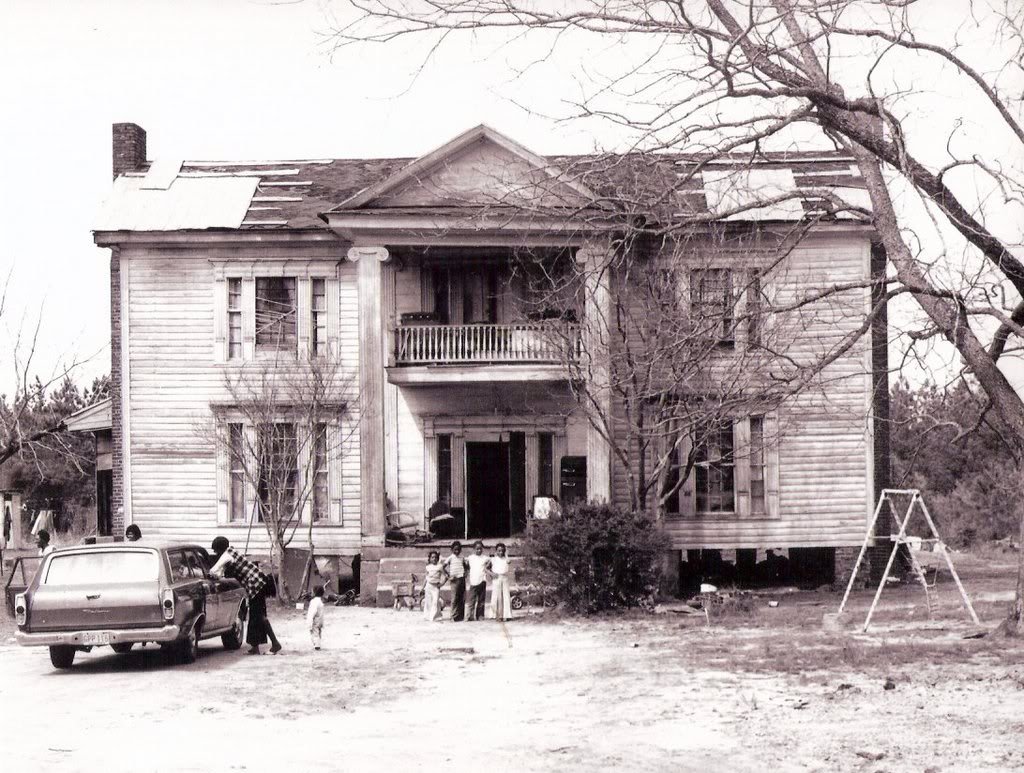 |
| Dan Dietz gave me this print of the house taken in the late 1960s showing the house on it's original land and in need of repair. Squatters had taken possession of the empty old house. |

 |
| The move |


 |
| The inside tour |
 |
| Rev. Jan Davis and his wife The front door of Shoal Creek |
 |
| Restored version of the exact same model |


