Showing posts sorted by relevance for query Tara Kane. Sort by date Show all posts

April 28, 2011

Tara Kane: Historical novel based around the gold rush and Soapy Smith.


Tara Kane, the book by George Markstein and Jacqui Lyons, was published in England and the United States in 1978. The storyline takes place in the Klondike 1897 and involves the adventures of a young woman who falls in love with Soapy Smith while searching for her husband.

Tara Kane had never got over the sudden disappearance of her husband and so resolves to track him down. Leaving the comforts and safety of her San Francisco home, her quest takes her to the icy wilderness of Klondike during the Gold Rush. But she finds Klondike is no place for a lone woman, and the harsh conditions and savagery are almost more than she can bear. Determined to find the truth once and for all, Tara battles on, and finds herself on a painful journey of self-discovery.

In the mid 1980s my father discovered the novel and shared copies with the rest of his siblings. In January 1987 while researching for my own book I wrote a letter to George Markstein. I received a reply from his co-author, Jacqui Lyons that George had passed away just a few days before my letter arrived.

... Sadly, it arrived a few days after George Markstein's untimely and premature death. However, as you may have noticed, I was closely involved in the writing of this book, so I hope you won't mind me replying on George's behalf. I know, if he'd lived, he would have been fascinated to read your letter and would have hastened to answer. Both od us grew to 'love' Jeff during the preparation of the manuscript, though during all our researches, I don't recall reading that he was married, so your letter is all the more interesting. One of the things that so inspired us was that no fiction could ever be written about Jeff - according to our research, he'd done it all.
Jacqui Lyons

Jacqui Lyons signing my copy of Tara Kane.


In January 1988 Jacqui Lyons arrived in Los Angeles from England and came to visit me. Sadly my father had passed away in December of 1987 and could not join us. We spent the afternoon talking about the book,  Soapy, George, and my father.


Signed last page of Tara Kane


Upon her return to England Jacqui sent me a thank you gift. The autographed last page of Tara Kane. What an honor it is to have received this. I framed it, thus the blurry copy you see above. My book was completed digitally so there is no "last page" to sign.

The whole point of this post was only to introduce some passages from the book now and again, but in preparing for the write up I brought back so many memories and bits of information that I wanted to share with you that it's now getting out-of-hand!

Tara Kane was published in several editions until 2001. The book can be obtained very economically online for those who wish to read the book.

ISBN-10: 0755102959
ISBN-13: 978-0755102952

Oh! I almost forgot. As promised, a selection from the book...

Tara confronts Soapy Smith...

“I guess you’ve heard the most terrible stories about this scoundrel Soapy Smith. How he runs all the rackets. How he owns dives and saloons. How he takes advantage of people. What a rogue he is. Correct?”

You believe you’re playing a really disarming game, don’t you thought Tara. Aloud, she said, “Why should I listen to stories about you, Mr. Smith? I’ve seen you in action. I know how you operate.”

Now he was smiling broadly. “Sure. I’m a businessman. An entrepreneur.”

Tara pushed her plate away. “Businessman? Selling people ten-cent bars of soap for five dollars? Rigging up fake telegraph lines? Fixing roulette wheels? You call that doing business?”

“You really don’t understand, do you? I’m a kind of educator. I teach people lessons they badly need. Hell, I put them wise, don’t you see? Show them how easy it is for a sucker to be parted from his dough. I figure that’s more a public service than some folks realize. There’s many a guy walking around watching his money after a course of instruction from me.”

Jeff Smith


.

May 25, 2011

More selections from Tara Kane, part 5.

The approximate spot where Soapy Smith died.


In this selection from Tara Kane, authors George Markstein and Jacqui Lyons use Soapy's partner, John Clancy as a Judas character that secretly goes to the opposition, in this case the White Pass & Yukon Railway, and agrees to spy on Soapy. Once again, the authors had no idea of the facts about Clancy,  Soapy's partner in Jeff Smith's Parlor and other saloons in Skagway who was exonerated by the vigilantes after Soapy's death, as not knowing anything about Soapy's crooked side. Needless to say this is absolutely ridiculous as Soapy would not have gone into business with someone  who would not back his sort of enterprises. My family has suspected for decades that Clancy made some sort of deal with the opposition in order to remain free of harm or jail.

In Tara Kane, Tara witnesses John Clancy meeting with the railroad men and reports it to Soapy.


“You know the hotel’s full of railmen? Well, I saw Clancy there.”
Suddenly Smith was very alert.

“He seems to have gone up in the world,” she went on. “He’s got new clothes. He was smoking a fat cigar. And he had a meeting with Tancrede, after I left. He seemed pretty much at home.”

“Well!” He examined the tip of his cheroot. He was almost talking to himself. “That explains a lot. It sort of looks as if our friend Clancy has been bought. I wondered why he’s been avoiding me. Now it figures.”

He stood up and went to the window, staring out in silence.

“Jeff,” Tara said quietly.

He said nothing.

“You can’t fight the railroad. You can’t blackmail them either. They’re too big.”

He swung around. “Nobody’s too big for Jeff Smith in Skagway. I mean to have myself a piece of that railroad, any way I can.”

“They won’t have you, Jeff. They won’t let you get a look-in.”

“You’d be surprised what can go wrong when you build a railroad. Accidents. Landslides. Explosions.” He smiled. “Believe me, Tara, a few armed men and a load of dynamite, they might find it cheaper my way.”

Tara recalled the cold, calculated eyes of Tancrede. “Jeff, if you try to stop themthey’ll kill you. They’ll hire somebody, and”


More to come


May 18, 2011
May 3, 2011 
April 29, 2011 
April 28, 2011


Jeff Smith


.

May 18, 2011

More selections from Tara Kane


Without knowing the history beyond what they read in an old biography, authors, George Markstein and Jacqui Lyons guess correctly that the powers behind the White Pass and Yukon Railway probably had a hand in Soapy’s undoing. My family had always believed this to be self-evident. The research behind my book, Alias Soapy Smith strongly shows the connections the railroad had with the vigilantes and the men who killed Soapy Smith.

In the following section of Tara Kane, Sir Thomas Tancrede and Michael J. “Big Mike” Henney of the White Pass and Yukon railway meet with Soapy and Tara Kane in his plush office.

Sir Thomas blinked and then cleared his throat. “Why don’t we get down to business? People say you’re interested in our railroad.” He rolled the brandy around the glass. “Is that right?”

“Damn right,” said Smith. “I know a good investment when I see one.”

Henney cut the niceties short. He waited until the waiters had left; then he said curtly, “What exactly is you proposition, Smith?”

For a moment, Smith looked pained. That kind of direct talk seemed more suited to the sawdust-and-spit world of the cheap bars than to this elegant supper table. Carefully he knocked the ash off his cheroot.

“We all have a dream, you and I,” he said after a while. Anybody less like dreamers than this trio would be hard to find, thought Tara, but she waited, amused. She wanted to hear his pitch.

“The dream is to make this territory a great land, a land which can make more money for all of us than anyone has imagined,” he went on. “The key to that land is the railroad. Open up the territory, and you shrink it to a manageable size. Cut the distances, and you’ve conquered it.”

“I say, Mr. Smith, you wax quite poetical.” Sir Thomas winked at Tara. “He can dress up thing, can’t he?”

“Well?” cut in Big Mike, unimpressed.

“The point is, Mr. Henney, I’d like us all to be partners.”

Smith leaned back, beaming at them. His watch chain and diamond cufflinks danced in the candlelight.

“Sorry,” said Henney gruffly. “No deal.”

Smith remained unruffled. “But you haven’t heard me out.”

Sir Thomas sighed. “Mr. Smith, we’re an Anglo-Canadian consortium. I raised my half of the money in the city of London and Mr. Henney got the rest in Ottawa. I don’t think we really want American involvement. No offense, of course.”

Smith nodded. “Aren’t you forgetting that the starting point of your railroad is on American soil?” he asked mildly.

“And aren’t you forgetting, sir, that under the ’71 Convention, Canada has the transit rights she needs?” retorted Henney. “This is a Canadian project, to serve Canadians on Canadian soil.”

“A little more brandy, gentlemen?” suggested Tara.

“I propose we leave that all to the politicians,” Smith said, clearly aggravated at her interruption. “We’re businessmen, all of us. I know you have the capital, but since when hasn’t some extra money been useful? You got big costs coming.”

“Maybe,” grunted Henney. “But we don’t want you in, Smith. We don’t want any part of you.”

Smith sat stone-faced. Sir Thomas looked a little worried.

“What Mike means …” he began.

“I know what he means,” snapped Smith.

“Then you know why we don’t want your kind of money,” went on Henney.

“So you don’t think my dough’s good enough,” said Smith very quietly, his lips drawn into a thin line. “You don’t want to soil your hands. You only like nice clean capital. Virgin dollars.” He laughed mirthlessly. “Tell me, Sir Thomas, how did your folks make their dough? Never shipped any slaves? Never conquered any colonies? Or you, Mr. Henney? Earned it all by the sweat of your brow?”

I don’t need lectures from a brothel owner,” spat Henney.

Smith’s eyes blazed. Tara knew that at any other time there would have been violence. But with an effort he remained seated.

“Mike didn’t mean that exactly,” conciliated Sir Thomas. He looked embarrassed.

“Sir Thomas, one thing we’ve got to get clear if we’re going to be partners,” said Smith. “You have to stop telling me what Mr. Henney does or does not mean. I can figure it out for myself.”

Sir Thomas pulled out a beautiful silver hunter.

“It’s been such a marvelous dinner, I hate to break it up, but perhaps we ought to retire now.”

He smiled at Tara, seeking an ally.

“Gentlemen, maybe you forgot a couple of things,” Smith said, ignoring Sir Thomas. “You need a lot of supplies, a lot of men, a lot of horses to build that one hundred and eleven miles of railroad. You haven’t got any of it.”

“Right now, Smith, “ Henney said triumphantly, “ships are on their way to Skagway with every damn thing we need, laborers, supplies, timber, horses. We got it all organized.”

Smith nodded. “Of course. They’re due in a couple of weeks, and within twenty-four hours of their arrival you’ll start laying the track. Eight weeks later you hope to have the first four miles of the line open.”

Henney’s eyes narrowed. “What are you getting at?”

Smith grinned smugly.

“Your point, sir,” said Sir Thomas crisply.

“I have a certain, let’s say, influence on the waterfront. The men listen to me. I dare say, gentlemen, that if I didn’t get a look into your railroad, they might not unload any of your ships.”

Henney pushed back his chair unceremoniously and stood up. “Now you listen, Smith,” he snarled. “I thought you’d start blackmailing us. Well sir, our railroad has the blessing of the authorities. They want it built. You try and hold us up, you try to stop us unloading, you start your bully-boy tricks, and we’ll have a battalion of United States infantry in Skagway so quick you won’t know what hit you. And I’ll tell you something else, your hired guns aren’t going to be much use against Army bayonets.”

He glanced at Sir Thomas. “I think it is time we went.”

The Englishman stood up and bowed to Tara. “I do apologize, dear lady,” he said. “Business can get so tedious.”

“Business, Sir Thomas,” she replied, smiling politely, “is never tedious. It interests me enormously.”

Sir Thomas looked slightly nonplussed. “We’ll see ourselves out,” he said, nodding at Smith. “Thank you for a highly entertaining evening. Good night.”

Smith did not stand up as they left the room.


May 3, 2011
April 29, 2011 
April 28, 2011 


Jeff Smith


.

May 3, 2011

More selections from Tara Kane


One of the most amazing things I found from reading the novel, Tara Kane was authors, George Markstein and Jacqui Lyons remarkable ability to figure Soapy Smith out. To be able to predict how he would act, what he might say, and do in certain situations. You have to remember that these two authors had no preconceived knowledge of Soapy and the only book they had was sparse in details. Yet time and again they correctly imagined what the real Soapy was like. They knew very little to nothing of Soapy's family life, his parents nor that he was married with children. They did not know Soapy kept somewhat of a scrapbook with all his letters, correspondences and business documents, but they imagined that he would...

One of the enjoyable parts of the book for me was when Tara comes across Soapy's scrapbook in his office.


… Tara sat sipping her coffee, unsure of what she should do until Smith came back. She got up and wandered about the room. On Smith’s desk lay a big leather album, bound in red morocco, with his initials embossed in gold on it. Idly, she began reading it.

Before her unfolded the making of Jefferson Smith. Or, at least clues to his life. There were photographs, newspaper clippings, even leaflets. Page after page of mementos, articles, stories, even small paragraphs, clipped out of dozens of papers and periodicals. Only a man with an enormous ego could have so painstakingly kept such a collection. She could visualize him, cigar clamped between his teeth, cutting out each item, and carefully pasting it into the album, beaming.

There were faded photographs of an elderly couple. His parents, Tara guessed: the father, white-haired with a goatee, proud, very much the gentleman; and the woman, dignified, handsome. Hard to believe that the offspring of the genteel, even aristocratic-looking couple was the notorious Soapy Smith.

There was another photograph of the old man, even more yellowed, in the uniform of an officer of the Confederate Army.

On a page by itself was a very old postcard-sized picture of a magnificent colonial mansion. It was not hard to imagine the carriages pulling up in front of it, the guests mingling on the lawn. Was this where Smith grew up?

There were photos of Smith himself: one as a little boy, in lace, looking so angelic that Tara had to giggle; another of him, a grown man, in a flamboyant uniform, presumably playing his role as an officer in the Mexican Army. A crumbled and half-torn photograph showed young Jefferson Smith, sporting a deputy’s badge no less. He was smiling broadly.

Many of the clippings appeared to date from 1892. One of the earlier ones was a curious article suggesting that Smith had avenged the killing of Jesse James by setting up Bob Ford, the man who had shot James in the back ten years previously.

In Denver, Smith had apparently lectured to a learned body of academics about the evils of gambling. According to the newspaper report of the gathering, “Mr. Jefferson Smith, a well-known social worker, described an establishment he ran as ‘an educational institution affording its patients release from the curse of gambling.’ No one, Mr. Smith explained, had a chance of winning, and this taught them the folly of indulging in gambling.” Tara arched her eyebrows. It sounded familiar to her. The amazing thing was that, according to the clippings, a body as respectable as the Keeley Institute had actually consulted Smith about his “scientific findings.”

There were clippings from the silver-mining town of Creede on other pages. Smith had become a leading member of the community, apparently dabbling in politics. But he left the town without being given the benefit of a big write-up. Or at least, that clipping was missing.

The album left Tara with a mixed impression of Jefferson Smith. A man, apparently from a well-to-do family, who had roamed all over the place, involving himself in all kinds of activities, sailing near the wind more than a few times. A man who loved play-acting, dressing up in uniforms, having his picture taken.

A man who now had made the Yukon his kingdom.

Behind that smooth, debonair exterior was a fine brain. Smith, despite the rackets he operated, the gang he ran, had ability, vision, nerve. If only he could apply his wit, his intelligence, to a good purpose.

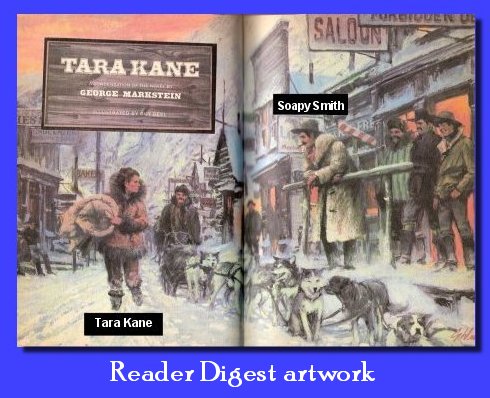
Artwork from the Readers
Digest condensed version


April 29, 2011
April 28, 2011


Jeff Smith


.

June 14, 2011

Tara Kane: Skaguay Military Company

(Click image to enlarge)


In the novel, Tara Kane the German photographer, Hart tries desperately to convince Tara of Soapy Smith's evil intentions of raising a private army to seize control of the ports and trails leading into Canada and the Klondike gold fields. This fictional account is based on the real regarding the creation of the Skaguay Military Company in May 1898. 

“Tara,” he said gravely. “You must get away from him. He is a bad man.”

“You don’t have to worry, I know all about Mr. Smith,” she replied dismissively, getting up.

I don’t think you do.” The way he said it made her stop. “There are rumors. He is planning something. Something dangerous. I hear stories.”

“I’m not interested in gossip,” she retorted.

“No, you must listen,” Hart said urgently. “He is raising an army. Shipping in weapons. Ammunition. Training men.”

“That’s his little hobby. He likes playing soldiers. He’ll come to see you any day now for a photograph of him in his pretty uniform. You’re taking it all too seriously, Ernst.”

“Don’t you understand?” Hart was getting excited. “He plans a Putsch, a revolt. When he has enough men and enough guns, he will take over the tow, the railroad, maybe Dyea, seize the Chilkoot, the White Pass.”

“That’s crazy!” she cried.

“With his army, who can stop him? A couple of deputy marshals? By the time they send troops, he’ll control everything.”

“Ernst, you’re being ridiculous.”

“I beg you, Tara, you must leave here. Before it’s too late.”

“Ernst, I don’t believe any of” she began, but he cut her short.

“I will protect you from him,” he burst out. “He won’t be able to do anything. You can rely on me. I will look after you and the baby. You need not have anything to do with the man ever again.”

Tara said nothing. …

…..........................................................................


[Tara confronts Soapy in his office]
There was a knock on the door. Smith ignored it, but Tara disengaged herself. Again the knock came.

“Yes?” Smith called out irritably. His eyes were on Tara. She was trying to take advantage of the operation to collect herself.

Yeah Mow came in and stopped when he saw the two of them.

“Well?” Smith demanded. His voice was sharp.

“I didn’t know you were busy, Boss,” grunted Yeah Now, “only they’re going to start unloading.” He stopped. “The cargo will be coming ashore soon. Thought you’d better know.”

“OK,” Smith said curtly, “I’ll be there.”

She could tell something was being kept from her. Yeah Mow closed the door, and Tara asked, “What cargo’s that, Jeff?”

Doubts were crossing her mind, and echo of what Hart had said, “When he has enough men and enough guns.”

“Christ, honey, we got more important things to talk about than that,” he said. Suddenly, he seemed guarded.

“No. I want to know.”

She sat down and looked at him challengingly. Her softness had gone. She was tough, businesslike.

“You don’t make sense,” he replied. Under his hooded lids, his eyes were wary.

“You keep disappearing for days on end. Nobody sees you. Then all these cargoes that arrive. You keep going to the waterfront. What’s so important about them? You keep that gunman outside your door. Your office gets burgled. What’s happening? Your right-hand wants to know what’s happening.

He hesitated, then he shrugged. “I’m training my men. Hell, I’m the CO of the outfit. I’m whipping them into shape. I got to spend time with them. And those cargoes, why they’re just supplies. Military supplies. Uniforms. Boots.”

“Arms?” Her voice was quiet.

He didn’t blink. “Sure. Rifles, sidearms. I’m having them shippedin, and I don’t aim to see them go astray. So I keep an eye on things. You don’t want my soldier boys to have wooden swords, do you?”

He laughed as if that was a good joke. He opened a drawer and took out some sheets of paper.

“Now while I’m gone, I’d appreciate you copying these out, just for me and a couple of the boys.”

He passed them over to her.

She glanced at them, uneasiness growing. “What are these list?”
“It’s the payroll. If the men get called out, if a state of emergency is declared.”

“You mean martial law? In Skagway? Who’d declare that?

“I like to be safe.”

“Safe from what, Jeff? She pressed.

“Safe from other people’s interference.”
She stood up, putting down the lists. “But all this is illegal. Recruiting private mercenaries in the name of the United States, shipping in arms, wearing uniforms, giving out ranks. National Guard, indeed!”

Smith looked amused. “He’s put you up to this, hasn’t he? That lousy photographer made your beautiful hair stand on end? Right?”

“I can use my own eyes,” Tara said. She didn’t want to bring Hart into this.

He grinned. “Now you listen. Congress has rushed through a bill authorizing the immediate enlisting of volunteer troops for the war. Here.” He went to a chair, picked up some Seattle and San Francisco newspapers. The headlines were there. They were recruiting men for the Spanish War.

“What’s good for Teddy Roosevelt is good enough for me,” went on Smith.

Tara shook her head. “You’ll have to try harder than that. You’re raising a private army, and I want to know why.”

He strode across the room to the newly installed safe. “Goddamn it, Tara, you can be the most aggravating female,” he shouted. He took out a sheet of paper and thrust it at her.

“Private army, indeed,” he growled.

The paper had an officially printed letterhead embossed with the legend: Office of the Secretary of War, Washington, D.C.

Dear Captain Smith, [it read] The President has passed over to the Department of the Army your letter and asked me to reply on his behalf.

He joins me in commending your patriotic spirit in forming your militia unit. You and your volunteer forces and the enthusiasm with which you have rallied to the colors in this hour of your country’s need are a tribute to the people of Alaska.

Your offer to put your unit at the disposal of the United States Army and to lead your men in an invasion of Spanish Cuba is greatly appreciated, but I can assure you that the forces we have available are adequate and there is no need for the War Department to require your services overseas.

I am, sir, your obedient servant,

And it was signed Russel A. Alger, Secretary of War.

“Well?” He stood beaming at her. “You still think I’m planning to start some cockeyed private war?”

She had to admit that it was not what she had expected. She hadn’t known that he had been in touch with Washington. She thought he was doing it all on his own here, thousands of miles away. Maybe he was right, she thought. Maybe Hart had wanted to paint Smith in the blackest colors. She gave him back the letter.

“How many men have you got now?” she asked.

“Two, three hundred,” he said, going out the door.

Washington knew what Smith was up to, and they had raised no objections. What was really going on? …


…...............................................................................


Smith displayed his letter from Washington proudly. It hung in a prominent position in the Oyster Parlor, reverently framed. Only Tara knew that he had cut out part of the letter and neatly joined the two other pieces. There was no mention of Washington brushing him off; only the grateful thanks of his President and the War Department.


May 18, 2011
May 3, 2011 
April 29, 2011 
April 28, 2011


Skaguay Military Company: pages 79, 471, 486-90, 494-95, 498-502, 505, 510, 514-15, 595.


Jeff Smith


.

April 29, 2011

Selection from Tara Kane.


Another selection from the book Tara Kane. Once again Tara and Soapy debate his choice of occupation.


“Jeff Smith, you know, I think you’re a crook. You take advantage of innocent people.”

“And what are all the others doing?” he demanded, his eyes steely. “Everyone here has come to use someone, something, somehow. The sourdoughs are here to tear the Territory apart so that they can make themselves rich on its gold. The city slickers are here to cash in on the sourdoughs. The railroad’s coming to profit from the sourdoughs going to the gold fields. And I’m here to entertain those poor suckers. But they needn’t be entertained by me or by any other rogue, as you so charmingly put it, unless they want to.”

“And you think that makes you decent? You believe you’re doing them a service, cheating them before anyone else has a chance?”

“Tell me, Tara,” said Smith very softly, regarding her from under his heavy lids, “haven’t you ever used anyone? I seem to recall a certain incident when the use you made of some poor, unsuspecting Mountie cost him his stripes. But that didn’t occur to you at the time, did it? You know why. Because you wanted to get to Dawson. You wanted to get there so badly you didn’t mind whose neck you trod on.”

“That’s not true,” she retaliated, blushing at the memory. “I never wanted Sergeant Campbell to lose his stripes. I didn’t hurt him on purpose.”

“But you did,” pointed out Smith. “He was a means to an end, so that sort of puts you in my league right away.”
“Your league! How on earth do you think that my one mistake puts me in with the likes of you? I’m not a cheat. I’ve never swindled or stolen from anyone!”

Smith made no reply for a while. Instead, he picked up a paperknife from his desk and toyed with it. “Whatever I’ve done I’ve thought, in that situation, at that moment, was the right thing to do.”

“So that makes it OK, does it? You make me laugh, Jeff Smith, you really do. You’re always right, aren’t you? Always above suspicion, always within the law!”

“Of course, Tara,” agreed Smith, “especially when the law doesn’t exist.”


Here are links to other posts on this blog pertaining to this topic:
April 28, 2011


Jeff Smith


.

August 29, 2009

Dorothy Corum where are you?


Over the last quarter century I have had the pleasure of corresponding with hundreds of wonderful people relating to the research of my great grandfather. Over that period my memory has subsided a bit due to the passage of time thus I would have forgotten many of my old contacts from years ago had it not been for my almost obsessive filing of everything pertaining to Soapy Smith. One lady in particular stands out from the rest of those contacts. When I received an email from this person 17 years later I did not need to look up her file to remember this special person. Her name was Dorothy "Dee" Corum. I was so excited to receive the email from Dorothy that I wrote her immediately. Stupidly, while cleaning up my files I accidentally erased her email and my response. I did not hear back from her and posted something about it here on August 20 that I feared my email to her might have been received as "spam." So here I try once again hoping she sees this post as I would love to hear from her.


(Click image to enlarge)

I
met Dorothy when she responded to an ad I published in the February 1987 issue of Alaska magazine asking for anything relating to Soapy Smith. Dorothy lived in Massachusetts and wrote me the following letter.

February 2, 1987

Dear Mr. Smith:

... I have long had an interest in your great-grandfather and have done a lot of research on him. I have been to Alaska 9 times—with Skagway always one of my stops. Gold Rush Cemetery has always been a destination—and in '82, '83, and '84 I carried flowers from Massachusetts to place on "Soapy's" grave. (The natives wondered where they came from). I feel a very special affinity to him. (I am enclosing a picture of myself taken in '82 at his grave—showing the first bouquet I placed there for him). [see above photo].

I wrote a lengthy article about "Jefferson Randolph Smith" a few years ago and submitted it to Alaska magazine, but they said they had recently published material on him and were not interested at that time in another article.

I am a high school teacher and travel a good deal. I travel in a motorhome with my mother as my companion. On every trip to Skagway, we hoped that Jeff Smith's Parlor (Museum) would be open, but it has been closed for many years. Before my last trip there in '84, I wrote to the owner of the museum [George Rapuzzi] and asked if it would be possible to visit the museum that coming summer. I got a letter back saying he would be glad to open it for my mother and me—but that it was not open to the general public and probably never would be again. He is a very elderly gentleman—a native of Skagway, born in 1899.

The highlight of that trip to Skagway was going through those doors into yesteryear. We stood at Soapy's Bar and had a drink (root beer) with Soapy (a mannequin that turns its head and raises its arm as its eyes light up when you enter). This building was your great-grandfather's and was moved from its original location to its present site. The bar belonged to Soapy, and the entire display is quite a tribute to him and his era.

In addition to taking us through this treasure, he played an original Martin Itjen (early Skagway showman) recording of that fateful July 8 that reenacts the entire scene. He is a wealth of information and memorabilia, and he would probably be glad to share his knowledge with you. He is a delightful person with whom I have corresponded ever since. ...

I personally don't think your great-grandfather was the scoundrel that history makes him out to be, and some of my research verifies that. A fictionalized account of Soapy's dealings in Skagway and Dawson City is well written in a novel that was hailed as "The Gone With The Wind of the Yukon." It is Tara Kane by George Markstein. I have read it at least a dozen times and will, no doubt, read it a dozen more. It portrays Jeff Smith as a lovable rogue who is charmed by a young lady. It is a fantastic character study, though fictionalized, and gives the reader a lot of food for thought. Though Markstein completely changed Soapy's ending, it is an excellent account of those wild, tempestuous times. I would love to see this book made into a movie.

I wish you luck in your quest for information and relics from your great-grandfather. I certainly look forward to any book you may publish. ...


Dorothy and I began corresponding by mail carrier and I learned a passion of hers was poetry. She sent me a poem about Soapy she simply entitled, SOAPY SMITH.


(Click image to enlarge)
SOAPY SMITH
by Dorothy Corum

Along with the poem Dorthy also sent me a copy of her manuscript that she had sent to Alaska magazine. I learned that she had written to George Markstein, author of Tara Kane and visited Creede, Colorado and even my hometown of Anaheim, California the year I graduated from high school. I eagerly invited her back to Anaheim to visit the private museum/saloon my father had built in honor of Soapy but sadly Dorothy no longer had the wish to travel much since the loss of her beloved mother and travel companion.

The last letter I received from Dorothy was in January of 1992 in which she enclosed the poem below. I hope she sees this post as I would love to hear from her.


(Click Image to enlarge)
SCOUNDREL OF SKAGWAY
by Dorothy Corum