Showing posts sorted by relevance for query Mondamin. Sort by date Show all posts

April 1, 2010

Historical mistakes can definitely be a plus.


(Click image to enlarge)
Photo 37-A: Grand photograph of a grand parade

May 1, 1898
Skagway, Alaska

(Alaska State Library, William R. Norton col.)

There is a mistake in my book for the caption for Photograph 37A (above) and B. It reads

Patriotic bunting on Jeff Smith’s Parlor indicates this photograph was taken on May 1, 1898, probably just before the parade of the Skaguay Military Company. A large crowd of citizens (children, women, men in formal dress) appears fresh and staged for a group photograph to commemorate the occasion. Nearly every face looks to the camera. Jeff is at attention on his mount, his posture erect and right arm straight down. Behind Jeff, a man standing among men holds a large sign reading, “The Skaguay Military Company.” This eastern side of Holly Street (6th Avenue today), between Broadway and State streets, was a business section. A little sign on the right of Jeff Smith’s Parlor reads, “Merchant’s Lunch,” and down the street (r to l) from Jeff Smith’s Parlor are various businesses: H. Bauer General Merchandise, H. B. Litt Ready Made Suits and Cloaks, Louvre CafĂ©, Barber Shop, Theatre Royal, New York-Alaska Trading & Mining, N. H. Wilson Druggist.


It started when Gary Jayne, a dealer on eBay sent me some copies of several photographs he had up for auction. In one of the photographs (I shall refer to as Mondamin #1 from here on) was what appeared to be the same man and horse in one of my photographs (#37A-B) in my book, Alias Soapy Smith. Cousin Jim (great-grandson of Soapy) and I have been corresponding back and forth a lot lately so I sent him a copy of Mondamin #1 for his own collection. He replied back with


“– I hate to say it, but several things cause me to doubt that #37A-B is Soapy. The man’s beard is pretty clearly grey, not the dark black that I associate with Soapy. Compare #33-35 to #37A-B. Also: Soapy’s hat is clearly grey in #35 (hard to tell in #38), whereas the hat of the man in #37A-B is clearly black. Now, Soapy certainly could have two hats. And, to me, these look like different horses. #35 is a grey or dappled horse. #37A-B looks much whiter. #38 looks somewhere between the white and the grey, but we can’t see the horse’s face and the exposure of the photo is not as good as either #35 or #37A-B. The biggest point to me is the beard.”


(Click image to enlarge)
“Mondamin #1”

Mondamin #1 was photographed in front of the Mondamin Hotel just two doors east of Jeff Smith’s Parlor. At first glance I thought Mondamin #1 might have been taken moments before or after Photograph #37. There are a number of people in the photo I was interested in seeing close up. The carriage holds two and then there is the gentleman on the horse at the left. This person and white horse looked strikingly like the man and white horse in photo #37 but this not the case. Getting out my larger copies I recognized my error. The man I thought to be Soapy is not. I was shocked that I had mistakenly identified the man. My publisher, Art Petersen a much-respected Alaskan historian, beautifully expressed thoughts about taking it for granted that it was Soapy. Art was

"… surprised and disappointed that the mounted figure in photos 37A & B is not Soapy. I guess it shows how powerful circumstantial evidence can be: a dark figure on a white horse (most probably Soapy's!) in front of "the Parlor" with a "Skaguay Military Company" sign behind him. A patriotic parade is being prepared for (or is just over), so what other parade could it be than the one that occurred on May 1, 1898, in which we know Jeff participated?"


Karl Gurcke believes the Mondamin #1 photo was from July 4, 1898. He writes,


“It's the 4 of July 1898 no doubt. The photos we have of the Decoration Day parade (May 1898) doesn't show anything on the Mondamin.”


So the question remains, who is this guy and while we are at it let’s question the other faces? The man on the horse is a tall, thin, almost frail-looking elderly man with a mid to long gray beard. My first thought was of Captain William Moore, the original inhabitant of Skagway (originally called Mooresville). However, Moore was heavier and shorter so that idea is improbable. Art Petersen thinks it might be I. N. Wilcoxen. Art writes that

"Perhaps it's Attorney I. N. Wilcoxen, a battle-scarred veteran of the last war (Alias p. 501 top). Maybe Soapy gave Wilcoxen his mount for the photo. The horse surely is Jeff's. The coloring and physique are too close in appearance in other photos to be some other horse. Too, the Post has Moore, Wilcoxen, Hornsby, Church, and Cudihee in a carriage, not on a mount. So perhaps no one in the parade was mounted. ... Guess I would have lost $$ betting on the fellow on the mount being Soapy in the Mondamin photo. That carriage, though, I'd bet, is the one described in the Post. (Yes, I confess to being a betting man, who ought to know better.)"

From Alias Soapy Smith, page 500-1.


From the customs house the procession headed for the city hall, where Captain Smith gave the order to “break ranks.” And a general round-up took place on Fifth Avenue before the city hall, but the avenue was crowded the entire distance between State and Broadway. By previous arrangement Dr. J. A. Hornsby had been selected as chairman of the “spread eagle” portion of the exercises, and for ten minutes he entertained the large crowd with the kind of patriotic speech that causes a man to want to take the next steamer for the scene of action. Dr. Hornsby retired by introducing the well known attorney, Walter Church, who, in his usually happy, eloquent and pleasant manner, delivered an address aptly appropriate and pointed. He was followed by Attorney I. N. Wilcoxen, a battle-scarred veteran of the last war. Mr. Wilcoxen is still able and willing to battle for the stars and stripes, and before his able address was concluded all his hearers were ready to enlist in the good cause. F. T. Kellar followed in a speech rampant in vim, vigor, humor and patriotism. He is only a “boy” but the war spirit is strong within him.


At age 61 Wilcoxen seems a very good nominee, but as of now we do not have any photographs of him.

From Marlene McCluskey of the Skagway Historical Society I learned that Judge Isaac Newton Wilcoxen died at the age of 73 on October 23, 1910 in Seattle and since he was a Civil War vet is buried in the GAR cemetery there. I. N. Wilcoxen was a member of the Arctic Brotherhood in 1900, a Judge in 1902, and member of the school board. He was also a lawyer and notary public in 1901.


Marlene and Karl Gurcke of the Klondike Gold National Historical Park think it might be George Brackett. Marlene writes that she

"… talked to Karl who said that he had looked at this photo before and thinks it is either Moore or possibly George Augustus Brackett, builder of the Brackett road. here is a link to a page with his photo which looks very similar: www.housengroup.com

I think that at one point there were some Brackett descendents that came here, they may know for sure, but I don't know where to located them, maybe White Pass has that...

... There was something about his right earlobe that looked like Bracketts too, but just guessing."

It does look like Brackett's beard in Photograph #37. Although he is not mentioned as having taken part in the May 1 parade it seems likely that he probably did considering how important his Road was.

By all means everyone is welcome to throw their two cents into the pot and give an educated opinion as to why it might be one and not the other. Until then the mystery remains open.


Soapy or Wiliam Saportas


We figured/imagined a great little scenario in which kind-hearted Soapy helped an aging veteran up onto his horse to get a photo with the Skagway Military Company, naturally the horse is in front of Jeff Smith's Parlor as that's where it was parked. Well, Soapy can't be standing there holding the horse so he backs off a ways... Take a look at the attachment and see if that's Soapy. Could he be behind the cameraman “directing the all important shot?”


Is that Soapy’s horse?


The horse surely is Jeff's. Art wrote.

"... to be brief, the shape, look, coloring, musculature--all discernable details from various photos of that fine animal sure make it look like Soapy's horse!The coloring and physique are too close in appearance in other photos to be some other horse."


The face in the window


In the photograph Mondamin #1 there is an open window on the second floor surrounded by patriotic decor. There appears to be a woman sitting next to the window looking out. Could this be the window to room #61, Soapy’s room? The location seems perfect to keep an eye on the Parlor and the streets of Broadway and Holly. The woman? Soapy's mistress mentioned after his death? Then again, it could be the hotel owner’s room or some other patriotic guest.


The parade carriage


The building behind is the Klondike Trading Company building or Sylvester's store on the southeast corner of Third and State. This is the building that is moved to the southwest corner of Third and Broadway in 1908, a third story added, and the whole thing turned into the Golden North Hotel.

The Denver Post has Moore, Wilcoxen, Hornsby, Church, and Cudihee in a carriage for the parade. Karl wrote,

"I don't know who the guys are but obviously some very important VIPs - perhaps associated with the railroad. Here's another shot of them. This is at 3rd and State."
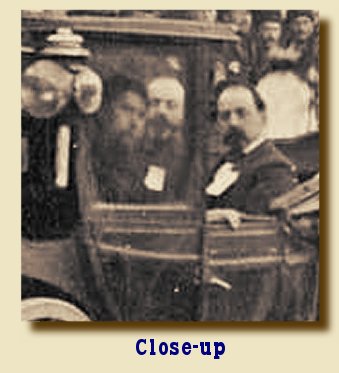


Note that the men in the carriage in each photograph are different, which would indicate different days.


One more question...


In the photograph Karl shared with us there is a figure that looks too familiar. Is this Soapy Smith? I just can’t help seeing him everywhere!


Although our research is never done I wish to thank those who donated their expertise and opinions and got us this far.

“Cousin Jim,” great-grandson of Soapy.
Art Petersen, editor, publisher, historian.
Gary Jayne, eBay dealer, early Alaskan artifacts.
Marelene McCluskey, Skagway Historical Society
Karl Gurcke, historian, Klondike Gold Rush National Historical Park.


.

December 8, 2014

Holly Street (6th Street) Skagway, Alaska

Holly Street
Skagway, Alaska
Circa 1899-1900
(Click image to enlarge)


olly Street

JEFF SMITH'S PARLOR
Skagway, Alaska 1899.

Oh, to be able to go back in time and walk down this street.  - Jeff Smith


      A great photograph by Eric Hegg, of Holly Street (now 6th Street) looking west from Broadway. In 1897-98 Holly was the main business street in town. This was taken in 1899, about a year after Soapy Smith was shot dead. His saloon, Jeff Smith's Parlor is now Clancy's Cafe, owned by John and Frank Clancy, business partners of Soapy's, who were oddly let out of any vigilante actions against the Soap Gang, even though they were very involved. The old sign bracket can still be seen on the front of the building in this photo.
      Also in the photo are the Hotel Mondamin, where Soapy lived (room #61), and where John D. Stewart stayed the night before he was robbed by the Soap Gang. According to personal accounts, Soapy also owned the small building in-between the Parlor and the Mondamin, which was used as a restaurant and gambling room. In this photo it is the Skaguay Oyster Parlor, under proprietorship of Frank Clancy.
      Down the street is the People's Theater, where Deputy Marshal James Rowan was shot and killed by gambler John Fay January 31, 1898. The vigilante committee of 101 wanted to perform their own trial and punishment of the killer but Soapy did not want them to take over control of the town so he hid Fay until the US Marshall could come in from Sitka and make the legal arrest of Fay and take him to Juneau for trial. Although Soapy had ulterior motives, what he did was the "legal" law and order thing to do, as opposed to taking the law into their own hands. Hiding Fay caused a lot of mixed feelings among the residence of the town, but surely Soapy made numerous "law and order" speeches that worked in his favor. Fay has been accused of being one of the Soap Gang, but more likely, this was Soapy doing his part as a "fixer," no doubt receiving a nice monthly sum from most, of the gambling houses, for his efforts.
      Across from the Mondamin was the Pack Train Saloon, which is rumored to have been in alliance with Soapy.


Mondamin Hotel


Mondamin Hotel: pages 461, 525-26.


He was sprawled out with his Stetson lying there, but nobody dared put his feet together or place his hands over his heart. They didn’t dare show sympathy for fear somebody would pull out a gun.
— Bobby Sheldon
Alias Soapy Smith, p. 537


DECEMBER 8


1765: Eli Whitney, the inventor of the cotton gin and the concept of interchangeable parts, is born in Westboro, Massachusetts.
1776: During the American Revolution General George Washington moves his retreating army across the Delaware River from New Jersey to Pennsylvania.
1863: President Lincoln announces Reconstruction, a plan to punish the southern states for the Civil War.
1863: American boxer, John Heenan, is defeated by Tom King of England in the first world heavyweight championship.
1869: The first 32 prison cells of the Colorado State Penitentiary are completed in Canon City, Colorado Territory.
1874: An unknown gang of men stop and rob the Kansas Pacific Railroad train near Muncie, Kansas, of a reported $30,000 and personal effects from the passengers. William "Bud" McDaniel, an associate of the James-Younger gang, is arrested in Kansas City, but he escapes from jail and is killed shortly afterward.
1874: A Comanche Indian camp in the Mushaqua Valley of Texas is attacked by soldiers under Lieutenant Lewis Warrington. Two Indians are killed, one is wounded, and one taken prisoner.
1879: “Big Ed” Burns is arrested with three men for stealing a gold watch and chain. Burns eventually becomes a member of Soapy Smith Soap Gang in Denver. Burns stays with the gang until Soapy’s death in 1898.
1883: John Heath and four masked men rob the store of A. A. Castanada in Bisbee, Arizona. Shooting erupts and several townspeople are killed in what newspapers call the Bisbee Massacre. The robbers rode away with $3,000 but are eventually captured and lynched.
1886: The American Federation of Labor is founded during a convention of union leaders in Columbus, Ohio.


August 9, 2009

Quick quotes...


The Mondamin Hotel
Skagway, Alaska 1915

The red dot in the above photograph is on the east outside wall of the Mondamin Hotel at the corner of Holly Street (now 6th) and Broadway Avenue Skagway, Alaska about 1915. Room #61 of the Mondamin is where Soapy Smith lived, which just so happens to be just a few doors from Jeff Smith's Parlor (Soapy's main saloon). Several letters to Soapy in the family collection are addressed to "Rm. #61." The Eagles Fraternity in Skagway has the 1898 hotel register that shows Soapy's signature for the room, as well as John Douglas Stewart's on July 8. Stewart, you will recall, is the man who was robbed of his gold poke, which inadvertently caused Soapy's death.

I'm a peaceful man. Yuh just might uh heard uh me ... the professor with a high degree in the teachin' uh the evils uh games uh chance. I'm known far and wide, as mah whole plan in life's tuh demonstrate tuh people how gamblin's destructive tuh the human spirit an' bank account just by rubbin' their noses right in it. Prove to 'em how they can't win so's tuh send 'em back tuh their wives an' little children tuh sit by the hearthstone, better an' wiser for the experience.
Welcome Suckers, James David Buchanan

July 25, 2017

Skagway, Alaska preparing for the 4th of July 1898

Skagway, Alaska
June 15, 1898
Broadway and Fourth Avenue
Courtesy of the Pat Hathaway Collection

(Click image to enlarge)


kagway prepares for the 4th of July


A very interesting photograph taken on June 15, 1898, looking north on Broadway from Fourth Avenue as the city prepares for the coming July 4th celebration and parade. Trees have been recently planted on Broadway, not seen in photographs taken the previous month. The rear of the Burkhard House (A) on the southwest corner of Broadway and Fifth shows the tops of the rear windows where soap gang member "Slim-Jim" Foster jumped out of, in a futile effort to escape his vigilante captors, holding him with the other primary members of the gang after the demise of their boss, Soapy Smith. That would not take place for another 24 days after this photograph was taken. Further down, on the north-west corner of Broadway and Holly Avenue, the Mondamin Hotel (B) can just be seen. Soapy lived in room #61 and his saloon, Jeff Smith's Parlor was two doors to the west. Flags and red, white and blue bunting can be seen adorning buildings as a man (C) holds a lengthy portion of bunting ready to drape the frontage of a building. 


"Do unto others what they’d like to do to you, but do it first."
Alias Soapy Smith, p 15


JULY 25


1805: Aaron Burr visits New Orleans with plans to establish a new country, with New Orleans as the capital city.
1850: Harvard and Yale University freshmen compete in the first U.S. intercollegiate billiards match.
1850: Gold is discovered in the Rogue River, Oregon.
1853: Outlaw Joaquin Murrieta and four of his men are shot and killed by California Rangers at Cantua Creek in central California. Murrieta’s head is lopped off to bring back as proof in order to collect the $1,000 reward. The hand of Bernardino “Three-Fingered Jack” Garcia was also taken.
1854: The paper collar is patented by Walter Hunt.
1861: The Crittenden Resolution is passed by Congress. It calls for the U.S. Civil War to be fought to preserve the union, not over the slavery issue.
1865: The Fight at Platte Bridge begins near Fort Casper, Wyoming. Indian Chief Crazy Horse's decoy party of Sioux fails to draw out the soldiers. Instead he attacks the fort.
1866: Ulysses S. Grant is named General of the U.S. Army. He is the first American officer to hold the rank.
1868: Wyoming Territory is created from portions of Dakota and Utah Territories in the Organic act.
1871: Seth Wheeler patents perforated wrapping paper.
1878: Charles Earl “Black Bart” Bowles robs the Quincy-Oroville stage a mile from Berry Creek, California.
1880: Lieutenant Hurst enlists Virgil Earp, and his brother Wyatt and Morgan, to accompany him to the McLaury Ranch, Arizona Territory, to inform the McLaury family of the theft of six government mules.
1881: “Big Ed” Burns opens a saloon in Casa Grande, Arizona from which to swindle victims from the incoming trains. Once it was discovered what they were doing a mob forced them to leave town. Burns joins Soapy Smith's Soap Gang.
1881: Four Mexicans are killed by cow-boys at Sarampion, Arizona.
1882: Roy Bean mails a local newspaper a postcard announcing the opening of his new saloon, the first one west of the Pecos River, San Antonio, Texas.
1890: Soap Gang members Charlie Graff, John Bowers, F. M. Hamaum and Ira H. Curtis are arrested in a mock auction house at Seventeenth and Market Streets in Denver, Colorado, charged with fraud by Herman Llamer who purchased a cheap watch, and made to believe to be a gold one.
1891: Con man Soapy Smith’s mock auction houses, who sell fake gold watches to unsuspecting victims on the streets of Denver, Colorado, are so notoriously successful that policemen are placed in front of the establishments to warn potential victims.
1895: Bannock Indians surround 250 settlers near Jackson Hole, Wyoming until they are dispersed by the 9th Cavalry.
1901: Harvey “Kid Curry” Logan, avenges the 1896 death of his brother John Curry. Logan waited in Jim Wither's corral in Montana all night, and shot Wither when he stepped out to brush his teeth.


November 7, 2017

Artifact #52: Envelope to Capt Jeff R. Smith


(Click image to enlarge)


apt. Jeff R. Smith


Artifact #52 from my personal collection is an envelope addressed to Soapy Smith in Skagway, Alaska. Unfortunately, the letter itself is missing, possible residing with the collections of another family member. 


Here's what we do know.
  • The individual who wrote the letter mailed it at around 5:30 p.m., on June 16, 1898, using a patriotic "Remember the Maine" envelope. The battleship Maine blew up in Havana harbor on February 15, 1898 and was the primary excuse for the Spanish American War.
  • It is addressed to "Capt" Jeff R. Smith, who took on the rank with the creation of his Skaguay Military Company.
  • "Box 61" refers to the mail box slot for room #61 of the Mondamin Hotel located two doors from Jeff Smith's Parlor on Holly Street (now Sixth).
  • The rear of the envelope is postmarked in Skagway on June 24, 1898, taking eight days to get to Soapy, arriving fifteen days prior to his demise on July 8, 1898.


(Click image to enlarge)


"He is one of the greatest characters in the west"
—Colorado state representative Lafe Pence, 1894
Alias Soapy Smith, p. 312.


NOVEMBER 7


1637: Anne Hutchinson, the first female religious leader in the American colonies, is banished from the Massachusetts Bay Colony for heresy.
1811: The Shawnee Indians under Chief Tecumseh are defeated by William Henry Harrison at the Battle of Tippecanoe, near the Wabash River in Indiana Territory.
1837: Elijah P. Lovejoy, an abolitionist printer, is shot to death by a pro-slavery mob in Alton, Illinois, while trying to protect his printing shop.
1859: The Jefferson Territory (Colorado) General Assembly meets in Denver to set the government in operation.
1874: The Republican Party is first symbolized as an elephant in a cartoon by Thomas Nast in Harper's Weekly.
1876: The cigarette manufacturing machine is patented by Albert H. Hook.
1876: John Ringo and George Glidden are arrested, ending the “Hoodoo War” in Texas. The feud began over cattle rustling, and last over a year. The Hoodoo’s were vigilantes who disguised themselves with hoods and boot-black.
1879: Frank H. Reid shoots and kills James Simons, a neighbor during an argument near Sweet Home, Oregon. Reid flees the scene but later returns for trial and although Reid was armed with a shotgun and Simons had but a stick in his hand, it was ruled as self-defense. On July 8, 1898 Reid shoots and wounds Soapy Smith in the Shootout on Juneau Wharf, Skagway, Alaska. Reid dies of his wounds 12 days later.
1881: Wyatt Earp and John “Doc” Holliday are jailed in Tombstone, Arizona Territory to await their hearing in the wake of the gunfight behind the O.K. Corral.
1885: Apache Indians under Chief Ulzana, attack two ranches south of the Mimbres Mountains in New Mexico Territory. Killed were Andrew Yeater and his wife. Their neighbor, John Shy barely escapes his burning house and saved his family.
1890: Soap Gang member Joe Simmons hits a Denver, Colorado Tivoli Club patron over the head with his pistol. The gun discharges and the bullet hits the wall.
1892: Denver crime boss Soapy Smith makes a blatant admission about election corruption to a Rocky Mountain News reporter saying “__ __ if any law could keep me from casting as many crooked votes as I __ __ pleased, and I don’t give a __ who knows that is my position. I will cast as many fraudulent votes as I want to, and there is no __ __ law can prevent me.”
1893: Colorado grants women the right to vote. It is the second state to do so.


July 10, 2020

How Soapy Smith conned his way to be Grand Marshal of the July 4, 1898 parade, Skagway, Alaska

Soapy Smith in July 4th parade
Skagway, Alaska 1898
Broadway and Fourth Ave.

Note Soapy is on the left of center, behind Joe Brooks.
Behind him is Brooks' Pack Train
Where is the Skaguay Military Company?
Where is the Fitzhugh Lee wagon?

Courtesy of
Klondike Gold Rush National Historical Park

(Click image to enlarge)


ow Soapy Smith conned his way to be Grand Marshal of the 4th of July

With the approach of the July Fourth 1898 holiday, Skagway, Alaska was filled with great excitement. The Commercial Club, consisting of business owners, took early control of planning the celebration and appointed a committee to arrange “for the proper observance and celebration of the glorious Fourth.” Skagway would have a parade, of course, and the committee decided it would consist of three divisions and three marshals, with Commercial Club President C. W. Everest as grand marshal. The commonly held historical belief is that Jefferson R. Smith, alias "Soapy" led the July 4, 1898 parade in Skagway, but according to pre-July 4 records and newspapers, Soapy was designated marshal of the 4th division, the position at the very end of the parade. The committee had planned the parade, but Soapy was planning to make it memorable.

Line-up for July 4 parade?
Is that Soapy?
Third Ave and State
Courtesy of
Darcie Culbeck

and
Klondike Gold Rush National Historical Park
 
(Click image to enlarge)

     Soapy was a very patriot man. In nearly all of the photographs of his numerous saloons and gaming houses in Colorado and Alaska between 1887-1898, there are American flags flying and red, white, and blue bunting draped across the façades. Surely, he reasoned, given his great success with the May 1 parade, no one knew better how to lead a celebration and stir a crowd’s emotions than he. Being dead last no doubt sat ill with Smith, captain of the Skaguay Military Company. There is no official  record of Soapy's complaint about his positioning in the parade. The committee had planned the parade, but Soapy would make sure no one would remember it. He had a plan, and he likely did not bother trying to change the committee’s minds about putting him at the end of the parade. In fact, adding another division at the very end of the parade may have been Soapy’s idea!

Is that Soapy Smith?
Close up from above photograph
Courtesy of
Darcie Culbeck

and
Klondike Gold Rush National Historical Park
 
(Click image to enlarge)

     In the earliest plans for the parade, Soapy’s name does not even appear. On July 1 his name is added as marshal of an added fourth division. The Skagway News published the program.

[1] Grand Marshal, C.W. Everest and aids J.F. Burkhard and A.P. Tony
[2] Band
[3] Marshal First Division—S.L. Lovell and aids
[4] Veterans
[5] Children’s’ Float with Goddess of Liberty
[6] News boys
[7] Chilkat Indians
[8] Grotesque characters
[9] Bicyclists
[10] Marshal Second Division—C.N. Hanson and aids J.G. Price and Sam Roberts
[11] Knights of Pythias
[12] Ladies Cavalcade
[13] City Brewing Float
[14] Gentleman’s Cavalcade
[15] Skaguay Brewing Float
[16] Floats and displays of Skaguay business and industries
[17] Marshal Third Division—F.W. Whiting and aids Messrs. Heney and Wilson
[18] Railroad employees
[19] Mechanic’s Floats
[20] Marshal Fourth Division—Jeff R. Smith and aids Wm. Tener and J. H. Brooks
[21] Skaguay Guards and “Fitizhugh Lee”
[22] Man of War Float
[23] Brooks' Pack Train.

Soapy before or just after the parade
The round badge dates this photograph
Jeff Smith's Parlor is seen at the far left
The Hotel Mondamin where Soapy lived is at the far right
Courtesy of
Royal British Columbia Archives
 
(Click image to enlarge)

The parade will form on Broadway at 1:30 p.m., and after parading the prin- [unreadable line] … front of the city hall where speeches will be delivered by the orators of the day, Messrs. R. W. Jennings, Walter Church, Judge Sehlbrede and Dr. Campbell.

Courtesy of
Royal British Columbia Archives

(Click image to enlarge)

      After the speaking, the athletic sports will take place on and contiguous to the Seattle and Skaguay dock, as follows:

1. 100 yard Foot Race, open to all.
2. 50 yard Sack Race, open to all.
3. 100 yard Fat Men’s race—contestants must weigh 200 pounds or over.
4. 75 yard Ladies’ Race, open to all.
5. Bicycle Race.
6. Tug of War—8 men.
7. Climbing Greased Pole, open to all.
8. Horse Race, ¼ mile, at low tide.
9. Indian Canoe Race, at low tide.

Prizes were donated by local businesses, including clothing, accessories, cigars, stationary, and a keg of beer. Frank Clancy, a partner of Soapy’s, donated a bottle of wine.
     Monday July 4, 1898 was the most festive day seen in Skagway up to that time. First thing in the morning the city was shaken by thundering echoes as shotguns were fired and dynamite placed under anvils was detonated. Red, white, and blue bunting brightened city buildings. American flags and patriotic banners fluttered everywhere in town. According to some accounts, Jeff and his associates handed out candy, peanuts, and firecrackers to the children.

Fitzhugh Lee float
Before the parade, in front of Jeff Smith's Parlor
Note the flag carrier, believed to be in
front of the Skaguay Military Company
Courtesy of
Royal British Columbia Archives
James A. Sinclair Collection

(Click image to enlarge)

     The parade’s fourth division had four parts: Captain (1) Jeff R. Smith, gang member William Tener and Joe Brooks. (2) The Skaguay Military Company and the Fitzhugh Lee float, (3) The Man of War float, and (4) The Brooks' Pack Train. The "Fitzhugh Lee'' float centered around a caged American bald eagle captured alive outside of Skagway by two men, who brought it to the city and gave it to Soapy in honor of his patriotic efforts in creating the all-volunteer Skaguay Military Company and offering its services to President McKinley during the Spanish-American War. Once the parade got under way, Soapy rode his dapple-gray horse alongside the J. H. Brooks as planned, but the only known photograph of Soapy in the parade shows that he is not leading the Skaguay Military Company or Fitzhugh Lee (photograph at top of article). Soapy is actually behind Brooks and to the left, not in the front center, like one would assume a grand marshal would place himself. Soapy is known to have craved the attention of the citizenry, so the question is begged, was his moving away from the center stage intentional? We know from photographs that “Fitizhugh Lee” was definitely decorated to be in the parade, consisting of a large wood and wire cage on a wagon decorated with six American flags and traditional tri-colored bunting. John Clancy’s six-year-old son, Frank, dressed as Uncle Sam, riding on the wagon behind the driver. However, a considered look at the parade photograph shows it is missing—in fact, that quite a bit is missing. The one known photograph taken of Soapy during the parade, and it offers some clues. There is more in that photograph, made conspicuous by their absences, that better offers us clues as to what could have happened that day.

Fitzhugh Lee float
Photo taken on Broadway during parade
Proof it was in the July 4 parade
 
(Click image to enlarge)

     No known newspaper accounts about the parade are known to exist. However, there are numerous published eyewitness accounts from people who witnessed the parade. Not a single eyewitness account is known to exist that states Soapy was positioned at the rear of the parade. All of them remember seeing Soapy at the head of the parade. Witnesses also spoke of seeing the Skaguay Military Company, but why would Soapy not be leading them as shown in the one existing photograph?
     Soapy was very proud of the Skaguay Military Company he commanded as it's captain. He led it, parading it through the streets of Skagway on May 1, 1898, and no doubt he was wanting to lead it again for July 4th. Since formed on March 19, 1898, Soapy had had his military unit drilling. A June newspaper account reported that the Company drilled "every night" (Sitka Alaskan Report 06/01/1898).

Only known photograph ofSoapy Smith in July 4 parade
Brooks Pack Train behind him
 Where's the Skaguay Military Company?

Where's the Fitzhugh Lee float?

Courtesy of
Klondike Gold Rush National Historical Park

(Click image to enlarge)

     In the parade photograph, Joe Brooks and his Pack Train has a sign advertising the pack train, but the division marshal is without one. A closer look at Soapy shows that he is off to the left, and behind Brooks, not in the middle, as one might assume a fourth division marshal would be.
     Soapy's history reveals a man who rarely gave up or gave in unless forced to, and even then, not without resistance. The parade committee chosen by Skagway merchants hardly seemed a threat to Soapy, so it is likely he had a plan to circumvent its will. So what did Soapy do to get to the front of the parade? What was his strategy? A plan so effective and generally pleasing that it remains a part of the annual July 4 parade tradition in Skagway to this day. Here is what I think happened during the parade that day.

SOAPY SMITH STEALS THE DAY.

     The parade moved south down Broadway towards the bay, with Soapy’s contingent at the very rear for the entire length of the parade. As the parade reached the end of its procession, Soapy put his plan into action. Riding his horse, he dashed up and down the length of the parade line-up, announcing that they should turn around and make another pass back through town. Everyone had worked hard on their floats and costumes and on getting organized, so in the spirit of the 4th of July, the idea of more parading probably sounded like fun. Having announced the proposed idea, and before the parade divisions could make a complete turn circle, Soapy convinced the parade entrants to simply turn about face and start the parade up again, from where they were. Soapy turned his horse and galloped back to the end of the parade, which was now the front of the parade, and started the procession, with him at the lead. Suddenly, out from the side streets, appeared the Skaguay Military Company, Fitzhugh Lee, and the Man of War Float, moving into place right behind Soapy’s horse. With Soapy now at the head of the parade, he led it back up the street before anyone could do anything, but follow along.


     This is when Soapy and his Military Company shined. They had been practicing for months, and were ready to make their captain proud. Reverend John Sinclair reported that “At scheduled intervals the Guards would exercise a neat maneuver and fire a volley into the air as Jeff would lift his hat, acknowledging the plaudits of the crowd. It was Soapy’s greatest hour.
     Always the planner when it came to managing a crowd, Soapy would have had his many friends, supporters, and particularly members of his gang, spread out among the spectators, boosting enthusiasm and excitement as Soapy would bring his mount to a stop and the military company would perform some sharp maneuver. Then lifting his hat and waving to the crowds to acknowledge their approval, he would lead on, guiding his mount from side to side to present himself. Of course, it is not known what Soapy actually did during the parade. Besides Sinclair’s accounting, this is just a possible scenario. However, it actually was Soapy at the head of his Skaguay Military Company, and they must have put on a spectacular show for him to be remembered as the grand marshal of the parade over 120 years later.

JEFF SMITH'S PARLOR
Before or after the July 4 parade

Soapy Smith is to the right of the Parlor door
Soapy's horse is the light colored one

(Click image to enlarge)

     Today, visitors to Skagway on July 4 will witness the parade make it’s way going in one direction on Broadway, and thanks to Soapy Smith, once the last entry reaches the end, the parade turns around and travels in the opposite direction, along Broadway.
     Official plans did not include Soapy as a speaker, following the parade, but of the post parade activities, Reverend Sinclair wrote in his diary, “Soapy was much in evidence. He was seated on the platform along with Governor Brady, Dr. Campbell and Messrs. Church, Humbert and Everest.” Soapy might have considered some stratagem by which he would be called upon to say a few words, such as planting members of his gang in the audience who could easily stir up the audience in wanting to hear a few words from captain Jeff Smith, the "grand marshal" of the parade. No record shows that Jeff actually addressed the crowd, but knowing Soapy, it seems unlikely that he would not have tried. The Skagway News reported how the fourth “was a great day for amateur photographers, as every man, horse, mule and float was ‘snapped’ at on every corner….” These picture-takers probably photographed the decorated speakers’ platform as well. Rev. Sinclair is reported to have taken up a good picture-taking position, but photographs of this venue, and the rest of the parade, have yet to surface. Hopefully one day they may.

OTHER PHOTOGRAPHS FROM THE PARADE


William Saportas
"One of the 'sure thing' men"

Member of the Soap Gang
July 4th parade
Courtesy of
Cynthia Brackett Driscoll

(Click image to enlarge)


Childrens Float with Goddess of Liberty
Courtesy of
University of Alaska, Fairbanks

(Click image to enlarge)


Ben Moore
July 4 parade
Courtesy of
University of Alaska, Fairbanks

(Click image to enlarge)


"A portion of the fourth of July street parade"
Moving north on State Street
Courtesy of
Cynthia Brackett Driscoll

(Click image to enlarge)


SOURCE:
Examining That Fiend in Hell: The Legend


"On this evening my friend “Soapy” seemed very depressed. He gave me a very interesting account of his life. He had never intended to be regarded as a bad man. He killed his first man in self defense. He just could not help it. It had to be done. He was terribly sorry and the next man also made it necessary for him to Snuff out his candle."
— Saunders Norvell, Forty Years of Hardware, 1924


JULY 10


1679: The British crown claims New Hampshire as a royal colony.
1776: The statue of King George III is pulled down in New York City.
1778: In support of the American Revolution, Louis XVI declares war on England.
1821: The U.S. takes possession of Florida, being sold by Spain.
1832: President Andrew Jackson vetoes legislation to re-charter the Second Bank of the United States.
1861: Fort Breckenridge, New Mexico Territory (Arizona) is demolished and abandoned by Union troops during the Civil War.
1863: Idaho Territory is created.
1866: Edison P. Clark patents his indelible pencil.
1877: Five masked men, probably the Sam Bass gang, rob a Deadwood, Dakota Territory stagecoach heading to Nebraska. No passengers or money was on the coach. The robbers asked about the next coach driving towards Deadwood. That coach was warned and hid at a ranch until certain the robbers had left. Soapy Smith would later witness the shootout that ended the life of Sam Bass in Round Rock, Texas.
1881: Outlaws, Frank and Jesse James rob the Davis and Sexton bank in Riverton, Iowa of $5,000.
1886: Outlaw, Sam Archer, of the Archer Brother gang, is on trial for murder. He is found guilty and will hang. Vigilantes will hang his older brothers, Tom, Mort, and John Archer without a trial.
1890: Wyoming becomes the 44th state to join the Union.
1898: Soap Gang member, Van B. Triplett hides out in the hills after Soapy Smith is killed, in Skagway, Alaska. Hunger becomes too much for him, and he sneaks back into town to eat. He is recognized and arrested while eating breakfast at the Pack Train restaurant. Later in the afternoon gang members, John Bowers, “Slim Jim” Foster, and George Wilder are captured in the hills, north of the town.
1900: The logo, “His Master’s Voice,” is patented. The logo for the Victor Recording Company shows the dog, Nipper, looking into the horn of a gramophone machine.
1901: Outlaws, Cole and Jim Younger are released from the Stillwater, Minnesota penitentiary.
1902: Etta Place and Harry “The Sundance Kid” Longabaugh sail to Buenos Aires aboard the Honorius from New York, working as a purser and stewardess.