February 2, 2023

The Bunco Steerer: A Detailed “Modus Operandi” in 1885.

THE “BUNCO STEERER.
Abilene Reflector
May 14, 1885

(Click image to enlarge)


HE “BUNCO STEERER.”
His “Modus Operandi” as Described by a Recent Victim.


The following publication from the Abilene Reflector, May 14, 1885, is about a typical account from the victim's view of an encounter with a bunco gang. The interesting difference in this particular article is that it is told in great detail, from start to finish. Though this bunco gang was based in New York, its "modus operandi" is nearly identical to the theatrical performances used by con man "Soapy" Smith and the soap gang in Denver, Colorado, in 1885-1895.

THE “BUNCO STEERER.”

His “Modus Operandi” as Described by a Recent Victim.

Remember, then, what, when a boy, I’ve
      Heard my grandma tell:
“Be warned in time by others’ harm, and you
     shall do full well!”
Don’t link yourself with vulgar folks, who’ve
      Got no fixed abode,
“Tell lies, use naughty words, and say “they
     Wish they may be blowed.”
                                                           —Ingoldsby Legends.[1]


      Since the time of the benevolent old gentleman of Margate who was so shamefully robbed by “the little vulgar boy,” other benevolent old gentlemen—and young ones, too—have been made the victims of the smooth-tongued gentry.
     It is wonderful how slow we are to learn by the sad experience of others. Although numberless cases of misplaced confidence have been duly exposed in the public press, yet several travelers from the rural districts, who pay occasional visits on business or pleasure to the large cities, always prove themselves sure game for the various types of cheats who eke out a perilous livelihood by trading upon their credulity.
     The world never will hear the complete details of all the tricks played on the unwary. Many who have come to grief reason philosophically that they have bought their sad experience at the price of the amount out of which they have been cheated, and so will not by recourse to the aid of the authorities, and its consequent publicity, allow themselves to be the butt or laughing stock of their friends.

     Foremost among the many cheats of all varieties who are always sure to infest thickly populated localities, are the “bunco” men. Their methods are very simple, and are unfortunately too often attended with success. A “bunco steerer” must, however, bring some brains into his nefarious calling, and it is sometimes wonderful to see what keen perception and persuasive faculties, which, if honestly applied, would win distinction for their possessor, are brought into play by the “bunco sharpers.”

     It takes a little ring of confederates to carry on this game successfully. There is first the “spotter,” who scouts out, as it were, the game, and then quickly apprises the “beaters,” who, if they succeed in hooking their man, pilot him into the hands of the lottery man and his confederates, who “play the greeny” for all he is worth, and then instantly vanish to meet again at some pre-arranged trysting-place, where the “swag” is honorably (?) “divied up.”
     The reader is familiar with the oft-recited details of the “bunco” man’s method: how the victim is accosted by a stranger in mistake and his name and address are secured, and then, armed with this valuable information, some young friend whom he has forgotten addresses him by his name and with an insinuating manner, of which the “bunco steerer” is complete master, wiles him into a saloon or a lottery shop, where the coup de grace is given, and, a sadder, wiser and poorer man laments over his misadventure.
     A too-confiding old gentleman, who does not give his real name, has furnished us with that portion of his diary which relates to a “bunco” trick. As it is eminently graphic and quite comprehensive, we think it unnecessary to indulge in further comment, so give it to our readers in his own exact words:
     SANDUSKY, O., April —. 1885. —To the Editor of — Sir: I send you herewith, according to promise, the leaves from my diary bearing upon the little trouble I got into in New York. As I do not wish my charitable neighbors in this locality should have the pleasure of commiserating with me, you will please withhold my proper name and for all purposes of identity and in this narrative call me yours truly.  
—JOHN SMITH.
THE DIARY.

      I am at home, safe and sound in Sandusky, thank God for that! And save that I am a little poorer in pocket and somewhat crestfallen in spirit, I am none the worse for my adventure. I had a little business to transact in New York, which could have been, perhaps, as well done by letter, but then a bachelor of my time of life often like to run away from the dull routine of home surroundings to experience for a while the bustle and unrest of a great city.
     I never travel without money. Some people tell me it is dangerous to carry about with me as much as I do on these occasions. Perhaps it is, but having had a sad experience in my youth of a journey I undertook without being burdened with the circulating medium, I have arrived at the conclusion that a fair allowance of money in one’s pocket is an essential ingredient to one’s enjoyment when out in the pursuit of health or happiness.
      I did not encumber myself with much luggage, but merely filled my pocket-book with moderate sized bills, took a little hand valise with a necessary change of clothing, and full of good spirits and philanthropy duly installed myself at the Astor House.
     I like lounging about the Astor House rotunda and steps. One can pick one’s teeth, meet an occasional acquaintance, and delight one’s gaze with the motley collection of human beings to be met there upon any day in the year.

     It was old Dr. Johnson, I think, who said, when asked for material for thought and description: ”Let us take a walk down Fleet Street.” Now, if the old doctor were alive in these days, and on a lecturing tour in America, and if asked what public promenade he would suggest to engender food for mental reflection he would, in my opinion, certainly reply, “Let us take a walk on Broadway.”
     I don’t exactly know whether I was thinking of the learned Doctor or not, or whether I was allowing my mind to wander fancy free, as I strolled up Broadway to make a call upon a friend. For convenience, I had placed a lot of papers and other matters in my hand valise, and, having plenty of time at my disposal, I lounged along, gaping from one side to the other and reflecting meditatively on the babel of sounds and the immense throng of people who surged and rushed in all directions.
The first bunco man
gathers the needed information.
Abilene Reflector
May 14, 1885

(Click image to enlarge)
     I think I had just passed Canal Street, when I was accosted by a rather genteel kind of man, who timidly stretched his hand out as if to greet me, and then, gazing at me with deep intent, said: “How d’ye do, Senator?”
     “You mistake, my good fellow,” said I, elevating one hand and warding off his advances. “I have not the honor of being a member of the Legislature, but am only a plain citizen and a mere visitor in this city.”
     “Well, well, well,” repeated the shabby-genteel party, “’tis really extraordinary. I could take my oath you were Senator Spoonbill; the same height, side-whiskers, long hair and dignified, gentlemanly appearance. Excuse me, sir, but you are not really joking?”

     “I assure you, on my honor,” said I, impressively, as I withdrew out the throng of passers-by, “that I was never more serious in my life. I am not Senator Spoonbill, but plain John Smith, of Sandusky, O.”
     “Dear me!” ejaculated the rather genteel party, “I should never have thought so. Besides, one of the Senator’s eccentricities is always to carry in his hand a black traveling bag with many of his valuables inclosed in it, just such a one as you have in your hand at present.”
     “My friend,” said I, “I know nothing of the Senator’s peculiarities, and furthermore I am not the man to carry my money or valuables in a hand bag, which might be snatched from me by the first desperado I should meet. No, sir; whatever money I carry about me is safely inclosed[sic] in my pocket-book, where the thief or designing rascal can not even see or lay a hand on it.”
     “You do quite right, sir,” meekly replied my new acquaintance, and I hope you will excuse me for the mistake I made in stopping you.”

     “Don’t mention it, my friend,” I replied, encouragingly. “The likeness, as you said, was so striking that you are not to blame, but before I leave you let me give you what we call down in Sandusaky ‘a pointer.’ Never carry your valuables in a hand-bag like your acquaintance, the Senator. Keep your money safely rolled up in your inside vest pocket, and then you can laugh at the thieves, ha! ha! ha!”
     With a chuckle of satisfaction at my own humor and a bow of respectful recognition at parting, I continued my walk up Broadway.
The second bunco man
moves in and introduces himself.
Abilene Reflector
May 14, 1885

 (Click image to enlarge)

     I can’t exactly say how I ever cultivated the taste for looking into shop windows. I know that every window I passed during the next half hour was scanned by me with such attention that I almost seemed to myself to be indulging in the process of appraising the value of goods set out for show. As I was turning the corner of Fourteenth Street, entering into Union Square, a foreign-looking young man, somewhat dudeishly attired, recognized me, and rushing over, grasped me firmly by the hand saying: “Hello, Mr. Smith: by Jove, you here? What in the name of wonder brought you down from Sandusky?”
     I was a little nonplussed at this warm greeting from a stranger, but as he knew me I thought it wiser to await developments, and said, with some politeness:
     “O, just ran down on a little business, and hope to be back home in a few days; but, you will excuse me, I cannot exactly place you, although you seem to know me very well.”
     “Know you,” said my friend, with evident delight. “I should smile!” Why, Mr. Smith, I knew you when I was a mere child. How long have you been living in your present residence?”
     “Well,” said I, “ever since my brother and myself dissolved partnership, and I retired from business.”
     “And how is your brother now?” he inquired.
     “How?” I said, in some surprise. “How the deuce can I tell? He was the first man incinerated in the new crematory. I guess what’s left of him is all right at home on the mantle-piece.”
     “Poor fellow,” said my young friend, with some sadness in his tone, “it was so sad, his taking off.”
     “Yes,“ said I, “You seem to have known him well. He was too fond, unfortunately, of taking rum at unseasonable hours, and that’s how he got so quickly incinerated. But might I ask your name?
     “Come, now,” he replied, “look me straight in the face and give a guess. Mind, though, I have been out of Sandusky a long time, knocking about Europe, and I am on my way home now, not like the prodigal son, either, as I have been in luck of late, and only this morning drew a prize of a thousand dollars, which I am this moment on my way to get cashed. But that is another matter. Now, as to my identity, I wish to please you with a surprise. Do you know the manager of the First National Bank?"

     “Do I! I should think so. He is my own banker, and as decent a fellow as ever I met. There’s not another man in the state of Ohio I have a greater regard for than Joe Hawley.”
     “Did you ever know that Joe had a son who went away to Europe?”
     “No; not as I’ve heard, young fellow. Joe is, like myself, an older bachelor, and all the boys he ever took an interest in were his nephews, Jim’s son’s. I guess one of them, Egbert, or Eggy, as they used to call him, did run away, but I always heard that he kinder got his blood up agin the Indians.”

     “No, sir; you are on the correct trail, but we must leave the Indian war-path. I gave it out that I was going West, but, by Jove! I did better and went East, made money in England, and now I am on my way back with lots of money to see dear old Sandusky.”
     “My dear boy,” said I. “I am delighted to meet you, and if you are not in a particular hurry to go home, guess you ought to wait for me. I am stopping, for the present, at the Astor House, and I am now on my way up to Sixteenth Street to meet an old Sandusky friend, D. Tobias Earwig.”
     “Friends again, by Jove!” ejaculated my companion. “Do you know Dr. Earwig? The second man I called on after leaving the landing-pier a short time ago. I promised to call on him, too, this very afternoon. In fact, he placed it upon me as an obligation. But there’s no use your going there now if you wish to see him.”
     “Why? May I ask.”

     “Because he is at this moment giving a demonstration at the Clinical in Harlem Hospital. You must have patience like myself, until four o’clock, and we can call on him together.”
     “Very good,” said I, resignedly; “I confess I am not in any great hurry, but I don’t relish the idea of walking about here carrying this confounded bag.”
     “Then I’ll settle that. I don’t mind confessing to you that the joy of getting home again has made me do a little too much in going round to see the Elephant, you know; and I guess a glass of good wine—Yellow Label, old man—won’t at all be out of place in my stomach. In fact, Dr. Earwig, our mutual friend, ordered me to take it. Come on.”
Enjoying the Yellow Label wine
getting the victim drunk.
Abilene Reflector
May 14, 1885

 (Click image to enlarge)

     I don’t know now why I yielded to the invitation of this stranger; but there was something in his easy manner which must have prepossessed me in his favor, and as I had a couple of hours’ lounging to do I easily fell a victim to his toils.
     My newly-found friend beckoned to a cabman, and before I could fully make up my mind, or even utter one word of expostulation, I was seated alongside him, and we were whisked up town at a rattling pace, until our conveyance stopped up with a sudden jerk at the door of a quiet-looking restaurant.
     We had the Yellow Label, as my friend called it, and as it was really good wine I felt bound to order a second bottle, when an acquaintance of my friend joined us, and I was duly introduced to him. This friend would insist upon a third bottle of the Yellow Label, and all the time kept wishing my young Sandusky acquaintance joy over his good fortune in winning such a large prize in some lottery.

     “Eggy,” said he, “I guess I’ll have another go at fortune. I have a few dollars which I can spare, and maybe I should have luck if you will only favor me with your—and your friend’s company.”
     “I don’t mind, old fellow,” was the reply. “Guess I want to get cash for my check, anyhow, but I won’t play any more, as I am going home to Sandusky as soon as possible.”
     “Come on, then,” said the other, “here’s a cab at the door. I am in a hurry, and can’t stay more than half an hour, play or not play.”

     I suppose it was the wine—Yellow Label—which rose in my head, but once more I found myself in a cab, and in a short time was ushered into a small apartment fitted up in office style, and my young Sandusky friend presented his check for payment.

     The party in charge was very polite, and begged my Sandusky friend to wait a few moments until he procured a counter signature of some other official before handing out the cash. Meanwhile the other friend said he would try his luck, and depositing a ten-dollar bill on the desk drew a ticket out of a little revolving mahogany box. He won. I saw him paid out fifty dollars, and I then began to take an interest in the game. My Sandusky friend asked the man in charge if he would give him credit pending the arrival of his winnings from his check, and he was prepared to play he beckoned me aside and confidentially informed me that if I followed his example, and invested the same amount as he did, we could win as much as would pay all our expenses and leave us a nice balance in our hands on landing at Sandusky. Perhaps it was the effect of the Yellow Label stuff, or perhaps the fellow mesmerized me, but I unfortunately accepted his advice and drew out a ten-dollar bill, and we won fifty dollars each. One of the party then suggested that a bottle of wine should be opened to our good fortune, and after partaking of a glass, my Sandusky friend whispered me that he was going now for a thousand, which he would add to the thousand already owed him. Again I am forced to make the sad confession that I resigned myself blindly to his advice; but luck did not seem to cling to him, as he won and lost by turns until he commenced, as he called it, to plunge. Of course, I plunged too, and my big roll of bills, amounting to over $300, soon dwindled down to a very small sum, until to my surprise I found myself compelled to borrow from my friend. His finances were drained out as well as my own, so he whispered me to take a chair and wait for him for a few minutes until he should return with the cash requisite for us to take out our revenge.
The False Alarm
getting rid of the victim.
Abilene Reflector
May 14, 1885

(Click image to enlarge)
     So I sat down and saw my young Sandusky friend politely bowing to me as he took his departure. I think I pulled nervously at my whiskers, and it began to dawn upon me that all was not as straight as it might be. I was thus engaged when a colored man rushed into the room and breathlessly informed me that he feared the police were at the front door, and I had better get out quickly by the back way, and take a cab to a place where my young Sandusky friend awaited me.
     I yielded automatically, and after a half-hour’s drive in the up-town portion of the city, my cabby pulled up and handed me my small hand valise and said I was to wait at this spot until he went for Mr. Hawley, whom he had instructions to drive back and join me at this particular place.
     I hadn’t even the presence of mind to take the number of that cab, my mind was in such a disturbed state; so I patiently waited for Hawley, who never turned up, although the shades of evening were approaching and the lamplighters were beginning to illuminate the district.
     I suppose it must have been that Yellow Label business which so obfuscated my intellectual faculties. It was quite dark and I was beginning to attract the attention of the passers-by before it fully dawned upon me that I had been cruelly swindled. Seeing a colored lamp in the distance which told me I was in the vicinity of a police precinct, I instantly rushed toward it to state my grievances.
Lodging a useless complaint
at the police station.
Abilene Reflector
May 14, 1885

(Click image to enlarge)
     I have a very great respect for the police force, but with all due respect for that highly intelligent body, the officer in charge smiled at me when I recounted my adventure, and, as he seemed to throw some doubts upon my sanity and jocularly remarked that, in his opinion, a good square sleep might take down the swelling in my head, I produced the only evidence of the swindle in my possession—a numbered ticket.
     This seemed to have little effect, as this very incompetent officer only folded his arms on the desk, and smiled at me more and more.

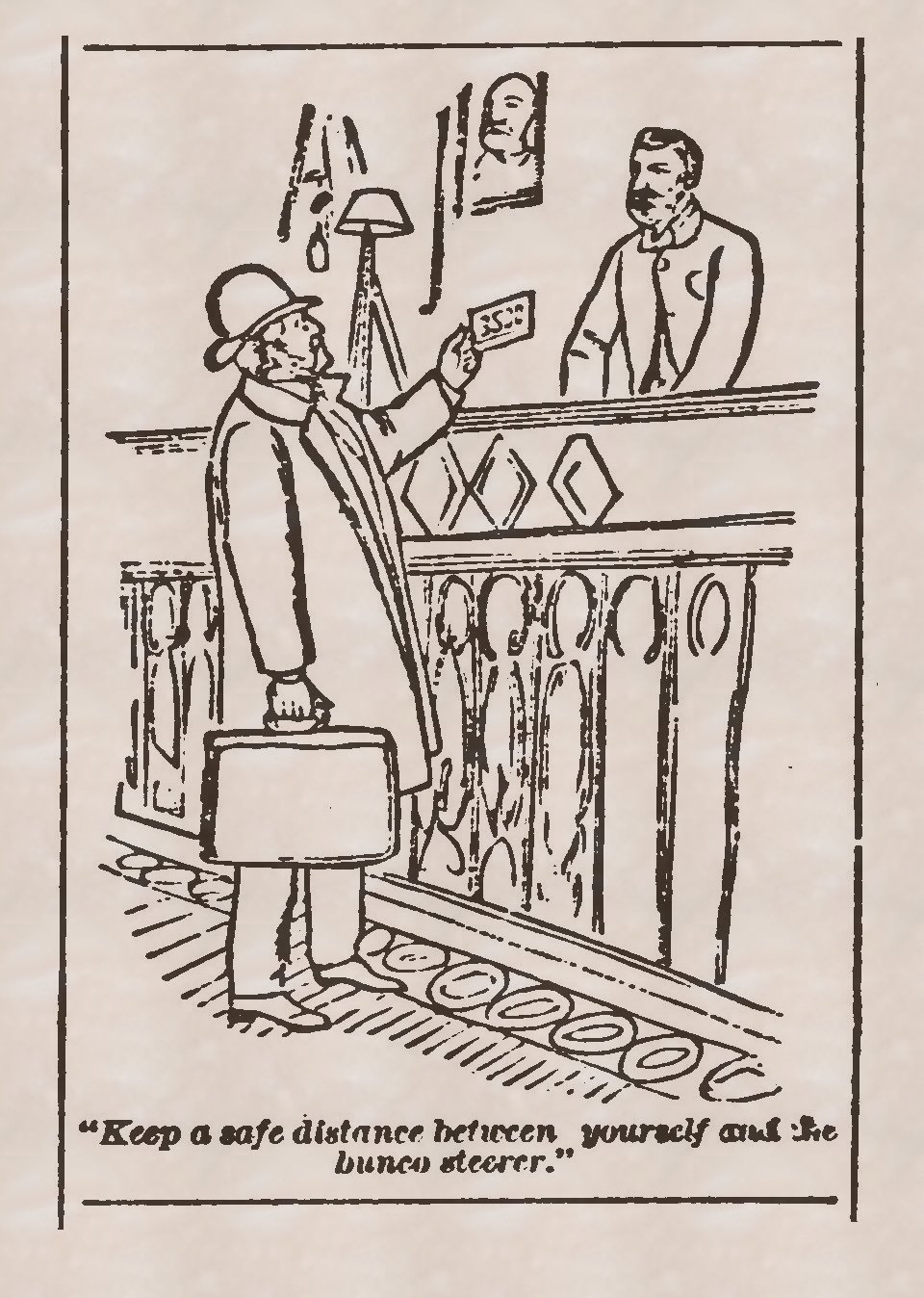
     “Go home, boss,” said he, “and when you next take a trip here from Sandusky, learn that it isn’t safe to stop and chin [to talk, chatter, gossip] in the streets with every one who says he knows you, and, above all things, keep a safe distance between yourself and the bunco steerer.”
—N.Y. Cor. Louisville Courier Journal.

NOTES:
[1]: The poem section comes from Misadventures at Margate. A Legend of Jarvis's Jetty. Mr. Simpkinson loquitur. page 315



"The surest of all “sure things” is a game operated with three little shells. It is one of the oldest bunko games in existence. The newspapers have published columns about it, and the names if its victims are as the sands of the sea."
—Aspen Daily Chronicle, July 30, 1889


January 25, 2023

Soapy Smith and Deputy U.S. Marshal Sylvester S. Taylor, Skagway, Alaska

Sylvester Slade Taylor
Four months after Soapy's death
San Francisco Chronicle
November 3, 1898

(Click image to enlarge)


EPUTY U.S. MARSHAL SYLVESTER SLADE TAYLOR
(04/03/1867 – 05/12/1958)


The Latest On A Forgotten Lawman.


Deputy U.S. Marshal Sylvester Slade Taylor, known as "Vess" to his family, has a black mark upon his record as a lawman which appears to be one of the reasons he remains largely unknown. In Skagway, Alaska, 1898, he was under the pay of bad man Jefferson Randolph "Soapy" Smith. After Soapy's death, via vigilantes, Deputy U.S. Marshal Taylor was "arrested" by the vigilantes along with members of the soap gang, charged with negligence of duty for his lack of performance after the robbery of miner John Douglas Stewart, and held until his boss, U.S. Marshal James McCain Shoup, arrived to relieve him of his duty. Historically, this is what Taylor is most famous for.
     Other than his involvement with Soapy Smith in Skagway, not much was known of Sylvester S. Taylor previous to 2010. In that year I had the pleasure of corresponding with a descendant of Taylor (second cousin twice removed) a family historian connected with the Ancestry.com profile for the Taylor family. This descendant wished to remain anonymous for privacy reasons and I still respect her wishes to this day. At the time, the Taylor family was not certain that their Sylvester Taylor was the same Deputy U.S. Marshal Taylor of Skagway, Alaska, fame. Even today the Ancestry profile mentions neither the lawman's profession nor his connection to Soapy Smith, however, there are solid links between the two that prove the two Taylors are one and the same.
     In every empire Soapy constructed, one of the first hurdles to jump was bounding the courts and the law under his control. Large graft payments were a common necessity in order for Soapy and his men to operate in newly arrived camps and towns. In Skagway, Alaska, 1898, one of the hurdles was 31-year old Deputy U.S. Marshal Sylvester Slade Taylor, who replaced Deputy U.S. Marshal James Rowan after he was killed on January 31, 1898. There are no details of how or when Taylor was lured into the criminal side of the law and placed on Soapy’s payroll as it was kept secret until early June 1898 when Mattie Silks publicly accused Taylor of being involved with the murder and robbery of Ella Wilson as well as being instrumental in a plan to murder of Silks. All of this was according to Silks herself and is questionable. Details of her accusations and story are equally interesting and can be found in my book, Alias Soapy Smith: The Life and Death of a Scoundrel.

Sylvester Slade Taylor
Taylor and Maddox family reunion
Palo Alto, Texas, August 6, 1922
From Taylor and Bevers Pioneer Families of Palo Pinto County, Texas
by Bobbie Ross, 1996
 
     Taylor’s final fall occurred after three of the soap gang swindled some funds and then outright robbed miner John Stewart’s gold in Skagway, Alaska, on July 8, 1898, which directly led to Soapy's death at the shootout on the Juneau Company Wharf. With the collapse of soap gang rule in Skagway, the vigilantes rounded up the gang and accused Taylor of being directly involved with Soapy, of silencing the news of the robbery, and of failing to arrest the culprits in the case. Vigilantes went to the home of Taylor to arrest him, only to find him sitting in a chair holding a baby (probably Stephan Alaska Taylor, born two months prior). Taylor was ordered to stay inside his home or risk death. Later he was accused of offering the return $600 of Stewart’s gold to Alaska’s Governor Brady if allowed to leave Skagway a free man. This request was denied and Taylor was charged with “willful neglect of duty.” [1][2] 
     U.S. Marshal Shoup arrived on Thursday, July 14, and within hours fired Taylor from his position and appointed vigilante J. M. Tanner in his place. The Daily Alaskan reported “ex-Deputy Marshal Taylor” was charged with "attempted extortion from a stampeder," but as the complainant left Skaguay for the interior, that charge was set aside, leaving only the charge of “willful neglect of duty, laid by Mr. Stewart.” Taylor was brought before the Committee of Safety to answer to the charges against him on July 15, 1898. “He waived examination” and was ordered held pending posting of $5,000 bond until his trial at Sitka, Alaska. Deputy U.S. Marshal Tanner took Taylor into custody.[3] Marshal Shoup later defended his hiring of Taylor, stating that when he appointed the man, he came “with exceptionally strong recommendations, having served in a similar capacity in Idaho …, where his reputation as an officer was unassailable.”[4] From Taylor's hearing in Skagway, it was discovered that from 1891 to 1896, Taylor had been constable and deputy sheriff in Nanpa, Idaho, and during a portion of that time, he was a deputy US marshal, and from May 1896 to January 30, 1898, he had been city marshal of Nanpa.[5]
     Reverend R. M. Dickey wrote that he associated with Taylor in Skagway, had dinner with him “and his friendly wife in their snug home.” In the fictional account of his time in Skaguay, Dickey characterized Taylor as “Strange and puzzling…,” “clever,” acting “With great courage,” a man of feeling who “completely broke down” in telling of a little girl who had died some ten years before.
And yet some people in Skaguay suspected that he was in fraternity with Soapy Smith and his league of cutthroats. We never believed that. And yet…. … Our conclusion was that he was a big-hearted man who fully determined to do right but who had in some way come under the power of Soapy and that he writhed under it. … There was something there, but whatever power Soapy had over him we never knew. It may be that he found himself powerless to enforce the law strictly and decided to follow a mediating path with the law breakers to amend their effect as best he could. Having submitted to appeasement once, perhaps he was in Soapy’s power.[6]
     On November 3, 1898, while awaiting the final results of his trial, a reporter from the San Francisco Chronicle had Taylor's likeness published (see top picture). On December 10, 1898, Taylor was acquitted of negligence. Evidence of his wrongdoing as a lawman was ample, but none of it was evidenced in court.[7] Though acquitted of negligence, Taylor’s career as a lawman was over. His name was now manacled to the legendary Soapy Smith, and no key could unlock it.
     Once able to leave Skagway, Taylor took his wife, Maud Ellen Stewart, and their five young children, including Stephen Alaska "Lou" Taylor, born in Skagway on May, 13, 1898, back to Idaho. In 1900, with the help of family member Pleasant John Taylor and an older brother or cousin, who was a "showman" and “movey projectionist,” Sylvester became manager of the show. In 1910 his occupation was still listed as “showman, vaudeville and movey projectionist." In 1919 Taylor's occupation is listed as working at the Isis Theater in Idaho.
      In the following from a Texas newspaper article from August 1922, Sylvester reminisces his early days in Texas, which includes a strong link to a career in law enforcement, considering his three older brothers were Texas Rangers.
      Early settlers will remember the three brothers of this family, who were Texas Rangers, known from border to border of the state of Texas as Ham [Hannibal Giddings Taylor], Eph [Ephraim Kelly Taylor] and Pleas [Pleasant John Taylor] (Doctor Stephen Slade Taylor’s sons). They lived in the days of Indians, and became Rangers to protect their homes, according to Sylvester Slade Taylor, of Reno, Nevada, who is in Fort Worth, visiting his son, S. J. Taylor, 1312 College Avenue. This is the second visit to Texas in thirty-five (35) years and the first time he had seen his sister, Mrs. Sarah Susan Taylor Click for thirty (30) years.
     "I went back home and went swimmin’ in the old swimming’ hole, in the nature way,’ the Texan said. ‘But the most exciting of the whole trip was when we went out to the Hart Ranch and saw a oil well brought in. They seem to bring ‘em in while you wait out there. It was the first one I’ve ever seen brought in and believe me it was some sight to these old Nevada eyes." He recounted many interesting things about the early days and the Indian raids. Remember the killing of the elder Dalton, father of Robert Dalton, owner of the Dalton Oil Tract. He saw his first train in Fort Worth, Texas.[8]
     In 1930, at age 63, Taylor is listed as a cigar salesman in Reno, Nevada. At age 73 in 1940 he is listed as an attendant at a local college in Spokane, Washington. Eighteen years later, on May 12, 1958, Sylvester Slade "Vess" Taylor passed away at age 91.
     At the time I published Alias Soapy Smith in 2009 I depended on the Taylor family tree on Ancestry.com complete with the inevitable mistakes that come with creating such a tree, for the pre and post-Skagway history of Sylvester Taylor. Thus, I was made to believe that Taylor "died comparatively young, though, in 1916 at age 49.” Since then, the information found on Ancestry.com has been updated and his actual death date, as shown in the death certificate below, is May 12, 1958, in Portland, Oregon.[9]
 
Death Certificate
Sylvester Slade Taylor
Courtesy of Ancestry.com

(Click image to enlarge)


NOTES:

  1. US v. Sylvester S. Taylor. Whiting wrote that Taylor was found "with a baby on each knee, for protection and also, sympathy." 
  2. Distant Justice: Policing the Alaskan Frontier, by William Hunt, 1987, p. 64. 
  3. Daily Alaskan 07/15/1898, p. 1. 
  4. Skaguay News, 07/15/1898. 
  5. Criminal case 1028-US v. Sylvester S. Taylor. Record Group 21 – US District Courts. Box 16 – 01/01/05 (2). National Archives and Records Administration, Pacific Alaska Region, Anchorage, Alaska. 
  6. Gold Fever: A Narrative of the Great Klondike Gold Rush, 1897-1899, by R. M. Dickey, Ed, Art Petersen, Klondike Research. pp. 84-85. 
  7. Distant Justice: Policing the Alaskan Frontier, by William Hunt, 1987, p. 65. 
  8. 1880, 1900, 1910 US Census, Taylor/Holloway Family Tree, accessed through Ancestry.com. 
  9. 1880, 1900, 1910 US Census, Taylor/Holloway Family Tree, accessed through Ancestry.com.


Sylvester Slade Taylor
Dec 24, 2010
Mar 23, 2014
Aug 13, 2017
Aug 18, 2017
Aug 24, 2017
Jan 14, 2020


Taylor, Sylvester S.: pages 508-12, 520, 527, 562, 575-78, 580-81.


"The Reverand Porter was fascinated with the game and firm in his belief that he could pick out the shell under which nestled the little black ball, but when the shell was lifted up the little black ball had mysteriously disappeared, as had also $52 of his hard earned wealth."
—Boulder Daily Camera, June 29, 1893


January 16, 2023

How Soapy Smith's gang obtained their victims at the Denver's Union Depot.

BUNCO IMPROVEMENTS
Barbour County Index
June 11, 1886.

(Click image to enlarge)


OW "SOAPY" SMITH'S GANG OPERATED
Details of one method they used to obtain potential victims at Denver's Union Depot.


     The details of the methods and tactics used by the confidence men to gain the trust of their intended victims are as interesting as the final swindle used upon the victims. 
     In researching for my book, Alias Soapy Smith: the Life and Death of a Scoundrel, I found that the two primary methods used by Soapy's gang in acquiring victims to swindle in Denver, Colorado, especially in the early days of his pre-empire career there, necessitated going out and finding them. The first and probably best, involved searching the "At the hotels" section of the local newspapers, which gave good information on out-of-town visitors registering at the hotels, including name, occupation, traveling companion(s), hometown, and whether the trip to Denver was one of business or pleasure. The boosters would choose a potential target and "accidentally" come upon the intended mark and claim surprise, "recognizing" a fellow hometown neighbor, knowing their name and facts about the town in which they hail from. Once the victim is fooled into believing that the sharper is a trustworthy peer of his hometown, the booster would encourage the man to go with him to one of numerous locations ready and waiting for the return of the booster and his prey. The second involved the boosters going to Denver's Union Depot and picking out complete strangers for the plucking. Most books, regarding this topic describe a typical case of  mistaken identity in which the booster would approach an intended greenhorn addressing them as if they know the target, but using the wrong name. Naturally the victim would state that the con man is mistaken, and with an apology, the sharper begins into a conversation geared towards finding out as much information as he can. After apologizing again, the con would excuse himself and pass off the gathered information onto the next booster, who would then approach the gullible individual pretending to know him, but this time using the correct name, etc. The details of how they might have done this has been left up to one's imagination. My book goes into a detailed fictional example of such a scenario. 
     Recently, I uncovered a newspaper article that exposed one method used by a bunko gang in New York and I bet the same tactic was used across the nation, including in Denver. The following was published by the Barbour County Index, June 11, 1886.

BUNCO IMPROVEMENTS.
The Dumb Alphabet Rapidly Growing in Favor Among the Crooks.

[N. Y. Sun.]

      “The rising generation of bunco steerers,” said a detective yesterday, “has improved on the rackets of the old-timers. Everybody knows that they work in pairs, and when they meet a greeny one braces him, gets his name and town from which he hails, apologizes for mistaking him for Mr. Smith or Jones, of Cohoes, or Kenaka, and goes back and posts his pal, who usually waits around the corner for him. The pal then tackles the hayseeder, after consulting his guide-book, getting the population, bank presidents’ names and the names of a few leading merchants of the town the ‘hayseeder’ came from. It often happened that the countryman grew suspicious as soon as the first bunco man left him, after getting his name, and when the second tackled him shortly afterward chock-full of knowledge about the town he came from, would laugh at him, and if he knew any slang at all would remark. Too thin!
     “The new game is apt to prove more successful. Two men working together now learn the dumb alphabet before they start out. The first man to strike the stranger throws his left hand behind his back, and with the dumb alphabet telegraphs the stranger’s name and whatever else he has learned to his pal, who is close behind him. In this way the second man is able to brace the stranger before the first man has done shaking hands with him, and there is no room left for him to believe that the men are acting together. Then the first man apologizes and walks away and the second man works the stranger. If he can, on the envelope, lottery or saw-dust game.


Obtaining victims: pages 65-69.


"Gambling in itself is bad enough even when the game is square (honest); but your professional gambler never plays the game that way. He is an expert with cards. His seemingly innocent shuffle of the pack gives him a full knowledge of where every card is located. He deals you a hand good enough to induce you to make dangerously high bets, but not high enough to win. He lures his victim by small winnings to destruction in the end. He uses cards so cleverly marked on the back that he can read the values of your hand as well as if he were looking over your shoulder, and governs his play accordingly."
—Harry Houdini, The Right Way to do Wrong, 1906.


January 15, 2023

Was Soapy Smith in Phoenix, Arizona in May 1882?

No Good Place for Sharpers.
Los Angeles Daily Herald
May 4, 1882


(Click image to enlarge)


as Soapy Smith in Phoenix, Arizona in May 1882?


The Los Angeles Daily Herald, May 4, 1882, reports the following.

No Good Place for Sharpers.

PHOENIX, A. T., May 3.—Three bunko sharps and top-and-bottom men were arrested here this morning. The officers are after another. The citizens are determined that, if not convicted, they must leave town, or cottonwood trees will bear the same fruit as in 1879.
      Could confidence man “Soapy” Smith have been in Phoenix in May 1882? There is no hard provenance yet, but the timing seems open to the possibility.
     At the time I published Alias Soapy Smith: The Life and Death of a Scoundrel, Soapy's whereabouts between 1881 and 1882 were uncertain. Since then a lot of new information has surfaced. Family collections contain few personal letters or newspaper clippings to show his activities. To survive, however, is a letter of reference that may explain his whereabouts, and his rapid movement between towns and states. Dated May 12, 1882, from the South Pueblo, Colorado, office of the Denver and Rio Grande Railway, it reads,
To whom it may concern

The barer Mr. Jeff. R. Smith has been in the employ of this company for the last fourteen months in the capacity of train baggage master. During that time he has served us it has been to the satisfaction of all concerned. He leaves our employ in good standing.

W. H. Bancroff
The letter bears the superintendent’s personal stamp. Two possibilities are that Soapy actually worked for the Denver and Rio Grande and had been on the job, or that the letter is a forgery, perhaps so that Jeff might move about by train, unmolested by railroad security. Either way, what came to be Soapy's life-long focus makes probable that he was swindling train passengers.
     In the summer of 1882, Soapy surfaced in Salt Lake City. He purchased a merchant’s license to operate on the sidewalk at South Temple, between East Temple 1st and East streets for the term of three months, starting June 11, 1882. The fee was $2.75. Though the license was good until September, he did not stay the full term. During this period, Soapy seems to have been a “hit and run” nomad, staying in each location long enough to swindle victims, and then leaving before facing prosecution.
     Less than two months later he was in Portland, Oregon, where he purchased a vendor license dated August 2, 1882. An edition of Portland’s Daily Standard of the same date exposes the infamous prize package soap sell for the first time.
     On January 25, 1883, Soapy acquired a license to “purchase goods” in Gonzales, Texas. Then on May 26, he paid $2.50 for the privilege of selling soap in Nebraska City, Nebraska. Just 4 days later, he bought a license to sell in Washington City, Iowa, some 300 miles away. At some point in 1883 Soapy made his way to Tombstone, Arizona. A small notebook in his handwriting notes money made while there. On December 26, 1883, he paid $4 for a vendor’s license in Phoenix, Arizona. Six days later, on New Year’s Day, he was arrested in San Francisco for operating the “soap racket.” This tells us that Soapy was constantly on the move between towns across the West. 
     Was Soapy in Phoenix, Arizona, in May 1882? It's a possibility. The research continues.


Phoenix, Arizona

Oct 05, 2009
Dec 26, 2015
Dec 22, 2019


Phoenix, Arizona: pages 40-41.


"Card sharping has been reduced to a science. It is no longer a haphazard affair, involving merely primitive manipulations, but it has developed into a profession in which there is as much to learn as in most occupations."
—John Maskelyne, 1894


January 12, 2023

Soapy Smith's roulette table up for auction.

Soapy Smith's roulette table
Courtesy of Potter and Potter Auctions

(Click image to enlarge)


OAPY SMITH'S ROULETTE TABLE UP FOR AUCTION!
Potter and Potter Auctions the Ricky Jay Collection.


Auction Description: Lot 318

SMITH, “Soapy” (Jefferson Randolph Smith, 1860 – 98). “Soapy” Smith’s Roulette Table and Wheel. Denver: George Mason and Co., ca. 1890. Handsome full-size roulette layout, table, and wheel manufactured by the noted gambling supply house and owned and used by notorious con man “Soapy” Smith. 95 ½ x 40 x 31”, outer wheel diameter (cradle) 31 ½”. Hub bears the manufacturer’s name. Wheel spins freely. Sold with a Mason and Co. check rack (stencil-marked by the maker underneath), and a later set of chips, likely manufactured by H.C. Evans of Chicago. Layout rubbed and worn, but in good condition overall; finish of table and legs also worn, but overall, a sturdy and impressive relic not only of the American west, but one of its most notorious figures, and among the most prominent makers of gambling equipment of the era. Accompanied by a letter of provenance from Smith’s descendant to Ricky Jay attesting to the provenance of the wheel and table, the family’s ownership of same, as well as a catalog from the sale of the Pullen Alaska Museum collection by Greenfield Galleries of Seattle, featuring the roulette wheel on its cover. One of the more notorious denizens of Skagway, Alaska, Smith’s reputation was as a con man, gambler, and criminal of considerable renown. After his family fortune was lost in the aftermath of the Civil War, Smith prospered by becoming a criminal kingpin in Texas, operating rigged games of Three Card Monte, poker, and the venerable Three Shell Game. Later, he lived and conned in Colorado for years, in both Creede (a mining boom town), and Denver. It was in the latter city where this wheel was manufactured by the famous firm of Mason and Co., one of the best-known gaming supply houses of the era. The sobriquet of “Soapy” was conferred on Smith thanks to a sleight-of-hand swindle devised to sell bars of soap. Smith demonstrated to a crowd how valuable cash prizes were hidden in the paper wrappers of a select number of bars, and when some customers ripped open the paper packaging to discover the hidden loot, business boomed. But these winners were “Soapy’s” accomplices – the laymen in the crowd never stood a chance of finding hidden greenbacks. A simple dexterous dodge made certain the bars of soap with the extra bills went straight to those in cahoots with the con man. Smith died in a gunfight in Juneau, Alaska on July 8, 1898. A dispute over a game of Three Card Monte led to the shootout that cost him his life.

Minimum Bid: $5,000
Estimate: $10,000 - $20,000
Number of Bids: 0
Time Left: [As of this post (01/12/2023) there are 43 days left]


Soapy Smith's roulette table
Courtesy of Potter and Potter Auctions

(Click image to enlarge)


     The roulette table belonged to my great-grandfather Jefferson Randolph Smith II, alias "Soapy" Smith. It is very possible that he used the table in one or more of his gambling houses in Denver and Creede, Colorado, etc., each location mentioning "roulette" being offered. He knew the George Mason Company of Denver well, as their store was only about two blocks from Soapy's Tivoli Club saloon and gaming house.  
     In 1897-98, during the Klondike gold rush Soapy shipped the table to Skagway, Alaska. As shipping to the new camp was at a premium, it is believed that the equipment, wheel, layout, etc., minus the table and legs, were shipped at a cost of $1,000 (according to Harriet Pullen). The table and legs are believed to have been made in Skagway, but it is equally possible that the entire setup was shipped. Either way, the items were likely crated because if
the ship company saw illegal gambling equipment, the charge might have been
even more.
An enormous price, but Soapy knew he would make his money back very quickly.
     After Soapy's death and the gold rush subsided, the table eventually made it's way to the Pullen House hotel operated by gold rush pioneer Harriet Pullen, who claimed to have known Soapy. The roulette table and other Skagway artifacts were placed in her hotel as a private museum of the Days of '98. The museum and hotel remained open until Pullen's death in 1947.

Soapy Smith's roulette table
Harriet Pullen age 80
standing with Soapy's roulette table
Pullen House, Skagway.
Jeff Smith collection

(Click image to enlarge)


Soapy Smith's roulette table
Harriet Pullen spins Soapy
Smith's roulette table
Pullen House, Skagway.
Jeff Smith collection

(Click image to enlarge)


     In 1959 Harriet Pullen's granddaughter Mary Kopanski moved the Pullen museum to the Food Circus Balcony at the Seattle Center in Seattle, Washington. In the 1970s the Seattle Center announced that they were tearing down the building and thus evicting the museum. Mary Kopanski decided to sell the collection at auction in 1975.
 
 
Pullen House Museum advertisement roulette table
Soapy's roulette table is mentioned
Pullen House, Skagway.
Jeff Smith collection
 
(Click image to enlarge)
 
      In 1973 My father, mother and I went to the Pullen collection auction in Seattle, Washington, where my father purchased the roulette table, Soapy's grave marker and other artifacts. Considering Soapy was a confidence man, my father believed that the table might be gaffed (rigged for cheating) and so when it arrived from the auction house he proceeded to carefully take it apart to examine it but no gaffing could be found. It's a square (honest) table. We built a saloon and gambling hall in a back building to display the roulette table and my father's gambling collection. I inherited the roulette table upon my father's passing in 1987.
     In the 2000s I sold the roulette table to magician/actor Ricky Jay, a big fan of Soapy's.
 

Soapy Smith's roulette table - Seattle Center museum 
Magazine article on Pullen Museum
Seattle Center, Seattle, Washington
Jeff Smith collection
 
(Click image to enlarge)
 
 
     Ricky Jay, an absolute master of slight of hand and card tricks passed away in 2018.
          Ideally, I would like to see the table sell for an enormous amount. High enough that the media might notice and report on it. One of my primary goals since the 1980s has been to see Soapy Smith become a very well-known character of the old west. All Soapy needs is a major motion picture or series about his life and death! 
     For more photographs of the roulette table see the "Potter and Potter Auctions" link below.

SOURCES


Soapy's roulette table: pages 74, 124-25, 126-27, 419-20, 451, 456, 471, 480. 


"He made fortune after fortune and spent it all in riotous living and in good deeds, for it must be ever said of "Soapy" that no hungry man ever asked aid of him and was refused."
——San Francisco Examiner, February 25, 1898


January 5, 2023

Will Raid the Camp at Skaguay: San Francisco Call, 09/06/1897.

WILL RAID THE CAMP AT SKAGUAY
San Francisco Call – Bulletin
September 6, 1897

(Click image to enlarge)


OLD OPERATIONS OF CRIMINALS."
 
Just weeks after Skaguay’s “founding” Soapy Smith was already entrenched within the gambling and saloon hierarchy of the new camp. Below is the transcription of the article from the San Francisco Call – Bulletin, September 6, 1897. My personal notes and comments follow.

WILL RAID THE CAMP AT SKAGUAY

Officers of Alaska Intend to drive Out the Lawless Element.

SHARKS ON THE TRAIL WITH A SHELL GAME.

Hardships of Unfortunate Gold-Seekers, Who Cannot Go Forward, Increased by the Bold Operations of Criminals.

      SEATTLE, WASH., Sept. 5.—Things have about reached a crises at Skaguay. Trouble, it is asserted, cannot be averted, and the condition of affairs is so alarming that Government officers are gathering in a squad to save Americans. The steamer Queen arrived from the north at 3 o’clock this morning and brings down the latest news. It is alleged that gamblers and other criminals, while robbing miners every hour of the day and night, are doing everything in their power to cause a blockade on White Pass and drive the thousands of desperate men into a winter’s camp at Skaguay, so that the robbery can continue. Some of the most notorious criminals of the country are there. The old shell game is being worked with success almost on the summit of White Pass by “Soapy” Jim Smith, a renowned crook from St. Louis. An ex-convict from Montana is assisting him. Then, too, thieves are at work. On August 27 one miner’s tent was relieved of $1400.
     On the Queen were George B. Kittinger of this city and Colonel F. S. Chadbourne of San Francisco, a State Harbor Commissioner of California. From interviews had with these men it is apparent that the worst has yet to be told concerning the horrors at Skaguay. Mr. Kittinger, who is the Alaska representative of Millionaire J. Edward Addicks, returned for additional funds with which to secure boats and transportation from their camp to the lakes. Before leaving the trail Mr. Kittinger offered two men $200 a thousand for whipsawing lumber at the lakes for two boats. The men refused the job, and Kittinger finally contracted to purchase the boats at $350 each. Kittinger says:
     “The feeling is most intense among the miners on the trail. Trouble of the most serious nature is likely to break out at any minute. The miners’ committee, impelled by the wholesale stealing that has been going on for weeks past, held a meeting and announced that the first man caught in theft would be strung up without the formality of a trial.
     “All the men in the camp have been made desperate by the failure to get over the trail and by the terrible hardships they have been compelled to endure in the hopeless struggle against odds. The miners have become suspicious of each other and quarrels are of hourly occurrence. Every man’s hand is raised against every other man. The lawless characters are much in evidence and dissensions and discords have broken out among the miners until such a thing as co-operation is impossible. Words are utterly inadequate to describe the trail. You cannot put it too strong. If there were 300 there instead of 6000 it would be different, but with men and horses—some of the latter not more brutes than the men—there is much struggling and fighting for a chance to get beyond the summit. All efforts to place the trail in shape for travel are utterly in vain.”
      The attention of the authorities of Alaska have been drawn to Skaguay, and Governor Brady and Collector Ivey detailed and announced to him his intention of raiding Skaguay with a force of deputy marshals, driving out the whisky smugglers, saloon men and dive keepers and arresting the confidence men and thugs.
     “This,” said Colonel Chadbourne, “is the only way in which they hope to avoid crimes of all descriptions during the winter. The whisky men and thieves have conspired to keep the trail blocked so that thousands will be forced to winter at Skaguay. They know that the authorities are not able to cope with them and figure on getting every dollar out of the tenderfeet from the East before spring sets in. All sorts of traps are laid for the unwary Easterners and men from the villages of the coast. Soapy Jim, one of the most notorious confidence operators on the coast, conducts a shell game right out on the open trail. Jack Jolly, the murderer who has just been released from the Montana penitentiary, is on the grounds and says that Skaguay is the easiest graft in the country.”
      Collector Ivey said that if he could break up the whisky smugglers and dive-keepers the camp would disperse, the gold hunters return to Juneau and the Sound for the winter and quiet would be restored.
     Governor Brady is quoted as saying that the situation is laden with trouble, and that he intends notifying the department at Washington of the condition of affairs. The action of the Collector’s deputies in taxing the Canadian mounted police $30 per head duty for their horses has incensed the Canadians, and as they passed up the trail they openly announced their intention of “cinching” the first of the American miners that got to Lake Tagish, where the Canadian customs officers is established.
     In spite of the attempt of the miners’ committee to close the trail so that it could be repaired, one party of twelve, with drawn revolvers and loaded rifles, announced their intention of going through to the summit. They passed a guard of miners and set out for the summit. The committee was called together and a number of armed men were sent after them to head them off. If trouble is averted it will be by the greatest good luck. The men have lost all sense of reason and are desperate and reckless.

GETTING READY FOR THE OPENING.
San Francisco Call – Bulletin
September 6, 1897

 (Click image to enlarge)
 
PICTURE

GETTING READY FOR THE OPENING.

      The above picture, which is from a sketch made by H. W. Nelson, represents a scene before the pioneer dance hall of Skaguay just previous to opening for business. The piano on the wagon was formerly used in Morosco’s Theater in this City, but four years ago it was taken to Juneau and placed in the opera-house there. When the Klondike craze set in and gave Skaguay a boom one of the first necessities of the new town was a dance hall. People couldn’t dance without music, and as all the fiddlers had thrown up their positions and gone to the mines, the piano in the Juneau Opera-house was purchased and shipped to the new town. The owner of the wagon in which the piano was transported from the beach was ordered out of town for taking $10 from the body of a man which he had recovered from the river. He accordingly disposed of his wagon and horses for the sum of $2250 and left. The present owner is now earning $240 a day with the outfit. The rope with a running noose at the end hanging from the limb of a tree is termed “The Policeman,” and is intended as a warning to the criminal element.
NOTES

  1. Soapy was still in Skaguay as of this newspaper publication, having arrived August 20, 1897 with partners Jerry J. Daly and Jack Jolly, the latter being mentioned as "the murderer who has just been released from the Montana penitentiary." According to Daly, the three men worked 19 days of the 23 days they were in the new camp, netting about $30,000, which was split three ways. After 23 days the trio boarded the steamer Queen and sailed to Seattle, Washington, arriving there on September 22, 1897. 
  2. The reporter/newspaper was in error in stating that Jefferson Randolph Smith's first name was "Jim."
  3. It should be noted that it was reported in Washington state newspapers that Soapy was "forced to leave" Skaguay by the vigilantes and the deputy marshals. This was not true. Soapy made alliances with the saloon proprietors, Frank and John Clancy brothers, setting up the early stages of his new empire in Skaguay and besides not wanting to get stuck in another Alaska winter as he did in 1896 in Hope, Alaska, he decided to spend the winter in the states. Something else encouraged him homeward. His wife Mary had written him that she was ill. By the time he had reached Seattle she had written again, that she was much feeling better. Bat Masterson, a friend of Jerry Daly, one of Soapy's associates during the Skaguay trip, reported in the newspaper that Soapy was not forced to leave Skaguay via the vigilantes or any lawmen.    
  4. The White Pass trail had just opened up in July 1897. It was over-grown with brush and trees. In the summer of 2022 I was in Skagway, Alaska. The Chilkoot trail out of Dyea is open and constantly maintained, unlike the White Pass trail, which appears today much as it did in 1897. There are only small sections out of Skagway that have been partially maintained enough to walk on. Other than that, it is pretty dense with foliage to attempt in summer time, let alone in the winter months. Because winter was coming in 1897, it was very dangerous to attempt to get to the Klondike from Skaguay. Many could perish. In fact, those that made it to Dawson (Klondike) in 1897 nearly starved to death that first winter, according to most histories. So much so that the North-West Mounted Police required each man to bring with him 2000 pounds of supplies in order to cross the border into Canada. Imagine if those 6,000 (according to article) had been allowed to continue on to the Klondike, how many might have starved to death, if they even made it to Dawson? Sort of lends credit to Soapy’s "defense" he often used in Alaska, that he was saving lives by sending the hayseeds back home, or in this case, turning them back towards Skaguay to spend the winter.
  5. Turning the stampeders on the trail back towards Skagway was good for Soapy Smith, as well as for the proprietors of the saloons, gambling dens and the other merchants of Skaguay as it meant more customers and profits in the winter months which were expected to wane considerably. The growing criminal underworld and legitimate merchants surely appreciated Soapy's actions and showed their loyalty by looking the other way when it came to his nefarious activities.
  6. The article's drawing, Getting Ready for the Opening, "represents a scene before the pioneer dance hall of Skaguay." Note that although 'pioneer dance hall' appears to be a name of the establishment it is not capitalized. As Clancy's Saloon and Music Hall was one of the first money backed establishments in Skaguay I believe the picture's description could be of the Clancy's place.
 
Clancy's Saloon and Music Hall
Courtesy of University of Washington Libraries

 (Click image to enlarge)


"When a sucker sees a corner turned up, or a little spot on a card in three-card monte, he does not know that it was done for the purpose of making him think he has the advantage. He thinks, of course, the player does not see it, and he is in such a hurry to get out his money that he often cuts or tears his clothes. After they have put up their money and turned the card, they see that the mark was put there for a purpose. Then they are mad, because they are beat at their own game. They begin to kick, and want their money back, but they would not have thought of such a thing had they won the money from a blind man, for they did think he must be nearly blind, or he could have seen the mark on the winning card. They expected to rob a blind man, and got left. I never had any sympathy for them, and I would fight before I would give them back one cent. It is a good lesson for a dishonest man to be caught by some trick, and I always did like to teach it."
—George Devol