June 13, 2016

Wink At Crimes: Repeat voting fraud in Denver 1895

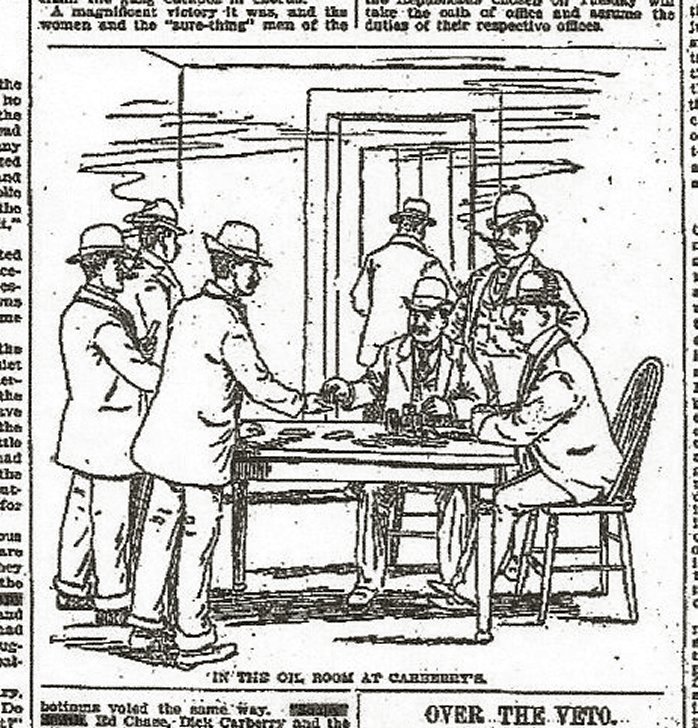
IN THE OIL ROOM AT CARBERRY'S
Repeaters get their names to vote under
Rocky Mountain News, April 4, 1895
 
(Click image to enlarge)


INK AT CRIMES
Repeat voting fraud in Denver, Colorado 1895.

     There may be no other 19th century American city in the west that suffered the bane of political corruption like that of Denver, Colorado. No where in the western states did the criminal underworld openly and outright control and rule unscrupulously, without fear and without punishment, than in the Queen City of the Plains. 
    As a matter of course, the one common presence, the scourge of Denver's exploited election process, is none other than Jefferson Randolph "Soapy" Smith. Following is merely one sampling of his involvement in the misdeeds and desecration of the Democratic voting process.
    On April 4, 1895 the Rocky Mountain News exposed something that most citizens in Denver took for granted, election fraud. The election that took place two days previous, on April 2, 1895, was not an honest one. Worse was the fact that the corruption was not all that careful about hiding their actions as no one in the city or state government seemingly cared to launch a real investigation into the crimes committed.
    The crime most noted was that of repeat voting, the process of one person voting numerous times, using the names of those citizens who were deceased.  


WINK AT CRIMES.

__________

No Prosecution of Repeaters or their Rich Backers.

__________

District Attorney Claims no Official Knowledge of corruption.

__________

Police Board Professes Ignorance of Proceedings at the Polls.

__________

Reform Commissioners Fear the Unseen Force and Will Not Interfere.

__________

Jury Wheel and All the Spoken under the Heel of an Unscrupulous Gang.

__________

    It was announced at the office of the fire and police board yesterday that no effort would be made to prosecute the parties guilty of repeating, voting dead men’s names, bribing voters or for any of the nefarious work that characterized the election Tuesday in the Third and Fourth wards. “We are not the public prosecutors,” is the ultimatum of the board. “I don’t know anything about it,” declares District Attorney Whitford [Greeley W. Whitford].
    This attitude is not entirely unexpected after the decision of the special policeman at the polls in the Third on Tuesday that the fact that a white man was attempting to vote a colored man’s name was not “proof.”
    At the headquarters of the gang in the European hotel everything was quiet when the reporter called yesterday afternoon. The “boys” who had visited the oil room the evening before did not leave the place until an early hour in the morning, and consequently were a little late in showing up. Most of them had accumulated a comfortable jag [drunk] with the corporation money paid them for repeating, and this also accounted in part for their tardiness.
    Those who did come to the rendezvous were dreamy-eyed, and they did not care to talk much. All admitted that they had been treated shabbily, and that the $2 a “plug” promised them by Soapy Smith, Dick Carberry, Jim Connors and others, who had charge of the joint, had been reduced. One brilliant thug suggested that they bring suit for the balance.
    “Why, you bloke,” exclaimed a weary, smooth-faced tough, “you’re a fool. Do we want to bother about being in court?”

The name of Dick Carberry may be Richard D. Carberry of the Carberry and Hanley (saloon?).

Prefers Utter Ignorance.

    The fire and police board does not know that ballot boxes were stuffed, that dead men’s names were voted, that the greatest outrages against the sacred elective franchise have been perpetrated. That is, the commissioners say they don’t know. The men who committed the crime are outspoken and with braggadocio tell the details of their sin. They are frank about the matter, because they have been assured by Soapy Smith and Dick Carberry that the fire and police board will shield the criminals and protect them from prosecution.
    “We’re all right, boys,” said one of the hobos yesterday. “You see we’ve got the police board, the prosecutor, the jury wheel and all the spokes.”
    This philosophical remark met with such favor that one bleary-eyed slugger called for the drinks all around and threw a $20 bill on the counter in such a careless fashion that all conversation stopped right there.
    “See here, Bill,” said one of his cronies, “you’ve been a-holding out on us. This ain’t fair. You’ve been a-knocking down for the cracks the rest of us has made.”
    This grave accusation was indignantly denied by Bill, who said that he “won out” $18 in Soapy’s gambling house, now in full blast.
    Kid Gallagher, the prize fighter was the subject of many congratulations. Times have been rather hard with “the Kid” of late and under and upper cuts that delighted those who gathered about the ring, while very pretty and artistic, have not brought in “the stuff.” As a consequence, the Kid has been obliged to pawn his sweater, his punch-bag and all the paraphernalia that make up the stock in trade of the semi-professional.
    Gallagher shook hands all around when he arrived late in the afternoon. He was quite a hero. He had made a record as a repeater, and had been on the go all election day.
    “How much did you make, Kid?” Was the inquiry.
    “Never you mind,” answered the youth. “You fellers all get to the bar and take something with me.”
    The request was readily readily complied with, and then the Kid unbosomed himself.
    “I don’t say, now mind, what I did, but I tell you fellers that it was a good day. I made enough so that I’ve just got my clothes, my sweater and my punch-bag out of soak,” declared the smasher.

Edward "Red" Gallagher, a Denver boxer, worked as a tough for Soapy. He followed Soapy to Skagway, Alaska in 1898.
Repeaters in Many Names.

    Jimmie Lewis, another prize fighter, among other illegal acts, was given the names of James N. Seper, 1731 Larimer and of George A. Swanson of 1740 Market street, which he is supposed to have voted.
    “Dutch, the expressman,” a swarthy fellow about 20, was lionized to a great extent because he had voted twenty-two times, at the assembly building, at the Winsor hotel and at the polling place on Sixteenth between Larimer and Market streets.
    Eddie Drain, a jockey, was not far behind, as it was said that he had twenty-five slips of dead men and it was announced by his admirers that he voted every “bloke.”
    Billy Lewis was surrounded by a crowd the moment he entered Carberry’s joint. Billy had told the corporation managers that he would obey instructions. When Billy offered his vote in precinct 5 of the Fourth ward, he was challenged. Did Billy weaken? Not he. He wanted to know why he couldn’t vote. He came very near forgetting the name of the person he was impersonating, but as he held the slip of paper given him in the palm of his hand, he glanced at it and his memory was refreshed. On being told that he was challenged, and the only way that he could be permitted to vote was by taking the oath prescribed by law.
    “I didn’t know what the oath was,” said Billy, “but I told ‘em to let her go. I raised my right hand as the judge told me to, and when he got through reading from the book, I said, “all right.”
    Billy voted under the name of William Jewell, It is claimed.
    The general estimate at Carberry’s yesterday was that the joint had cast 1,000 illegal votes. But it’s a small matter, as the Tramway organ maintained yesterday. McMurray would have been elected anyway.

Facts Can Be Furnished.

    Of course it would be impossible for the fire and police board to obtain any information concerning the crime against decency and law. Has the fire and police board tried? Does the fire and police board need any facts other than those already in the possession of the chief of police?
    At Republican headquarters, the matters of repeating and of all manner of election frauds are received in a jocular vein. “When I bet,” said one of the hangers-on, “I bet on the ‘machine’ and on the money that would be used. I didn’t know just how Graham would use the stuff, and I didn’t care.”
    “Why,” said the secretary of the fire and police board. “of course the board doesn’t care about the evidence. The board has nothing to do with the matter. See the prosecuting officer.”
    District Attorney Whitford was found at his offices in the People’s bank building.
    “What are you going to do about the frauds on election day, Mr. Whitford?” was asked.
    “Why, I don’t know anything about them,” was the answer. “This is the first I have heard of the matter. No complaint has been made that I know about.”
    “Are you making any effort to obtain information or to make an investigation?”
    “Not much that I know of.”
    “Is the fire and police board or the sheriff trying to get at the facts?”
    “Not that I know of.”
    “Are you going to prosecute the parties guilty of the outrages?”
    "Why, I tell you that I don’t know anything about the matter.”
    The fire and police board is not the prosecutor; the sheriff is not the prosecutor.
    Looks as though the thug philosopher who remarked, “We have the police board, the prosecutor, the jury wheel and all the spokes,” had about sized the situation correctly.


All Sing in Chorus.

    It was said yesterday that many illegal votes were also cast in the Second Ward. But what does it matter? “McMurray would have been elected anyway,” Exclaim the gang cuckoos in chorus.
    A magnificent victory it was, and the women and the “sure-thing” men of the bottoms voted the same way. “Soapy” Smith, Ed Chase, Dick Carberry and the others knew what they were about. The women who attended the mass meetings to protest against opening the gambling houses voted the same ticket for “party” that Carberry, et al. voted for “business and do stuff.”
    There will be no arrests, no prosecutions of any nature. The men who stuffed the election are of the toughest class in Denver. How can the police board now help assisting their friends who stood by them so nobly on election day?
    All the ballot boxes were deposited yesterday in the office of the city clerk and two officers detailed to watch and “prevent any tampering with the returns.”

Two days later the Rocky Mountain News published the names of the known repeaters

    At the repeaters‘ rendezvous, the following record is given out lawlessness, and the men who did the repeating have been paid by the money of the corporations on the basis of having done this "work:”

1 —Billy Mahan, pugilist, voted thirteen times.
2 —Billy Lewis, pugilist, voted twenty-two times.
3 —Jimmy Lewis, pugilist, voted twenty times.
4 —Kid Lewis, pugilist, voted seventeen times.
5 —"Dutch,” expressman, voted nineteen times.
6 —Ed Train, alias Mayberry, voted twenty-one times.
7 —Jack Verome, machinist, voted six times.
8 —Billy Lerou, blacksmith, voted three times.
9 —Dan Closkey, painter, voted four times.
10—Ike Meyer, bartender, voted three times.
11—John Davis, brakeman, voted five times.
12—Lon Brown, brakeman, voted four times.
13—Billy Ketchin, fireman, voted seven times.
14—Jerry Black, calciminer, voted two times.
15—Joe Martin, clerk, voted two times.
16—Pat Mullene, driver, voted two times.
17—McLeod, “tout,” voted six times.
18—Evans, “tout,” voted three times.
19—Berkley, "tout," voted four times.
20—Robinson, “tout," voted six times.
21—Ed Smith, no occupation, voted eight times.
22—Sam Zeigie, no occupation, voted three times.
23—John Ricker, no occupation, voted six times.
24—Mike Reynolds, no occupation. voted seven times.
25—Dave Patterson, gambler, voted eleven times.
26—Claud Hilder, gambler, voted five times.
27—Baxter, gambler, voted four times.

   
All the parties above named were of those who were assigned to vote electors’ names on Larimer street, at the Windsor hotel, on Arapahoe street and in Jimmy Doyle’s own Precinct on Sixteenth near Market.
   Of course the list is incomplete, but the district attorney, who “doesn’t know,” might with diligence add to the number of those who are now known to have committed election day crimes. Diligence is necessary, as the perpetrators of the outrage have, many at them, already left the city with the “swag” which they received for this day's work.

The list of names contains only one recognizable name, that of Ed Smith, probably the boxer "Denver Ed" Smith, a pugilist working for Soapy. Known for his boxing history, but known to Soapy fans as having had an altercation during the Logan Park riot in 1889. The odds increase a tad as there are four other "pugilists" listed.


(Click HERE for the April 6, 1895 RMN article)


"He devoted his God-given talents and abilities to the pursuit of the fast buck by employing every swindling scheme then known to man."
Alias Soapy Smith.


JUNE 13


1777: The Marquis de Lafayette arrives in the colonies to help in their war against the British.
1789: Ice cream is served to General George Washington by Mrs. Alexander Hamilton.
1825: Walter Hunt patents the safety pin. He sells the rights for $400.
1865: While in Idaho Territory, Indian Chief Crazy Horse sneaks into the Sioux camp being relocated to Fort Kearney, Nebraska, to plan an escape.
1865: Ex-lawman and camp boss Sumner “old Pink” Pinkham is shot and killed in a duel with con man J. Ferdinand Patterson in Idaho City, Idaho.
1866: The 14th Amendment of the Constitution, designed to grant citizenship to and protect the civil liberties of recently freed slaves, is passed by Congress. It is ratified on July 9, 1868.
1868: The Thirteenth Infantry, under the command of Captain J. L. Horr, with a group of Indian scouts, engaged hostile Indians, killing three, at Twenty-Five Yard Creek, Montana Territory.
1877: Nez Perce Indian Chief Joseph starts off with 250 warriors, 450 women and children, and 2,000 horses, in an attempt to make it to Canada after talks break down when a band of his younger warriors kill eleven settlers.
1878: A posse led by Texas Ranger captain June Peak and Sheriff W. F. Eagan corner the Sam Bass gang near Salt Creek in Wise County, Texas. A gun battle ensues in which Arkansas Johnson is killed and others are wounded. Bass, Barnes, and others manage to escape on foot after the posse captures their horses.
1882: Oscar Wilde speaks at the Tabor Grand Opera House in Denver, Colorado for two nights.
1887: Railroad tracks of the St. Paul and Manitoba Railroad cross the eastern boundary of Wyoming.
1888: Congress creates the Department of Labor.
1898: The Canadian Yukon Territory is organized. The Yukon separates from the Northwest Territories and is given separate territorial status, two years after the discovery of gold in the Klondike. Dawson City, with 30,000 residents, becomes the capital.
1904: Oklahoma City Police Officer Joseph Burnett shoots and kills Edward Capehart O’Kelley during an arrest which developed into a brawl. O’Kelley had been only recently released from prison after serving time for the murder of Robert Ford in Creede, Colorado 1892. It is believed bad man Soapy Smith talked O’Kelley into killing Ford.


June 11, 2016

A glimpse of the Denver underworld, October 1895: Part 2

"Big Mitt"
Friendly poker scam

CLICK HERE TO READ PART ONE?


art two:
A glimpse of the Denver underworld, October 1895


      A previous days expose’ published in the Rocky Mountain News (October 17, 1895) about Denver's bunco activities also uncovered a clear affiliation between the criminals and Denver's police and detective departments revealing that the two main bunco gangs under control of "Big Ed" Chase and Lou Blonger were working the streets unmolested by the police, according to the newspaper. What was probably meant to be a one day article turned into a scandal of epic proportions.
      Following is a condensed version of the Rocky Mountain News article published on October 18, 1895, an addendum to the previous day's publication on the bunco gangs of Denver. Text in bold are important names.

ROBBING THE AFFLICTED.
__________

Latest Schemes of Denver Bunco Steerers.
__________

Steerers Called In.
     Owning to the disclosers of the News concerning the bunco operations carried on by men employed by Ed Chase and Lou Blonger all the steerers working under these two bosses were ordered to discontinue work yesterday morning. The steerers were unable on this account to do any harm to the strangers who are in the city during the early part of the day. Detectives De Lue and Finch were detailed by Chief Goulding to see to it that no tricks were turned by the fraternity on Seventeenth street and last evening the detectives reported that they did not find any of the bunco men about. The bunco bosses expect to put their men upon the streets again before the week has passed and the steerers, although they did not appear upon the streets yesterday were quietly at work as an opportunity equal to the present one of fleecing “suckers” will not be overlooked.
     “I have given my men positive orders,” said Chief Goulding yesterday, “to arrest all bunco men found at work. We won’t have them around. They’re no good and they’ll do up a sucker every time they get a chance.”
     It seems that the officers ordered to arrest the bunco men have played the chief for a “sucker,” for it is a notorious fact that the gangs of steerers employed by Chase and Blonger have not been called to account for the tricks they have turned during the week.  These men, whose names were given in yesterday’s News have not been molested by the police, while “grafters” of the cheap variety have been dragged into the chief’s office and threatened with prosecution for vagrancy unless they at once leave town. This “grand stand play” has not the stamp of sincerity upon its face. While these poor unfortunates are driven from the city courtesies are being extended the gambling and bunco fraternities that would not be tolerated in any other city in the United States, especially at festival times.
“Rubes and Jays.”

     To the victims of bunco steerers. Female pickpockets and gambling games the police have given the name of “Rubes” and “jays,” signifying innocent and credulous persons from the country districts. “He’s a regular Rube,” is an expression often heard at headquarters after some victim made penniless by the duplicity of “grafters” has told his story. Little sympathy is shown this class of complainants.
     The man who played the “Soapy” Smith game on Seventeenth street Wednesday did not show himself yesterday in the capacity of a swindler. Speaking of this man Chief Goulding said yesterday that when he heard that the new fakir was repeating the old “soap” game he ordered his men to run him off the street. The stranger, however, sold his little packages all day and did not quit work until 6 o’clock in the evening. For about eight hours the police and detectives had the opportunity to benefit the populace by taking the swindlers into custody, but they failed to avail themselves of it.
     Yesterday there were a number of gambling games in operation in different shops on lower Seventeenth street. There were the “wheels of fortune” and other small games which did not bring any large sums to their owners. The nickel-in-the-slot machine was to be seen in nearly every saloon and cigar stand in the city.
Lost His Roll.

     About 8 o’clock yesterday morning a man of mystery called at police headquarters and reported to Captain Duggan that $40 had been stolen from him. Without taking the trouble to ask the man’s name Duggan told him to go to the detectives.
     After repeating his story to the sleuths he was accompanied to Noonan and Walker’s saloon at the corner of Eighteenth and Market streets by Detective Gardner.
There is a mystery surrounding Detective Gardner. It is a possibility that this is Robert Gardner, husband of Soapy's sister Emmie Lou. It would certainly explain any alliance with the bunco men.
The stranger claimed that he entered the saloon at an early hour in the morning with several friends and went to sleep upon the floor. When he awoke, he said his “roll” was gone. There was no evidence that anyone connected with the saloon had taken the money and inquiry developed the fact that the “Rube,” as the detectives called him, had visited several resorts of a questionable character.
I have to appreciate the journalism of the era for labeling saloons as “resorts of a questionable character.”
     Detective Gardner, too, failed to get the name of the “Rube,” and the latter will probably never have the satisfaction of seeing the thieves who stole his money brought to justice.
     A case reported to the detectives about noon indicates that pickpockets are busy in the crowds that daily flock to the principal streets to see the parades. The complaint concerning the light-fingered fraternity was made by Mrs. J. W. Bramey of 342 South Thirteenth Street. She was standing at the corner of Sixteenth and Champa streets about 10 o’clock when her gold watch attached to a long chain was snatched from her. As the woman was in the midst of a crowd she was unable to see the thief.
One would believe that with such scalding testimony of police alliance with the bunco gangs, that they would decide that their positions, within the city and social standings, even their very jobs, were in danger and not worth protecting the criminals, but the pay was too good to pass up. This alliance continued for another 35 years, until the Blonger empire was finally toppled in 1929.


"Smith was not strong physically or of commanding appearance but he was always a leading personality in a mining camp and many a man breathed easier when the word came that ‘Soapy’ Smith died here with his boots on and a cigar in his mouth."
—Henry “Yank Fewclothes” Edwards
Alias Soapy Smith, p. 592.


JUNE 11


1776: The Continental Congress forms a committee to draft a Declaration of Independence from Britain.
1865: More than 400 ex-Confederate soldiers under General Joseph Shelby march into Austin, Texas where 40 of them break into the state treasury. Nineteen volunteer guards storm the building to thwart the robbery. One robber is killed and $17,000 is stolen.
1865: 2,000 Sioux Indians are forced to march from Fort Laramie, Idaho Territory to Fort Kearney, Nebraska.
1867: Indians kill a soldier of the 7th Cavalry escorting the mail near Big Timbers, Kansas.
1878: The outlaw Sam Bass shoots it out with Texas Rangers led by June Peak, in Denton County but Bass is able to escape unhurt. Six weeks later eighteen-year-old Soapy Smith witnesses Bass' death in Round Rock, Texas.
1879: Royal Gorge War in Canon City, Colorado, continues since March 25, 1879. Violence between the rival railroads of the Rio Grande of Colorado and the Atchison, Topeka and Santa Fe of Kansas, over ownership and use of the Royal Gorge pass. Bat Masterson and 65 men are hired to defend the Kansas line. Private mercenaries of the Rio Grande fail in their attacks until after 3 p.m. when Masterson’s fortification is surrounded. Masterson and his men are allowed to leave unharmed. Two are killed and two wounded during the fighting.
1880: Jeanette Rankin, the first woman elected to the U.S. Congress, is born.
1882: Soapy Smith purchases a street vendors license in Salt Lake City, Utah, to hawk his prize package soap.
1885: Dick Glass, a black Creek Indian outlaw is shot and killed by Deputy U. S. Marshal Sam Sixkiller near Post Oak in Oklahoma Territory.
1889: The Washington (D.C.) Business High School opens. It is the first school devoted to business in the U.S.
1895: Charles Duryea receives the first U.S. patent granted to an American inventor for a gasoline-driven automobile.
1899: Outlaw Tom “Black Jack” Ketchum, and two men are caught on the run after a botched robbery in the Twin Mountains, New Mexico Territory. Ketchum will eventually hang for his crimes on April 26, 1901 at Clayton, New Mexico Territory.


June 10, 2016

A glimpse of the Denver underworld, October 1895: Part 1

 
(Click image to enlarge)


art one:
A glimpse of the Denver underworld, October 1895

Because of their attack upon saloon proprietor John Hughes, Bascomb Smith is in jail and Soapy Smith absent from Denver, Colorado. The Blonger brothers have taken his place as one of the cities main crime bosses.
     An expose’ from the Rocky Mountain News on October 17-18, 1895 clearly shows that the bunco crime world of Seventeenth Street did not end with his departure. The article on the 17th exposes that the bunco men are working the city unmolested by the police. The following day a reporter is sent out to Seventeenth Street, only to find that the two bosses have called a halt to street activities, at least until the newspaper reporter went away.
     Following is a condensed but wonderful version of the Rocky Mountain News article published on October 17, 1895 exploring the two main bunco gangs of Denver managed by "Big Ed" Chase and Lou Blonger, including some of the top named members of the gangs and details of their methods. Games described include a prize package racket, the top and bottom dice scam and the "big mitt" friendly poker game swindle. Text in bold are important names.

Bunco Man and Police. 
__________

“Soapy” Smith’s old game of the large bill in a wrapped package worked openly on Seventeenth Street. Fakirs of every stripe victimize people under the eyes of officers. Two losers reported, one at bunco candy stand and the other at “T B” [Top and Bottom] game.
__________

     Before the gray of the morning had cleared away yesterday the bunco steerer, the human type of the spider, was to be seen Seventeenth street. The candy man sold small bars of chocolate and licorice for $1 each and told the crowds who gathered about him that there were $10 bills inside the wrappers. His work was exactly similar to that of “Soapy” Smith and yesterday he gathered in at least $300...
     … One of the Mexicans in the delegation went by Senator Barcin from Trinidad lost $50 at the “T B” game.
     Carl Johnson of Dubuqus, Ia., lost $15 at the candy stand at the corner of Seventeenth and Market streets.
     Victims are numbered by the dozens and the aggregate of the money lost cannot be estimated. In the lower part of the city there were two bunco joints, one at 1731 Market street
, the other at 1750 Blake street..

Considering the rivalry between the Smith and Blonger brothers, it is a wonder that Lou Blonger did not find a way to move into the old Tivoli Club location. The street numbers changed but it appears that Blonger opened his base of operations north of the old Tivoli Club at Seventeenth and Market Streets, perhaps in the old George Fisher saloon on the northeast corner of Market and Wazee Streets. Ed Chase operated on Blake Street east of Seventeenth Street.  

Blonger [Lou Blonger] runs the Market street joint while Chase’s ["Big Ed Chase] men steer their new acquaintances into the little store room on Blake street.
     The bunco men at work for Blonger are “Little Duff” Cline, “Long and “Shorty” Washburn, “Red” Gibson, and Jim Thorton. Chase’s bunco staff is composed of W. H. Jackson, formerly the right hand man of “Soapy” Smith, “Buck” White, “Rev.” Wilder, so named on account of the penchant he has for trapping preachers and religious men, and Harry Lester.
Worked Openly.

     All these men were upon Seventeenth street yesterday, engaged to their nefarious work and the police mad no efforts to round them up....
     … The secrets of the bunco business have been divulged and the revelations are of a startling character. Blonger pays his steerers 30 percent of the amount they secure from their victims. Chase gives his steerers 40 percent of their earnings. Part of the money left after the steerer is given his share is reserved for the “inside” men and “expenses.” The headquarters of the bunco men at 1750 Blake and 1731 Market are called the “Big Mit” joints. These places have been used for the purpose named for the past six months.
     The games, all of the “sure thing” variety, carried on by the bunco men of Denver, are the “Big Mit,” the “T. B,” and the “Lock.”

How the “T B” Is Worked.

     The “T. B” was the trick by which the steerers earned most of their cash yesterday. The game is played with dice and it is invariably successful in case the “sucker” puts up his money. Under one of the hundred or more pretexts which the steerer has at his command the “sucker” is taken into a saloon. Not long ago a traveling man was bilked of a large sum of money in trying to beat the “T. B” and his case will serve to explain the method of the expert crooks in relieving innocent persons of their cash. The steerer met the traveling man on Seventeenth street near the Union depot and asked to be directed to Lawrence street. The traveler said that he was a stranger in the city. The pair walked together up Seventeenth and the steerer stopped at a saloon and invited his victim to step inside with him.
     “I am looking for a man named Captain Jackson,” said the steerer, “and I was told that he spent most of his time here. If you’ll wait we will look about the town a while.” They entered and the steerer inquired at the bar for “Captain Jackson.”
     “He’ll be back in a few minutes,” answered the bartender, who was previously instructed regarding what he should say. The steerer than ordered the drinks. At this stage of the proceeding there entered the barroom from the rear an accomplice of the capper. The accomplice was what the sports call a “poppy lookin’ guy.” He wore chin whiskers and a long sweeping linen duster and carried a satchel in his hand.

Working the Sucker.

     Without deigning to notice the two men he shuffled to the bar and pulling a roll of bills from his vest pocket, called out:
     “give me a little drink; I’m going on the next car and dern if I ain’t feelin’ putty dry.” He place a $10 bar on the bar.
     “I haven’t change for that,” said the bartender.
     “Take a drink with us, old man,” interrupted the bunco steerer. The “old man” showed intense hesitancy but the bunco sharp was ready to take up his lines.
     “Then let’s shake dice for the drinks.” Proposed the steerer. The bartender thereupon produced the dice cup and ivories and the steerer started to threw the five dice. The “old man” gazed with wondering eyes upon the dice and finally acknowledged that he did not know anything about the game.
     “Well, we’ll try something easier—an old army game called Twenty-one.”
     “I wanted to see a feller here a minute,” interrupted the “old man,” “but I’ll be back directly.” He left the barroom, remaining outside for about five minutes. While he was away the steerer convinced his real victim that the aggregate of the numbers upon the top and bottom of three dice, no matter how thrown, would always be 21.
     Upon the return of the “old man,” the steerer said:
     “I’ll bet I can throw twenty-one every time, counting the top and bottom numbers.”
     “I don’t believe it,” declared the “old man.”
     “Why,” he said, “you kin as well tell me that you can count the hairs on my head as tell me that you kin throw the same number counting the top and bottoms of them dice every time!”
     Waxing bold the “old man” shouted exhibiting the roll of greenbacks.
     “I’ll lie you down that I kin skin you at that guess game. I don’t allow that nobody can throw the same numbers every time.”
     The money was placed in the hands of the traveling man. The dice were thrown and the steerer, of course, won the bet.
     Calling the traveler aside the steerer said in a low tone: “Take $5 out of the $10. You were with me and you ought to get half.”

Here’s Where the Sucker Bites.

     This was a scheme to ascertain the size of the suckers “roll.” Innocently the victim pulled out his pocket book, well filled with bills, from his inside pocket and gave the steerer $5, taking the $10 offered. The “old man,” of course, did not see this act, and from all appearances he was very angry over his loss. The steerer and his friend walked up to the bar again and more drinks were ordered.
     "I’ll bet you fifty you can’t do that again,” said the old man,” shaking with excitement. The steerer, of course, told the “sucker” that it was sure money and told him to put up the cash. The traveler readily puts up the money and the stakes held by the bartender. The steerer again throw the dice and the number thrown was twenty-one, as before, but the steerer took the dice, one by one, and pushed them across the bar in order that the “old man” might see the count. With a movement of the fingers almost imperceptible the steerer turned one of the dice and counted the top and one side, making the aggregate number twenty-four.
     The bet was paid to the “old man” who at once skipped out, leaving the “sucker” and ‘steerer” to morn their loss. In this case the “steerer” said that he will make good the loss as soon as he received money from his father, and the traveling man did not discover that he had been tricked by the “steerer” until the father failed to appear at the saloon with the money as he agreed to do.

The “Big Mitt.”

     The “Big Mitt” is stud poker in which a deck of cards [missing] picked by the [missing] who plays the [missing] hand is good. The “steerer” takes his victim into a saloon and under the pretense of looking for some man, conducts him into a rear room where two men are seated at a table playing cards. The “steerer” is told, of course, in answer to his questions, that the man wanted is not in but that he will return in a few minutes. “What are your chips?” asked the steerer. “Five cents apiece—a dollar a stack,” answers the dealer. The “steerer” buys a stack and starts to play. He wins a number of stacks and the “sucker” will probably suspect that something is wrong. To all appearances, however, the “steerer” and dealer and the “cold” hard man are strangers to each other. As a general thing the “sucker declines the first invitation to take a hand, but a simple trick is used with effect to get him into the play. Perhaps a dozen stacks of chips are before the “steerer,” who, apparently by accident, overtures a couple of stacks. There is a vacant chair at the side of the stranger. The “steerer,” who assumes great interest in the play, casually asks the “sucker” to stack up the chips which have fallen, and nine times out of ten the “sucker” sits down in the chair to arrange the fallen chips. Then the dealer at the next deal throws out cards to the “sucker,” which appears at the time to be a very usual mistake. “But I don’t want to play,” insists the “sucker.” “Oh, play some of my chips,” interrupts the “steerer,” as he gives the stranger a stack. This generally starts the real game, but the “big mitt” is not called into use until the “sucker” has won a goodly amount of cheap chips. The “steerer” also plays in good luck, and the dealer, whose duty it is to produce the “big mitt at the proper time, begins to get angry. He complains bitterly of his ill luck, and during his talk the “steerer” whispers something in the ear of the “sucker.” The moment the attention of the victim is diverted the dealer takes the “cold” deck, exactly similar in appearance to the deck in use from the open drawer. The deck used throughout the game is slipped into the drawer and cards are dealt again, the “sucker” being given a high hand. Being assured of success the “sucker” generally all of his chips and money and the result shows that the man who plays the “still” hand wins and the money goes to the house.

Getting the Victim Quieted.

     The victim may complain, but the cards show for themselves that he is beaten. The “steerer” then kindly offers to bear part of the loss of his new friend and starts out with him to see “dad.” They find the individual upon the street where the trick was turned. “Dad” is usually a venerable gentleman with a fatherly appearance. The “steerer” asks him for money, saying that he lost all that he had.
     “What, have you been gambling again?” asks “Dad.” I won’t give you a cent till we get home again. In case the destination of the “sucker” is Chicago the steerer tells him that his home is in that city. The steerer has a few words with “Dad” but the latter positively refuses to give his “son” the money until he reaches home. In cases where a big bust is made by the bunco man the game had been carried to the extent that “dad” and the steerer boards the train with the “sucker.” When the train reaches the suburbs and slows up at a crossing the bunco men jump off, leaving the “sucker” in his seat. Frequently the man who is fleeced demands back his money and while the row is in progress a man dressed as a police officer enters. He informs the “sucker” that in Denver persons found gambling are subjected to imprisonment and heavy fine. Upon threats of imprisonment the victim weakens, fearing the attending publicity of the affair.

Victims Who Fought.

     In a saloon om Lawrence street some time ago the “T. B” was played upon a strapping farmer who lost $20. A scrap followed a demand on the part of the farmer for the return of the money and it required the united strength of six men to throw the kicker out of the place. The resurrection of the “Soapy” Smith practices in Denver yesterday was a great surprise to those acquainted with the tricks of swindlers.
     “Why is this game allowed?” was asked a policeman at the corner of Seventeenth and Market streets, where a fat man was swindling dozens of “suckers” last evening.
     “That man has a license,” sneered the policeman. “They told me at headquarters to let him alone, that he was given a license to sell.”
     The fat man, who is a new addition to the bunco fraternity of Denver, stood upon a wagon which he had engaged at an adjoining livery stable. His stock in trade consisted of a black satchel and a quality of licorice and chocolate cut into small square bars. After the manner of “Soapy” Smith he wrapped some of the bars in two dollar and others in $10 bills. He then placed another wrapping of paper upon the bars and threw the little packages into his satchel. Picking up two or three of the packages he would offer to sell them for $1 each. Carl Johnson, an innocent Swede bought fifteen packages and secured nothing for his trouble but a lot of cheap candy. Another man lost $10 and others lost larger amounts while the fakir was stationed at the Market street corner. The man worked all day upon Seventeenth street and neither police nor detectives appeared to be aware of his presence. There were “cappers” attending him who always won at the game. When the fakir quit work about 6 o’clock he retired into a saloon at the corner with Lou Blonger. He will doubtless be around today unless the police see fit to stop the swindle. ...


CLICK
HERE TO CONTINUE TO PART TWO.


"Smith had a bright sense of humor. Although a desperado, his deeds of kindness would have done credit to any man. A man in want was never turned down by Jeff…. He often risked being thrown in jail to help a pal out of trouble."
—Henry “Yank Fewclothes” Edwards
Alias Soapy Smith, p. 592.


JUNE 10


1776: The Continental Congress appoints a committee to write a Declaration of Independence.
1801: The North African State of Tripoli declares war on the U.S. The dispute is over merchant vessels being able to travel safely through the Mediterranean.
1806: The New York Commercial Advertiser becomes the first newspaper to cover the sport of harness racing.
1851: John Kirkpatrick and eight others kill 24 Indians at Port Orford on the southern coast of Oregon, on what is called Battle Rock. Stories vary from self-defense to murder.
1854: The U.S. Naval Academy in Annapolis, Maryland, holds its first graduation.
1856: Frank Jackson, a Sam Bass Gang member, is born in Llano County, Texas.
1857: First Lieutenant George Crook is wounded by an arrow as he leads the 4th Infantry against Indians in Pitt River Canyon, California.
1858: The Army takes control of Fort Bridger, Wyoming Territory.
1859: The Comstock Load is discovered in Utah Territory (Nevada). Over $300 million in silver and gold is taken out of the ground over the next 20 years.
1865: John Keene is the first person hanged on the "hanging tree" in Helena, Montana Territory.
1877: John Good, a Texas cattle rancher is accused of being a horse thief by a man named Robinson, who attempts to shoot Good, but his revolver gets tangled in his clothing and Good shoots and kills Robinson with four shots.
1881: The James-Younger gang robs the Davis and Sexton Bank in Riverton, Iowa, of $5,000.
1885: Salina, Kansas celebrates the arrival of the Missouri-Pacific Railroad.
1889: Jim Masterson, brother of Bat Masterson, and five others are tried for the murder of J. W. English, shot during the “Battle of Cimarron” in Kansas. All are acquitted.
1898: U.S. Marines land in Cuba during the Spanish-American War. Bad man Soapy Smith previously created a private militia and offers it for service in the war effort.


June 9, 2016

Soapy Smith's wedding photograph, 1886

 
(Click image to enlarge)


can remember my father telling me that the portrait photograph (see above) was Soapy and Mary's wedding photo. The family stories have mostly turned out to be correct so I had no reason to reject the idea. However, I grew up with the concept of a typical long white wedding gown, so I always wondered about this photograph every time I came across it.
    I recently came across the Pat Garrett and Apolinaria Gutierrez wedding photograph and was floored in how similar it is to Soapy and Mary's, right down to the dresses. I would say that my question has been answered. There is no reason to believe that the photograph of Soapy and Mary is not of their wedding day. 


Soapy meets and marries Mary: page 104-106.


"Smith’s personal bravery was never questioned. He feared neither police departments nor things of the mining frontier. For twenty years he was the prize bunco steerer of the West and his bunco games were masterpieces of their kind…."
—Henry “Yank Fewclothes” Edwards
Alias Soapy Smith, p. 592.


JUNE 9


1790: John Barry copyrights Philadelphia Spelling Book, the first American book to have done so.
1860: Malaeska, the Indian Wife of the White Hunter by Ann Stevens, is the first published "dime novel."
1872: Marshal William Brooks is wounded three times while arresting Texas cowboys in Newton, Kansas.
1876: Left Hand, a Hunkpapa Lakota Indian leaves the U.S. Army as a scout. He joined the Sioux and sixteen-days later (June 25) he fights against Custer at the Battle of Little Bighorn.
1878: A posse comes upon the Sam Bass gang near Denton, Texas. A shootout erupts and one of the posse is wounded and two horses killed, but the gang escapes. Soapy Smith would witness the shooting death of Sam Bass in Round Rock, Texas.
1898: Gold being transported by Canadian officials to a ship in Skagway, Alaska. Canadian officials are fearful that bad man Soapy Smith is planning to rob it.
1898: Train and bank robbers, Pierce Keaton, Bud Newman and Bill and Jeff Taylor, stop a train outside of Coleman, Texas. Lawmen and armed crew-members, engage in a gun battle; Newman is wounded in the arm and Keaton in the leg. Keaton fires killing fireman Lee Johnson. The outlaws flee on horseback, but are tracked down and captured four hours later, minus Jeff Taylor.
1902: Outlaws Harry Tracy and David Merrill escape from the Salem, Oregon prison after a rifle is smuggled in to them. Tracy had been sentenced to twenty years and Merrill for fifteen. Tracy and Merrill soon have a falling out and Tracy shoots and kills Merrill. Tracy remains at large until August 6, 1902, when a posse surprises him on a ranch near Creston, Washington. Tracy is hiding in a wheat field with two bullet wounds in his left leg. He cannot stop the bleeding and cannot escape, so he shoots himself in the head.
1904: Outlaw and Wild Bunch gang member Harvey “Kid Curry” Logan commits suicide with a bullet to the head after being trapped and wounded by a posse near New Castle, Colorado. Two days previous he and others had robbed a train at Parachute, Colorado.


May 31, 2016

New May 1, 1898 Soapy Smith Decoration Day photo found

Holly Street, Skagway, Alaska
May 1, 1898
Courtesy of Alaska State Library - Historical Collections
 
(Click image to enlarge)


Holly Street, Skagway, Alaska
May 1, 1898
Courtesy of Alaska State Library - Historical Collections
 
(Click image to enlarge)


ecoration Day 
Skagway, Alaska, May 1, 1898


     Historian Diane Purvis of the Facebook group Pacific Northwest, Alaska, California, and British Columbia has located a second photograph of the May 1, 1898 parade. Because there are only slight variations in the two shots it is obvious that they were taken just seconds a part. The bottom photograph was located previous to 2009. It is in my book Alias Soapy Smith. One key difference is that the photographer etched in "Decoration Day Skagway" twice in the latest find. This determines with certainty that this photograph is from May 1, 1898.
     In Alias Soapy Smith I recorded that the date of the photograph was May 1, 1898, but according to E. J. "Stroller" White of The Skaguay News the parade took place on Monday May 30. However, the Denver Evening Post reported on the parade in their May 24 issue, six days prior to the festivities. The article is copied from the May 2 edition of the Skagway News that mentions the parade occurring "last Sunday," making the date of the parade May 1.

Why such a wide variation in the dates of Decoration Day and Memorial Day?

Decoration Day is what Memorial Day was first called. Today we celebrate it on the last Monday in May, but in the 19th century Decoration Day was celebrated on different dates all across the country, between late spring and early summer. 


The following is from the Denver Evening Post May 24, 1898.

By 7 o’clock … upwards of six hundred men and many ladies could be seen on the streets wearing red, white and blue badges which read: “Freedom for Cuba! Remember the Maine! Compliments of Skaguay Military Company. Jeff R. Smith, captain.” At 7:30 o’clock a procession nearly two blocks in length formed on Broadway, led by a carriage containing Dr. Hornsby and Moore, Walter Church and Deputy United States Marshal John Cudihee, and headed by the Skaguay Cornet band. Standard Bearer Tanner of Denver, Colo., proudly bore a large silk flag on which is inscribed the words, “First Regiment of Alaska Militia.”
     Beside him marched Captain Jeff R. Smith of the Skaguay guards.
    Following were members of the United States Army, the Skaguay guards and citizens in all upwards of four hundred men, to say nothing of a number of women, who [being] patriotically inclined, donned male garb, and joined in the procession. Along [the way] were seen many banners and transparencies on which were inscribed such mottoes as “Death to Weyler,” “Down with Spain,” “Freedom for Cuba,” etc. To the soul inspiring strains of “Marching Through Georgia,” the procession headed up Broadway to Seventh avenue thence west to Main street and to the post office, where the nation’s flag was saluted, and with bared heads, the gallant members of the procession and upwards of two thousand sidewalk escorts listened to the melody of that old tune so dear to the heart of every American, “The Star Spangled Banner.” From the post office the march was continued to the United States customs house on State street, when heads were again bared and that time-honored American melody, “Yankee Doodle,” floated out on the evening breezes.
     From the customs house the procession headed for the city hall, where Captain Smith gave the order to “break ranks.” And a general round-up took place on Fifth Avenue before the city hall, but the avenue was crowded the entire distance between State and Broadway. By previous arrangement Dr. J. A. Hornsby had been selected as chairman of the “spread eagle” portion of the exercises, and for ten minutes he entertained the large crowd with the kind of patriotic speech that causes a man to want to take the next steamer for the scene of action. Dr. Hornsby retired by introducing the well known attorney, Walter Church, who, in his usually happy, eloquent and pleasant manner, delivered an address aptly appropriate and pointed. He was followed by Attorney I. N. Wilcoxen, a battle-scarred veteran of the last war. Mr. Wilcoxen is still able and willing to battle for the stars and stripes, and before his able address was concluded all his hearers were ready to enlist in the good cause. F. T. Kellar followed in a speech rampant in vim, vigor, humor and patriotism. He is only a “boy” but the war spirit is strong within him.
     Jeff R. Smith, captain of the Skaguay Guards, made the closing address.
     While Jeff’s eloquence is not of that style which is said to make arches of Irish oak resound, yet he has a manner which causes his hearers to vociferously applaud. He closed his address by asserting that he had actually captured Weyler, and had him then and there in custody.
     The Seattle Post Intelligencer quoted Jeff’s closing remarks.
    “There is one man, who in this terrible strife, has transcended the bounds of fair war. He has murdered the helpless and weak, debauched women and starved little children. Mr. Chairman, this man we have with us today. I have him here, and now we will proceed to hang and burn Butcher Weyler.”
     The Denver Evening Post continued.
     At that moment “Weyler” was run up on a pre-arranged wire and properly hooted at by the crowd. A big bonfire was at once started, and Weyler was burned in effigy amid the deafening yells of upward of two thousand enthusiastic Americans.


Sources:
Wikipedia: Decoration Day


Decoration Day, May 1, 1898
April 1, 2010


Decoration Day: pages 500-502.


"He died with many good deeds to his credit, as well as the other kind, but it is always the bad things he did which people remember."
—Henry “Yank Fewclothes” Edwards
Alias Soapy Smith, p. 592.


May 31


1854: The Kansas-Nebraska Act is passed by Congress.
1859: The Philadelphia Athletics are formally organized to play the game of Town Ball.
1867: Two soldiers on escort duty from Fort Dodge are killed by Indians near the Bluff Ranch, Kansas.
1870: E. J. DeSemdt patents asphalt.
1877: Colonel Nelson Miles reports that 2,300 Sioux Indians have surrendered in the last two months, at the Red Cloud and Spotted Tail Agencies in Nebraska.
1879: Madison Square Garden in New York opens.
1880: The League of American Wheelman, the first U.S. bicycle society is formed in Newport, Rhode Island.
1883: Soapy Smith purchases a street vendors license to sell his prize package soap in Washington City, Iowa.
1884: Dr. John Harvey Kellogg patents flaked cereal (Corn Flakes).
1889: More than 2,200 people die after the dam in Johnstown, Pennsylvania collapses. In Denver, Colorado Soapy Smith donates to a charity drive to help the survivors.
1900: Carry Nation goes on her first saloon wrecking rampage in Kiowa, Kansas.


May 15, 2016

Denver's mega election fraud of 1895


he more things change, the more they stay the same.


   When I published Alias Soapy Smith: The Life and Death of a Scoundrel in 2009 I had plenty of information on Soapy's involvement in the Denver election scandal of 1889, as it is the most famous, considering Mayor Wolfe Londoner, the Chief of Police, Bat Masterson and many more, were implicated with fraud and corruption. It also made Soapy Smith's empire the recognized leader of Denver's criminal underworld in newspapers all-across the nation. I know that the '89 trial did not put an end to political corruption in Denver but I had little idea the future scandals were equally well-known, at least in the newspapers. I thought that the criminal underworld adapted to better hiding tactics, but newspaper coverage of the 1895 elections proved that wrong. I am equally surprised about how much the Rocky Mountain News was able to uncover. I uncovered and copied these stories several years ago and am just now getting around to them. It's very fascinating stuff.
   The election fraud machine was so powerful that honest officials, if there were any, were powerless to do anything for fear of not only their positions, but their political positions, and perhaps their very lives as well. The police, the sheriffs, the district attorney, the grand jury, were all aware what was taking place, and did nothing. Minus a few reported ballot box thefts I researched since my books publication, this one article shows that little had changed since the corrupt were first caught in 1889. The following clipping was published in the Rocky Mountain News on April 6, 1895.

[Click HERE to read the previous April 4, 1895 article first]


OFFICERS AFRAID TO ACT.
__________

Political Pull Will Protect Election Thugs.
__________

NOBODY KNOWS ANYTHING AT ALL.
__________

Lawbreakers Brag About controlling All Legal Machinery from the Grand Jury to the Sheriff’s Office—A List of Names Which the Purblind Prosecution Is at Liberty to Use—Circumstantial Statement of Places Where Crooked Work Was Carried on—Number of Times Each One Voted.
__________

    District Attorney Whitford “doesn‘t know” anything about the ravished ballot boxes in the Third and Fourth wards last Tuesday. Members of the police board “don't know,” the grand jury has been dismissed for the term, and the district attorney has informed the court that there is nothing more to bring to the attention of that jury. The thieves and thugs who voted dead men's names have, many of Them, left the town, and the remainder are still being harbored in Denver. There may be some connection between their continued residence in the bottoms and the nightly prowlings and thieveries which are being committed in the residence portion of the city.   It begins to look as if the assertion made at the repeaters‘ headquarters in Dick Carberry‘s saloon by the criminals protected by the authorities that “we have the police board, the prosecutor, the jury wheel and all the spokes" is about correct.


Time to Escape.

    Notwithstanding the dense ignorance prevailing at the city hall, Soapy Smith is retailing with a great deal of satisfaction, "how we did it,” the gambling houses are running as in the palmy days, and the element that the snivel service reform police board pledged it would wipe out, is having things all its own way in Denver just at present, and to honest citizens a very bad way it is.
   There will not be another grand jury until the April term convenes, and not then unless the court is informed by the public prosecutor that it is necessary to have such a jury in attendance. If the action of Greeley W. Whitford is awaited in the premises there will be plenty of time for all the hoboes who assisted by voting dead men’s names in making possible the "glorious victory" last Tuesday, to escape to greener fields, if there are any such pastures in the country just now for the sand-bagger and the thief.
   No action has been taken by the police department, the detective department, the sheriff's office, the prosecutor’s office or any department of the city or county whose duty it is by law to apprehend and punish criminals, to know anything at all about the repeating that Smith and his gang are making merry over. The farce of the transaction is not apparent to the dozen citizens in the Fifth precinct of the Third ward, to the men in the Sixth precinct of the same ward, as well as the Fourth, who found when they reached the polls that their names had been voted by prize fighters and toughs. Some people have no sense of humor.


Record of Repeaters.

    At the repeaters‘ rendezvous, the following record is given out lawlessness, and the men who did the repeating have been paid by the money of the corporations on the basis of having done this "work:”

1—Billy Mahan, pugilist, voted thirteen times.
2—Billy Lewis, pugilist, voted twenty-two times.
3—Jimmy Lewis, pugilist, voted twenty times.
4—Kid Lewis, pugilist, voted seventeen times.
5—"Dutch,” expressman, voted nineteen times.
6—Ed Train, alias Mayberry, voted twenty-one times.
7—Jack Verome, machinist, voted six times.
8—Billy Lerou, blacksmith, voted three times.
9—Dan Closkey, painter, voted four times.
10—Ike Meyer, bartender, voted three times.
11—John Davis, brakeman, voted five times.
12—Lon Brown, brakeman, voted four times.
13—Billy Ketchin, fireman, voted seven times.
14—Jerry Black, calciminer, voted two times.
15—Joe Martin, clerk, voted two times.
16—Pat Mullene, driver, voted two times.
17—McLeod, “tout,” voted six times.
18—Evans, “tout,” voted three times.
19—Berkley, "tout," voted four times.
20—Robinson, “tout," voted six times.
21—Ed Smith, no occupation, voted eight times.
22—Sam Zeigie, no occupation, voted three times.
23—John Ricker, no occupation, voted six times.
24—Mike Reynolds, no occupation. voted seven times.
25—Dave Patterson, gambler, voted eleven times.
26—Claud Hilder, gambler, voted five times.
27—Baxter, gambler, voted four times.

    All the parties above named were of those who were assigned to vote electors’ names on Larimer street, at the Windsor hotel, on Arapahoe street and in Jimmy Doyle’s own Precinct on Sixteenth near Market.
   Of course the list is incomplete, but the district attorney, who “doesn’t know,” might with diligence add to the number of those who are now known to have committed election day crimes. Diligence is necessary, as the perpetrators of the outrage have, many at them, already left the city with the “swag” which they received for this day's work.

The list of names contains only one recognizable name, that of Ed Smith, probably the boxer "Denver Ed" Smith, a pugilist working for Soapy. Known for his boxing history, but known to Soapy fans as having had an altercation during the Logan Park riot in 1889. The odds increase a tad as there are four other "pugilists" listed.


"Denver Ed" Smith: pages 50, 89-90, 97, 271, 275.


I never talk much about Jeff Smith. He was the warmest hearted man I ever knew and writers … always get things mixed and paint up the bad side of his career. He never threw down a pal. I never talk about him except to warn young persons from gambling. Never gamble, if you would respect yourself. It makes you treacherous and spoils friendships. If you will let vice alone and put your energies in other directions you cannot fail.
—Henry “Yank Fewclothes” Edwards
Alias Soapy Smith, p. 592.


MAY 15


1602: Cape Cod is discovered by Bartholomew Gosnold.
1862: Congress creates the Department of Agriculture.
1863: Osage Indian warriors kill Confederate officers at Drum Creek, Kansas.
1872: The Sante Fe Railroad reaches Wichita, Kansas.
1872: Buffalo Bill Cody tracks and kills four Indians who committed depredations near North Platte, Nebraska.
1876: “Snowshoe Thompson,” the famed skiing mail carrier of the High Sierras dies. He is Norwegian born, Jon Torsteinson who changed his name to John Thompson and became famous in 1856 when he delivered mail between Placerville, California and Carson City, Nevada on skis in three days carrying a sixty pound sack of mail. He continued the same route for 20-years.
1880: Three settlers are killed by Apache Indians at Kelly's Ranch, New Mexico Territory.
1882: Doc Holliday is arrested in Denver, Colorado at the request of an Arizona peace officer and charged with the murder of Florentine Cruz. The Governor of Colorado refuses to extradite Holliday to Arizona. It is believed Holliday met Denver underworld boss Soapy Smith during this period.
1883: With permission from the Mexican government U.S. troops attack Chato's camp, Sierra Madres, Mexico.
1887: A large funeral is held for Ponca Indian Chief Wasiki in Arkansas City, Kansas.
1895: Soapy Smith and his younger brother, Bascomb are arraigned and charged with assault to kill Arcade saloon propreitor John Hughes. Upset, Soapy goes on a drinking binge with gunfighter and Soap Gang member, Joe Palmer. They were, in the words of the Denver Times, “as jolly as a pair of pirates.” Soapy was arrested twice that day for carrying a gun.
1911: The U.S. Supreme Court orders the dissolution of Standard Oil Company, ruling it is in violation of the Sherman Anti-Trust Act.