Showing posts sorted by relevance for query Haigh. Sort by date Show all posts

October 22, 2013

That Fiend in Hell: Soapy Smith's Denver reign in the Haigh dissertation.

Goldbug Council of War—A Daily Scene in Boodle Hall.
Soapy Smith at the head table
Rocky Mountain News, October 16, 1892
(Click image to enlarge)


n 2009 Jane G. Haigh completed her dissertation for a PhD in history and American Indian studies at the  University of Arizona. The title of her work is Political Power, Patronage, and Protection Rackets: Con Men and political Corruption in Denver 1889-1894.

On page 8 of That Fiend in Hell, Cathy Spude incorrectly states that Jane Haigh

dispels the notion that Smith was influential in Denver politics, concluding that he was used by the Denver politicians as a tool to buy votes. 
      Spude goes on to expand Haigh's supposed "conclusion" by stating that Soapy's "infamy" came from "the pleasure Denver newspapermen took in making fun of him—and by extension the candidates that he supported—than any real influence he had in Denver politics." Spude gives Haigh a general footnote credit, which cites no page(s) and adds how "This conclusion" should be taken into account in evaluating "Smith's overall legend."
      I own a copy of Haigh's dissertation, have read it thoroughly and looked back through it numerous times. I found it well written and informative, but I also found that Haigh presents a very different history than the one of which Spude writes. Nowhere in the dissertation does Haigh indicate that Soapy was merely a tool, that Denver newspapermen took Soapy's reign lightly, or that they made fun of him. On the contrary, Haigh does write that "The most well known con man in Denver was Jefferson Randolph 'Soapy' Smith..." (p. 38). To demonstrate Soapy's prominence and degree of influence, Haigh quotes numerous newspaper accounts, such as this one published on July 29, 1889, in Denver's Rocky Mountain News:
Soapy, in the language of the fly-by-night fraternity “has” Denver…. He has it to do with what he will in so far as all professional swindling and stealing is concerned…. The city is absolutely under the control of this prince of knaves, and there is not a confidence man, a sneak thief, or any other parasite upon the public who does not pursue his avocation under license from the man who has become great through the power vested in him by those whose sworn duty it is to administer the laws out of fear or favor. (Dissertation, p. 77; also see more of this article in Alias Soapy Smith, pp. 145-46. The article includes this subtitle in capitals: "HE OWNS THE TOWN.")
Haigh adds the following:
Arkins [editor and owner of the Rocky Mountain News] was correct that in addition to his personal soap game and gambling, Soapy Smith had gained control of a downtown protection racket that exercised authority over the operations of thieves and con men, and paid off the police on behalf of all. Soapy developed this practice in Denver, perfected it in Creede, Colorado at the height of the brief silver rush, and later applied it to his advantage at Skagway, Alaska at the beginning of the Klondike Gold Rush.  (Dissertation, p. 77)
      An examination of the dissertation shows that the "conclusion" Cathy Spude claims Jane Haigh draws does not belong to Haigh but to Spude and Spude alone. 

      Click HERE for more discussion of Cathy Spude's book, That Fiend in Hell.


"A morsel of genuine history is a thing so rare as to be always valuable."
—Thomas Jefferson


OCTOBER 22

1746: The College of New Jersey is officially chartered. The name is later changed to Princeton University.

1836: Sam Houston is inaugurated as the first elected president of the Republic of Texas.

1844: The world was expected to come to an end on this day according to the followers of William Miller.

1859: Fort Larned in Kansas, also known as “Camp Alert,” is established to protect travelers, commerce, and mail on the Santa Fe Trail. It also provided a more centralized point for the distribution.

1876: U.S. troops arrive at the Red Cloud Agency in Nebraska to move Sioux Indians to central camps. Near Camp Robinson Red Cloud is forced to surrender all ponies and weapons to the 4th Cavalry. 400 Indians return to the agency.

1879: Thomas Edison conducts his first successful experiment with a high-resistance carbon filament.

1883: The New York Horse show opens. The first national horse show is formed by the newly organized National Horse Show Association of America.

1902: Train robber, Camillo Orlando Hanks, alias ”Deaf Charley,” is killed by lawman Pink Taylor after a saloon brawl in San Antonio, Texas. Hank’s was a notorious train robber during the latter nineteenth century, often aligning himself with Robert Leroy “Butch Cassidy” Parker’s Hole-in-the-Wall Gang.


December 13, 2010

Soapy performed the prize package soap racket in Hope, Alaska 1896

 (Click image to enlarge)


In May 1896 Soapy was traveling in Alaska seeking a new empire to conquer. On June 9, 2010 I posted a letter Soapy wrote to his wife while in Cooks Inlett at Resurrection Creek where the gold camps of Hope and Sunrise stood. I knew Soapy had visited there but have never heard of any accounts from others there, until now.

Below is a very nice article published in Alaska by Clark Fair that reveals a brand new (to me) clue about Soapy's early days in Alaska including a diary account from a gentleman who witness the last known and recorded performance of Soapy operating the prize package soap racket. Here is the article in its entirety.


The Redoubt Reporter
Dec 8, 2010

Almanac: ‘Soapy’ squeaks through Hope
By Clark Fair

It was a tantalizing prospect. Jefferson Randolph “Soapy” Smith, the infamous 19th-century scourge of Denver and Skagway, may have visited the streets of tiny Hope, and even attempted his famous soap scam there.

Hope and Sunrise Historical Society members had one solid piece of evidence to support the idea, an 1896 diary entry from a young gold-seeker who professed a firsthand sighting of the famous con artist in action in Hope. They lacked only an equally solid second piece of evidence to support and lend credence to the first.

This fall, they got their wish.

In August, Dr. Jane Haigh, assistant history professor at Kenai Peninsula College and author of “King Con: The Story of Soapy Smith,” came to speak about Smith at a historical society meeting in the Hope Social Hall. Haigh knew before she arrived that the historical society members believed Smith had come to Hope, but she was skeptical of the claim because she hadn’t yet seen the group’s documentation.

A few months earlier, Haigh had met with a few of the historical society members, heard their claim about Smith’s visit to Hope, and agreed to bring her information to them and combine it with their own. After Haigh spoke in general about Smith at the August meeting, those in attendance got down to the real business at hand.

Diane Olthuis, historical society president, produced a copy of the diary entry.

The diary had been written by Joel A. Harrington, who had been born in Montana in 1873 and had, in 1896, traveled onboard the Marion to Hope when the gold rush there was just getting under way. The diary that Harrington kept might never have come to the attention of the Hope and Sunrise Historical Society if it hadn’t come first to the attention of the Anchorage Daily News in the summer of 1953.

Serialized by the newspaper under the title “Saga of Cook Inlet Gold,” excerpts of the diary ran over the course of several weeks. Sometime later, a newspaper friend of historical society member Billy Miller borrowed the paper’s copies of the diary and mimeographed them for Miller.

Miller and his wife, Ann, read over the diary entries and homed in on the mention of Soapy Smith in their town. Ever since, said Ann Miller, “I’ve always been trying to convince everybody of that.”

On May 19, 1896, while in Hope, Harrington wrote, “Later we took a stroll through the town, saw the stump where ‘Soapy Smith’ had his stand, wrapping $5.00 and $10.00 bills in the soap wrapper and selling them, but no one got a bill, except his ‘cappers’ who were working with him. His pickings were poor here, ‘tis said.”

A “capper” is a “shill,” a person who poses as a customer in order to decoy “marks” — victims, in other words — into participating.

These accomplices were helping Smith run the very con that had earned him his famous nickname. It was a scam that Smith, arguably the most renowned confidence man of the Old West, had already run repeatedly and successfully in Texas and in Denver and Creede, Colo., and would continue to run again when he moved his operations to Skagway the following year.

The “prize soap racket,” as it was dubbed by newspapers of the time, involved Smith offering a special monetary enticement as he sold soap on a street corner. As a crowd gathered, he would extract from his wallet several bills, often ranging from a dollar to $100, and wrap them around some of the bars of soap. Then he would wrap plain paper over the bills and appear to mix all the bars together, and then sell the soap for one dollar per bar.

At some point, one of his shills would buy a bar, tear off the wrapping and proclaim loudly that he had won some money — and the rush would be on. Soon, Smith would announce that no one had yet won the bar wrapped in the $100 bill and would auction off the remaining soap. Of course, he had palmed the big-money bar, and his shills got most of the rest.

If selling soap had been Smith’s only claim to infamy, he might have gone down in history as a very minor villain. But Smith was more than that. He bought the influence of politicians, officers of the law and even judges. He organized crime rings, controlled businesses through strong-arm tactics, ran large gambling operations and robbed unsuspecting miners of their hard-earned gold.

At the August historical society meeting, the appearance of the very specific diary excerpt excited Dr. Haigh, who then produced two corroborating pieces of evidence for the Hope faithful.

First came a very short report from a Juneau newspaper: A gambler named John Rudolph (a Smith pseudonym) had been arrested in the spring of 1896 for “flimflaming the guys” with a scheme involving the sale of cakes of soap supposedly wrapped in $10 and $20 bills.

“No one else in the West is known to have practiced this particular con game,” said Haigh.

This information placed Smith in Alaska a year earlier than had been previously reported, but the next piece of evidence, especially in combination with the newspaper story and diary entry, seemed to solidify the Smith-in-Hope claim.

Soapy Smith’s great-grandson, Jeff Smith, the author of a recent history of his famous ancestor, “Alias Soapy Smith,” also runs an extensive website of information, photographs and artifacts related to his namesake. Among the numerous personal letters in the online collection is one (scanned in its original form and also displayed in a typed transcription) from May 10, 1896 — only nine days before Harrington wrote his diary entry in Hope.

The brief letter to Smith’s wife back in St. Louis, according to Jeff Smith, was written aboard the steamer General Canby near Coal Bay, on the northern shore of Kachemak Bay, inside the Homer Spit. It reads (with errors intact): “Dear Mollie. Am well, will be to my destination tomorrow if nothing goes wrong. Have had a hell of a trip. You can write to Resurection Creek, Cooks Inlett, Alaska. Have no time to write now as we hail a steamer bound for San Francisco to mail this. Have heard no word from you since I left Denver. Yours Jeff — Love to all.”

“These three items together,” said Haigh, “add up to the conclusion that Smith was indeed in Hope in the spring of 1896, a period that had been a gap in my own timeline of his travels.”

Hope and Sunrise Historical Society members share Haigh’s satisfaction — and a certain level of vindication — at the findings.

“We were thrilled to find out we were correct,” said Olthuis.

Soapy Smith sojourned in Hope only a few days before realizing that the level of action there didn’t meet his expectations, and so he moved on. By 1897, he began establishing another criminal empire in Skagway, one of the entry points for the crush of gold-seekers funneling into the backcountry to join the Klondike Gold Rush.

In Skagway his criminal exploits caught up with him, and by the summer of 1898 he was dead. After three members of his gang bilked a miner out of his sack of gold during a game of three-card monte, the miner sought help, and in stepped a vigilante group called the “Committee of 101.”

On July 8, during what was later called “The Shootout on Juneau Wharf,” Smith began an argument with armed and angry city engineer Frank Reid; gunfire ensued and both men were mortally wounded.

As with many of the famous and infamous alike, however, Soapy Smith continues to make news long after his passing. As Smith once profited from the denizens of Skagway, they arrange tours around Smith lore and continue to profit from his presence there so long ago.


Clark Fair's article is excellent. However, the part in which Jane Haigh takes credit for my research upsets me. She couldn't exactly take credit for the letter in my personal collection but she did take credit for the Juneau arrest of Soapy under the name of "John Rudolph" which was first exposed in my book. Below is my thank you response to Clark for his fine article.


Hello, Clark, Hope, and Sunrise.

I am the author of Alias Soapy Smith: The Life and Death of a Scoundrel that is mentioned in your article. I have known for years that Soapy had been in Hope and Sunrise, and contacted the Historical Society there with my information, including the letter he wrote to his wife in 1896. It was in my book that Jane Haigh learned of the Juneau arrest as I own the original article in which Soapy (my great-grandfather) wrote a note to his wife about losing his money and signed the clipping. I hate to sound like a party-pooper but it bothers me when Jane Haigh takes credit for my research that I spent 25-years of my life on. One only need read her book to see how little she knew of Soapy before publication of my book in 2009. Now, suddenly, she's the expert.

I admit never having heard about the diary in your article which is very exciting news. My book clearly shows evidence that Soapy was indeed in Hope and/or Sunrise, but the diary shows that he performed the "prize package soap racket" while there and that makes it even more exciting as this is recorded evidence of the last known time Soapy performed the swindle, whereas previously the last record was in Juneau when he was arrested under the name of "John Rudolph".

Thank you very much for including my name and my book. All those interested in learning more about Soapy Smith are encouraged to visit my website and blog devoted to his exciting adventures.

Clark was quick and kind enough to send me the nice response below.


Dear Jeff

I'd heard that you kept your eyes and ears open to any news or articles relating to your great-grandfather, and that you were known to respond to almost everything you discovered. Still, I was surprised to hear from you so quickly.

Thank you for the comments on my article. It's nice to know that I got the facts straight and that I was able to help bring to your attention another piece of information. I try to be very careful in attributing my information to the proper sources, which is why I was careful to state that the letter Soapy wrote on board the General Canby came from your website (which is astonishingly thorough, I must say).

Based on your comments about Jane Haigh, however, I am concerned that you and she may have had some sort of disagreement in the past, and that my story may have exacerbated that disagreement. If that is the case, I apologize. She is, after all, the one who directed me to your website in the first place.

Good luck with your continuing research. I understand that copies of Joel A. Harrington's diaries can be found on Anchorage Daily News microfilm in Anchorage, probably in the city library. But I noticed also, online, that there are copies of the diaries--and maybe even the originals--in Idaho, where Harrington eventually settled. I think that Idaho State University may have what you need. I'm suggesting these possibilities because I know (from examining your website) that you like to show ORIGINAL copies of artifacts whenever possible. On the other hand, perhaps that one excerpt is all you require.

Anyway, thanks again.
Clark Fair


.

January 27, 2011

King Con: The Story of Soapy Smith, by Jane Haigh. A book review.

(Click image to enlarge)


I created a new page located in the tabs at the top of the blog. It's a book review of Jane Haigh's book about Soapy Smith. Below is the page in its entireity.


KING CON: THE STORY OF SOAPY SMITH  by Jane Haigh

King Con: The Story of Soapy Smith. Jane Haigh. Whitehorse, Yukon, Canada: Friday501, 2006. 120 pages, 5⅝X9". Photographs, footnotes, appendixes, index. $9.95 (paper)

Book Review by Jeff Smith

I decided to write this review because it's about an ancestor of mine and because it concerns research I have conducted in a serious way for thirty years.

Jane Haigh, the author, is about as nice a person as you are going to meet, down to earth and polite. She first contacted me while working on her version of a Soapy Smith biography to ask for some of my research. Still working on my own comprehensive book about Soapy, I declined, but I did lead her to some of the usual starting points. A specific help provided, however, was my pointing out that she was proposing to publish the wrong man's face on the cover of her book.

The copyright page contains a disclaimer: "Extreme care has been taken to ensure that all information presented in this book is accurate and up to date. Neither the author nor the publisher can be held responsible for any errors." Perhaps it was known that there were errors and repetitions of fabrications because this slim volume contains many. For example, in documenting the story that Soapy was a cowboy, a footnote reads, "There is no actual documentation of this cowboying story…" (p. 105). But the story is retold anyway. Many other details from other accounts are presented without qualification or even documentation. These instances number far more than readers, not to mention historians, should be asked to accept. The unexplained disclaimer cannot excuse repeating all the old errors, fictions, and falsehoods from other sources.

For a relatively new biography, surprisingly, there is no new information about Jefferson Randolph Smith II, and there was quite a bit to be had that is in plain sight. For example, the biographer repeats the "rumors that Soapy's gang robbed the bodies" of men who died in the terrible avalanche of April 3, 1898, in a makeshift morgue set up for that purpose (King Con, p. 78). A little research reveals the actual story, which lays that canard to rest (see Alias Soapy Smith, pp. 495-97). Another example is the old story of Soapy's having planned to intercept and rob a Canadian shipment of gold coming through Skagway. This supposed event is told in slightly varying forms in other publications and is briefly retold in this book. The story is so preposterous on its face that it calls for interpretation. Fortunately, of supporting assistance is a newspaper account of the time, which helps reveal the probable nature of that event, which is far from that of an attempted robbery. (For analysis, see Alias Soapy Smith, pp. 514-16.)

In addition to no new information, also missing is some key old information. For example, there is Jeff's venture in 1896 up to Juneau (where he was arrested), on across the Gulf of Alaska to Homer Spit and Seldovia, and up Cook Inlet to the gold rush communities of Hope and Sunrise. That was a difficult and interesting journey for which there is fairly easily available and credible documentation (see Alias Soapy Smith, pp. 408-16). Another example of important historical information is the shooting of Cliff Sparks in Denver, for which Soapy was a primary suspect for a long time. This event is connected over years to a sensational situation in Skagway involving Denver Madam Mattie Silks. This incident and related happenings appear in this book but they are told upside down and with no attempt to reveal connections or nuances. (In Alias Soapy Smith, see pp. 507-13.)

The 101 footnotes mostly consist of quotes from previous biographies. Unfortunately, the footnote numbers become misaligned with the endnotes starting with #77. There are two footnotes marked #102, but it doesn't matter because the actual notes are missing from the endnotes, as is #103.

Readers looking for a quick, mostly undocumented distillation of the old, mostly erroneous details and stories about Soapy Smith may find this book worth the price. A majority of the foremost events are related and make for interesting reading—and some of them are even all true. Many, however, are in error or are outright fictions. Readers looking for a biography based in fact and that offers considered analysis would do well to look elsewhere.

Jeff Smith
January 2011
Corona, California


Here are links to other posts on this blog pertaining to this topic:
December 13, 2010
April 14, 2009


.

January 19, 2012

Same old bogus lottery swindle.

"Where there's a bill, there's a way"


Pensioners fall victim to bogus lottery "win"

The following comes from the East Grinstead Courier and Observer, January 19, 2012 and was post on Sussex.

AN elderly couple were tricked into believing they had won £12,000 – but instead were conned out of £1,750.

Pensioners Michael and Jane Haigh have been left struggling financially since they were stung by the overseas scam.

Michael and Jane Haigh
 

The couple, of Shepherds Grove Road in Hammerwood, were fooled into parting with their hard-earned cash to release the "winnings" in November.

But after weeks of daring demands and persistent phone calls from people claiming they were from the "Euro World Lotto Corporation", the pair realised they had fallen victim to a cold-calling lottery fraud.

Mrs Haigh, 69, said: "It was just awful. It was absolutely traumatic. Michael got phone calls for weeks afterwards. They absolutely hounded him.

"One day, he got this phone call out of the blue, saying he had won. He thought it must be right, because it was the same firm that he has used before.

"They gave him instructions to go down to the bank and get money out. They then said the money had not gone through and he had to do it again.This carried on going until we realised what was going on. It was just a nightmare from then on."

Mr Haigh, 70, had used the lottery firm, which no longer exists, more than a year ago, which led him to believe the fraudulent phone call was legitimate.

He explained: "They said I had won e14,000, or £12,000. I couldn't believe it at first. Then all the phone calls came. The problem was I had to pay them the VAT, which they said I would immediately get back with the winnings.

"I realise in retrospect that I was fooled, but being of an older generation I had tended to trust people more than I should, especially when the initial contact seemed bona fide.

"I thought it was worth going for, but I ended up losing £1,750.

"I don't feel bitter about it, because in one sense it's my own fault. But I feel betrayed by the people who are constantly telling me I'm a very lucky person. I feel it doesn't speak very highly of human nature.

"I'm left now picking up the pieces to restore my own bank balance."

Sussex Police has issued a warning following further reports of people in the area, particularly the elderly and vulnerable, being targeted by individuals claiming to be from foreign lotteries.

PC Kate Buckler said: "There might have been other victims. If you are contacted in this way about an alleged lottery win, please remember – if it sounds too good to be true, it probably is.

"Keep your personal details and finances safe and never agree to any financial transaction over the phone with someone you don't know."

I responded with the following...


I am sorry for their loss. They are not alone. This bunco swindle has changed little in 150 years, minus the technology used. Human nature has not changed nor have the methods used by the gangs of con men to separate the unwary from their cash.

My great-grandfather was an American confidence man of the old west. Those interested in history might recognize the name "Soapy" Smith. Many of the same games he operated in the 1880s are still used today. Besides displaying the very interesting history of Soapy Smith, my websites also serve to educate people about the various methods employed by those who use their wits to rob their prey.


Jeff Smith


.

April 14, 2009

King Con: The Story of Soapy Smith

King Con: The Story of Soapy Smith
Jane G. Haigh
Whitehorse, Yukon: Friday 501 Publishers, 2006. 118 pages. Illustrations, glossary, bibliography, index. $9.95, paper.

This book actually came out in 2006 but I have spoke little of it because I was simply not impressed. I decided to speak out now because author, Clark Secrest, whom I have admired, wrote a review for the Colorado Historical Society which basically agrees with my view of the book.

I found the book online before it was published. I wrote to the author, Jane Haigh, because the photograph she had on the cover was not that of Soapy Smith. Lucky for her I did write as that would have been an embarrassing goof. I thought she would go out of her way to talk with me but never did, or has since. She was nice enough to put my website address in her book but amazingly never utilized any of the information there. When I recieved my first copy of the book in a Seattle book store I was very dissapointed. Like Secrest, I found many errors in the book, not just historically inaccurate items, but simple publishing errors. One Secrest did not mention is that the last dozen or so footnotes don't match up to the numbers and some are missing altogether. But nothing beats what Jane did.


The Photograph to the right is of William Saportas, a prominant member of Soapy's gang in Skagway, Alaska. After Soapy was killed, he and other accused members of the Soap Gang were rounded up and deported from the city. Nine of those deportees, including Saportas, were lined up for a group photo for future identification if by chance any of them decided to return to Skagway. This photo of Saportas is the photograph of she had on her original book cover, thinking it was Soapy. To her credit she removed the photo from the cover, but it was what she did inside that had me laughing, unfortunatly at her expense.


B
elow is a portion of the original photograph showing six of the nine deportees, that Haigh published in her book on page 64. I circled William Saportas. Note what she wrote for the photo caption.

Above: Members of the gang pose after they were rounded up, and prior to being deported back to Seattle. The man standing in the middle wearing the hat is pretending to be Soapy.

Besides the fact that five of the six are wearing hats, anyone who knows the situation in Skagway at the time would know that no person in their right frame of mind would "pretend to be Soapy." Considering there is no provenance for such a statement, it is, in my opinion, the all time idiotic statement ever made about the photograph.

After Soapy's death the town and vigilante's went on a witch hunt riot, threatening to hang every member of the gang when found. The United States military threatened martial law and amazingly no one else was killed in the aftermath. Anyone "pretending" to be Soapy would have probably never made it on the boat out of Skagway.

Below is the books review by Clark Secrest.

Jefferson Randolph “Soapy” Smith of Colorado was among the developing West’s most accomplished swindlers. His sobriquet came from his deceit of selling five-dollar chances to win a lucky bar of soap whose inner wrapping might be a fifty-dollar bill. Among Smith’s other scams were the old shell-game; a fake telegraph office where homesick prospectors paid to send a “telegram” to faraway loved ones (unaware that “telegraph wire” ended abruptly outside Soapy’s back door); a bogus stock exchange; impersonation as a distinguished military officer; and his scam of “discovering” the calcified “mummy” of an ancient giant-man and charging suckers two-bits to awe over it. (It was actually a casting made at a Denver concrete works.) Mostly, he gambled away his earnings.

Few street-fakirs of the late 1800s West were as slick as was Smith. Creede and Denver were his domains, but the latter was kindest to him—there, he knew the politicians and the police, he prospered and felt appreciated. Despite his forays into other markets, it was Denver to which he always returned, and indeed he had proclaimed that it was to Denver that he would soon retire after one last clean-up through the new gold camp of Skagway in the Klondike. He didn’t get the chance; it was there that he would be shot dead in 1898 at age thirty-eight.

Soapy was a charismatic white-collar racketeer. Widely read, he was said to have quoted Shakespeare by the hour; he tried not to swindle locals, confining his targets to the touring crowd; he was charitable when the mood struck; usually sober; quiet, generous, unpretentious, imaginative, agreeable yet obstinate, and an accomplished organizer and civic schmoozer. And he was forthright: “At [my] Tivoli [gambling hall]” he testified before Denver’s Fire and Police Commission in an inspired spasm of soul-cleansing, “I am running an educational institution! . . . At the Tivoli I have a cure for the gambling habit. The man who steps into my place...is not compelled to play. He must use his own judgment.... Why should we tell him it is useless to buck our tables? Let him learn for himself by actual experience.... He has, of course, no chance of winning a cent, because, in my games, the player cannot win. When he leaves, he has learned a valuable lesson, one he will never forget.... In fact, gentlemen, I should be recognized as a public benefactor!”

Soapy Smith is the subject of two previous biographies. The first was The Reign of Soapy Smith; Monarch of Misrule: In the Last Days of the Old West and the Klondike Gold Rush by William Ross Collier and Edwin Victor Westrate. At 299 pages, the book is characterized by manufactured dialogue, fabricated situations, absent annotation, and no bibliography, but is a fun read and one must hope that much of it is true.

Next arrived Soapy Smith: King of the Frontier Con Men (1961) by Frank C. Robertson and Beth Kay Harris. The book is 242 pages, characterized by manufactured dialogue, fabricated situations, and absent annotation. It has a paltry one-page bibliography, but is a fun read and one must hope that much of it is true.

Now comes King Con: The Story of Soapy Smith by Jane G. Haigh (2006), a slim ninety-one pages of text, padded with twenty-three pages of backmatter (not counting the very basic index)—an epilogue, chronology, statistics, census of henchmen, notes, glossary, bibliography—some of which could have been effectively integrated into the text; others of which could have been trimmed or omitted. The raison d’etre of King Con, as stated in the preface, is that there is “no good book in print about the most famous bad guy in Alaskan history”—which doesn’t say much about the class of early Alaskan bad guys. One would think that Alaska history must have had worse rascals than this rather inoffensive Soapy Smith, whose prevailing sin was simply to fleece greedy suckers who deserved it.

Smith’s glory years were in Colorado, but King Con’s stated focus is upon his ten-month tenure in Alaska, which necessarily limits the book’s scope. King Con certainly is better acquainted with early Alaska than early Colorado, the latter upon which it inflicts notable glitches—Leadville’s famed Clarendon Hotel is presented as the “Clarion” and the town of Creede—central to the Smith story—is spelled three different ways. Denver’s Larimer Street was not the town’s brothel district, as the author asserts, and additional stumbles are evident: The Collier-Westrate Smith book was initially published in 1935, not in 1937, and in New York, not in Denver, as stated, and the Robertson-Harris book was published, as well, in New York rather than Denver. (A curious disclaimer on the copyright page states that “Neither the author nor the publisher can be held responsible for any errors,” so I don’t know upon whom we can pin all this.) First names frequently are missing, and the book succumbs to curious typographical oddities, one of them the presentation in italics of place, organization, and other proper names; and in one case the text manufactures a new word—“disinformation.” Annotation is sparse, complicating attempts to determine origins of data, and the prose sometimes wanders far from the subject.

King Con is at its best when discussing the Skagway gold rush. The book presents itself (p.5) as a “complete” Smith biography, an assertion that the text far from justifies. While King Con is much less thorough than its forerunners, it will be, if judiciously utilized, a useful addition to the Soapy Smith historiography.

Clark Secrest, former editor of the Colorado Historical Society’s quarterly magazine, Colorado Heritage, is the author of Hell’s Belles (University Press of Colorado, 2002) and Children of the Storm: The True Story of the Pleasant Hill School Bus Tragedy co-written with Ariana Harner (Fulcrum Publishing, 2001).

Published online September 2007
Colorado Book Review Center.
www.coloradohistory.org


March 4, 2016

Did Soapy Smith make a political speech in Montana in 1889?

"Soapy Smith" gives a speech in Montana
Helena Independent
September 13, 1889


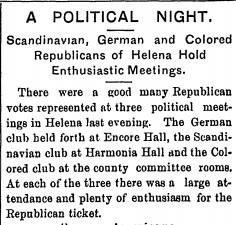
OAPY SMITH IN HELENA, MONTANA? 
MAKING A POLITICAL SPEECH?
September 13, 1889


I received a very interesting email from author Jane Haigh.

Hello Friend Jeff,
      An academic contact doing research on Scandinavian Republican politics discovered this Helena newspaper article from 1889, and forwarded it to me. I see from your book that Soapy was in Montana around that time, but I never heard of him making public political speeches before, and he mentions he was active in Minnesota Republican politics, also new to me. Just thought you would be interested, and perhaps you have some more information or thoughts?
      Congratulations on the opening of Jeff Smith's Parlor in Skagway!

Cheers
Jane Haigh, Phd
Alaskan Author

Following is my response.

Hello, friend Jane.
      Thank you very much for thinking of me, and sending this very interesting newspaper article!
      It very well could be him. The dating is right. The first few days of September 1889 the Soap Gang is fleeing in several directions after the gunfight at the Pocatello train depot. Bascomb flees into Dillon, Montana, which is good enough reason for Soapy to venture into the state. He is still on trial for the attack on John Arkins and Denver is at the beginning of one of its numerous reforms. Soapy could very well have been looking for a new home, or at least making plans for one if the empire in Denver collapsed.
      The pros for this being our Soapy is good, however, there is one snag. That is the use of the name of "Soapy." As you know he did not like that alias. Only his enemies called him "Soapy." He used the alias when making threats. There is one good possibility; perhaps the editor of the Helena Independent was on to Jeff Smith's real identity and used the article to expose him? This is just over a month after the Arkins assault, which made newspaper headlines all-across the U.S. Surely the Independent could have recognized the name but forgot the details to give its readers a biography of "Soapy." Perhaps they refrained from outright accusing "Jeff Smith" of any involvement in crime, just to protect themselves from a libel case.
A day later I received some information from my favorite genealogist researcher, Linda Gay Mathis. Linda writes,
This "Soapy Smith" mentioned in your article, previously, may have been Cyrus Little Smith (C. L. Smith). See these 2 newspaper clips from Friday, September 13, 1889 Paper: Helena Daily Herald (Helena, Montana) Page: 8. Also, will post a bio of Cyrus Little Smith.


Helena Daily Herald
September 13, 1889


_________________________________________________


Helena Daily Herald
September 13, 1889
"C. L. Smith"


A biography of Cyrus Little Smith


      C. L. Smith was born at Dover, Wayne County, Ohio, January 22, 1845. John R. Smith, his father, was a farmer, and while Cyrus was still a small child his parents removed to Southern Michigan, settling in an unbroken wilderness. There were no schools on the Michigan frontier in those early days, and Cyrus was taught to read by his mother. As the country settled up, schools of a poor quality began to be established, and at the age of eleven the boy secured his first four months' schooling. This was in a little log school house, where presided a Baptist preacher. The seats were oak slabs with stout wooden pins for legs. He attended this school for two winter, learning the rudiments of reading, spelling and arithmetic. During these two terms he had but one book of his own, the arithmetic. In 1858 he went to Southern Indiana and worked in a nursery for the next years. When the war broke out in 1861, Mr. Smith enlisted, though only sixteen years of age. He became a member of Company E, Eleventh Michigan Infantry, and served three years and two months, principally in Kentucky, Tennessee and Georgia. Among the noted battles in which the participated were those of Stone River, Chickamauga, Lookout Mountain, Mission Ridge and the battles before Atlanta. Soon after being mustered out of the service he came to Minnesota, in October, 1845, and engaged in selling trees and shrubbery for an Eastern nursery company. At the same time he began planting and experimenting on his own account, and in this way proved his inborn taste for horticultural affairs. Mr. Smith frankly admits a financial failure at the nursery business, the principal cause being poor health. He suffered from diseases contracted in the army, which prevented him from working out doors a large part of each year, but he acquired considerable practical experience in nursery and gardening matters which he turned to account in newspaper and literary work. For all this time he has been largely engaged with horticultural and agricultural papers, and addressing farmers at institutes and other gatherings throughout the state. At the same time he has not abandoned farming and gardening, but has cultivated a tract of forty acres, where he raises various trees and a variety of crops, largely for experimental purposes. As a Republican Mr. Smith has been especially active since 1885. During these later years he has done much aggressive work for the Republican party. His observation of the condition of the farming classes and the common people for many years have convinced him that, notwithstanding all the mistakes made by the party of his choice, its principles and policies have been for the best interests of the people. During the Fish-Donnelly regime of the Populist party, Mr. Smith was state organizer of Republican League Clubs, and made an aggressive campaign against the Populistic influences. He frequently met the enemy on the stump and was active and successful in joint debates. Mr. Smith was one of the organizers of the Minnesota State Horticultural Society in 1866. He served as secretary of the State Forestry Association for four years and a member of the executive committee for six years. He has been a member of the State Dairymen's Association since its organization, and on January 25, 1895, was appointed assistant dairy commissioner of the State Dairy and Food Commission of Minnesota. Mr. Smith rendered valued service in preparing the Minnesota forestry exhibit for the World's Fair in 1893. He took an active part in the first farmers' institute held in the state, and aided in securing their establishment as a permanent state institution. Since 1891 he has been agricultural editor of the Farmers' Tribune.

Source: Progressive men of Minnesota. Published by The Minneapolis Journal, 1897.
      Talk about a mystery for the ages! There is no denying that Linda may be right. The Helena Independent may have politically opposed C. L. Smith, thus calling him "Soapy Smith" in derision may have been the latest trendy insult in Montana as it was in Colorado. All this information will be included in the file with the original newspaper article for future use, and to keep from making the same automatic assumption. 
      Thank you very much Jane Haigh and Linda Mathis for sharing your fine detective work with us! I've known both Jane and Linda for a number of years, and am happy to call them "friends."


"A bunch of con men opposed to Smith were trying to horn in and get the pull with the big bugs. Stopping to exchange a few words with a vigilance committee, contrary to his usual custom of ‘firing first and talking afterwards,’ caused his death."
— Henry “Yank Fewclothes” Edwards
Alias Soapy Smith, p. 589.


March 4


1634: Samuel Cole opens the first tavern in Boston, Massachusetts.
1681: England's King Charles II grants a charter to William Penn for an area that later becomes the state of Pennsylvania.
1766: The British Parliament repeals the Stamp Act, which had caused bitter and violent opposition in the American colonies.
1778: The Continental Congress votes to ratify the Treaty of Amity and Commerce and the Treaty of Alliance. The two treaties are the first entered into by the new government.
1789: The first Congress of the United States meets in New York and declares that the Constitution is in effect.
1791: Vermont is admitted as the 14th state. It is the first addition to the original 13 American colonies turned states.
1794: The 11th Amendment to the U.S. Constitution is passed by Congress. The Amendment limits the jurisdiction of the federal courts to automatically hear cases brought against a state by citizens of another state. Later interpretations expanded this to include citizens of the state being sued, as well.
1826: The first railroad in the U.S., the Granite Railway in Quincy, Massachusetts, is chartered.
1837: Chicago, Illinois is granted a city charter.
1861: The Confederate States of America adopts the "Stars and Bars" flag.
1868: John Chisholm, trailblazer of the Chisholm Trail dies in Oklahoma before the trail is named in his honor.
1877: Emile Berliner invents the microphone.
1880: Halftone engraving is used for the first time in the Daily Graphic, published in New York City.
1881: Eliza Ballou Garfield becomes the first mother of a U.S. President to live in the executive mansion.
1881: Outlaw Billy the Kid writes and sends a letter to Governor Lew Wallace, asking for a meeting to discuss the situation in regards to the Lincoln County War, as well as a pardon for himself.
1886: The University of Wyoming in Laramie is chartered.
1902: The American Automobile Association is founded in Chicago, Illinois.
1908: The New York board of education bans the act of whipping students in school.


May 15, 2012

Is this Soapy Smith?

Soapy Smith?
price: $500


ack on April 28, 2012 I posted the above portrait by artist Bill Cummings of Soapy Smith and mentioned that there was one minor problem with it and asked if anyone knew what it was? No one responded so I will give the answer.

It's not Soapy Smith...


The artist apparently found one of the sources that list Soap Gang member, William Saportas, in the photograph below, as being Soapy, but it was taken AFTER Soapy had died in the shootout on Juneau Wharf. Yes, Saportas can be confused with looking sort of like Soapy but no contemporary accounts list him as so.

Nine members of the Soap Gang await deportation from Skagway

Even historian Dr. Jane Haigh nearly made this mistake, publishing the face of Saportas on the cover of her book, stating that it was Soapy. Lucky for her I brought this to her attention before it was published but Dr. Haigh could not let go of the similarity, so she wrote in her book in the caption under the photo above that Saportas was "pretending to be Soapy." However, other photographs of Saportas look pretty much like the one above so her conclusion is incorrect.


William Saportas
April 28, 2012
July 2, 2011
May 7, 2011 
April 1, 2010


William Saportas: pages 89, 450, 471-75, 506-07, 516, 532, 566, 572-74, 590.


MAY 15
1602: Cape Cod is discovered by Bartholomew Gosnold. 
1862: The U.S. Congress creates the Department of Agriculture. 
1863: Osage Indian warriors kill Confederate officers at Drum Creek, Kansas. 
1872: The Sante Fe Railroad reaches Wichita, Kansas.
1872: Buffalo Bill Cody tracks and kills four Indians who committed depredations near North Platte, Nebraska. 
1876: “Snowshoe Thompson,” the famed skiing mail carrier of the High Sierras dies. He is Norwegian born, Jon Torsteinson who changed his name to John Thompson and became famous in 1856 when he delivered mail between Placerville, California and Carson City, Nevada on skis in three days carrying a sixty pound sack of mail. He continued the same route for 20-years. 
1880: Three settlers are killed by Apache Indians at Kelly's Ranch, New Mexico Territory. 1882: Doc Holliday is arrested in Denver, Colorado at the request of an Arizona peace officer and charged with the murder of Florentine Cruz. The Governor of Colorado refuses to extradite Holliday to Arizona.
1883: With permission from the Mexican government U.S. troops attack Chato's camp, Sierra Madres, Mexico. 
1895: Soapy and Bascomb are arraigned and charged with assault to kill, John Hughes. Upset, Soapy goes drinking in Denver saloons with gunman and Soap Gang member, Joe Palmer. They were, in the words of the Times, “as jolly as a pair of pirates.” Soapy is arrested twice that day for carrying guns.


May 7, 2011

These men are not Soapy Smith.

Not Soapy Smith


There are a few photographs that appear when Googling Soapy Smith that are not Soapy. The problem with this is that others tend to use the photographs thinking it is Soapy and before long the photographs become ingrained and undoing the damage is next to impossible. Take a close look at some of the more well known characters of the old west, such as Wyatt Earp, and you will find numerous photographs people use to identify him, that are not him.

The Bertillon photo at the top of the page is not Soapy Smith. It has been used by a person known only as "Spill Guy." Several years ago, and again in April 2010 he posted the photo in a list of the ten most famous confidence men in history. While I am thrilled that he included Soapy in the list at number 6, the photo is not of Soapy. I have written to him at least twice and he refuses to respond. As I have never seen the photo listed anywhere else I can only guess that he knows the person who owns the photo or he owns it himself and does not want to hear from me for obvious reasons.


Altered Soapy


The above photo is perhaps the most used photograph of Soapy. It is Soapy but it has been altered. Believed to have been done in the 1960s the artist wanted to depict Soapy in a bad man's black hat and took a known photo of him and gave him one.


Because of the low-end artwork involved in giving Soapy a black hat, the often used photo also gave rise to the myth that Soapy had black hair over his true dark brown.


Too old to be Soapy Smith


The next one above is another Bertillon photograph of a David Smith, Alias "Rub Dub" located at the Bancroft Library. University of California, Berkeley. The following is what is listed in the file with the photo.

David Smith, alias Rub-a-Dub Smith, alias Soapy Smith of Denver, Colorado, and old time bunco man. Served time in San Quentin Prison for grand larceny. His line was crooked faro games and the old soap trick of rolling a piece of soap up with bills from $5.00 to $50.00 and dropping them in to a grip and charging $5.00 to put your hand in the grip and take out a package. No one was ever known to get anything out but a piece of soap. I have seen hundreds of people in Denver trying there [sic] luck at his game in the year 1879. (J.B.C. [Jesse B. Cook])

Identifier:
:108b

Collection:
Jesse Brown Cook Scrapbooks Documenting San Francisco History and Law Enforcement, Volume 21

It is not known when the Soapy Smith reference was placed in with the photo, or by whom. I contacted the curator several years ago about the mistake and they won't make any changes, not even my suggestion of placing another note in with the photograph stating the mistake. It didn't matter that Soapy died in 1898 at the age of 37 (does this man in the photo look 37 to you?) 


This one above shows an apparently beardless man (or woman) named "Sophi Smith," on a horse that clearly is not Soapy's gray. This comes from a poker table manufacturing firm which states this photo,

is of a hotel and saloon in Skagway, Alaska in the 1890s. The saloon featured a bar, a poker room, and a pool room, and the proprietor was none other than John Knecht’s Great Great Grandfather, John David Harbst. Look a little more closely at this photo and you’ll see the infamous outlaw, card player, and grifter Soapy Smith on horseback.


As they requested, I tried to look closely but the photo is just too small. I contacted them in hopes of getting a larger copy to look at but was refused.


William Saportas


The last non-Soapy photograph I'll show you today is another one that has been commonly mistaken as being Soapy for many years. Although it does resemble the famous con man it is actually one of his gang members, William Saportas, the man who warned Soapy with a note, to do something quick when the vigilantes were down on the wharf deciding his fate.


The Soap Gang about to be deported


The mistake comes from this photo of the Soap Gang awaiting to be deported out of Skagway AFTER Soapy had been killed. "X" marks Saportas often misidentified as Soapy standing with his gang.

Author Jean Haigh nearly placed Saportas' photo on the cover of her book, had it not been for me informing her who it really was. Unable to shake the resemblance she wrote in her book that Saportas was "pretending to be Soapy Smith." As an example of how stupid this sounds, try to imagine a German solider dressing up and pretending to be Hitler as the Russian army made it's way into Berlin.  


A little research on Jane Haigh's part would have revealed that Saportas looked the same in most of his photographs.


April 14, 2009


Jeff Smith


.