June 15, 2023

FINDING SOAPY SMITH’S BIRTHPLACE

Same style home, by same builder
What Dr. Ira E. Smith's home may have looked like about 1840
Newnan Historical Society says homes were not painted

(Click image to enlarge)


INDING SOAPY SMITH’S BIRTH PLACE
The Latest regarding the home of Dr. Ira Ellis Smith and Ellen Stimpson Peniston.

     In researching my family history for the book, Alias Soapy Smith: The Life and Death of a Scoundrel, I learned that my great-grandfather, confidence man Jefferson Randolph “Soapy” Smith II was born in the home of his grandfather, Dr. Ira Ellis Smith.

 
Dr. Ira Ellis Smith home
Circa 1970-80s.
Photo by Joseph Jefferson Smith and James Rothmund Smith

(Click image to enlarge)
 
     On March 25, 1828, the state of Georgia held a land grant lottery for the sale of land ceded to the state in a treaty with the Creek Indians. Dr. Ira Ellis Smith (1794-1869) won the right to purchase land in the Sixth district of Coweta County, named for the large Coweta Indian population in the region. The land Dr. Smith purchased was thirty-nine miles southwest of the future city of Atlanta and seven miles beyond the settlement of Newnan. On April 1st, five days after the auction, Dr. Smith bought land in nearby Fayette County. It appears that he may have moved closer to his new property in Coweta, moving from Oglethorpe County, Georgia until the house could be constructed (Coweta Co., deed book A, p. 102. “John Houston of Fayette to Ira E. Smith of Oglethorpe Co. for $500 land in Dist 6.”)

 
Possibly the oldest known photo of Dr. Smith's home
Circa: 1960s-70s
Photo by Joseph Jefferson Smith

(Click image to enlarge)
 
     The Smith’s are said to be one of the first families to reside there. Ira was well-liked and succeeded as a physician and planter. His popularity gained him a seat in the House of Representatives for the Sixth District in the Georgia Legislature; he served from 1832 to 1837 and again in 1851. He was elected a state senator in 1839, 1841-42, 1849, and 1853. According to Edwin Smith, a grandson of Ira, “the Smith family was equal in standing to any in Georgia, … claiming descent from long lines of well-known people.”

 
Dr. Smith home
1983
Courtesy of Vintage Aerial

(Click image to enlarge)
 
     Ira Ellis Smith’s wife, Ellen Stimpson Peniston (1802-1860), in a letter from her sister to a niece, is described as the “Belle of Virginia” and “the Flower of Georgia.” Another family letter boldly states that she was the most educated lady in Georgia. Another letter by Ellen’s brother John Gilbert Peniston tells of a duel fought in September 1820 over the sixteen-year-old Ellen. It took place in St. Petersburg, Virginia, between R. C. Adams and James B. Boisseau. She was “Educated in Baltimore,” and
her accomplishments equaled her personal charm, so it was no wonder that she should have many lovers. Admiring friends gave her a party in her honor. During the evening one man showed her such marked attention that her escort became jealous and challenged his rival to fight a duel. The next day the word came to Ellen that both men had been killed. A sad shock to her, though she loved neither of them. … In old Blandford churchyard both men, Adams and Boisseau, were buried.
Ironically, the attending physician at the duel was Dr. Ira Ellis Smith. Between 1830 and 1835, Ira had a plantation mansion built on the land he bought in Coweta County, christening the home “Shoal Creek.” It was located “seven miles east of Newnan, close to Thomas’ crossroads on the Old Wynn’s Pond Road.” From the outside, the house is imposing, appearing larger than it is on the inside. A large center hall is flanked by two spacious rooms, a small kitchen, and a sitting room. Upstairs are two large bedrooms, each with fireplace. Some of the original furnishings and family heirlooms are on permanent display in Newnan at the Male Academy Museum, where young Jefferson “Soapy” Smith obtained his education.

 
Dr. Smith home
1983
Courtesy of Vintage Aerial

(Click image to enlarge)
  
     Cotton and corn were grown on the Smith Plantation, supplementing the income from Dr. Smith’s medical practice. In 1844 Moses P. Kellogg came to Coweta county to be a teacher. With a large family to educate, Ira offered Kellogg a teaching job and a place to live in the Smith home. There he would teach eight of the Smith children. School was held in a small room added to the rear of the house. Arrangements were made to open a school on Fayetteville Road for children from the surrounding area. One of Kellogg’s brightest students was Ira’s son Luther, who went on to become president of Emory College.

 
Where the land is believed to have been
Posey Road and Hwy 34
Courtesy of Google

(Click image to enlarge)
 
     Of Dr. Smith’s eleven children, the fifth was Jefferson Randolph Smith Sr. (1831-1902), a lawyer who married Emily Dawson Edmondson (1837-1877). Around 1859 Jefferson Randolph and Emily moved in with Dr. Smith at Shoal Creek to help care for his ailing wife, Ellen. Another Ellen, the daughter of Columbus Darwin Smith and the granddaughter of Ira, named Ellen Smith Faver, also moved to Shoal Creek. She moved in after her mother, Nancy Edmondson, died on October 21, 1860. Two days later Ira’s wife Ellen also died. Ten days later, November 2, 1860, Jefferson Randolph Smith II (1860-1898) was born. Edwin Bobo Smith, a cousin of Jefferson R. Smith II (Soapy), also came to live in the home for a time.
 
Soapy Smith's birth place as it looked in 2007
486 Pete Davis Rd, Coweta County, Georgia

(Click image to enlarge)

      Dr. Smith soon moved to the home of his son, Ira Ellis Caspar Wistar Smith. Dr. Smith died in 1869. Jefferson and his parents moved out of the house around 1875-76, moving to Texas to escape Reconstruction. The owners of the Smith house for the next 118 years is currently unknown. I was introduced to Jannar Davis and his wife, the owners of the house in 2007.
     The house was set to be razed in 1994 to make room for a parking lot when Jannar Davis and his wife purchased it and moved it to property the Davis’ owned.
     In 2007 I gave a presentation on Soapy Smith to the Newnan Historical Society. I was able to see the Ira Ellis Smith house at the new location, but due to time constraints only drove by the original land location.
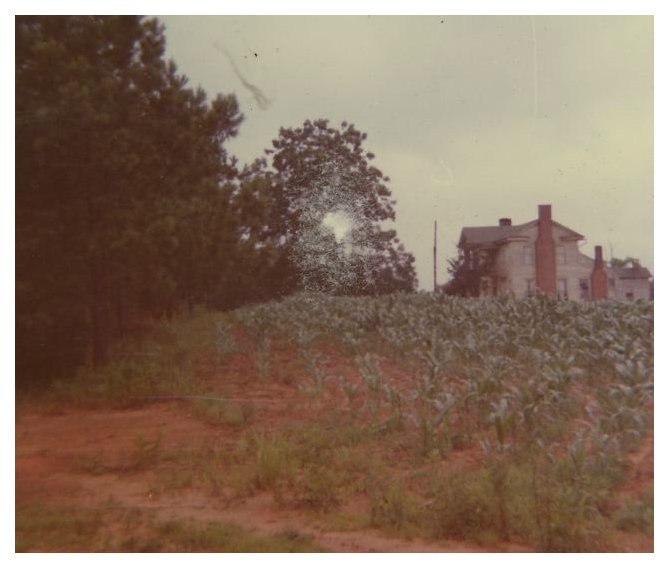
Soapy Smith's birth place as it looked in 1968
Original location-side view
Corn can be seen growing in the field
Photo by Joseph Jefferson Smith and James Rothmund Smith

(Click image to enlarge)
     
     After returning home I realized I did not have the needed addresses or contact information for neither the original land location or the address and contact information for the Davis’, and could not obtain any assistance from anyone in Coweta County.
     In early 2014 the Davis’ were able to get the house listed on the National Register of Historic Places, and in December they sold the home and moved to Seminole, Florida. Letters addressed to them have been returned so for now their contacts are once again missing.


Soapy Smith's birth place as it looks in 2023
486 Pete Davis Rd, Coweta County, Georgia
Courtesy of Google

(Click image to enlarge)
 
     Sixteen years would pass before I met Sid Brown, a retired law enforcement detective, and his wife, a genealogy researcher, who told me that between them, “if we can't locate the Davis’, then he's left the country.” They were able to find the location of the house’s current location (486 Pete Davis Rd, Coweta County), and the general location of where the original lot was located (Hwy 34 East and Posey Rd.). Eve Graybeal Olsen from the Coweta County Georgia Genealogy group on Facebook added in her findings, maps and photographs, and together we all narrowed the location of the land where the house originally stood, but as the land has been built upon since 1994, including the introduction of a side-street, the exact placement of the Smith house is still a mystery, But, photographs taken from the air in 1983 show farmland on both sides of the house, leading to the assumption that both sides of the land on each side of the side-street belonged to the Smith home, perhaps the house sitting directly in the center, perhaps in the center of the side-street itself.

SOURCES
  • Sid Brown (Sid helped greatly. Without Sid Brown I would still not know the address of the house or the location of the land where the home originally stood. Thank you, Sid!).
  • Eve Graybeal Olsen
  • Vintage Aerial
    Photo #1
    Photo #2


Sep 10, 2009
Aug 16, 2011
Aug 18, 2011


Dr. Ira Ellis Smith house: pp 20-23.



"A rich man is either a scoundrel or the heir of a scoundrel."
—Spanish Proverb


June 2, 2023

Soapy Smith's Childhood Education

"Male Seminary and Normal School,"
Independent Blade
Newnan, Georgia
November 2, 1860,

(Click image to enlarge)


OAPY SMITH'S CHILDHOOD EDUCATION

     The Smith family passed down the history that young Jefferson Randolph Smith II had enrolled in "a Sabbath school, and was able to continue his education throughout the war, after the war’s end and on into Reconstruction." I believe the ad from the Independent Blade, a Newnan, Georgia newspaper dated November 2, 1860, is for the school Jefferson may have attended. In researching Soapy all these decades I found that a major portion of the family history turned out to be true. There is no provenance regarding this particular school but Newnan was not that large of a community, and the heading of the ad, "Male Seminary and Normal School," caught my eye.
      A Christmas speech written for the Sabbath school play in 1871 shows clear evidence of a good education and signs of wit.

Newnan, GA. Dec. 24 1871

Friends and Patrons. Ladies and Gentleman, we heartily welcome you on this festive occasion. With buoyant and grateful hearts we commemorate the nativity of Him at whose birth the morning stars sang together and the sons of God shouted for joy. Let the community for its blessings, rejoice, and especially should we as a Sabbath school rejoice, that we have been blessed with such kind patrons and efficient teachers. And how can we express our gratitude (and admiration) for this beautiful tree? A tree is known by its fruits, and this one is one that speaks for itself. It must have sprung from a generous soil in a genial clime. Leaden with such rich and luscious fruit, its bending boughs are more persuasive than speech; and the masich[1] it bears would puzzle Linnaeus[2] to classify or name it. Ladies, in our hearts we thank you for it. Again a hearty welcome and a joyous festive Christmas eve to all.[3]

NOTES:

[1] masich: may be mastic, “1. A gum or resin which exudes from the bark…. 2. An evergreen shrub yielding mastic gum….” It fits with the following named botanist who was challenged to name its origin. (OED)

[2] Linnaeus: Carolus Linnaeus (1707-1778), famed Swedish naturalist and botanist, established system of nomenclature for taxonomy of plants. His published works number 180. (Encyclopedia Britannica, 1892)

[3] Copy of original sent to John R. Smith by Joseph J. Smith, 12/08/1969. The original (location currently unknown) is nicely hand written in cursive and very readable. Someone, in different script, perhaps his mother, wrote at the top, “Jeffies Christmas Welcome, Sabbath School play.”


Sabbath School: pages 23-4.


"Never play cards with a guy nicknamed after a city."
—Unknown


May 31, 2023

Soapy Smith's father and maternal grandfather, Georgia, 1861.

Jefferson R. Smith, Adm'r.
Georgia Banner and Sentinel
Newnan, Georgia
February 1, 1861

(Click image to enlarge)


oapy Smith's father and maternal grandfather.

     Jefferson Randolph Smith, Sr., (1831-1902) is my great-great-grandfather, father of Jefferson Randolph Smith, II (alias "Soapy"). Jeff Sr., was an attorney in Newnan, Georgia. The newspaper clipping is from the Georgia Banner and Sentinel, of Newnan, dated February 1, 1861 just about two months before the start of the Civil War. The clipping shows that Jeff Sr., is administrator for the estate of Joseph Henry Edmondson (often spelled Edmundson).
     Joseph Henry Edmondson (1792-1858) is my 3rd great-grandfather. Joseph is the father-in-law of Jeff Sr., as Jeff Sr., married Joseph's daughter, Emily Dawson Edmondson, who would give birth to Jefferson Randolph Smith, II (alias "Soapy"), making Joseph, Soapy's maternal grandfather. At the date of this clipping, Jeff II ("Soapy") is age four months. 
     There are very few known samples of the two newspapers in Newnan, Georgia in existence so I am lucky to find my ancestors named.
 
Joseph Henry Edmondson
 Oak Hill Cemetery
Newnan, Coweta County, Georgia

 (Click image to enlarge)
 
 
Joseph Henry Edmondson
 Oak Hill Cemetery
Newnan, Coweta County, Georgia

(Click image to enlarge)
 
 
Joseph Henry Edmondson
 Oak Hill Cemetery
Newnan, Coweta County, Georgia

(Click image to enlarge) 
 
SOURCES
  • Find-A-Grave
  • A History of Coweta County from 1825 to 1880, by W. U. Anderson, p. 19.

Joseph Henry Edmondson


"Win if you can, lose is you must, but ALWAYS cheat!"
—Jesse Ventura


May 3, 2023

Soapy Smith and the quote: "Charity covers a multitude of sin."


(Click image to enlarge)


harity covers a multitude of sin."
 
     I posted the above quote image on my Facebook group, Soapy Smith's Old West, and friend Markie Whalen asked if "the ends justify the means?" I occasionally hear from people who believe that because I am a descendant of Jefferson Randolph "Soapy" Smith, that I am guilty of defending his crimes. Below is my response to that allegation.
     No, I do not believe that the "ends justify the means." Nonetheless, "Soapy" was indeed known for his charity around the west, as well as his crimes. In turn, I ask the question, If Soapy's crimes are not lessened because of his charity, should Soapy's charities be lessened because of his crimes?
    Personally, I don't believe that charity reduces the severity of the criminal act, but there are many who do believe this. Just ask anyone who follows Democratic and Republican politicians!
     "Charity covers a multitude of sin." This expression above originated in the New Testament (I Peter 4:8): “And above all things have fervent charity among yourselves: for charity shall cover the multitude of sins.”


"The bunko sharp walks up to the man on the street, claiming his acquaintance at once. A gentleman who has seen this done several times says: “It is perfectly astounding how they impose upon a man when they have once settled upon him. They walk up with the most perfect air of gratified surprise, grasp the man’s hand warmly and shake it vigorously. The man is astonished at first, but time after time, after a short conversation I have seen them walk off arm in arm."
Evening Post (San Francisco), May 6, 1876


April 14, 2023

Soapy Smith in Leadville, Colorado, December 1888

‘Soapy’ had his fangs in deep
Los Angeles Daily Herald
January 12, 1896

(Click image to enlarge)


OAPY SMITH IN LEADVILLE
December 1888


Following is a newspaper story about a man who witnesses bunko man "Soapy" Smith swindle a drunk prospector, and decides he should take advantage of the victim as well. I start the transcribing at paragraph eight, but the entire article is posted above, for those that wish to read the entire article, published in the
Los Angeles Daily Herald, January 12, 1896. From the man's memory this event took place in December 1888.
… “The night I struck Leadville, just to show I didn’t hold myself higher than the residents of Leadville, I went into Richardson’s and bought $50 worth of chips, all for the honor and glory of Kentucky Flat. In one hour and a half I was standing up against the stove thinking it over. I didn’t have enough money left to buy a split [a bet on the faro table], and the essentials for the celebration hadn’t been paid for.
     “While I was chewing on the situation by the stove, in comes ‘Soapy” Smith with a stranger called ‘Doc.’ You know ‘Soapy?’ He was the most capable bunco man that ever came over the divide. He had a record of ‘conning’ a policeman out of his star. The man with ‘Soapy’ was drunk and clamorous for a game. He had his pockets bulging with money. I heard afterward he’d sold his mine over in Clear Creek, and came over to go into the silver. ‘Soapy’ had his fangs in deep. His scheme was not to rob the man outright, but he had it fixed up with the faro dealer —to do the job smooth and clean, and leave no place open for future criticism. Smith just borrowed money from his friend to get into the game, and as fast as a card came out of the box the dealer grabbed off ‘Soapy’s’ stake, win or lose. They played entirely with $50 bills. ‘Doc’ had ‘em wrapped up in packages of ten. I didn’t know there were so many $50 notes on earth as he flashed up, and I yearned for one of the bundles; just naturally sickened and pined for it. He went on with the game, not winning and not losing, same as drunks always play. I invented a scheme to coax him out and rob him. I had a plan that would have worked, but I discarded it. I couldn’t turn crook, tough as my own luck was. All the time this foolish man was shoveling out money in $500 lots to ‘Soapy,’ and the dealer was mowing it away in his lap, it came so swift. Presently the drunk says he’ll step out into the barroom for a drink. Then I says to myself. ‘Here’s where you get action,’ and I followed him through the swing doors into the saloon.
     “He was holding on to the bar, waiting for the drink. I makes a quick step to him and whispers, ‘Smith wants some more money.’
     “The ‘doc’ makes a kick about the kind of luck his friend seemed to be playing in, but goes down in his vest for the stuff. He tossed out a little roll, which I counted in my room over in the hotel. It was $488. The price of two bottles he and ‘Soapy’ Smith broke somewhere was gone from one of those $500 packages. Kentucky Flat had its celebration all night.
     “That, Grant,” said The Busted Prospector, “was the nearest I ever came to turning a crooked trick.”
     “Oh, there was nothing wrong about that any more than any other kind of robbery—just plain stealing, that’s all,” said Crumley.
     “No, it wasn’t robbery,” argued the Prospector. “I might have stood him up and got the whole bundle. It was finding it.” —William E. Lewis in Chicago Times-Herald.
     Was Soapy in Leadville in December 1888? According to the Leadville Herald Democrat Soapy was reported in Leadville on May 1, 1888.
One of the slickest and best known rascals in the whole western country is reported … on his way to Leadville…. The gentleman … —Soapy Smith—is known to many people in Leadville, as he has been here frequently, and always with … a small valise filled with small cakes of soap in little boxes, and a very pretty Mrs. Smith, who travels with him.

     The individual telling the story said he went into "Richardson's" to gamble. In looking at the city directories for 1882-1890, I found one, Rufus Richardson listed as owning a restaurant at the rear of 123 W. 5th in 1887. On the Sanborn maps of 1886 and 1889 the address is listed as a store.
     For the entire story of this amazing confidence man, you can read my book, Alias Soapy Smith: The Life and Death of a Scoundrel.


"Having got him partly or wholly drunk, he is in a fit condition to understand the beauties and mysteries of 'bunko.'"
Evening Post (San Francisco)
May 6, 1876


April 12, 2023

Did Soapy Smith operate in Sacramento, California in 1887-88?

The soap trick man
Sacramento Daily Union
September 22, 1887

(Click image to enlarge)


as Soapy Smith operating at Sacramento, California in 1887-88?
(quick answer: Maybe.)

      On April 23, 2023 I published a story on the possibility that Soapy Smith operated his prize package soap racket in Sacramento, California, in mid-July 1885. My conclusion is that “The timing, between June 23 and August 1, 1885, is right, thus Soapy may have operated in Sacramento, California, on July 14, 1885.”
     Since posting that story I have found two more newspaper clippings in which a prize package soap racket operator worked the streets of Sacramento in late September 1887 and mid–February 1888. The following is from the Sacramento Daily Union, September 22, 1887.
The soap trick man—the sharper who gulls the verdant by offering for sale little packages of soap, into which he ostensibly puts a $5 greenback, the purchaser finding to his disappointment that it was only a pretense—has commenced business on the streets. His scheme is little if any better than the shell game for the public.
This newspaper account is dated just over two years after the initial prize package soap man in Sacramento, July 15, 1885. All I have at this time is circumstantial evidence that I supply from Soapy’s timeline, via my book, Alias Soapy Smith: The Life and Death of a Scoundrel and my extensive files. We need to keep in mind that it is possible that any one of the three, or even all of them, are different individual bunko men. One, two, or all three may be Soapy. Also possible is that none of them is Soapy Smith. 
     In 1887 Soapy was an established criminal and political power in Denver, Colorado. He was married and had a child on the way. Though well established, Soapy still needed to leave Denver periodically, for short periods of time, sometimes longer, depending on the severity of his crimes, until the memory of his crimes were swept under a rug.
     I investigated the known traveling plans and locations of Soapy, and whether he was in Denver previous to and post September 22, 1887, to see if a trip to Sacramento was possible. Following is what I uncovered.
  • On January 1, 1887, the Rocky Mountain News reported that Soapy had made a trip to St. Louis to see his wife when she was close to giving birth. Though eight months previous to the soap man in Sacramento, this is the first of many trips Soapy made going east of Denver. A February 13, 1887, letter to Jeff shows he had been in St. Louis with his wife and baby son during Christmas. A month after their son Jefferson was born, he wrote to his wife Mary on March 19, 1887, Mary and the baby were still at her mother’s in St. Louis, and trips were still being made to see them.
  • In July 1887 the Rocky Mountain News somehow got hold of Soapy's travel itinerary and published it.
Soapy Smith, one of the local celebrities of Denver and one of the most pushing business men in the city, left last Tuesday evening in the rain for a month’s sojourn in the East. While absent he will give away small samples of Denver’s best soap and new crisp fifty dollar bills among his friends at Saratoga, Long Branch, Coney Island, Brighton Beach and other health and pleasure resorts. We are sorry to lose “Soapy” from among us, but will console ourselves by allowing the “Hifen” to unload its surplus amount of “soft soap” on the susceptible candidates. With Smith out of the way, the “Hifen” has no rivals in the state.
      How did the News obtain Soapy's itinerary? Possibly a reporter had cultivated a source within the soap gang. Equally possible, though, is that Soapy or a confederate purposely led a reporter to believe that Soapy was headed east when actually he went in another direction. No evidence shows he went east at this time. He may have gone as far east as St. Louis to see his family or in the opposite direction altogether. Soapy could not afford to have his actions and his comings and goings generally known because whether true or untrue, his reputation linked him to any criminal event within his general vicinity. Another concern for Soapy was that publication of his travel plans would not only alert the law but also any rivaling bunco operations. Either entity, or both, could spell trouble. So he learned to be secretive or to misdirect the newspapers and his enemies when he planned on traveling.
  • Soapy acted as timekeeper in a boxing match on November 18, 1887, eighteen miles from Denver.
     So, we see that Soapy left Denver in July, about two months before a trip to Sacramento would be made. We also know that about two months after the Sacramento trip, Soapy was "eighteen miles from Denver."
     Technically, the timing is right for Soapy to possibly have gone to Sacramento.  


Ordered the police to stop the soap trick man
Sacramento Daily Union
February 14, 1888

(Click image to enlarge)


     Two years, seven months after the first recorded soap scammer in Sacramento, California, and almost five months after the last incident, the mayor of Sacramento orders the city police to "put a stop" to a "soap swindler." The Sacramento Daily Union, February 14, 1888 published the blurb.
Mayor Gregory yesterday ordered the police to put a stop to the soap swindler’s operations on K street. Why does the Mayor make fish of one and fowl of another? Why does he not give the same orders regarding the Chinese lotteries and the faro banks?
Is it Soapy Smith or another soap sell operator? Again, I am working with circumstantial evidence from Soapy's timeline via my book and files. In 1888 Soapy's criminal and political empire in Denver, Colorado, is larger and more powerful than it was five months previous. In 1888 he opens his first saloon enterprise, the Tivoli Club. His wife and child are back at home in Denver, in their new home. Did Soapy travel back to Sacramento? Once again, I investigated the known traveling plans and locations of Soapy, and whether he was in Denver previous to, and post February 14, 1888, to see if a trip to Sacramento was feasible.
  • From January through May 1888, Denver citizens read little of Soapy Smith in the Denver newspapers. There seems to have been a reform movement going on within the city, demanding police action.
  • On January 26, 1888, the Rocky Mountain News reported Soapy's role of timekeeper during a boxing match in Boulder County, Colorado. During the match one of the boxers was knocked down, and possibly when Soapy completed the ten count mark before the downed fighter again arose, the referee either did not hear Soapy's ten count indicating the fight was over or he chose to ignore it and let the fight continue. Accusations of foul play were made but with no apparent repercussions.
  • On January 31, 1888, Police Chief Henry C. Brady had his officers sweep the streets of confidence men and tinhorn gamblers. Fourteen men were arrested, all within proximity of Larimer and Sixteenth streets. Seventeenth Street, where Jeff was based, was seemingly ignored. Soapy was likely out of the city, having been in Boulder for the boxing match there. Likely Soapy operated his prize package soap racket in surrounding towns, but likely not Boulder itself. Could be that this is when he headed to Sacramento. 
  • At some date after February 12, 1888, when the building's owner received permission from the city of Denver to open a saloon, Soapy's Tivoli Club saloon and gambling house opened its doors. The earliest mention of the Tivoli Club is published in the Rocky Mountain News on November 22, 1888, due to an anti-gambling raid by the city police. If Soapy went to Sacramento, then it is probable that the Tivoli opened well after February 12th.
  • On July 8, 1888, Soapy was definitely back in Denver when he swindled two men who reacted with their fists. “A ‘soap’ man and two grangers [farmers] got into trouble yesterday morning, in which the grangers, as usual, got the worst of it.”
I was surprised when the first Sacramento date, July 14, 1885, fit into Soapy's timeline making it possible that it was Soapy operating the prize package soap racket there. However, I did not expect all three Sacramento dates to fit into Soapy's timeline. However, there is no provenance yet, so it could simply be a good coincidence. All three will go into my files as "possibles."


April 3, 2023


"You can't cheat an honest man--Never give sucker an even break--and never smartin' up a chump!"
—W. C. Fields


April 3, 2023

Was Soapy Smith in Sacramento, California in 1885?

The "soap man"
Sacramento Daily Union
July 15, 1885

(Click image to enlarge)


as Soapy Smith in Sacramento, California in 1885?
The quick answer: Very possible.


      I came across the mention of a "soap man" in the Sacramento Daily Union,
July 15, 1885.
The gambling games following the circus found Sacramento a poor place to operate in yesterday, as the Chief of Police shut down upon them all in short order. In fact none of the schemes, including those of the “soap man” and the “greenback man,” were allowed to commence. Even the individual who sold articles, promising to give a prize with each, was advised to close his operations.
     My first thought is "could this be Jefferson Randolph Smith, alias 'Soapy?'" Though on the rare side, there were other prize package soap racket men operating in the West, so my first task is to find any circumstantial evidence indicating that it could be Soapy. One way to accomplish this is to search my book, Alias Soapy Smith: The Life and Death of a Scoundrel and my files to see where Soapy was at during the period of the newspaper facts, which in this case is previous and post July 15, 1885. Usually I can determine, on a possibility scale, whether it could be Soapy Smith or not. What I gather goes into my files for possible future discovery that may alter the potential feasibility of the "soap man" being Jefferson "Soapy" Smith.
     The following information comes from my book and files.
     Soapy's name was absent from the Denver newspapers for much of 1884 and for the first five months of 1885. He seems to have kept an extremely low profile as he established himself in the city. During this period, he might still have been traveling, and one trip might have led to a stay of many months. Eight years later, in 1893, the Rocky Mountain News published Soapy's own words that he had gone to operate at the World’s Industrial and Cotton Centennial Exposition in New Orleans, which ran from December 16, 1884, to June 2, 1885.

     The absence of Soapy's name from the newspapers ended in May 1885 when J. Brockman, a Denver resident, had Soapy arrested for swindling him. Soapy did not want to return the victim’s money. The Rocky Mountain News reported the incident.
     The arresting officer, Henry W. Barr, did not have enough evidence to prove that Soapy had actually swindled Brockman, so he arrested Soapy for being in violation of the city lottery ordinance and had him held in jail pending receipt of $500 bond. The following day John P. Kinneavy, saloon entrepreneur and Soapy's friend, posted bail. At the trial on the lottery charge, attorney Judge Miller represented Soapy and was able to get him off with a fine.
Smith claims that he does not pretend that everyone can be lucky and was very indignant when Judge Barnum fined him $25.00. He gave notice that he would appeal the case.
No appeal of the case is recorded. On the day of the trial, the city council passed an ordinance against schemes like the soap racket, including 
any person who shall be engaged in any fraudulent scheme, device or trick upon the streets, through fares or public places or elsewhere in the city, or who by the aid, use or manipulation of any article or articles, thing or things what so ever in packages, boxes or otherwise arranged, whereby persons are induced, or sought to be induced, to purchase any such packages, articles or thing with a view to obtaining money, jewelry, or other property therein contained or therein connected in any manner. And it shall constitute no defense.
The ordinance seemed designed to stop Soapy in particular and all bunco men in general. Soapy was able to continue his street business for a solid month before the city council adopted a resolution on June 23, 1885, to rescind his peddler’s license. Soapy then left Denver for an extended cooling off period. For forty-two days, from June 23 to August 1, 1885, there is no sign of him. Then his name appeared in an August 2, 1885, news account of a boxing match in Rawlins, Wyoming. Soapy was the timekeeper. 
     The timing, between June 23 and August 1, 1885, is right, thus, the conclusion is that Soapy Smith may very well have been operating in Sacramento, California, on July 14, 1885.
 
ADDENDUM
 
There are two more dates in which Soapy Smith could have operated in Sacramento, California. You will find them both HERE.


"Son, one of these days in your travels, a guy is going to come up to you and show you a nice brand-new deck of cards on which the seal is not yet broken, and this guy is going to offer to bet you that he can make the Jack of Spades jump out of the deck and squirt cider in your ear. But, son, do not bet this man, for as sure as you are standing there, you are going to end up with an earful of cider."
—Damon Runyon


March 12, 2023

Possible victim of the Soapy Smith gang, Denver, 1884.

Roped-in
Omaha Daily Bee
June 25, 1884

(Click image to enlarge)


OSSIBLE VICTIM OF THE JEFFERSON R. SMITH GANG.


Omaha Daily Bee
June 25, 1884

COLORADO.

Col. Fletcher, a tourist from Boston, was roped-in by the bunko men of Denver and relieved of $1,000.


The story of Soapy Smith can be had in the book, Alias Soapy Smith: The Life and Death of a Scoundrel.

NOTES:

  1. $1,000.00 in 1884 is the equivalent of $33,472.95 in 2023. 
  2. According to the Rocky Mountain News there were at least two, possibly three bunko gangs operating in Denver at this time. For certain "Doc" Charles Baggs and Jeff R. Smith were operating in Denver at this time. 
  3. Jeff R. Smith was not known as "Soapy" Smith until May 1885, neither was the gang known as the soap gang.


"In many cases the bunko sharp is compelled to return a portion of the money to avoid such trouble, and sometimes comes to grief at the hands of the law. In such cases the matter is compromised with the man, his money is returned and he is induced to leave, so that when the case comes up for trial the sharp escapes for lack of prosecution."
Evening Post (San Francisco)
May 6, 1876