Showing posts with label Canada. Show all posts

October 13, 2025

Artifact #93: Soapy's son, hires attorney to stop the slurring of his father's name.

"As his son I am proud of his
efforts to succeed in life"
Jefferson Randolph Smith III
Artifact #93-2
Jeff Smith collection

(Click image to enlarge)


oapy's son hires a legal firm to stop the defamation of his father's name.

At age 30, Jefferson Randolph Smith III, Soapy and Mary's oldest son, was protecting his father's legacy and his mother's reputation from "libel" and scandal. He was also protecting himself as he worked behind the scenes in St. Louis city politics and couldn't afford his rivals finding out that his father was a notorious old west confidence man and crime figure.

The six typed documents are rough draft/copies for Jefferson's files. The first one is dated July 20, 1917, reading as follows

St. Louis, July 20 1917.

Lord Shaughnessy, K.C.V.O.
President, Canadian Pacific Railway Co.,
Montreal, Canada.
My dear Lord Shaughnessy:-
In the most recent issue of your booklet "Alaska" you devote considerable space to an arraignment of my father who lost his life in Skagway nearly twenty years ago. There is considerable in his life that probably appeals to many persons as romantic but probably you yourself recall those days of the making of Alaska when the great Klondike gold rush was on. He was only one of thousands who led a life more or less rugged.

Of all the thousands of stories that have appeared in the newspapers and magazines in the United States not one of them ever referred to him as an outlaw. It was evident to these writers and publishers that although he had figured in the upbuilding of a new country he was far from being other than a man who could be trusted [Jeff adds in pencil: "solider of fortune."]
As his son I am proud of his efforts to succeed in life because circumstances had forced upon him early in life the responsibility of caring for a large family, thus robbing him of the education that he made possible for his brothers and sisters.
Letters from the Presidents, statesmen and recognized men of affairs addressed to him in confidential terms and which are in my possession show that irrespective of all that was said and published of him he was well-thought of, trusted and respected. These men know he was not an outlaw or "part outlaw."
Scores and scores of persons not only in St. Louis but elsewhere throughout the country, especially in the great Northwest know me as the son of the man you so unfairly arraign and I cannot let this go unchallenged.
I am enclosing a copy of your booklet in which you[r] attack him and his people appears.
It is fascinating how Jefferson, my grandfather, defended his father's career choice in writing, how proud he is "... of his efforts to succeed in life because circumstances had forced upon him early in life the responsibility of caring for a large family, thus robbing him of the education that he made possible for his brothers and sisters."

Four days later Jeff received a reply.

"Let me assure you that we are very sorry"
Artifact #93-3
Jeff Smith collection

(Click image to enlarge)

The reply reads as follows.

CANADIAN PACFIC RAILWAY COMPANY
J. M. GIBBON,
GENERAL PUBLICTY AGENT.

J. C. S. BENNETT,
OFFICIAL PHOTOGRAPHER
MONTREAL, July 24, 1917.
IN YOUR REPLY PLEASE REFER TO FILE NO. B 10951

Reference to Mr. Smith in "Alaska" Folder.

Jefferson Smith, Esq.
5348 North Market Street,
St. Louis, Mo.

Dear Mr. Smith,

Lord Shaughnessy has referred to this Department your letter July 20th. regarding reference in our "Alaska" folder to your late father.

Let me assure you that we are very sorry that this reference has caused you any pain. The person who compiled the booklet in question cannot have taken a great deal of care to verify his statements, although he is one upon whom we usually place great reliance.

I shall see that the statement is not repeated in any further issue of the booklet.

Yours truly,

CS Stokes [signed]
Asst. General Publicity Agent.

Jeff didn't let it go. Some time later Jeff hired an attorney from the firm of Morris and Zachritz, who after several months contacted the company via a two page letter.

Soapy Smith
Artifact #93-1A
"Half outlaw - half political heeler"
Jeff Smith collection

 (Click image to enlarge)


"Insisting on immediate action"
Artifact 93-1D
Jeff Smith collection

(Click image to enlarge)


This two page letter is dated January 10, 1917. As Jeff had written his first letter to the publishing company on July 20, 1917, it is believed that this first letter to the same company, by Jeff's attorney is actually January 10, 1918.

January the 10th
Nineteen - seventeen.

Dear Sir:-

In re:- FILE NO. B-10951

In your publicity folder, entitled "ALASKA", widely circulated throughout North America during the summer months, your company published of and concerning the deceased father of Mr. Jefferson Smith, of this city, certain false and defamatory statements, which we quote as follows:-
"To-day Skagway boasts scarcely a thousand souls, but in the eighteen years of its life it has crowded in enough incident to provide volumes for the historian. All have read of the famous gambling hells with which the town was once infested, and none should fail to make the four-mile journey out to the old cemetery where lies the body of "Soapy Smith", the famous Boss of the town, half outlaw, half political heeler. The Sylvester Wharf still stands, half a ruin now, to mark the place where "Soapy" Smith was shot, and the day when the sober citizens of Skagway decided to reform the town, which was suffering from its evil reputation.
Skagway, once the wildest, wickedest town in the world, in now a model of  propriety."
This drew from our client a vigorous protest, in the form of a letter to Lord Shaughnessy, under date of July 20th, 1917, also briefly setting forth his father's real status in the community. Under the date of  July 24th a reply was written by your Mr. C. S. Stokes, Ass't General Publicity Agent, (File No. B-10951) which although conciliatory in tone, did not offer a plausible excuse for the appearance of the above statements and was not followed by a retraction.

 On the authority of:- "HUOT -vs- NOISEAUX 2 Quebec Q. B. 521 and under the Revised Statutes of Missouri, Section No. 4818, our client's rights in the premises seem clear. The decision fully sustains the right of a son to maintain an action for the defamation of his deceased father and the statute provides as follows:-

"A libel is the malicious defamation of a person made public by any writings, sign, picture, representation of effigy tending to provoke him to wrath or expose him to ridicule or to deprive him of the benefits of public confidence and social intercourse, or ANY MALICIOUS DEFEMATION MADE PUBLIC AS AFORESAID,  DESIGNED TO BLACKEN AND VILIFY THE MEMORY OF ONE WHO IS DEAD AND TENDING TO SCANDALIZE HIS SURVIVING RELATIVES AND FRIENDS."

The appellate courts of this State have repeatedly cited and applied the above statute to both civil and criminal cases. See the following decisions:-
Kenworthy -vs- Journal Co. 117 App 327
Julian -vs- Kansas City Star 209 Mo 35
Spurlock -vs- Investment Co. 59 App 225
Houston -vs- Wooley 37 App 16
McCloskey -vs- Pub Co. 152 Mo 339

Our client is insisting on immediate action on our part, to the end that the memory of his father may be vindicated and the stigma on his own name and that of his family may be removed. However, before taking action in the premises, we deem it advisable to communicate the above facts to you.

Awaiting your early advice, we are
Very truly,

MORRIS AND ZACHRITZ

Hon. E. W. Beatty, K. C.,
General Counsel,
Canadian Pacific Railway Co.,
Montreal, Canada.

Seven days later, on January 17, 1918, the Canadian Pacific Railway Company responds to Jefferson's attorneys. 


"I will communicate with you later"
Artifact 93-4
Jeff Smith collection

(Click image to enlarge)


Canadian Pacific Railway Company
Law Department
L-32612

E.W. BEATTY, K.C.
Vice President and General Counsel.

W.H. CURLE, K.C.
General Solicitor.

E.P. FLINTOFT
Assistant General Solicitor.
MONTREAL 17th, Jan'y 1918

Messrs Morris and Zachritz,
Attorneys and Counsellors,
506 Times Building,
St. Louis, Mo.

Dear Sirs:-

The Vice-President and General Counsel has asked me to acknowledge receipt of your letter to him of 10th instant, on behalf of Mr. Jefferson Smith.

I will communicate with you later after enquiring into the matter.

Yours Truly,

W. H. Curle
General Solicitor

WHC/MLR

On February 2, 1918 W.H. Curle responds with Jefferson's attorney's for the last time.


Canadian Pacific Railway Company

Law Department
L-32612

E.W. BEATTY, K.C.
Vice President and General Counsel.

W.H. CURLE, K.C.
General Solicitor.

E.P. FLINTOFT
Assistant General Solicitor.
MONTREAL 17th, Jan'y 1918

Messrs Morris and Zachritz,
Attorneys and Counsellors,
506 Times Building,
St. Louis, Mo.

Dear Sirs:- Re Jefferson Smith 

Referring to your letter of 10th ultimo to the Vice President and General Counsel.

I am instructed to decline the suggested claim of your client.

Yours truly,

W. H. Curle
General Solicitor.

WHC/MLR      
At this point Jefferson opted to end the legal suit as he knew the next step, his only recourse, was to go to court trial. Records show that in his lifetime, Jefferson attempted to force corrections in the telling of his father's life, numerous times, including films, books and other published works. What is not surprising is that he never took his legal complaints to the court room, as there was always a good possibility that any research by the defense attorneys would uncover and expose to Jeff's political rivals, the fact that his father was a known confidence man, using that fact against any candidates Jeff worked for, thus ending his political career.  


Jefferson R. Smith III
APR 27, 2021
JAN 14, 2022


"With spots quadrangular of diamond form, Ensanguined hearts, clubs typical of strife, And spades, the emblems of untimely graves."
—William Cowper




November 13, 2024

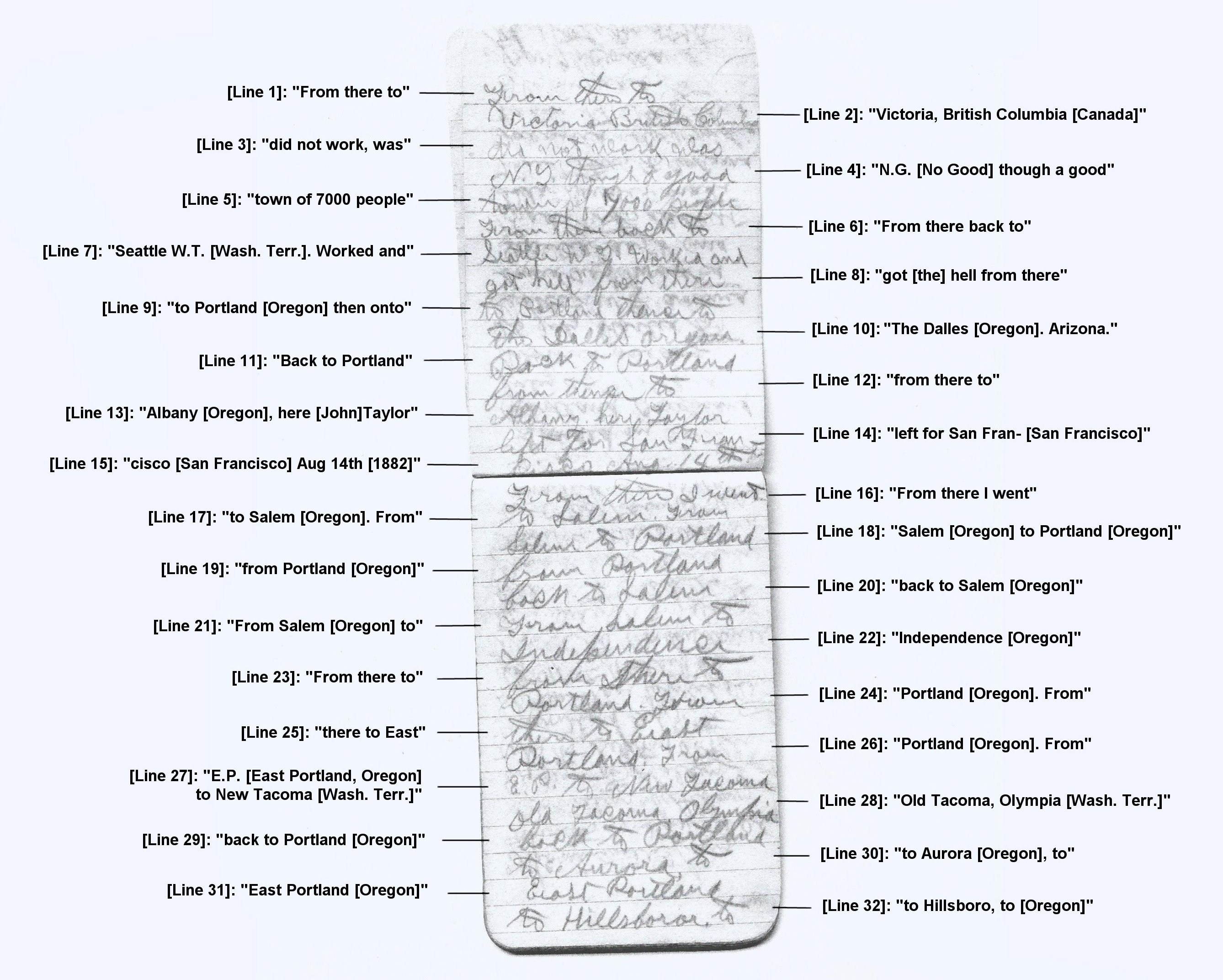
Soapy Smith's "STAR" notebook, 1882: Part #12 - page 12

Soapy STAR notebook
Page 12 - original copy
1882
Courtesy of Geri Murphy

(Click image to enlarge)


OAPY SMITH'S "STAR" NOTEBOOK
Part #12 - Page 12

     This is part #12 - page 12, dated 1882. This is a continuation of deciphering Soapy Smith's "star" notebook from the Geri Murphy's collection. A complete introduction to this notebook can be seen on page 1.
     The notebook(s) are in Soapy's handwriting, and often times pretty hard to decipher. A large part of this series of posts is to transcribe the pages, one-at-a-time, and receive help from readers on identifying words I am having trouble with, as well as correcting any of my deciphered words. My long time friend, and publisher, Art Petersen, has been a great help in deciphering and adding additional information. 
     I will include the original copy of each page, an enhanced copy of each page, a copy in negative, and a copy with typed out text, as tools to aid in deciphering the notes. There are a total of 24 pages. This means that there may be upwards of 24 individuals posts for this one notebook. Links to the past and future pages (pages 1, 2, 3, etc.) will be added at the bottom of each post for ease of research. When completed there will be a sourced partial record of Soapy's activities and whereabouts for 1882-1883.
     Important to note that the pages of the notebook do not appear to be in chronological order, with Soapy making additional notes on a town and topic several pages later.
     Rather than plans to go somewhere, this is an accounting of where Soapy has already gone (Oregon, Washington Territory and and Victoria, British Columbia.) in 1882. Previous pages contained to do lists, work notes, an itinerary. This page engages in journaling—the recording of past events, perhaps for the purpose of revisiting them, or memorializing them for oneself, like a diary entry. The interesting thing is that, although the writing records the communication of twenty-one-year-old Soapy Smith with himself, the writing also communicates with us about him 142 years later (and potentially far beyond today). 
     Page 12 is a continuation from page 11, and is continued on page 13 and 14.
     Below are my attempts to attempts to make the writing easier to see and decipher.

Soapy STAR notebook
Page 12 - enhanced copy
1882
Courtesy of Geri Murphy

(Click image to enlarge)

Soapy STAR notebook
Page 12 - negative copy
1882
Courtesy of Geri Murphy

(Click image to enlarge)

     Below is what I believe to be the correct deciphering of the text, dated 1882. Do you agree, or do you see something else? All comments, suggestions and ideas are welcome! I will update the new information to this post.

Soapy STAR notebook
Page 12 - decipher copy
1882
Courtesy of Geri Murphy

(Click image to enlarge)


Page 12
  • Line 1: "From there to"
  • Line 2: "Victoria, British Columbia [Canada]"
  • Line 3: "did not work, was" 
  • Line 4: "N.G. [No Good] though a good"
  • Line 5: "town of 7000 people"
Interesting that Lines 3-5 discuss the first known note from Soapy that he did "no good" in the town of Victoria, British Columbia. What he apparently found in Victoria was a Canadian town much more settled, or with a heavier police presence than the communities of the North-West U.S., and so returned to them with his "sales" campaign. 
     Quite an interesting picture of young Soapy is emerging, To remain so consistently on the road, bouncing from place to place and back to some of the same places, shows a man who loves his work and is willing to work hard to make a success of it.
  • Line 6: "From there back to"
  • Line 7: "Seattle W.T. [Washington Territory]. Worked and"
  • Line 8: "got [the] hell from there"
In regards to Victoria, Soapy had written, "did not work, was N.G. [No Good]." Perhaps sales were slow due to complications such as dissatisfied customers who complained among themselves and/or to constabulary such as it was in Seattle, but Jefferson's "got [the] hell from there" indicates a possible police entanglement from which he escaped, or bribed his way to freedom. It doesn't appear that he was arrested.
  • Line 9: "to Portland [Oregon] then onto"
  • Line 10: "The Dalles [Oregon]. Arizona."
The Dalles is a town 80 miles east of Portland, on the Columbia River. On line 10 Soapy writes "Arizona." Did he travel down to Arizona after leaving The Dalles in Oregon? Going to Arizona would have taken 2.5 or 3 days just one way, so it doesn't seem possible for him to fit going there and back into his itinerary, so why did he write "Arizona?" Was it just a mistake? I know that I, myself have been writing, while thinking of something else, and find that I had written down something I was thinking of without realizing it.
  • Line 11: "back to Portland [Oregon]"
  • Line 12: "from there to"
  • Line 13: "Albany [Oregon], here [John] Taylor"
  • Line 14: "left for San Fran- [San Francisco, California]"
  • Line 15: "cisco [San Francisco, California] August 14, 1882"
     Soapy travels back to Portland and on to Albany, Oregon, where on Aug 14, he mentions "Taylor," which is likely John Taylor, believed to be Soapy's mentor since his start in Texas. Taylor is also mentioned in this notebook on page 2. Taylor, left for San Francisco and other endeavors while Soapy continued to work in Oregon and Washington Territory.
  • Line 16: "From there I went"
  • Line 17: "to Salem [Oregon]. From"
  • Line 18: "Salem [Oregon] to Portland [Oregon]"
  • Line 19: "from Portland [Oregon]"
  • Line 20: "back to Salem [Oregon]"
  • Line 21: "From Salem [Oregon] to"
  • Line 22: "Independence [Oregon]"
  • Line 23: "From here to"
  • Line 24: "Portland [Oregon]. From"
  • Line 25: "there to East"
  • Line 26: "Portland [Oregon]. From"
  • Line 27: "E.P. [East Portland, Oregon] to New Tacoma [Washington Territory]"
  • Line 28: "[and] Old Tacoma. Olympia [Washington Territory]"
  • Line 29: "back to Portland [Oregon]"
  • Line 30: "to Aurora [Oregon], to"
  • Line 31: "East Portland [Oregon]"
  • Line 32: "to Hillsboro [Oregon], to" [continued on page 13 - not published yet.
It will be interesting to see page 13 and learn where Soapy's travels led next. The picture on a map through page 11 shows a zig-zag pattern. When the notebook has been seen completely, it will be interesting to map all of his summer "sales" campaign on one map. I expect his canvassing from July into September 1882 will completely blanket settlements of the North-West states and territories.


STAR NOTEBOOK
April 24, 2017
Part #1
Part #2

Part #3

Part #4
Part #5 

Part #6
Part #7
Part #8
Part #9 
Part #10

Part #11
Part #13

Part #14
Part #15

Part #16


"Honesty is the best policy…unless
you can tell a convincing lie."
—Keith C. Cobb, Exceptions to the Rules, 2001.


December 17, 2019

Another Soapy Smith - Fitzhugh Lee story version

  SOAPY SMITH'S EAGLE
July 4, 1898 Skagway, Alaska
Fitzhugh Lee float

(Click image to enlarge)


nother Fitzhuge Lee version


      During the first annual July Fourth parade in Skagway, Alaska, "Soapy" Smith entered a float, carrying a wire cage with a live bald eagle, Soapy had name Fitzhugh Lee, in honor of the Spanish-American War general of the same name.

      The standard version used in my book, Alias Soapy Smith: The Life and Death of a Scoundrel, states that
An immense American eagle, as full of fight as a cocoanut is of meat, and with an armament that would put the Vesuvius to shame. His beak is a variable [veritable] “iron virgin” for ferocity, his talons are an inch and a half long and sharp as a dagger. He is as large as a large gobbler, measuring 9 feet from tip to tip.
      The great bird was caught … about thirty miles down the canal by Frank Howard and three companions … on a prospecting tour. He was found wedged in between two rock walls…. When they saw him, he showed fight instantly, and they were obliged to lasso him first, then throw a heavy blanket over him. Yesterday the boys arrived in Skaguay with the bird in a big dry goods box, heavily grated, and with a large rope fastening his legs together. Even then he … was open to any engagement to fight.
      The boys took him to Capt. Jeff Smith as a present, a big wire screen cage has been built for him … behind the saloon, where he now is monarch of all … within his reach. Yesterday a full grown hen was put in the cage, and with one stroke he tore her head off, and scattered her limbs and feathers all about him. He had half eaten her before her heart had ceased to quiver. [Unknown Skaguay newspaper clipping. 7/1/1898, author's collection]

      Recently, I came across a new version published in The Klondike Nugget (Dawson, Yukon Territory) on July 4, 1900, two years, three days, after the original story's publication. Which is more accurate will likely remain a mystery to the ages.  

The Klondike Nugget,
Dawson, Y. T.
July 4, 1900

An Eagle With a History.

      Those who were just in Skagway on the fourth of July two years ago have not forgotten the fine specimen of the proud bird, emblematic of freedom, an American eagle, that traveled in a large wire cage in the procession.
      A Week Previous to the Fourth two Indians were out in a canoe fishing in Lynn Canal near the mouth of the Chilkat River. They had a number of fish in the boat and were intently watching their lines in the water when – swoop, hugh – they felt their canoe shiver from end to end, it upset their canoe and the Indians found themselves struggling in the chilly water. But they were not alone; with them was a large bird, and eagle which had came down like a shot from heaven, having been attracted by the fish in the boat. The eagle had struck the boat with such force as to upset it and, at the same time stun itself to such a degree as to render it incapable of flying away until the Indians had time to recover themselves and right their canoe, when they proceeded to capture the author of their fright and sudden immersion.
      The eagle fought desperately, but was finally tied by the feet, muzzled and rendered harmless. The captors brought it to Skagway and sold it to “Soapy” Smith for $15. Four days after the Fourth, and while gazing on the same eagle which was in a cage in the rear of “Jeff’s Parlor,” the man Stewart was held up and robbed of $2800, which robbery led up to “Soapy’s” death and the final scattering of his crowd, a number of whom are still in San Quentin penitentiary, while for others are about to do to be discharged from the U. S. jail at Sitka after having served two years.
      Three months later the eagle, having been kept in captivity all the time, was set free, and when last seen it was upwards of 1000 feet high and sailing in a direct line from Mount St. Elias.

ABOUT THE PHOTOGRAPH: The photograph above was taken by Reverend John Sinclair on July 4, 1898. It depicts the moments previous to the big scheduled parade. The float, a freight wagon, holds a large wire cage containing the live American bald eagle given to Soapy Smith a short time earlier. Behind the wagon a man holding a large American flag will be followed by Soapy's private volunteer army, the Skaguay Military Company, in which Soapy is Captain. The small boy dressed as "Uncle Sam" is the 9-year-old son of Soapy's business partner John Clancy. The wagon rests in front of Soapy's saloon, Jeff Smith's Parlor (far right). The white and grey horse between the Parlor and the wagon is Soapy's. He will be riding the same as (officially) the fourth division marshal of the parade, but Soapy manages to force his way to the front of the parade, becoming the unofficial grand marshal.


Fitzhugh Lee: July 4, 2009 


Fitzhugh Lee: pages 520-22, 525, 595.


"Reid carted an old Smith and Wesson six-shooter, an ancient gun he had used in the rip-roaring days of the west and which he considered the best gun in Skagway. He said it never failed him but its failure finally cost his life."
—Matthew M. Sundeen, Alias Soapy Smith, p. 533."


DECEMBER 17


1777: France recognizes American independence.
1791: A traffic regulation in New York City establishes the first street to go "One Way."
1860: Cavalry and Texas Rangers attack the camp of Peta Nocona's Indian Comanche’s on the Pease River in Texas. Ranger Lawrence Ross and his men join a detachment of Cavalry from Camp Cooper and Fort Belknap for the attack. Fourteen Indians are killed, two are taken prisoner, along with a white female, Cynthia Parker, who had been kidnapped as a child in 1839. She is the wife of Peta Nocona and the mother of baby daughter, Quanah Parker.
1866: General Patrick Connors commands that Indians living north of the Platte River “must be hunted like wolves.”
1872: “Scouts of the Plains” written by Ned Buntline played to a packed house staring Bill Cody and Texas Jack Omohundro. Despite not being good actors Buffalo Bill and Texas Jack are a hit.
1882: “The soap fiend with his little tricks is again in town, taking in the four bits and the dollars of the unsuspecting verdants. The game is to roll up little bits of soap in paper with an occasional bank note enclosed, and then mixing all together sells the privilege of choice for the figures named. In nineteen cases out of twenty the buyer gets his nubbin of soap and blue paper, but the bank notes, like hen’s teeth, are too scarce for him to find.” (Arizona Weekly Citizen, Tucson)
1886: Sam Belle is shot and killed by Frank West at a Christmas party.
1895: George Brownell obtains a patent for his paper-twine machine.
1903: Orville and Wilbur Wright succeed on their second attempt at engine powered flight. The aviation age is born when their flying-machine stays aloft for 12 seconds traveling a distance of 102 feet at Kitty Hawk, North Carolina.


November 17, 2017

Soapy Smith musical

The cast of Stonecliff pose
during the death scene of Soapy Smith.
Is that Jesse Murphy about to shoot Soapy?

(courtesy of Crystal Schick/Yukon News)

(Click image to enlarge)

     Originally, this was to be a post about a play (this one a musical) in which "Soapy" Smith play a part. While that is newsworthy for this blog and Soapy family and fans, I did not take much notice of the photograph of the actors rehearsing until I was ready to publish the post. It appears that (1) Frank Reid (left) is wounded in the lower region, a pistol lays nearby. (2) Soapy (center) is laying down, appearing to be holding his leg (as if wounded), with no rifle nearby, and reaching one arm towards (3) another man (right) who has a rifle, perhaps just grabbing it away from Soapy and now pointing it at him? Could this third man be Jesse Murphy? Is this all just coincidence, or did the writer of the play Stonecliff read Alias Soapy Smith: The Life and Death of a Scoundrel, or perhaps one of my many blog posts? Very interesting.


hite Pass and Yukon Route musical chugs on without director.

The cast and crew of Stonecliff are pushing forward without Conrad Boyce, who went on medical leave.

Jackie Hong Nov. 16, 2017 8:00 a.m.
At the 11th hour, the cast and crew of Stonecliff, an upcoming musical about railway builder Michael James Heney and the construction of the White Pass and Yukon Route, hit an unexpected obstacle that threatened to derail months of preparation and work.

With less than two weeks before Stonecliff was set to debut in Whitehorse, creator, director and producer Conrad Boyce told the company Nov. 5 he’d experienced a medical issue and needed to fly to Ontario for surgery the next day. He wouldn’t be able to return in time for the opening night Nov. 17, or for any other part of the musical’s tour.


“We were shocked. It’s not something you’d expect,” actor Doug Rutherford said in a phone interview Nov. 8.

But within hours, and over orders of pizza, the shock had given way to planning. The cast and crew decided against pulling the plug and instead, like Heney, chose to forge ahead, splitting up Boyce’s responsibilities among themselves to make sure Stonecliff would make it to the stage as planned.

“It’s really important for us, I think, to go ahead, and it’s an important story and it’s a local story that we can all feel passion for,” said actress Angela Drainville, who, on top of playing Harriet “Ma” Pullen, took over as producer for the Whitehorse run. “I think we were all committed to making sure that it was staged and (that we) really do justice to the presentation and we are confident that we will be able to do that, so here we are.”

Named after Heney’s hometown of Stonecliff, ON., the musical, which stars Shaw Festival actor Billy Lake, follows the struggles and triumphs of Henney and his crew as they build the White Pass and Yukon Route, taking the audience on a journey from from Skagway to Carcross to Whitehorse.


“It’s one of those perfect musicals where it has all of those experiences — it has some tragedy, certainly, you can’t build a railroad without tragedy, but there’s also a lot of great comedic and romantic moments where you’re released from that drama as well,” Drainville said.

Producing the Whitehorse leg felt like a natural fit, she added, since she’s familiar with the Yukon Arts Centre and has extensive experience with producing events, including the annual Atlin Arts and Music Festival.

Other cast members who stepped in include story narrator Bruce Barrett, who will be producing the shows in Skagway and Dawson, actor RP Singh, who will be doubling as technical director and playing character Reverend Sinclair actor James McCullough, who will be filling in as director as well as portraying John Hislop, and actor Brett Chandler, who’s taking over logistical and transportation coordination.


“It’s amazing, actually, how many hats Conrad was wearing, because there seems to be far more people wearing far more hats than they used to, than we were Sunday,” said Rutherford, who’s portraying Eratus Hawkins. Rutherford had originally stepped forward to produce the Anchorage portion of the tour, but the cast and crew ultimately decided, under the circumstances, to scrap it and focus on the Whitehorse, Skagway and Dawson stops instead.

Boyce had also left the cast and crew in as good of a position as he could have, Barrett said, which made continuing on without him easier.

“We more or less just looked at it and we decided it was doable because the actual show itself was kind of at, let’s say, the 95th percentile of completion. The hard work of actual production and direction and all the artistic components, all of these things were in place and the show was really looking pretty good, so I think that’s what made us decide that, yes, we can carry on,” he said.

“I think we’re getting pretty settled in at this point. I would definitely say we’re almost to where we would be comfortable in saying (it’s) business as usual.”


And in a poetic sort of way, Boyce’s departure and the cast and crew persevering through the challenge of filling in the gaps he left has brought everyone even closer to the story, Barrett said.

“It’s so interesting because it’s a show which is all about overcoming adversity,” he said. “The story’s (about) the unlikely success of, basically, a farm boy from the Ottawa Valley who wound up being renowned as the greatest railway man in North America and his passion and his dedication and his ingenuity and his inventiveness which allowed him to do the things he did. I would say, we’re all taking a bit of inspiration from that right now, so that makes the show very much in the spirit of the show’s hero far more so than anybody would have ever predicted.”

Drainville agreed.


“I think it’s really giving us an understanding, a little bit, of what Michael Henney went through in terms of building the railway, in terms of now staging, making sure this gets to the stage without Conrad,” she said, laughing. “There’s an allegory there.”

Stonecliff runs Nov. 17 to 19 at the Yukon Arts Centre.


SOURCE: yukon-news


"It is said of “Soapy” Smith that he lost more money at faro than any other man in the history of Denver, and old-time gamblers do not dispute the claim."
Rocky Mountain News, July 11, 1915


NOVEMBER17


1800: Congress holds its first session inside the partially completed Capitol building in Washington, D.C.
1856: Fort Buchanan, named for recently elected President James Buchanan, is established near the Sonoita River in southern Arizona as part of the Gadsden Purchase of 1853. The fort protects emigrants traveling through the new territory from the Apache Indians, who are strongly resisting Anglo incursions.
1863: Council Bluffs, Iowa is designated the eastern terminus of the Union Pacific Railroad by President Lincoln.
1871: The city of Boulder is incorporated in Colorado Territory.
1874: An earthquake is reported in Yuma, Arizona Territory.
1877: Outlaw Jesse Evans and his gang escape Lincoln, New Mexico Territory after jailers “forgot” to lock the cell doors the night before.
1882: Indian Chief Rain in the Face and 500 Sioux surrender at Fort Keogh, Montana.
1883: Charles E. “Black Bart” Bowles, is sentenced to 6 years in San Andreas, California prison after confessing to the November 3, 1883 stagecoach robbery.
1890: Indian uprising is reported in Mandan, North Dakota.
1896: Judge Isaac “hanging judge” Parker dies from heart trouble and dropsy. Parker had been a Congressman, appointed federal judge for the Western District of Arkansas with jurisdiction over Indian Territory. He sentenced more than 160 to death, although only 79 were actually executed.


April 8, 2015

Mummies Alive airs April 19, 2015

The Mummies Alive Team examines McGinty-Sylvester
(Click image to enlarge)


ummies Alive will air April 19, 2015!


      In the second week of August 2014 I was hired to talk about McGinty, Soapy Smith's petrified man (mummy), for a new Canadian TV show, Mummies Alive. It was filmed in Scottsdale, Arizona for a one day shoot. I flew in from California and flew back the following day. It was a fun and educational experience, and I'm looking forward to seeing out it turns out.


THE DEAD COME BACK TO LIFE IN MUMMIES ALIVE
New Six-Part Series Narrated by Jason Priestley
Premieres Sunday, April 19th at 10pm ET on HISTORY


McGinty (Sylvester)

      When most people think of mummies, they think of Ancient Egypt. In fact, mummies have been found all over the world, from different cultures and time periods. They represent our most precious human link to our distant ancestors and are now the focus of a new, groundbreaking series, Mummies Alive, premiering Sunday April 19th at 10 pm ET on HISTORY.
     The series kicks off with an episode about ‘The Gunslinger Mummy,’ a mummy that has been on display at a Seattle curiosity shop since the 1950s. According to legend, he was an American Wild West cowboy, killed 120 years ago in a saloon shootout. He’s got what appears to be a bullet hole in his stomach, but using CT imaging technology and state-of-the-art, virtual autopsy techniques, investigators discover his story may have involved much more than initially thought. A notorious con man, the sideshow circuit, and a lesson on how to turn a buck using the myth of the Old West, all become part of the investigation.
     “We like to look at each episode like a classic detective story,” says Saloon Media’s series producer Steve Gamester. “It starts with a dead body and a lot of questions that need to be answered. Some mummies show signs of violence while others are found in spectacular places and linked to iconic events in history. Mummies Alive takes a close look what clues were left behind and pieces together a compelling story.”
     Every episode of Mummies Alive starts out like an ancient cold case, where there is a search for clues and new leads. As the investigation unfolds, the mummies come to life in exquisite animation, using the latest motion capture technology to achieve a hyper-real look. Colour returns to sunken cheeks, lungs fill with fresh air, and ancient eyes open to stare into the camera.
     Mummies Alive is produced by Canada’s Saloon Media and the UK’s Impossible Factual in association with Shaw Media, and is narrated by Canadian actor Jason Priestley.
     Mummies Alive main broadcasters are HISTORY Canada and Smithsonian Channel US. Additional international broadcasters include Yesterday (UK), ZDF (Germany), and SBS (Australia).


Saloon Media video
Sylvester from Mummies Alive is
seen at minute 0:50


Links
Mummies Alive broadcast release
Mummies Alive (Saloon Media)


McGinty: pages 82, 235, 237-45, 395-96, 407, 517, 520, 594.


There is not a man on the Denver police force who did not breath a sigh of relief when he read that “Soapy” was dead. It was bound to come, and all realized that, but the question bothering the police officials was how long “Soapy” was to go about killing other men.
Rocky Mountain News
Alias Soapy Smith, p. 584


APRIL 8


1513: Explorer Juan Ponce de Leon claims Florida for Spain.
1789: The U.S. House of Representatives holds its first meeting.
1832: About 300 soldiers of the 6th Infantry leave Jefferson Barracks, St. Louis, to confront the Sauk Indians in the Black Hawk War.
1883: A footrace in Trinidad, Colorado between men named Maxwell and Corteze D. “Cort” Thompson. Thompson, the husband of Denver brothel madame Martha A. “Mattie” Silks, wins the race. Bad man Soapy Smith would be mixed up with Thompson in the 1892 shooting death of gambler Cliff Sparks and then Silks accused Soapy of trying to have her murdered for money in 1898.
1834: Cornelius Lawrence becomes the first mayor to be elected by popular vote in a New York City election.
1839: The first Intercollegiate Rodeo is held at the Godshall Ranch, Apple Valley, California.
1862: Confederate troops abandon the town of Sante Fe, New Mexico Territory during the Civil War.
1873: Alfred Paraf patents the first successful oleomargarine.
1891: Soapy Smith shoots and wounds Jack Devine in the Turf Exchange saloon in Denver, Colorado.


February 5, 2014

When "based on true story" films wander too far from the true story

Soapy gets his throat cut
Screen shot taken by Jeff Smith
Scene from Klondike miniseries
courtesy of Scott Free Productions
(Click image to enlarge)


  can remember the day I saw information regarding Klondike, a Discovery Channel miniseries on the Klondike gold rush. I wondered and asked every where I could think of, to find out if Soapy Smith would be portrayed. The minute I heard Soapy would be seen, Eric James' old warning came to the foreground of my memory, "be careful what you wish for." Eric James, a Jesse James outlaw descendant, knows well of the disappointments Hollywood can being a family member or hardcore historian. Now that the miniseries has aired, there are viewers who accept what they saw on the screen as very close to the truth, and then there are the viewers who want to know more, to seek out the rest of the story along with the truth. Enough of the latter have seen my website and ordered my book as both have shown increases so I can see positives for what the producers created. I can easily disprove that Soapy died in a gunfight, rather than from the knife of an Tlinglit Indian, but some of the untruths told in the miniseries cut deeply, not so much in myself as those who actually live in Dawson, the Klondike, and even Alaska.  
      After the airing on Discovery Channel, January 20-22, 2014 I began to receive comments regarding the historical mistakes. One female historian wrote to me about what she noted. Her email follows but her name is being withheld per her request.

      The whole story takes place a year before actual events, such as the actual killer snowslide on the Chilkoot, which occurred in April, not June as portrayed. Of course Soapy never "operated" in Dawson and almost certainly never even went there (600 miles overland from Skagway). Of course the Tlingit never waged an attack on the Mountie Jail in Dawson. And there never ever was an old man and a child held there for murder. There were, though, 4 Tagish young men held there for the bushwhacking murder of a Klondiker. The only First Nation people ever hanged in Dawson were two of the Nantuck brothers, for killing for that 1898 killing (see p. 161 GOLD FEVER for a photo of them in chains). They were sentenced to hang, but two died of TB before the hangman's noose could be cinched around their necks. These were Tagish, not Tlingit. (BTW, their bodies were unearthed in Dawson by accident in 2010 while digging to prepare for a new Dawson sewage plant; the bodies were reburied in Tagish in 2011). What a strange mess in KLONDIKE, which could have had some dignity had the the writers applied "historical reason" (as you put it) instead of hog wild abandon. Fiction can be truer than true (in that it has the power to convey human truth), but this production gives fiction a bad name. Even worse was the representation of Soapy as a whiny nincompoop. The man had the manners of a gentleman, not the demeanor of rodent. The person portraying Soapy should have been Tim Roth; he has the gravitas and range to catch Soapy's elusive, mercurial nature. ... Anyway, I agree with you that KLONDIKE is a "piece of crap." The sets were pretty good, looking like a street in Dawson, and the diggings looked good, too. But they can't compensate for the bad history. That was fatal.
I also had some very interesting views from historian Brenda wilbee.
1) The Tlingit are American Natives who lived in Dyea and Haines area of SW Alaska. They never, as a group, went to Dawson City. That would be the Throndike Whech'in who lived in Dawson. They were not a violent people, but retreated under the onslaught of whites to Moosehide, just south of town, down river. They never went after the Mounties; the Mounties never went after them. They are now a vital part of the Dawson Dity community; their reserve is just north of town, where they are able to enjoy home ownership, thanks to the Yukon government and unlike so many of other First Nations people.
2) The Mounties were sent up in 1895, a full year before the gold rush, under Insp. Constantine, and stationed in Forty Mile, down river a few miles and Yukon government seat at the time. They did not arrive after the fact. Sam Steele was sent up at the onset of the gold run in 1897, where after firmly establishing law at the passes into the Yukon, taking away guns and requiring everyone to have a full year's supply of goods and gear, he took over Constantine's new posting at Dawson City.

3) The Mounties were not violent. They upheld the law with little more than sheer guts, heroism, and Canadian authority. You'll not find a single journal of anyone disparaging the Mounties. They certainly did not hold a gun to an old man's head, let alone a child's, behaving like terrorist thugs.

4) William Ogilvy, Minister of the Interior, went up in 1886, as a surveyor a full decade before the gold rush, in anticipation of lawless Americans surging over the border. His job was to define the American/Canadian boundary. At the onset of the gold rush, he was asked to survey Dawson City, and as the rush came on, he was asked by the miners to resurvey their claims to avoid errors, claim jumping, and violence. He did this willingly and without pay, and you'll not find a single miner denigrating Ogilvy. He was, and still is, regarded (along with Sam Steele) a real hero--a man of integrity and utmost honesty. He (nor Steele) ever made a dime off the millions of dollars of gold floating around. Ogilvy certainly did not dictate orders to the Mounties, and he certainly did not luxuriate in hot baths while threatening Sam Steele.

5) The Canadian Mounties were formulated under the model of the Irish Constabulary; meaning they made their own laws as they sat fit, carried them out, and executed the punishments. The most common form of punishment was for drunkenness, and that was assignment to the woodshed. More serious issues involved a pink slip--a one-way invitation to leave town. This pretty much kept people on the up and up.

6) There was, however, political corruption under first Yukon Commissioner. This was remedied under William Ogilvy when he was elected to the position at the height of the gold rush in 1898. He eliminated nepotism, graft, and British aristocracy. None of which was mentioned in the film.


January 17, 2014


I haven't begun to read it yet, but leafing through it I can tell you this: It's probably the most thoroughly documented biography or non-fiction book I've ever seen. I saw enough to know that it's filled with drama and adventure not commonly found in biographies ...
— James David Ellen, speaking of Alias Soapy Smith


FEBRUARY 5


1783: Sweden recognizes the independence of the U.S.
1846: The Oregon Spectator (Oregon City, Oregon) is the first newspaper published on the Pacific coast.
1848: Female outlaw Myra Belle “the Bandit Queen” Shirley, alias Belle Starr, is born in Arkansas. She married outlaw James Reed and joined the outlaw Tom Starr Gang.
1861: Samuel Goodale patents the moving picture “peep show” machine.
1881: Phoenix, Arizona is incorporated.
1897: Sylvester Scovel (Friend of Soapy Smith), a U.S. war correspondent for the New York World is arrested and jailed in Sancti Spíritus, Cuba. He is held on four counts, including communicating with the Cuban insurgents and traveling with forged papers. The World declares Scovel to be “in imminent danger of butchery.”