Showing posts with label Artifacts. Show all posts

October 13, 2025

Artifact #93: Soapy's son, hires attorney to stop the slurring of his father's name.

"As his son I am proud of his
efforts to succeed in life"
Jefferson Randolph Smith III
Artifact #93-2
Jeff Smith collection

(Click image to enlarge)


oapy's son hires a legal firm to stop the defamation of his father's name.

At age 30, Jefferson Randolph Smith III, Soapy and Mary's oldest son, was protecting his father's legacy and his mother's reputation from "libel" and scandal. He was also protecting himself as he worked behind the scenes in St. Louis city politics and couldn't afford his rivals finding out that his father was a notorious old west confidence man and crime figure.

The six typed documents are rough draft/copies for Jefferson's files. The first one is dated July 20, 1917, reading as follows

St. Louis, July 20 1917.

Lord Shaughnessy, K.C.V.O.
President, Canadian Pacific Railway Co.,
Montreal, Canada.
My dear Lord Shaughnessy:-
In the most recent issue of your booklet "Alaska" you devote considerable space to an arraignment of my father who lost his life in Skagway nearly twenty years ago. There is considerable in his life that probably appeals to many persons as romantic but probably you yourself recall those days of the making of Alaska when the great Klondike gold rush was on. He was only one of thousands who led a life more or less rugged.

Of all the thousands of stories that have appeared in the newspapers and magazines in the United States not one of them ever referred to him as an outlaw. It was evident to these writers and publishers that although he had figured in the upbuilding of a new country he was far from being other than a man who could be trusted [Jeff adds in pencil: "solider of fortune."]
As his son I am proud of his efforts to succeed in life because circumstances had forced upon him early in life the responsibility of caring for a large family, thus robbing him of the education that he made possible for his brothers and sisters.
Letters from the Presidents, statesmen and recognized men of affairs addressed to him in confidential terms and which are in my possession show that irrespective of all that was said and published of him he was well-thought of, trusted and respected. These men know he was not an outlaw or "part outlaw."
Scores and scores of persons not only in St. Louis but elsewhere throughout the country, especially in the great Northwest know me as the son of the man you so unfairly arraign and I cannot let this go unchallenged.
I am enclosing a copy of your booklet in which you[r] attack him and his people appears.
It is fascinating how Jefferson, my grandfather, defended his father's career choice in writing, how proud he is "... of his efforts to succeed in life because circumstances had forced upon him early in life the responsibility of caring for a large family, thus robbing him of the education that he made possible for his brothers and sisters."

Four days later Jeff received a reply.

"Let me assure you that we are very sorry"
Artifact #93-3
Jeff Smith collection

(Click image to enlarge)

The reply reads as follows.

CANADIAN PACFIC RAILWAY COMPANY
J. M. GIBBON,
GENERAL PUBLICTY AGENT.

J. C. S. BENNETT,
OFFICIAL PHOTOGRAPHER
MONTREAL, July 24, 1917.
IN YOUR REPLY PLEASE REFER TO FILE NO. B 10951

Reference to Mr. Smith in "Alaska" Folder.

Jefferson Smith, Esq.
5348 North Market Street,
St. Louis, Mo.

Dear Mr. Smith,

Lord Shaughnessy has referred to this Department your letter July 20th. regarding reference in our "Alaska" folder to your late father.

Let me assure you that we are very sorry that this reference has caused you any pain. The person who compiled the booklet in question cannot have taken a great deal of care to verify his statements, although he is one upon whom we usually place great reliance.

I shall see that the statement is not repeated in any further issue of the booklet.

Yours truly,

CS Stokes [signed]
Asst. General Publicity Agent.

Jeff didn't let it go. Some time later Jeff hired an attorney from the firm of Morris and Zachritz, who after several months contacted the company via a two page letter.

Soapy Smith
Artifact #93-1A
"Half outlaw - half political heeler"
Jeff Smith collection

 (Click image to enlarge)


"Insisting on immediate action"
Artifact 93-1D
Jeff Smith collection

(Click image to enlarge)


This two page letter is dated January 10, 1917. As Jeff had written his first letter to the publishing company on July 20, 1917, it is believed that this first letter to the same company, by Jeff's attorney is actually January 10, 1918.

January the 10th
Nineteen - seventeen.

Dear Sir:-

In re:- FILE NO. B-10951

In your publicity folder, entitled "ALASKA", widely circulated throughout North America during the summer months, your company published of and concerning the deceased father of Mr. Jefferson Smith, of this city, certain false and defamatory statements, which we quote as follows:-
"To-day Skagway boasts scarcely a thousand souls, but in the eighteen years of its life it has crowded in enough incident to provide volumes for the historian. All have read of the famous gambling hells with which the town was once infested, and none should fail to make the four-mile journey out to the old cemetery where lies the body of "Soapy Smith", the famous Boss of the town, half outlaw, half political heeler. The Sylvester Wharf still stands, half a ruin now, to mark the place where "Soapy" Smith was shot, and the day when the sober citizens of Skagway decided to reform the town, which was suffering from its evil reputation.
Skagway, once the wildest, wickedest town in the world, in now a model of  propriety."
This drew from our client a vigorous protest, in the form of a letter to Lord Shaughnessy, under date of July 20th, 1917, also briefly setting forth his father's real status in the community. Under the date of  July 24th a reply was written by your Mr. C. S. Stokes, Ass't General Publicity Agent, (File No. B-10951) which although conciliatory in tone, did not offer a plausible excuse for the appearance of the above statements and was not followed by a retraction.

 On the authority of:- "HUOT -vs- NOISEAUX 2 Quebec Q. B. 521 and under the Revised Statutes of Missouri, Section No. 4818, our client's rights in the premises seem clear. The decision fully sustains the right of a son to maintain an action for the defamation of his deceased father and the statute provides as follows:-

"A libel is the malicious defamation of a person made public by any writings, sign, picture, representation of effigy tending to provoke him to wrath or expose him to ridicule or to deprive him of the benefits of public confidence and social intercourse, or ANY MALICIOUS DEFEMATION MADE PUBLIC AS AFORESAID,  DESIGNED TO BLACKEN AND VILIFY THE MEMORY OF ONE WHO IS DEAD AND TENDING TO SCANDALIZE HIS SURVIVING RELATIVES AND FRIENDS."

The appellate courts of this State have repeatedly cited and applied the above statute to both civil and criminal cases. See the following decisions:-
Kenworthy -vs- Journal Co. 117 App 327
Julian -vs- Kansas City Star 209 Mo 35
Spurlock -vs- Investment Co. 59 App 225
Houston -vs- Wooley 37 App 16
McCloskey -vs- Pub Co. 152 Mo 339

Our client is insisting on immediate action on our part, to the end that the memory of his father may be vindicated and the stigma on his own name and that of his family may be removed. However, before taking action in the premises, we deem it advisable to communicate the above facts to you.

Awaiting your early advice, we are
Very truly,

MORRIS AND ZACHRITZ

Hon. E. W. Beatty, K. C.,
General Counsel,
Canadian Pacific Railway Co.,
Montreal, Canada.

Seven days later, on January 17, 1918, the Canadian Pacific Railway Company responds to Jefferson's attorneys. 


"I will communicate with you later"
Artifact 93-4
Jeff Smith collection

(Click image to enlarge)


Canadian Pacific Railway Company
Law Department
L-32612

E.W. BEATTY, K.C.
Vice President and General Counsel.

W.H. CURLE, K.C.
General Solicitor.

E.P. FLINTOFT
Assistant General Solicitor.
MONTREAL 17th, Jan'y 1918

Messrs Morris and Zachritz,
Attorneys and Counsellors,
506 Times Building,
St. Louis, Mo.

Dear Sirs:-

The Vice-President and General Counsel has asked me to acknowledge receipt of your letter to him of 10th instant, on behalf of Mr. Jefferson Smith.

I will communicate with you later after enquiring into the matter.

Yours Truly,

W. H. Curle
General Solicitor

WHC/MLR

On February 2, 1918 W.H. Curle responds with Jefferson's attorney's for the last time.


Canadian Pacific Railway Company

Law Department
L-32612

E.W. BEATTY, K.C.
Vice President and General Counsel.

W.H. CURLE, K.C.
General Solicitor.

E.P. FLINTOFT
Assistant General Solicitor.
MONTREAL 17th, Jan'y 1918

Messrs Morris and Zachritz,
Attorneys and Counsellors,
506 Times Building,
St. Louis, Mo.

Dear Sirs:- Re Jefferson Smith 

Referring to your letter of 10th ultimo to the Vice President and General Counsel.

I am instructed to decline the suggested claim of your client.

Yours truly,

W. H. Curle
General Solicitor.

WHC/MLR      
At this point Jefferson opted to end the legal suit as he knew the next step, his only recourse, was to go to court trial. Records show that in his lifetime, Jefferson attempted to force corrections in the telling of his father's life, numerous times, including films, books and other published works. What is not surprising is that he never took his legal complaints to the court room, as there was always a good possibility that any research by the defense attorneys would uncover and expose to Jeff's political rivals, the fact that his father was a known confidence man, using that fact against any candidates Jeff worked for, thus ending his political career.  


Jefferson R. Smith III
APR 27, 2021
JAN 14, 2022


"With spots quadrangular of diamond form, Ensanguined hearts, clubs typical of strife, And spades, the emblems of untimely graves."
—William Cowper


October 10, 2025

Artifact #91: Soapy Smith's son James graduation commencement exercises, circa 1897-1904.


Artifact #91
James Joseph Smith
Commencement Exercises
Jeff Smith collection

(Click image to enlarge)


ames Joseph Smith
Commencement Exercises for Soapy Smith's youngest son, circa 1897-1904.
     The document has no date, but advertises the piano as being furnished by the Val A. Reis Music Company of St. Louis, which had a store open between 1891-1908, thus, I am guessing that James was between the age 7-16 (1897-1908). Although it is a graduation commencement exercise, there appear to be several "intermediate" classes that are involved, thus I do not know for certain if this is James' graduation ceremony.
     James was born November 27, 1892, in Denver, Colorado. He was in St. Louis, Missouri with his mother when his father, Jefferson Randolph "Soapy" Smith was gunned down (murder) in Skagway, Alaska (July 8, 1898). In the graduation commencemnt exercises, James being selected to give one of the several recitations was a big honor. Good grades were probably a factor. Additionally, he would have been an engaged student in academic activities such as elocution or speech classes and showed ability in that area. It seems likely that a teacher nominated him and others from the class for the recitations. I say elocution class because an old manual on the subject has a list of practice topics.
     It is not known when he moved to Milwaukee, Wisconsin, perhaps moving there when he married Eulaila Ann Breene in 1922. For about 70 years my side of the family had lost touch with James. Though my father, aunts and uncles did their best to find him, they were probably searching under the name "James Luther Smith," but all of his records show that his name was James Joseph Smith.
     Artifact #91 is commencement exercises for St. Bridget's High School in St. Louis, Missouri. James is listed under "Recitation ━ 'The Boy Hero.'" I could not locate the poem so I am thinking that James may have authored it.
     St. Bridget's High School opened in 1853 as a predominantly Irish school, which makes sense for his mother, Mary Eva (Noonan) Smith, sending James there, as she was Irish, both her parents born and raised in Ireland before coming to the United States. The school and church were demolished in 2003 to make way for a Kroger grocery store.


James Joseph Smith 


James Joseph Smith; pages 108, 418.


"In a game of poker, I can put the players' souls in my pocket."
—Beausourire


June 1, 2025

Soapy Smith's "STAR" notebook, 1884, Denver: Page #20

Soapy Smith STAR Notebook
Page 20 - Original copy
1884
Courtesy of Geri Murphy

(Click image to enlarge)


oapy Smith's early empire growth in Denver.
Operating the prize package soap sell racket in 1884.

This is page 20, the continuation of page 19, and dated May 6 - May 29, 1884, as well as the continuation of pages 18-19, the beginning of Soapy Smith's criminal empire building in Denver, Colorado. 
     It is the continuation of deciphering Soapy Smith's "star" notebook from the Geri Murphy's collection. A complete introduction to this notebook can be seen on page 1.
These notebook pages have never been published before! They continue to be of revealing interest. The picture that the pages draw is of young 22 year-old Jefferson pursuing "soap sales" over a very wide spread of territory and in a very tenacious, even driven, way.
     The notebook(s) are in Soapy's handwriting, and sometimes pretty hard to decipher. A large part of this series of posts is to transcribe the pages, one-at-a-time, and receive help from readers on identifying words I am having trouble with, as well as correcting any of my deciphered words. My long time friend, and publisher, Art Petersen, has been a great help in deciphering and adding additional information.
     I will include the original copy, an enhanced copy, and a negative copy of each page. Also included will be a copy with typed out text, as tools to aid in deciphering the notes.
     There are a total of 24 pages. This means that there may be upwards of 24 individuals posts for this one notebook. Links to the past and future pages (pages 1, 2, 3, etc.) will be added at the bottom of each post for ease of research. When completed there will be a sourced partial record of Soapy's activities and whereabouts for 1882-1884.
     Important to note that the pages of the notebook do not appear to be in chronological order, with Soapy making additional notes on a town and topic several pages later.
     Pages 18-20 are very important as they are descriptions of Soapy's early beginnings of his criminal empire in Denver. From my research I know that Charles L. "Doc" Baggs and "Big Ed" Chase are the two main bunko bosses in Denver, and Soapy is not yet fully entrenched in the Denver underworld at this time.
     Although the communication of twenty-one-year-old Soapy Smith is with himself, the writing also communicates with us about him 142 years later (and potentially far beyond today).
     The bulk of page 20 is a list of sales (soap) in Denver, along with a few plans for future work trips.      
     Below are my attempts to attempts to make the writing easier to see and decipher.

Soapy Smith STAR Notebook
Page 20 - Enhanced copy
1884
Courtesy of Geri Murphy

(Click image to enlarge)


Soapy Smith STAR Notebook
Page 20 - Negative copy
1884
Courtesy of Geri Murphy

(Click image to enlarge)


Soapy Smith STAR Notebook
Page 20 - Deciphered copy
1884
Courtesy of Geri Murphy

(Click image to enlarge)


Page 20
  • Line 1: "May 6th two sales $71.00" [1884]
  • Line 2: "May 7th two sales $75.00" 
  • Line 3: "May 8th 000 00.00"
  • Line 4: " ' ' [May] 9 000" [scratched out]
  • Line 5: "May 10 two sales [$]43.00"
  • Line 6: "May 11 Sunday 0000"
  • Line 7: "May 12 two sales [$]2800"
  • Line 8: " ' ' [May] 13 00 0000"
  • Line 9: "May 14 one sale [$]2600"
  • Line 10: "May 15 one sale [$]2000"
  • Line 11: "May 16th 000 0000"
  • Line 12: "May 18 two sales $7600"
  • Line 13: "May 19 one sale [$]7400"
  • Line 14: "Race Trinidad [Colorado] June 2d [2nd]"
  • Line 15: "C. Gus Jones."
  • Line 16: "Ft. Worth"
  • Line 17: "Tex" [Texas]
  • Line 18: "C. Gus Jones"
  • Line 19: "Racs [races] 27. 28 and 29 May"
  • Line 20: "at Cheyenne" [Wyoming]
     One hundred and forty-one years ago, Soapy Smith was enjoying considerable "sales" success on Denver street corners with the prize package soap sell racket. On Tuesday May 6, for two sales, he made $71, the equivalent of making $2,523.54 in 2025 dollars. On Monday, May 19, in just one sale he obtained $74 (equivalent to $2,630.17). Over the 14 days he operated, May 6 – 19, he worked 8 days and took in $413 (equivalent to $14,679.20), about $51.63 ($1,835.08) per work day, which was an enormous amount in 1884. Even better is taking into consideration that each sale probably didn't last longer than 30 minutes, thus in the 8 days he performed a total of 13 sales for a total of 6.5 hours, meaning that Soapy was making about $63.54 per hour! That's good money today, but that $63.54 is equivalent of $2,258.39 per hour in 2025 dollars! Guess he could afford to take the 5 days off that he did (lines 3, 4, 6, 8 and 11). 
     Note that his days off are not really consecutive (May 8, 9, 11, 13 and 16). Perhaps he also took days off because he felt he should, or had to. Several possible reasons come to mind, such as to allow sore losers time to move on, to allow the market to refresh with new customers, and to reduce exposure that could attract the constabulary, or even a policeman's threat of arrest, or the complaint by one of his victims.
     One must wonder who Jones from lines 15 and 18 might be. A supplier of goods in Fort Worth? A friend? A Ft Worth confidence man Soapy knows, or perhaps a victim seeking the return of his losses? I looked for a "C. Gus Jones" in Texas during this period and found one Gus Jones, a Black machinist and family man.

Union Pacific Railroad map
1883
Courtesy of Library of Congress

Click image to enlarge

     The final comments are in regards to the races in Cheyenne, Wyoming on May 27-29, 1884. A Cheyenne newspaper tells of races in May but of their not being well attended because of the weather. The same paper reported ongoing lightning, heavy rain, and flooding. Going to Cheyenne from Denver was about a one-day journey on the Union Pacific Railroad. The 1883 Union Pacific map above shows an established route that ran about 110 miles north to Cheyenne, less than half the distance to Trinidad. The distance makes Cheyenne as likely a place to take in races as Trinidad. If Soapy went to Cheyenne for those three days of races as he apparently considered doing, he was likely disappointed by the weather.

The Democratic Leader
Cheyenne, Wyoming
May 29, 1884

Click image to enlarge


The Democratic Leader
Cheyenne, Wyoming
May 29, 1884

Click image to enlarge


"Neither gunman nor ruffian, but always a lawless marauder, he was the Robin Hood of the frontier. Continually at odds with the law, which pursued him in endless exasperation, he was, frequently, the law’s best friend."
—The Reign of Soapy Smith, 1935


November 26, 2024

Soapy Smith's "STAR" notebook, 1882: Part #14 - page 14

Soapy STAR notebook
Page 14 - Original copy
1882
Courtesy of Geri Murphy

(Click image to enlarge)


OAPY SMITH IN CALIFORNIA
♫ California's the place you outta to be
So he loaded up his grip and moved to Grass Valley ♪

This is page 14, dated 1882, the continuation of deciphering Soapy Smith's "star" notebook from the Geri Murphy's collection. A complete introduction to this notebook can be seen on page 1. Page 14 is a continuation from page 11, 12 and 13, concluding on page 14, which is what we are visiting today.
     Note that these notebook pages have never been published before! The pages continue to be not only of revealing interest but also of rewarding surprise! It initially seemed that pages 11 through 13 were composed in San Francisco. But as this next page directly continues from page 13, and if this page is the last of the list of places, then probably the list was composed later than in San Francisco. I guess it hardly matters, though, because what's of most interest is where and when the visits occurred. The picture that the pages draw is of young 22 year-old Jefferson pursuing "soap sales" over a very wide spread of territory and in a very tenacious, even driven, way. From the end of July until the first week of November, Jeff was on a perpetual motion swindle campaign.
     The notebook(s) are in Soapy's handwriting, and often times pretty hard to decipher. A large part of this series of posts is to transcribe the pages, one-at-a-time, and receive help from readers on identifying words I am having trouble with, as well as correcting any of my deciphered words. My long time friend, and publisher, Art Petersen, has been a great help in deciphering and adding additional information. 
     I will include the original copy of each page, an enhanced copy of each page, a copy in negative, and a copy with typed out text, as tools to aid in deciphering the notes. There are a total of 24 pages. This means that there may be upwards of 24 individuals posts for this one notebook. Links to the past and future pages (pages 1, 2, 3, etc.) will be added at the bottom of each post for ease of research. When completed there will be a sourced partial record of Soapy's activities and whereabouts for 1882-1883.
     Important to note that the pages of the notebook do not appear to be in chronological order, with Soapy making additional notes on a town and topic several pages later.
     Rather than plans to go somewhere, this page is an accounting of where Soapy has already gone. Page 13 covered his travels through Oregon, Washington Territory, and California in 1882. This page (#14) covers his journey and work in California. Previous pages contained to do lists, work notes, an itinerary. This page engages in journaling—the recording of past events, perhaps for the purpose of revisiting them, or memorializing them for oneself, like a diary entry. The interesting thing is that, although the writing records the communication of twenty-one-year-old Soapy Smith with himself, the writing also communicates with us about him 142 years later (and potentially far beyond today). 
     Below are my attempts to attempts to make the writing easier to see and decipher.

Soapy STAR notebook
Page 14 - enhanced copy
1882
Courtesy of Geri Murphy

(Click image to enlarge)


Soapy STAR notebook
Page 14 - negative copy
1882
Courtesy of Geri Murphy

(Click image to enlarge)


Below is what I believe to be the correct deciphering of the text, dated 1882. Do you agree, or do you see something else? All comments, suggestions and ideas are welcome! I will update the new information to this post.

Soapy STAR notebook
Page 14 - deciphered copy
1882
Courtesy of Geri Murphy

(Click image to enlarge)


Page 14
  • Line 1: "19, 20, 21st at"
  • Line 2: "Santa Cruz [California] + [and]"
  • Line 3: "Watsonville [California] 23 + [and] 24"
  • Line 4: "at Hollister [California] 25th"
  • Line 5: "Gilroy [California] 26 to 30th in + [and] 24"
  • Line 6: "Frisco [San Francisco] and Vallejo [California]"
  • Line 7: "Back to Gilroy [California] to"
  • Line 8: "Roses [short for Roseville] on 31st"
What looks like "Roses" I am certain is short for "Roseville." It was a major railroad junction (just called "Junction" early on) for the Central Pacific Railroad. It is said to have been named for the roses that grew in abundance in the area. I determined the cite had to be Roseville by consulting an 1882 railroad map from the Library of Congress. I followed possible routes from Gilroy to Grass Valley and Nevada City, and Roseville is the closest possible name to what Jeff jotted in the notebook. Here is how it's shown on the map, "Rose V."

"Rose V"
1882 railroad map
Courtesy Library of Congress


The earliest naming of Roseville in print was in the 1860s, but how was it referred to by those who lived there or passed through? Maybe as "Roses." It must have been a good locale because Soapy spent 2½ or 3 days there. Coincidentally, this finding was quite a surprise to Art Petersen who has aided me in deciphering Soapy's handwriting, as he lived in Roseville for 8 years, some of them near the noisy railroad yards.
  • Line 9: "till [until] 2nd from there"
  • Line 10: "to Grass Valley [California]"
  • Line 11: "+ [and] Nevada [short for Nevada City]"
This is "Nevada" for "Nevada City," incorporated in 1851. "City" was added in 1864 to distinguish it from the newly-admitted adjoining state to the east. Grass Valley and Nevada City, both 1849 gold rush towns, had rich mines in proximity, some producing ore until 1900. Back then, trains ran to them when the locations had economic vitality.
  • Line 12: "Colfax [and] Red Bluff [California]"
  • Line 13: "Chico [and] Marysville [California]"
  • Line 14: "Sacramento [California], and"
  • Line 15: "From there to"
  • Line 16: "Oakland [California] Nov. 6th"
  • Line 17: "From Oakland [California]"
  • Line 18: "to Santa Rosa [California]"
  • Line 19: "86.86."
The numbers on line 19 suggests that money is being indicated. Could that be a tally of "soap sales" receipts from Santa Rosa? Or could it be a tally of the cost of train fare to all the California locations he visited on the Central Pacific Railroad?

Map of Soapy's California route
1882 Central Pacific railroad route


     Since I had crawled through the 1882 railroad map I was drawn to tracing the locations on a map, which is attached. Of course, the arrows are as the "crow flies." The actual routes, as the 1882 map shows, were curving (though some straight) and involved train changes at places like Colfax and Sacramento (and probably some others) and a ferry ride to Vallejo from San Francisco.


"Your best chance to get a Royal Flush
in a casino is in the bathroom."
—V.P. Pappy


November 13, 2024

Soapy Smith's "STAR" notebook, 1882: Part #12 - page 12

Soapy STAR notebook
Page 12 - original copy
1882
Courtesy of Geri Murphy

(Click image to enlarge)


OAPY SMITH'S "STAR" NOTEBOOK
Part #12 - Page 12

     This is part #12 - page 12, dated 1882. This is a continuation of deciphering Soapy Smith's "star" notebook from the Geri Murphy's collection. A complete introduction to this notebook can be seen on page 1.
     The notebook(s) are in Soapy's handwriting, and often times pretty hard to decipher. A large part of this series of posts is to transcribe the pages, one-at-a-time, and receive help from readers on identifying words I am having trouble with, as well as correcting any of my deciphered words. My long time friend, and publisher, Art Petersen, has been a great help in deciphering and adding additional information. 
     I will include the original copy of each page, an enhanced copy of each page, a copy in negative, and a copy with typed out text, as tools to aid in deciphering the notes. There are a total of 24 pages. This means that there may be upwards of 24 individuals posts for this one notebook. Links to the past and future pages (pages 1, 2, 3, etc.) will be added at the bottom of each post for ease of research. When completed there will be a sourced partial record of Soapy's activities and whereabouts for 1882-1883.
     Important to note that the pages of the notebook do not appear to be in chronological order, with Soapy making additional notes on a town and topic several pages later.
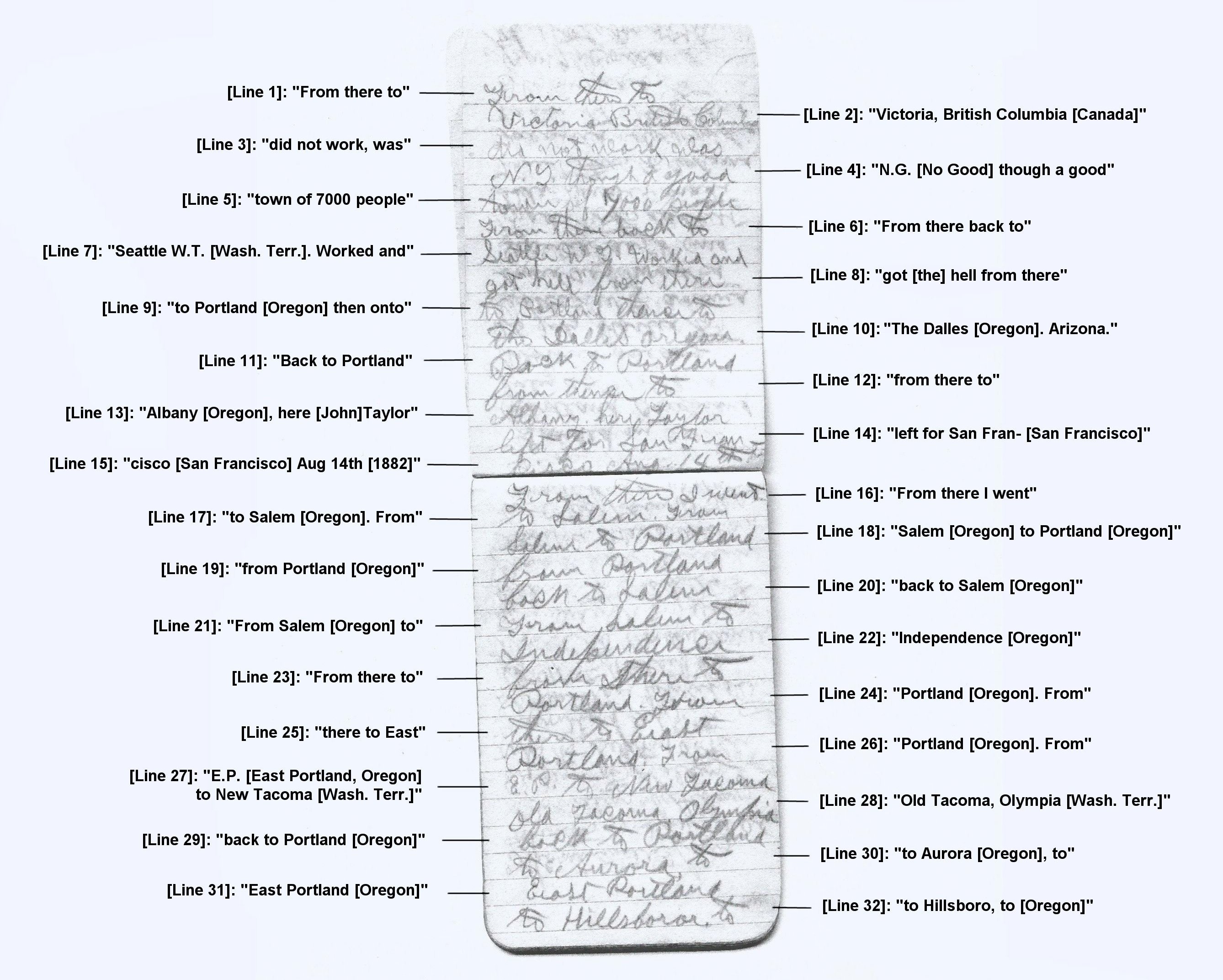
     Rather than plans to go somewhere, this is an accounting of where Soapy has already gone (Oregon, Washington Territory and and Victoria, British Columbia.) in 1882. Previous pages contained to do lists, work notes, an itinerary. This page engages in journaling—the recording of past events, perhaps for the purpose of revisiting them, or memorializing them for oneself, like a diary entry. The interesting thing is that, although the writing records the communication of twenty-one-year-old Soapy Smith with himself, the writing also communicates with us about him 142 years later (and potentially far beyond today). 
     Page 12 is a continuation from page 11, and is continued on page 13 and 14.
     Below are my attempts to attempts to make the writing easier to see and decipher.

Soapy STAR notebook
Page 12 - enhanced copy
1882
Courtesy of Geri Murphy

(Click image to enlarge)

Soapy STAR notebook
Page 12 - negative copy
1882
Courtesy of Geri Murphy

(Click image to enlarge)

     Below is what I believe to be the correct deciphering of the text, dated 1882. Do you agree, or do you see something else? All comments, suggestions and ideas are welcome! I will update the new information to this post.

Soapy STAR notebook
Page 12 - decipher copy
1882
Courtesy of Geri Murphy

(Click image to enlarge)


Page 12
  • Line 1: "From there to"
  • Line 2: "Victoria, British Columbia [Canada]"
  • Line 3: "did not work, was" 
  • Line 4: "N.G. [No Good] though a good"
  • Line 5: "town of 7000 people"
Interesting that Lines 3-5 discuss the first known note from Soapy that he did "no good" in the town of Victoria, British Columbia. What he apparently found in Victoria was a Canadian town much more settled, or with a heavier police presence than the communities of the North-West U.S., and so returned to them with his "sales" campaign. 
     Quite an interesting picture of young Soapy is emerging, To remain so consistently on the road, bouncing from place to place and back to some of the same places, shows a man who loves his work and is willing to work hard to make a success of it.
  • Line 6: "From there back to"
  • Line 7: "Seattle W.T. [Washington Territory]. Worked and"
  • Line 8: "got [the] hell from there"
In regards to Victoria, Soapy had written, "did not work, was N.G. [No Good]." Perhaps sales were slow due to complications such as dissatisfied customers who complained among themselves and/or to constabulary such as it was in Seattle, but Jefferson's "got [the] hell from there" indicates a possible police entanglement from which he escaped, or bribed his way to freedom. It doesn't appear that he was arrested.
  • Line 9: "to Portland [Oregon] then onto"
  • Line 10: "The Dalles [Oregon]. Arizona."
The Dalles is a town 80 miles east of Portland, on the Columbia River. On line 10 Soapy writes "Arizona." Did he travel down to Arizona after leaving The Dalles in Oregon? Going to Arizona would have taken 2.5 or 3 days just one way, so it doesn't seem possible for him to fit going there and back into his itinerary, so why did he write "Arizona?" Was it just a mistake? I know that I, myself have been writing, while thinking of something else, and find that I had written down something I was thinking of without realizing it.
  • Line 11: "back to Portland [Oregon]"
  • Line 12: "from there to"
  • Line 13: "Albany [Oregon], here [John] Taylor"
  • Line 14: "left for San Fran- [San Francisco, California]"
  • Line 15: "cisco [San Francisco, California] August 14, 1882"
     Soapy travels back to Portland and on to Albany, Oregon, where on Aug 14, he mentions "Taylor," which is likely John Taylor, believed to be Soapy's mentor since his start in Texas. Taylor is also mentioned in this notebook on page 2. Taylor, left for San Francisco and other endeavors while Soapy continued to work in Oregon and Washington Territory.
  • Line 16: "From there I went"
  • Line 17: "to Salem [Oregon]. From"
  • Line 18: "Salem [Oregon] to Portland [Oregon]"
  • Line 19: "from Portland [Oregon]"
  • Line 20: "back to Salem [Oregon]"
  • Line 21: "From Salem [Oregon] to"
  • Line 22: "Independence [Oregon]"
  • Line 23: "From here to"
  • Line 24: "Portland [Oregon]. From"
  • Line 25: "there to East"
  • Line 26: "Portland [Oregon]. From"
  • Line 27: "E.P. [East Portland, Oregon] to New Tacoma [Washington Territory]"
  • Line 28: "[and] Old Tacoma. Olympia [Washington Territory]"
  • Line 29: "back to Portland [Oregon]"
  • Line 30: "to Aurora [Oregon], to"
  • Line 31: "East Portland [Oregon]"
  • Line 32: "to Hillsboro [Oregon], to" [continued on page 13 - not published yet.
It will be interesting to see page 13 and learn where Soapy's travels led next. The picture on a map through page 11 shows a zig-zag pattern. When the notebook has been seen completely, it will be interesting to map all of his summer "sales" campaign on one map. I expect his canvassing from July into September 1882 will completely blanket settlements of the North-West states and territories.


STAR NOTEBOOK
April 24, 2017
Part #1
Part #2

Part #3

Part #4
Part #5 

Part #6
Part #7
Part #8
Part #9 
Part #10

Part #11
Part #13

Part #14
Part #15

Part #16


"Honesty is the best policy…unless
you can tell a convincing lie."
—Keith C. Cobb, Exceptions to the Rules, 2001.