Showing posts with label Seattle. Show all posts

November 21, 2024

Soapy Smith's "STAR" notebook, 1882: Part #13 - page 13

Soapy STAR notebook
Page 13 - Original copy
1882
Courtesy of Geri Murphy


(Click image to enlarge)


OAPY SMITH'S STAR NOTEBOOK
Part #13 - Page 13

This is page 13, dated 1882, the continuation of deciphering Soapy Smith's "star" notebook from the Geri Murphy's collection. A complete introduction to this notebook can be seen on page 1. Page 13 is a continuation from page 11 and 12, and concluding on page 14.
     The notebook(s) are in Soapy's handwriting, and often times pretty hard to decipher. A large part of this series of posts is to transcribe the pages, one-at-a-time, and receive help from readers on identifying words I am having trouble with, as well as correcting any of my deciphered words. My long time friend, and publisher, Art Petersen, has been a great help in deciphering and adding additional information. 
     I will include the original copy of each page, an enhanced copy of each page, a copy in negative, and a copy with typed out text, as tools to aid in deciphering the notes. There are a total of 24 pages. This means that there may be upwards of 24 individuals posts for this one notebook. Links to the past and future pages (pages 1, 2, 3, etc.) will be added at the bottom of each post for ease of research. When completed there will be a sourced partial record of Soapy's activities and whereabouts for 1882-1883.
     Important to note that the pages of the notebook do not appear to be in chronological order, with Soapy making additional notes on a town and topic several pages later.
     Rather than plans to go somewhere, this page is an accounting of where Soapy has already gone (Oregon, Washington Territory, California) in 1882. Previous pages contained to do lists, work notes, an itinerary. This page engages in journaling—the recording of past events, perhaps for the purpose of revisiting them, or memorializing them for oneself, like a diary entry. The interesting thing is that, although the writing records the communication of twenty-one-year-old Soapy Smith with himself, the writing also communicates with us about him 142 years later (and potentially far beyond today). 
     Below are my attempts to attempts to make the writing easier to see and decipher.

Soapy STAR notebook
Page 13 - enhanced copy
1882
Courtesy of Geri Murphy

(Click image to enlarge)


Soapy STAR notebook
Page 13 - negative copy
1882
Courtesy of Geri Murphy

(Click image to enlarge)


Below is what I believe to be the correct deciphering of the text, dated 1882. Do you agree, or do you see something else? All comments, suggestions and ideas are welcome! I will update the new information to this post.

Soapy STAR notebook
Page 13 - deciphered copy
1882
Courtesy of Geri Murphy

(Click image to enlarge)


Page 13
  • Line 1: "McMinnville [Oregon] from"
  • Line 2: "there to Independence [Oregon]"
  • Line 3: "Corvallis [and] Albany [Oregon]"
  • Line 4: "Eugene to Halsey [Oregon]"
  • Line 5: "up to Sept 10th"
  • Line 6: "Harrisburg [Oregon] Sep 11th"
  • Line 7: "Junction City [Oregon] Sep 12th"
  • Line 8: "back to Halsey [Oregon], from"
  • Line 9: "there to Brownsville [Oregon]"
  • Line 10: "Brownsville to Salem [Oregon]"
  • Line 11: "Salem [Oregon] til [until] Sep 24th"
  • Line 12: "Good fair Salem [Oregon]"
  • Line 13: "to Portland Portland [Oregon]"
  • Line 14: "to Dayton W.T. [Washington Territory]"
  • Line 15: "Waitsburg, Walla [Washington Territory]"
  • Line 16: "Walla [Washington Territory] no good."
  • Line 17: "for me from"
  • Line 18: "Walla Walla to (1882)"
  • Line 19: "Spokane Oct 5th [1882]"
The scratched out figures that appear between lines 17-19 seems to be Soapy trying to remember how much he had made up to that point, which is not "Oct 5th of 82" but "by Sept 18th 1882" of line 20. It could be that he scratched out the numbers and that date because he decided that he had remembered incorrectly and gave up trying to compute how much he took in. The scratched out numbers, though, give a sense of how much he was taking in. The figures appear to be 

200.00
200.00
250.00
650.00

According to Tom's Inflation Calculator, $1 in 1882 equals $32.32 in 2024. So the total of $650 in 1882 would be equivalent to about $21,008 today.
  • Line 20: "by Sep 18th 1882."
  • Line 21: "Cheney [Washington Territory] Oct 6th"
  • Line 22: "7 [th] to Dalles [Oregon] [Oct] 8th"
  • Line 23: "to Portland, Or. [Oregon]"
  • Line 24: "From there 9th to"
  • Line 25: "Dalles, Oregon"
  • Line 26: "Back to Portland [Oregon]"
  • Line 27: "10th and sailed on"
  • Line 28: "15 Oct for"
  • Line 29: "San Francisco [California]"
  • Line 30: "arrived 18th per"
  • Line 31: "Steamship Queen"
  • Line 32: "of the Pacific"
     Soapy is moving from place to place, never spending very long anywhere, but returning to most of the more profitable towns in a hit-and run method, which was very common for most of the confidence men of the wild west. Now with page 13, it appears reasonable to conclude that the writings from page 11 on were filled out in San Francisco or beyond. He's remembering the trip.
     Soapy arrives in San Francisco on October 18th 1882. An old blog post of mine shows that "Jeff R. Smith" registered into the Brooklyn Hotel on October 29-30, 1882. Soapy went to San Francisco at least four times, staying in the same hotel. Soapy remained in town at the Brooklyn, where on November 2 "Jeff R. Smith, Ft Worth" signed the hotel register and again on November 13. Also signing the register on the 13th was "John Taylor, Denver." Could Soapy have stayed in San Francisco for a time and been joined by John Taylor, his old mentor and partner in crime? Note that this time he lists his residence as "New York," and each time he registers he changes his "resident" city. Likely this is for self-protection purposes ("I'm from Denver, I've never been to San Francisco before.").
     The Steamship Queen of the Pacific is a very interesting story in itself. Construction of the 336-foot, iron hulled, commercial passenger cargo steamer was built in Philadelphia  for The Oregon Railway and Navigation Company and the Pacific Coast Steamship Company in 1882. She had three decks, two masts, and could carry 300 passengers.

Queen of the Pacific
San Francisco Chronicle
October 15, 1882


As Soapy noted, he arrived in San Francisco on October 18, 1882, which matched the mention in the San Francisco Chronicle, October 19, 1882. Interesting to note that the trip from Portland, Oregon to San Francisco took 52 hours (four days, four hours).   
 

52 hours from Portland
San Francisco Chronicle
October 19, 1882


The day following Soapy's arrival in San Francisco the captain of the Queen of the Pacific was arrested.

AN ANGRY CAPTAIN
San Francisco Chronicle
October 20, 1882

Below is the contents of the newspaper story.

AN ANGRY CAPTAIN
His Arrest Caused by a Hotel Runner.
E. Alexander, Captain of the Queen of the Pacific, was arrested yesterday by Officer Eagan on a warrant sworn out by C. M. Barnes on a charge of using vulgar language. It seems from the complaint that Barnes was a passenger on the Queen of the Pacific on he down trip, and that while he was soliciting among the cabin passengers he was attacked by the first mate, who handled him very roughly, tearing his coat nearly off of him, the mate claiming that he had no right to solicit in the cabin, as he had only a third-class ticket. Barnes had the first mate arrested on the arrival of the steamer, and in attempting to go on board of the steamer yesterday the Captain called him a dirty loafer, and told him that if he ever came on board the steamer again he would smash his head. Barnes, the complaining witness, is a runner for the Brooklyn Hotel.
Is it a coincidence that Soapy was staying at the Brooklyn Hotel?

BUT WAIT, THERE'S MORE!

THE STEAMSHIP QUEEN

     The steamship name, Queen of the Pacific was shortened to Queen in 1890. The same steamship that carried Soapy Smith and his gang back and forth between Skagway, Alaska and Seattle, Washington during the Klondike gold rush (1896-1898), 15-years after he traveled from Portland to Seattle in 1882.
     The Queen played a key role in the founding of Skagway, Alaska, where Soapy would soon control the criminal underworld. On July 26, 1897, just nine days after the steamship Portland arrived in Seattle with its “Stacks of Yellow Metal,” the Queen anchored in deep water near Mooresville (Skagway, Alaska) and asked Captain Moore, the owner of the land, for permission to unload passengers and supplies. The Queen’s Captain Carroll did not know whether his passengers were entering the United States or Canada as the area was claimed by both countries.
     Soapy Smith's second voyage on the Queen [of the Pacific] was in September 1897. Soapy, Jerry J. Daly and Jack Jolly arrived in Skagway, Alaska just a few weeks after it was founded as a trail-route to the gold fields in the Klondike, Canada. The three men worked swindles on the stampeders with great success. Working 19-days of the 23 that they were there, they made about $30,000 dollars. On the 23rd day they boarded the Queen for Seattle.  


STAR NOTEBOOK
April 24, 2017
Part #1
Part #2

Part #3

Part #4
Part #5 

Part #6
Part #7
Part #8
Part #9 
Part #10

Part #11
Part #12
Part #14
Part #15

Part #16


"If, after the first twenty minutes, you don't know
who the sucker at the table is, it's you."
—Author Unknown


November 13, 2024

Soapy Smith's "STAR" notebook, 1882: Part #12 - page 12

Soapy STAR notebook
Page 12 - original copy
1882
Courtesy of Geri Murphy

(Click image to enlarge)


OAPY SMITH'S "STAR" NOTEBOOK
Part #12 - Page 12

     This is part #12 - page 12, dated 1882. This is a continuation of deciphering Soapy Smith's "star" notebook from the Geri Murphy's collection. A complete introduction to this notebook can be seen on page 1.
     The notebook(s) are in Soapy's handwriting, and often times pretty hard to decipher. A large part of this series of posts is to transcribe the pages, one-at-a-time, and receive help from readers on identifying words I am having trouble with, as well as correcting any of my deciphered words. My long time friend, and publisher, Art Petersen, has been a great help in deciphering and adding additional information. 
     I will include the original copy of each page, an enhanced copy of each page, a copy in negative, and a copy with typed out text, as tools to aid in deciphering the notes. There are a total of 24 pages. This means that there may be upwards of 24 individuals posts for this one notebook. Links to the past and future pages (pages 1, 2, 3, etc.) will be added at the bottom of each post for ease of research. When completed there will be a sourced partial record of Soapy's activities and whereabouts for 1882-1883.
     Important to note that the pages of the notebook do not appear to be in chronological order, with Soapy making additional notes on a town and topic several pages later.
     Rather than plans to go somewhere, this is an accounting of where Soapy has already gone (Oregon, Washington Territory and and Victoria, British Columbia.) in 1882. Previous pages contained to do lists, work notes, an itinerary. This page engages in journaling—the recording of past events, perhaps for the purpose of revisiting them, or memorializing them for oneself, like a diary entry. The interesting thing is that, although the writing records the communication of twenty-one-year-old Soapy Smith with himself, the writing also communicates with us about him 142 years later (and potentially far beyond today). 
     Page 12 is a continuation from page 11, and is continued on page 13 and 14.
     Below are my attempts to attempts to make the writing easier to see and decipher.

Soapy STAR notebook
Page 12 - enhanced copy
1882
Courtesy of Geri Murphy

(Click image to enlarge)

Soapy STAR notebook
Page 12 - negative copy
1882
Courtesy of Geri Murphy

(Click image to enlarge)

     Below is what I believe to be the correct deciphering of the text, dated 1882. Do you agree, or do you see something else? All comments, suggestions and ideas are welcome! I will update the new information to this post.

Soapy STAR notebook
Page 12 - decipher copy
1882
Courtesy of Geri Murphy

(Click image to enlarge)


Page 12
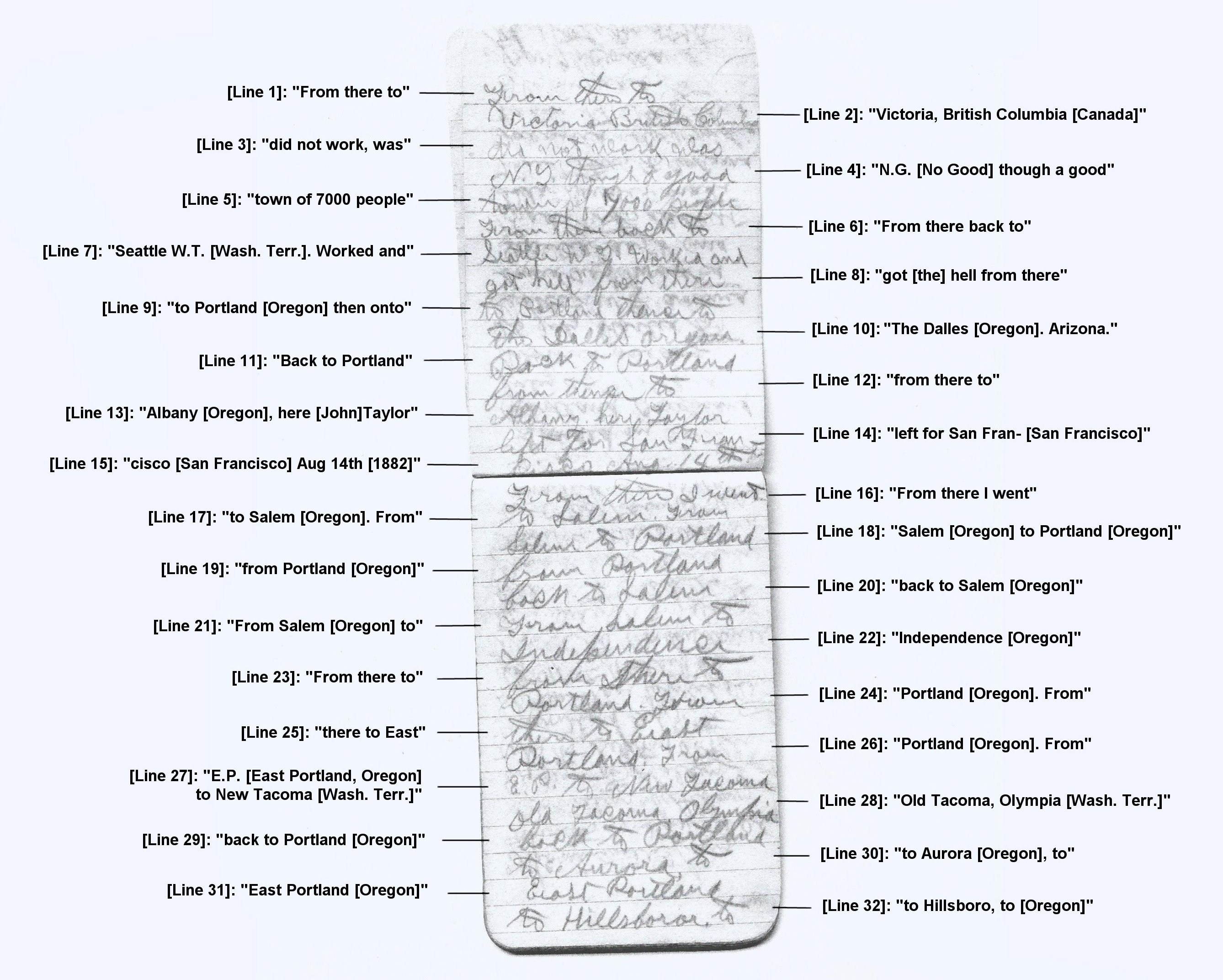
  • Line 1: "From there to"
  • Line 2: "Victoria, British Columbia [Canada]"
  • Line 3: "did not work, was" 
  • Line 4: "N.G. [No Good] though a good"
  • Line 5: "town of 7000 people"
Interesting that Lines 3-5 discuss the first known note from Soapy that he did "no good" in the town of Victoria, British Columbia. What he apparently found in Victoria was a Canadian town much more settled, or with a heavier police presence than the communities of the North-West U.S., and so returned to them with his "sales" campaign. 
     Quite an interesting picture of young Soapy is emerging, To remain so consistently on the road, bouncing from place to place and back to some of the same places, shows a man who loves his work and is willing to work hard to make a success of it.
  • Line 6: "From there back to"
  • Line 7: "Seattle W.T. [Washington Territory]. Worked and"
  • Line 8: "got [the] hell from there"
In regards to Victoria, Soapy had written, "did not work, was N.G. [No Good]." Perhaps sales were slow due to complications such as dissatisfied customers who complained among themselves and/or to constabulary such as it was in Seattle, but Jefferson's "got [the] hell from there" indicates a possible police entanglement from which he escaped, or bribed his way to freedom. It doesn't appear that he was arrested.
  • Line 9: "to Portland [Oregon] then onto"
  • Line 10: "The Dalles [Oregon]. Arizona."
The Dalles is a town 80 miles east of Portland, on the Columbia River. On line 10 Soapy writes "Arizona." Did he travel down to Arizona after leaving The Dalles in Oregon? Going to Arizona would have taken 2.5 or 3 days just one way, so it doesn't seem possible for him to fit going there and back into his itinerary, so why did he write "Arizona?" Was it just a mistake? I know that I, myself have been writing, while thinking of something else, and find that I had written down something I was thinking of without realizing it.
  • Line 11: "back to Portland [Oregon]"
  • Line 12: "from there to"
  • Line 13: "Albany [Oregon], here [John] Taylor"
  • Line 14: "left for San Fran- [San Francisco, California]"
  • Line 15: "cisco [San Francisco, California] August 14, 1882"
     Soapy travels back to Portland and on to Albany, Oregon, where on Aug 14, he mentions "Taylor," which is likely John Taylor, believed to be Soapy's mentor since his start in Texas. Taylor is also mentioned in this notebook on page 2. Taylor, left for San Francisco and other endeavors while Soapy continued to work in Oregon and Washington Territory.
  • Line 16: "From there I went"
  • Line 17: "to Salem [Oregon]. From"
  • Line 18: "Salem [Oregon] to Portland [Oregon]"
  • Line 19: "from Portland [Oregon]"
  • Line 20: "back to Salem [Oregon]"
  • Line 21: "From Salem [Oregon] to"
  • Line 22: "Independence [Oregon]"
  • Line 23: "From here to"
  • Line 24: "Portland [Oregon]. From"
  • Line 25: "there to East"
  • Line 26: "Portland [Oregon]. From"
  • Line 27: "E.P. [East Portland, Oregon] to New Tacoma [Washington Territory]"
  • Line 28: "[and] Old Tacoma. Olympia [Washington Territory]"
  • Line 29: "back to Portland [Oregon]"
  • Line 30: "to Aurora [Oregon], to"
  • Line 31: "East Portland [Oregon]"
  • Line 32: "to Hillsboro [Oregon], to" [continued on page 13 - not published yet.
It will be interesting to see page 13 and learn where Soapy's travels led next. The picture on a map through page 11 shows a zig-zag pattern. When the notebook has been seen completely, it will be interesting to map all of his summer "sales" campaign on one map. I expect his canvassing from July into September 1882 will completely blanket settlements of the North-West states and territories.


STAR NOTEBOOK
April 24, 2017
Part #1
Part #2

Part #3

Part #4
Part #5 

Part #6
Part #7
Part #8
Part #9 
Part #10

Part #11
Part #13

Part #14
Part #15

Part #16


"Honesty is the best policy…unless
you can tell a convincing lie."
—Keith C. Cobb, Exceptions to the Rules, 2001.


November 5, 2024

Soapy Smith's "STAR" notebook, 1882: Part #11 - page 11

Soapy Smith's "star" notebook
Page 11 - original copy
1882
Courtesy of Geri Murphy

(Click image to enlarge)


OAPY SMITH'S "STAR" NOTEBOOK

Part #11 - Page 11

     This is part #11 - page 11, dated 1882. This is a continuation of deciphering Soapy Smith's "star" notebook from the Geri Murphy's collection. A complete introduction to this notebook can be seen on page 1.
     The notebook(s) are in Soapy's handwriting, and often times pretty hard to decipher. A large part of this series of posts is to transcribe the pages, one-at-a-time, and receive help from readers on identifying words I am having trouble with, as well as correcting any of my deciphered words. My long time friend, and publisher, Art Petersen, has been a great help in deciphering and adding additional information. 
     I will include the original copy of each page, an enhanced copy of each page, a copy in negative, and a copy with typed out text, as tools to aid in deciphering the notes. There are a total of 24 pages. This means that there may be upwards of 24 individuals posts for this one notebook. Links to the past and future pages (pages 1, 2, 3, etc.) will be added at the bottom of each post for ease of research. When completed there will be a sourced partial record of Soapy's activities and whereabouts for 1882-1883.
     Important to note that the pages of the notebook do not appear to be in chronological order, with Soapy making additional notes on a town and topic several pages later.
     Page #11 is late July 1882, thus written previous to page #10, making this is page different from the others seen so far. Rather than plans to go somewhere, this is an accounting of where Soapy has already gone (Oregon and Washington Territory). Previous pages contained to do lists, work notes, an itinerary. This page engages in journaling—the recording of past events, perhaps for the purpose of revisiting them, or memorializing them for oneself, like a diary entry. The interesting thing is that, although the writing records the communication of twenty-one-year-old Soapy Smith with himself, the writing also communicates with us about him 142 years later (and potentially far beyond today). The way Soapy remarks on where he went and that he had a significant success in Seattle portrays his desire to remark on it for himself.

Art Petersen writes,
This page may be the reason the notebook survived Jeff's many travels. It might have become a good luck talisman in that it documented the luck he had made for himself. Keeping the notebook meant preserving proof of that magical good luck power. This thinking could be overstating the case, but something about the notebook made it worth keeping with him or kept safe somewhere. What this page documents in journal form could be that something.
Below are my attempts to make the page easier to decipher.

Soapy Smith's "star" notebook
Page 11 - enhanced
1882
Courtesy of Geri Murphy

(Click image to enlarge)

Soapy Smith's "star" notebook
Page 11 - negative
1882
Courtesy of Geri Murphy

(Click image to enlarge)

     Below is what I believe to be the correct deciphering of the text, dated 1882. Do you agree, or do you see something else? All comments, suggestions and ideas are welcome! I will update the new information to this post.

Soapy Smith's "star" notebook
Page 11 - deciphered
1882
Courtesy of Geri Murphy

(Click image to enlarge)


Page 11
  • Line 1: "Landed in"
  • Line 2: "Portland, Oregon"
  • Line 3: "July 25th 1882." 
  • Line 4: "Worked one day"
  • Line 5: "26 July Started to"
  • Line 6: "Seattle, W.T. [Washington territory] arrived"
  • Line 7: "Same day. Worked"
  • Line 8: "several days. And"
  • Line 9: "made the largest"
  • Line 10: "sale I ever made. $112.00" [?]
  • Line 11: "From there to New"
     Lines #11, #12 and #15: At first I thought that "New" [New Tacoma] was "NW," the abbreviation for North-West, but I did find reference to New Tacoma. 
     Tacoma was incorporated on November 12, 1875, following its selection in 1873 as the western terminus of the Northern Pacific Railroad due to lobbying by McCarver, future mayor John Wilson Sprague, and others. However, the railroad built its depot in New Tacoma, two miles (3 km) south of the Carr–McCarver development. The two communities grew together and joined, merging on January 7, 1884. The transcontinental link was effected in 1887, and the population grew from 1,098 in 1880 to 36,006 in 1890. Rudyard Kipling visited Tacoma in 1889 and said it was "literally staggering under a boom of the boomiest."
     Lines #8 through #10: The 1882 amount of $112 is better understood for us when considered in 2024 dollars. Tom's inflation calculator puts the figure at $3,619.84. Quite a clean-up for the work of "several days." If the time in Seattle were 3 days, Soapy made "sales" of over $1,000 a day.
  • Line 12: "Tacoma, done well. [Washington territory]"   
  • Line 13: "From there to"
  • Line 14: "Olympia, back to [Washington territory]"
  • Line 15: "New Tacoma from [Washington territory]"
  • Line 16: "there to Port Townsend [Oregon]"
     Sometime after August 24 when The Great Sherman Circus itinerary was first published and Soapy recorded it on page #10, he went to the next notebook page to reflect on his successes so far in the northwest.
     An estimate of Soapy's time in each location is about 2 days, except for Portland for about half a day and Seattle for about 3 days. Travel time of half a day or more is added to the dates. Travel from New Tacoma to Port Townsend, however, could have taken a full day or more by ship up Puget Sound.

Towns Soapy went to
Washington Territory
Google Maps

Estimation of dates for each town in chronological order.
  • Portland, Oregon, July 25-26, 1882.
  • Seattle, Washington Terr., July 26-30, 1882.
  • New Tacoma, Washington Terr., July 30-August 2, 1882. 
  • Olympia, Washington Terr., August 3-5, 1882. 
  • New Tacoma, Washington Terr., August 5-8, 1882. 
  • Port Townsend, Washington Terr., August 8-11, 1882.


STAR NOTEBOOK
April 24, 2017
Part #1
Part #2

Part #3

Part #4
Part #5 

Part #6
Part #7
Part #8
Part #9 
Part #10

Part #12
Part #13

Part #14
Part #15

Part #16 


"Take risks: if you win, you will be happy; 
if you lose, you will be wise."
—Author Unknown


January 12, 2023

Soapy Smith's roulette table up for auction.

Soapy Smith's roulette table
Courtesy of Potter and Potter Auctions

(Click image to enlarge)


OAPY SMITH'S ROULETTE TABLE UP FOR AUCTION!
Potter and Potter Auctions the Ricky Jay Collection.


Auction Description: Lot 318

SMITH, “Soapy” (Jefferson Randolph Smith, 1860 – 98). “Soapy” Smith’s Roulette Table and Wheel. Denver: George Mason and Co., ca. 1890. Handsome full-size roulette layout, table, and wheel manufactured by the noted gambling supply house and owned and used by notorious con man “Soapy” Smith. 95 ½ x 40 x 31”, outer wheel diameter (cradle) 31 ½”. Hub bears the manufacturer’s name. Wheel spins freely. Sold with a Mason and Co. check rack (stencil-marked by the maker underneath), and a later set of chips, likely manufactured by H.C. Evans of Chicago. Layout rubbed and worn, but in good condition overall; finish of table and legs also worn, but overall, a sturdy and impressive relic not only of the American west, but one of its most notorious figures, and among the most prominent makers of gambling equipment of the era. Accompanied by a letter of provenance from Smith’s descendant to Ricky Jay attesting to the provenance of the wheel and table, the family’s ownership of same, as well as a catalog from the sale of the Pullen Alaska Museum collection by Greenfield Galleries of Seattle, featuring the roulette wheel on its cover. One of the more notorious denizens of Skagway, Alaska, Smith’s reputation was as a con man, gambler, and criminal of considerable renown. After his family fortune was lost in the aftermath of the Civil War, Smith prospered by becoming a criminal kingpin in Texas, operating rigged games of Three Card Monte, poker, and the venerable Three Shell Game. Later, he lived and conned in Colorado for years, in both Creede (a mining boom town), and Denver. It was in the latter city where this wheel was manufactured by the famous firm of Mason and Co., one of the best-known gaming supply houses of the era. The sobriquet of “Soapy” was conferred on Smith thanks to a sleight-of-hand swindle devised to sell bars of soap. Smith demonstrated to a crowd how valuable cash prizes were hidden in the paper wrappers of a select number of bars, and when some customers ripped open the paper packaging to discover the hidden loot, business boomed. But these winners were “Soapy’s” accomplices – the laymen in the crowd never stood a chance of finding hidden greenbacks. A simple dexterous dodge made certain the bars of soap with the extra bills went straight to those in cahoots with the con man. Smith died in a gunfight in Juneau, Alaska on July 8, 1898. A dispute over a game of Three Card Monte led to the shootout that cost him his life.

Minimum Bid: $5,000
Estimate: $10,000 - $20,000
Number of Bids: 0
Time Left: [As of this post (01/12/2023) there are 43 days left]


Soapy Smith's roulette table
Courtesy of Potter and Potter Auctions

(Click image to enlarge)


     The roulette table belonged to my great-grandfather Jefferson Randolph Smith II, alias "Soapy" Smith. It is very possible that he used the table in one or more of his gambling houses in Denver and Creede, Colorado, etc., each location mentioning "roulette" being offered. He knew the George Mason Company of Denver well, as their store was only about two blocks from Soapy's Tivoli Club saloon and gaming house.  
     In 1897-98, during the Klondike gold rush Soapy shipped the table to Skagway, Alaska. As shipping to the new camp was at a premium, it is believed that the equipment, wheel, layout, etc., minus the table and legs, were shipped at a cost of $1,000 (according to Harriet Pullen). The table and legs are believed to have been made in Skagway, but it is equally possible that the entire setup was shipped. Either way, the items were likely crated because if
the ship company saw illegal gambling equipment, the charge might have been
even more.
An enormous price, but Soapy knew he would make his money back very quickly.
     After Soapy's death and the gold rush subsided, the table eventually made it's way to the Pullen House hotel operated by gold rush pioneer Harriet Pullen, who claimed to have known Soapy. The roulette table and other Skagway artifacts were placed in her hotel as a private museum of the Days of '98. The museum and hotel remained open until Pullen's death in 1947.

Soapy Smith's roulette table
Harriet Pullen age 80
standing with Soapy's roulette table
Pullen House, Skagway.
Jeff Smith collection

(Click image to enlarge)


Soapy Smith's roulette table
Harriet Pullen spins Soapy
Smith's roulette table
Pullen House, Skagway.
Jeff Smith collection

(Click image to enlarge)


     In 1959 Harriet Pullen's granddaughter Mary Kopanski moved the Pullen museum to the Food Circus Balcony at the Seattle Center in Seattle, Washington. In the 1970s the Seattle Center announced that they were tearing down the building and thus evicting the museum. Mary Kopanski decided to sell the collection at auction in 1975.
 
 
Pullen House Museum advertisement roulette table
Soapy's roulette table is mentioned
Pullen House, Skagway.
Jeff Smith collection
 
(Click image to enlarge)
 
      In 1973 My father, mother and I went to the Pullen collection auction in Seattle, Washington, where my father purchased the roulette table, Soapy's grave marker and other artifacts. Considering Soapy was a confidence man, my father believed that the table might be gaffed (rigged for cheating) and so when it arrived from the auction house he proceeded to carefully take it apart to examine it but no gaffing could be found. It's a square (honest) table. We built a saloon and gambling hall in a back building to display the roulette table and my father's gambling collection. I inherited the roulette table upon my father's passing in 1987.
     In the 2000s I sold the roulette table to magician/actor Ricky Jay, a big fan of Soapy's.
 

Soapy Smith's roulette table - Seattle Center museum 
Magazine article on Pullen Museum
Seattle Center, Seattle, Washington
Jeff Smith collection
 
(Click image to enlarge)
 
 
     Ricky Jay, an absolute master of slight of hand and card tricks passed away in 2018.
          Ideally, I would like to see the table sell for an enormous amount. High enough that the media might notice and report on it. One of my primary goals since the 1980s has been to see Soapy Smith become a very well-known character of the old west. All Soapy needs is a major motion picture or series about his life and death! 
     For more photographs of the roulette table see the "Potter and Potter Auctions" link below.

SOURCES


Soapy's roulette table: pages 74, 124-25, 126-27, 419-20, 451, 456, 471, 480. 


"He made fortune after fortune and spent it all in riotous living and in good deeds, for it must be ever said of "Soapy" that no hungry man ever asked aid of him and was refused."
——San Francisco Examiner, February 25, 1898