December 25, 2021

"Shavy" [Shavie] Smith: Did "Soapy" Smith have an earlier alias?

Denver Republican
October 16, 1883

(Click image to enlarge)
 
NOTE: There has been additional research finds added. You will find them at the bottom of the article in dark red.


id the Denver Republican give conman Jefferson Randolph Smith his first Alias?
 
On October 16, 1883 the Denver Republican posted a sentence in the Police Court section of their newspaper that read, "Shavy Smith was fined $10 and costs for raising a disturbance." Could young Jefferson been running his prize package soap sell racket and "raised a disturbance?" It would certainly not be the first time. The name may have come from a newspaper reporter who knew that the arrestee was named "Smith," but did not know the first name. It would not be the first time that individuals placed invented alias' in front of "Smith," including "Sopolio" and "Soapy." Could the reporter added "Shavy" to Smith?
     In researching the name "Shavy" I found a site that stated that between 1880-2019 there have been 69 reports of female babies being christened "Shavy." With no apparent data or provenance, that's supposedly 69 named "Shavy" in 139 years. We cannot ignore the fact that the very few "Shavy's" in 1883 caused a criminal disturbance. What are those odds?

[following is the first addendum containing information from Art Petersen, Professor of English, author, publisher and historian]
    
     "Shavy" was a new and interesting moniker to me, so I looked it up in DARE (Dictionary of American Regional English) and the OED (Oxford English Dictionary) but found no entry. That seemed strange as these dictionaries are huge, scholarly collections of words and their derivatives. So on speculation I looked in my grandmother's 1908 Colliers dictionary and found "SHAVIE n. a trick or prank. Scotch." Checking "shavie" in DARE, I found nothing but did find it in the OED and in Merriam-Webster online. The term is definitely an archaism. I've heard of people being "clipped" as well as "shaved" but not "shavied."
     Without explanation or derivation, dictionary synonyms and etymologies showed words like "caper, knavery, monkeyshine(s), roguery, trick, swindle, crook."
     I have now only a subscription to Newspaper.com, and a check there showed the word used in the 1880s and 1890s as names for horses, crooks, but also just a plain nickname--context revealed little, but I didn't spend much time with these articles as the citations also showed confusion with Shaw (the name), shaved, and shaving.
     But the newspaper writer seems probably apt in naming Soapy as Shavy Smith, as in con game trickster Smith. Interesting as an early nickname for Jefferson before being christened with the more memorable Soapy.
 
[following is the second addendum containing information from Linda Gay Mathis,  genealogist and historian]

 
Sunday's Slugging
Denver Tribune
July 18, 1883
Courtesy of Linda Gay Mathis

 (Click image to enlarge)


Below is the article's content.

SUNDAY’S SLUGGING

An Amateur Prize Fight at the Fair Grounds Winds Up In a Bloody Row.

      There was an amateur prize fight of a very bloody nature at the Fair grounds Sunday night. The particulars have been kept quiet by the parties engaged for fear of the police. Charles Garderner and Jack Reddy are rival cooks of rival hotels, and because of their respective capabilities in the culinary art they have become personal rivals. Both claim to be men of muscular abilities, and this has some what stimulated the antagonism. Though they were not avowed enemies, they had a hostile meeting one day last week and agreed to settle all of their differences in the ring by moonlight on Sunday night.
     The matter was kept exceedingly quiet, and there were only three witnesses, the seconds to the combatants and the hackman who drove them to the place. “Shavy” Smith was second to Gardner, and Gilbert Balls was second to Reddy. A ring was improvised by drawing a circle on the ground.
     In the first round Gardener struck Reddy a terrible blow. Reddy ran in and clinched, and, in doing so, violated all the aggreements that had been made by setting his teeth on Gardener’s thumb, biting him severely. Then, releasing his hold, he set his teeth in Gardener’s cheek, holding him with the grip of a bulldog.
     Then “Shavy” Smith, as Gardener’s second, stepped up and demanded that Reddy should let go, and kicked him. Then Balls, the second to Reddy, made an assault on Smith, when the latter turned, threw Balls upon the ground and gave him a terrible kick over the eyes, cutting a bloody gash, which required seven stitches by a surgeon to close.
     Then a general rough and tumble fight ensued between principles and seconds, and the struggle continued till all parties were willing to quit. They returned to town, each by his own route, and all of them a bloody and badly mutilated set.
____________________________

The original newspaper story from the Denver Republican for Shavy Smith was dated October 16, 1883, three months later the Denver Tribune article dated July 18, 1883 is published. Are they both writing about the same incident, or are they discussing different affairs? Could the "disturbance" case have taken three months to go before a judge? If so, was this intentional?

There are a number of clues that I find too much of a coincidence for "Shavy" not to be Soapy Smith. They are as follows.

  • "Shavy" Smith is working in an official capacity within a boxing ring. On numerous occasions throughout his life, Soapy Smith worked as a time-keeper, a referee, etc. within a boxing ring.
  • The use of "Shavy" in the Denver Republican does not indicate the sex of the individual causing the "disturbance." A portion of the upper first half of this blog post deals with the name, and whether it is a male or female. The primary difference in the Denver Tribune article is that "Shavy" Smith is male.
  • In the Denver Republican "Shavy" is not encased with quote marks giving the impression that it is a forename (first name). In the Denver Tribune article quote marks surround "Shavy," indicating that it is not a forename, but rather an alias, like "Soapy" Smith.
  • “Shavy’s” quick and violent reaction at the start of the free-for-all fight in the Denver Tribune article aligns with “Soapy’s” quick-to-violence history, a little too much to be mere coincidence.
  • Perhaps more of a circumstantial clue, than a solid one, is the name of "Charles Gardener," of whom Soapy was his "second" in the boxing match. Soapy’s sister, Emma Lu "Emmie" Smith, married Robert Gardner, so I can't help but wonder if the newspaper misspelled the name, printing "Gardener" instead?
With this new information I’m going to officially state that I believe that “Shavy” Smith is “Soapy” Smith.

SOURCES
:
Merriam-Webster online
Oxford English Dictionary
Colliers dictionary, 1908
Art Petersen
Linda Gay Mathis


"Horse sense is a good judgment which keeps horses from betting on people."
—W.C. Fields


December 21, 2021

Artifact #90: A postcard from Emmie Lu Gardner to Jeff R. Smith III, 1912

Artifact #90
Postcard text area
Jeff Smith collection

(Click image to enlarge)


 mma Lu "Emmie" Smith [Gardner]


Artifact #90 is a postcard sent from Soapy Smith's sister, Emma Lu "Emmie" Smith [Gardner] in Waco, Texas, to Jefferson R. Smith III, in St. Louis, Missouri, September 25, 1912. Emma is about age 45, her date of birth believed to have been in 1867. She will pass away in 1915. Jefferson R. Smith is her nephew, aged 25, and working for the St. Louis Times.
 
Postmarked from Waco, Texas, on September 25, 1912 at 2 pm., the stamp is missing, appearing to be torn off. My father, John Randolph Smith, admitted once that as a young and avid stamp collector, he did remove some stamps when the opportunity arose.

The following is the text of the written portions.

Waco Tex
Sept 25, 1912.
Dear Jeff.

I wrote you a letter and a card about 2 months ago. Did you get them? Write me at 927 Franklin Street 
Waco Texas
Love to all
Your loving Aunt
Emmie Lu Gardner
 
[addressed]
Mr. Jeff Smith
St. Louis
Mo
Care St. Louis Times
 
 
Artifact #90-front photo
Waco, Texas court house
Jeff Smith collection

(Click image to enlarge)
Emma Lu "Emmie" Smith
May 4, 2021 


Emma Lu "Emmie" Smith: pages 22, 121, 377, 397, 403-04, 589. 201.


"he [Soapy Smith] was really known more as a Robin Hood. who helped the poor and unfortunate, than as a gangster."
—Frances Lebby Stanton [Peniston] (Smith family)


December 1, 2021

Photograph: Entrance to Juneau Company Wharf, circa 1930s-40s.

Entrance to Juneau Company Wharf
Location of the shootout on Juneau Wharf 1898
Circa 1930s-1940s
Jeff Smith collection

(Click image to enlarge)


 ntrance to Juneau Company Wharf
 
 
Here is a new addition to my photograph collection. The above is the cropped, close-up showing the entrance to the Juneau Company Wharf where Soapy Smith and Frank Reid shot it out in the Shootout on Juneau Wharf, July 8, 1898. Every time I find and publish a new photograph of the location were Soapy was killed, I think of the historians who post new finds of the lot behind the OK Corral in Tombstone, where the Shootout on Fremont Street took place on October 26, 1881.
     The photograph below shows the entire frame.
 
Entire photograph
Circa 1930s-1940s
Jeff Smith collection

  (Click image to enlarge)


Juneau Wharf
Nov 29, 2008
Dec 23, 2008
Jun 02, 2009
Nov 01, 2009
Feb 16, 2011
Apr 23, 2011
Mar 01, 2011
Apr 19, 2012
May 02, 2012
Feb 23, 2014
Oct 14, 2014
Nov 30, 2016
May 17, 2017
Aug 16, 2017
Nov 12, 2021


Juneau Wharf: pages 9, 12, 530-32, 535, 538, 546-51, 554, 564, 575, 595.


"[Frank H. Reid] … never was anything but a crooked bartender."
—Cecelia Selmer Price
1958 letter to Justin M. Smith (Soapy’s grandson)


November 30, 2021

Artifact #89: Letters to and from Skagway historian Cecelia Selmer Price, 1958-1963

Artifact #89
Letter to Justin M. Smith
From Cecelia Selmer Price
May 9, 1958
Courtesy of
Jeff Smith collection

(Click image to enlarge)


also told him that he was really known more as a Robin Hood, who helped the poor and unfortunate, than as a gangster."

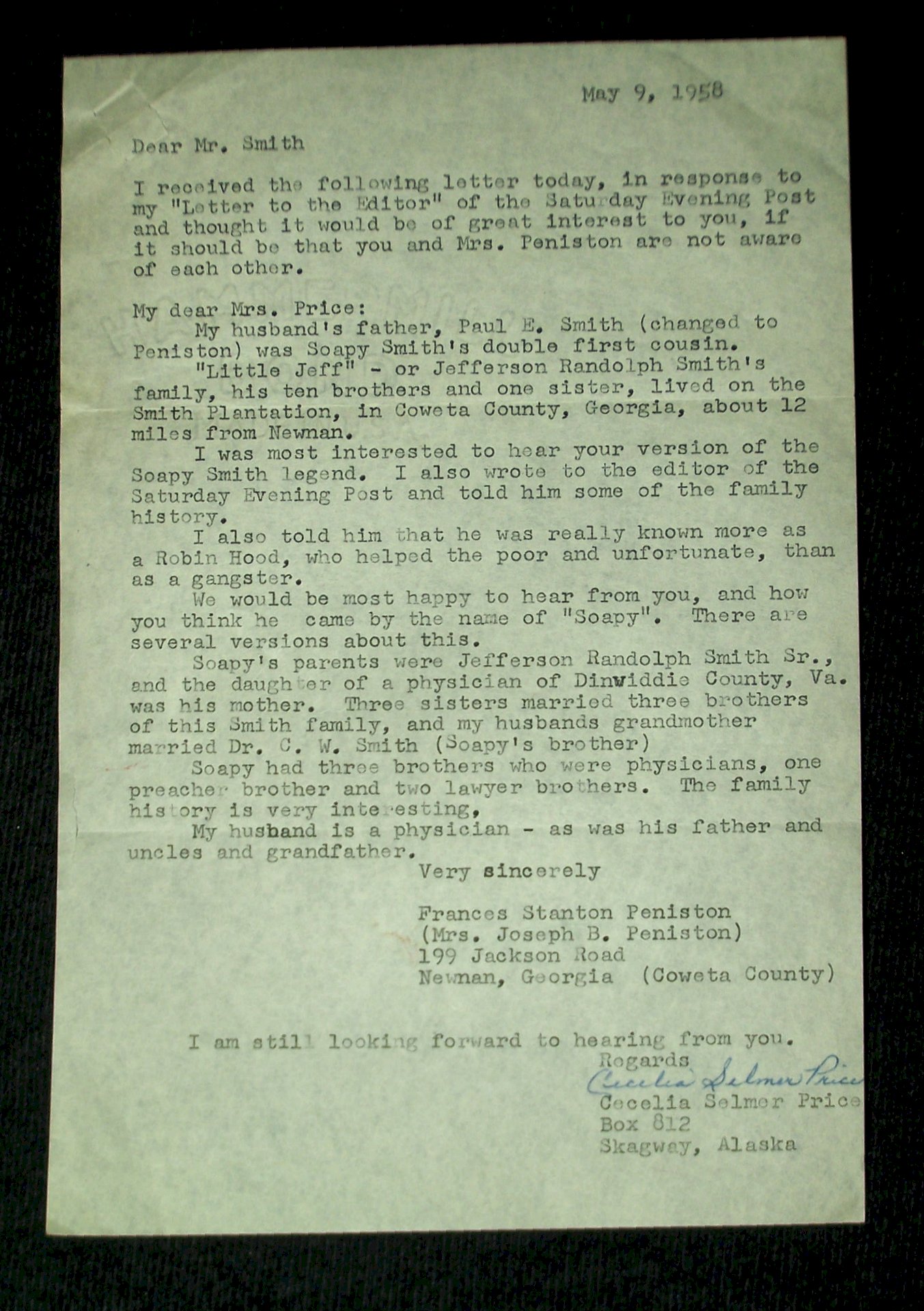
Artifact #89 contains the first communication with Skagway resident and historian, Cecelia Selmer Price, a typed letter to Justin M. Smith (my uncle), May 9, 1958. I would not be born for another five months.
     It all started with a small piece written by Harold Helfer published in the Saturday Evening Post, May 10, 1958. 
 
So We Commemorate
A PIONEER GANGSTER

Saturday Evening Post
March 22, 1958
Jeff Smith Collection

 (Click image to enlarge)
 
Below is the context of the article.
 
So We Commemorate
A PIONEER GANGSTER
 
Leering down from all comers from a cliff above the harbor of Skagway, Alaska, is a white-painted skull twenty-five feet high, shaped of natural stone. It serves as a reminder of the abrupt end of Skagway's leading bad man, Jefferson R. (Soapy) Smith, and is lettered: Soapy Smith's Skull.
     Soapy Smith, a lanky, sardonic saloonkeeper with a long black beard, ruled Skagway ruthlessly during the hectic 1898 gold rush. Hijacking, shakedowns and the stealthy technique of taking rivals "for a ride" were among his specialties long before Chicago and New York gangsters used them.
     If his crooked gambling tables failed to part a flush prospector from hard-earned gold, Soapy resorted to holdup at pistol point. When he publicly robbed grizzled old Alexander Steward of $3500 in nuggets, however, it was too much even for wide-open Skagway to stomach.
     Frank Reid, a railroad construction boss for the White Pass and Yukon Railway, organized vigilantes. Soapy and his gang overawed them without a shot. Then Reid called a law-and-order meeting on a harbor pier. Sneering, Soapy stalked down the pier to break up the meeting. Reid, . 45 in hand, warned- then fired. Soapy shot back.
     Soapy died almost instantly. Reid passed away in agony twelve days later. The two were buried nearly side by side. But where Soapy's wooden slab bore only his name, age and death date, Reid's marble monument is inscribed: FRANK REID-THE MAN WHO GAVE HIS LIFE FOR THE HONOR OF SKAGWAY.

NOTE: The blue pen ink notes that don't make sense. Who wrote this, and why, is unknown.
      Price wrote a "letter to the editor," responding to the article, and the Saturday Evening Post published it. Below is the page cut from the issue, and the content of that letter.
 
 
The Legend of Soapy Smith
Cecelia Selmer Price
The Saturday Evening Post
May 10, 1958
Jeff Smith collection

 (Click image to enlarge)
 
 Below is the content of Cecelia Price's "letter to the editor."

Dear Sirs:
     I have just finished reading several paragraphs on page 78 of your March 22 issue, written by a Harold Helfer, entitled, SO WE COMMEMORATE: A PIONEER GANGSTER. There's been a lot of tripe published about Soapy Smith in the last sixty years, but this is the living end....
     The "grizzled old Alex Steward" that Mr. Helfer says was robbed of %3500 was a young man in his early twenties named John Stewart who lost a poke consisting of $2500 in Soapy's saloon.
     Frank Reid (who killed Soapy) was never at any time employed by the White Pass & Yukon Railway. He had been a schoolteacher in Oregon, but his main occupation was that of bartending, both in Oregon and Alaska, and he was a bigger crook than Soapy Smith ever dreamed of being.
     Now we come to the picture of the four dubious-looking men. None of them is Soapy Smith.... The bearded man identified as Soapy was a gambler named Turner Jackson....
     I have lived in Skagway all my life, and my family has been here since the gold rush. For the past eleven years I have made a thorough study of the life of Soapy Smith.
 
CECELIA SELMER PRICE
Skagway, Alaska  
   
In April 1958 Alaska Sportsman forwarded a letter written by my uncle Justin M. Smith, a grandson of Soapy, to Cecelia Price, and on April 10, 1958 she typed out a letter to Justin.
 
Typed letter from Cecelia Selmer Price
To Justin M. Smith
April 10, 1958
Jeff Smith collection

 (Click image to enlarge)
 
 Below is the content of the letter to Justin Smith.

April 10, 1958
Mr. Justin M. Smith
5618 Vecina Drive
Corina, California

Dear Mr. Smith:

     Mr. Tobin of the Alaska Sportsman has forwarded your letter to me, and I must say that I'm utterly speechless to learn that there really are living decendents[sic] of Soapy Smith. I knew he was married and had a son, but I always felt that any living members of his family would have stepped forward long ago and claimed relationship to my "Gentleman Outlaw."
     I say "my" because, as a Skagway-ite, and a writer, I have devoted the past eleven years to serious research on your grandfather's life - so seriously in fact, that I feel I knew him personally, and in all probability - know more about him than anyone else now.
     As a result, I wrote a book - "Gentleman Outlaw" - which I have condenced[sic] for SAGA Magazine. Since your letter states that you have his papers and letter, would it be asking too much to be allowed copies of them for reference? I will gladly reimburse you in anyway, and you have no idea how they would help my work. Knowing now that they exist, and may be available, I will hold off on sending the manuscript to SAGA, until I have heard from you.
     As you may be interested in my past research, I am sending, under separate cover, my story "The Green Farm Kid" which will appear in the Sportsman, The story was certainly not of any effort to write, as it's word for word they[sic] way I took it down in shorthand, while Fletcher talked. I consider it to be an excellent example of the real Soapy.
     You will also be pleased to know that I sent the Saturday Evening Post a nasty letter in reply to that stupid "So We Commemorate" in their last issue. As you know - the man the identify as Soapy was not him at all. Frank Reid never worked for the White Pass, and never was anything but a crooked bartender.
     Enclosed with this letter are a few excerpts from "Gentleman Outlaw" which I will not change, even in view of the fact that you have Soapy's papers, etc., since I can prove the events to be correct. Believe me - Jesse James has nothing on Soapy, and I certainly hope my efforts will bring him into his own, and I hope you will allow me the use of copies of his papers.
 
Most sincerely
Cecelia Selmer Price
Box 8L2
Skagway, Alaska  

I could not find Cecelia's stories, "Gentleman Outlaw" and "The Green Farm Kid" online. It is unknown if they were ever published.    
     Upon seeing Price's "letter to the editor," Smith family member, Frances Stanton Peniston of Newnan, Coweta County, Georgia obtain Price's mailing address from the Saturday Evening Post and wrote to Price. Upon receiving the letter, Price wrote to Justin M. Smith again. Following is the transcribed letter artifact #89, for ease of reading.
 
May 9, 1958
Dear Mr. Smith
 
I received the following letter today, in response to my "Letter to the Editor" of the Saturday Evening Post and thought it would be of great interest to you, if it should be that you and Mrs. Peniston are not aware of each other.
 
My dear Mr. Price:
     My husband's father, Paul E. Smith (changed to Peniston) was Soapy Smith's double first cousin.
     "Little Jeff" - or Jefferson Randolph Smith's [Jeff Sr., Soapy's father] family, his ten brothers and one sister, lived on the Smith Plantation, in Coweta County, Georgia, about 12 miles from Noonan.
     I was most interested to hear your version of the Soapy Smith legend. I also wrote to the editor of the Saturday Evening Post and told him some of the family history.
     I also told him that he was really known more as a Robin Hood. who helped the poor and unfortunate, than as a gangster.
     We would be most happy to hear from you, and how you think he came by the name of "Soapy". There are several versions about this.
     Soapy's parents were Jefferson Randolph Smith Sr., and the daughter of a physician of Dinwiddie County, Va. was his mother. Three sisters married three brothers of this Smith family, and my husbands grandmother married Dr. C. W. Smith (Soapy's brother)
     Soapy had three brother and two lawyer brothers. The family history is very interesting.
     My husband is a physician - as was his father and uncles and grandfather.
 
Very sincerely
Frances Stanton Peniston
(Mrs. Joseph B. Peniston)
199 Jackson Road
Newnan, Georgia (Coweta County)
 
I am sill looking forward to hearing from you.
Regards
Cecelia Selmer Price
Box 812
Skagway, Alaska
 
Frances Lebby Stanton
Married Joseph Bowdoin Peniston
1898-1994


Frances Stanton Peniston made some major errors in her description of her husbands family.
     All correspondence written by Justin to Cecelia is missing or non-existent. Above her signature is the message, "I am still looking forward to hearing from you," which indicates that Justin may not have contacted her. At some point Justin did give his portion of the Soapy Smith collection to his brother (my father) John Randolph ("Randy") Smith. Within Justin's portion of the collection were the letters sent to him by Cecelia Price, and this appears to have been when John learned of Cecelia and began communicating with her.
 
Typed letter from John Randolph ("Randy") Smith
To Cecelia Selmer Price
September 13, 1963
Jeff Smith collection

 (Click image to enlarge)
 
 Below is the context of the letter.

FROM THE DESK OF
RANDY SMITH
9-13-63
Dear Cecelia,
     The Soapy Smith clan is a very peculiar bunch!
     There was originally nine of us children born to my late father, Jefferson R. Smith (Soapy's son). Two of the girls have passed away; three boys and four girls remain. We are not as close as we should be and are living all over the country.
     I have just run across a letter that you wrote to my younger brother Jesse in 1958. I do hope you are still active along these lines!
     We all have an extremely deep affection for Soapy, perhaps in a different way than you say you have in your letter, for we have lived with Soapy's wife and also feel we knew him personally..... nothing was hidden from us kids, both good and bad.
     To get to the point.....I do not know to what extent you have communicated with Jesse, however my older brother Joe has in his care, outside of a few odds and ends, everything that was handed down belonging to Soapy. He is now in the process of having copies of letters etc. distributed to all members of the family. Perhaps we can exchange copies of interesting articles.
     You sound more like a Smith then most of us!
     Why not join our family!
 
Sincerely,
 
Randolph J. Smith
618 Elmwood Street
Anaheim, California
 
To introduce myself:
 
     I was born in St. Louis Missouri in 1917, the son of Jefferson R. Smith and Grandson of Soapy.
     Enclosed is a copy of two newspaper clippings.
     My father was involved in politics, in one way or another, most of his life and for reasons of his own kept much of his past to himself. Some however did get out.
 
The fact that John ("Randy") wrote, "I do hope you are still active along these lines" indicates that this is the first correspondence he had written to Cecelia. 
     

Typed letter from John Randolph ("Randy") Smith
To Cecelia Selmer Price
September 30, 1963
Jeff Smith collection

 (Click image to enlarge)
 
     At some point between September 13 and September 30, 1963 John R. and Dorothy Smith (my father & mother), Joseph J. and Thelma A. Smith (my uncle and aunt), Justin M. and Ester Smith (my uncle and aunt) and Cecelia Selmer Price, met with Royal Pullen, son of Harriet Pullen of Skagway, both being pioneers of that town. My father recorded the interview. That interview reel-to-reel tape and a recorded cd of the tape is in my collection and the information was used and credited on several pages throughout my book, Alias Soapy Smith: The Life and Death of a Scoundrel.
     Below is the context of the letter.
 
FROM THE DESK OF
RANDY SMITH
9-30-63
 
Cec,
     
     I wish to sincerely thank you for making it possible for us to obtain the tape recording of Mr. Pollen[sic]. Upon returning to Anaheim we replayed the tape and the results were excellent. As soon as possible I will make copies and will forward one to you if you so desire.
     As I do not know Mr. Pullens[sic] address, will you please convey our deepest appreciation to him and his wife. They are certainly wonderful folks. ...and by the way, so are you.
     Perhaps some of the differences that arose came about because of the DINNER we had.
     My wife Dotti and I both thank you again for the time you spent with us, and perhaps when you are in Anaheim we might get together for LUNCH.

Randy Smith
618 Elmwood Street
Anaheim, California

This is the last communication with Cecelia Selmer Price that I have in my files. 
     I remember learning about Cecelia Price from my father, and how she believed that Soapy was a "gentleman outlaw" and was not the only criminal in Skagway. That the vigilantes that killed Soapy had criminals and "not so innocent" citizens within it's ranks. She said that "Reid [Frank H. Reid, shot Soapy at least twice during the shootout on Juneau Company wharf, before being shot and mortally wounded by Soapy] was a crooked bartender at best." I am not making any judgement calls here, but rather I am simply letting the reader know who Price was and what she told my father. I wish I had been old enough to meet her.


Cecelia Selmer Price: page 531.


"[Frank Reid] was a bigger crook than Soapy Smith ever dreamed of being."
—Cecelia Selmer Price
1958 letter to Justin M. Smith (Soapy’s grandson)


November 21, 2021

Is this William Allen the Soap Gang member of the same name?

WILLIAM ALLEN
Wanted handbill
Courtesy of eBay

(Click image to enlarge)


s this William Allen the Soap Gang member of the same name?


Keep in mind that the individuals that created the handbill in Denver, Colorado, including Sheriff Robert J. Jones, may not have known William Allen's history, and that some of the known information may be completely false, which was discovered in 1892 accounts when Soapy Smith hid Allen, even publishing a fake notice of death and obituary, to keep him from being extradited back to Creede, Colorado where he would be tried for his part in the murder of faro dealer Reddy McCann

I was not able to find a lot about William J. Allen. According to Robert K. DeArment in his Knights of the Green Cloth (1982), Billy Allen was a "gambler of a somewhat higher grade" in Deadwood, South Dakota in 1876. He seemed to migrate between jobs as a policeman and bartender. For many historians Allen is best known for his altercation with famed gun-fighting dentist, John Henry "Doc" Holliday in Leadville, Colorado on August 19, 1884.

[John "Doc"] Holliday had borrowed $5 from an ex-Leadville policeman named Billy Allen, a bartender and special officer at the Monarch [saloon], a position that gave him the right to carry a gun and make arrests on the premises. Allen worked with Tyler and Duncan and was a member of their gang. Holliday was laggard in repaying what he owed Allen. In fact, he was nearly busted, his jewelry already in hock. Allen cornered him in the Monarch on Friday, August 15, 1884, and told him to pony up by noon on August 19 or else. The “or else” was a promise at the very least to thrash him—a promise Allen, a robust man fully 50 pounds heavier than 33-year-old Holliday, could easily have kept—or at the worst to kill him.
     Doc Holliday was acutely aware of the danger he was in as August 19 dawned, his creditor still unsatisfied. Keeping gambler’s hours, Holliday had gone to bed at 5 in the morning and did not awaken until 3 in the afternoon—well past the deadline set for repaying the $5. Knowing that Allen was thick with the thieves at the Monarch, Holliday believed the debt would serve as a convenient pretext for his enemies to put him out of the way once and for all. He would later call Allen a “tool of the gang.”
     Holliday left his room in the Star Block, a building located at 405 Harrison Ave., shortly after 3 p.m. He came upon a gambler named Pat Sweeney, who told him Allen had been to Hyman’s earlier that afternoon and was armed. Upon hearing this news, Holliday hiked back up the stairs to his second-floor room and may have concealed his revolver about his person, or he may have entrusted it to Sweeney or to a close friend and fellow boarder, Frank Lomeister, to carry to Hyman’s—testimony on this point is inconclusive. He then sent Lomeister to find Marshal Harvey Faucett or Captain Ed Bradbury of the Leadville Police Department and seek their aid.
     En route to Hyman’s, Holliday bumped into Faucett himself in front of Sands and Pelton’s clothing store at 312 Harrison. He explained his predicament to the marshal, asking if Allen really was a special policeman. Sensing Holliday’s apprehension that this appointment would permit Allen to walk the streets armed, Faucett answered that even though Allen was a special, he had no right to carry a gun outside of the Monarch. Holliday then made a strange statement: “I’ll get a shotgun and shoot him on sight.” Strange, because it showed intent—to the city marshal, no less—to commit a crime in Colorado, and it was Holliday’s lawful conduct in this sanctuary that guaranteed he would not be extradited to Arizona Territory. There, he would have to stand trial for the Tucson train yard murder of Frank Stilwell on March 20, 1882—if Holliday’s sworn enemies did not assassinate him first. Events strongly suggest this remark showed Holliday’s desperate state of mind, but if he was carrying a concealed weapon and therefore liable to a fine he could not afford to pay, it may also have been disingenuous and intended to forestall the marshal’s searching him. Whatever the full intent, it alerted Faucett to a prickly situation. He set off posthaste to find Billy Allen. He entered the Monarch shortly thereafter, but Allen had just left.
     Holliday shuffled through the double glass doors into Hyman’s an
      d made sure his revolver was placed behind the bar, close by the lighter on the cigar case next to it. Versions differ as to the caliber of the large single-action Colt revolver, some claiming it was .41, others .44.
    
Billy Allen had left his house uptown and strolled down the Avenue. He stopped at the Tabor Grand Opera House to pick up theater tickets and get his shoes shined, and then went into the Monarch. After spending a few moments in the saloon, he was putting on his coat to continue down to Hyman’s when one of the proprietors, Cy Allen (no relation to Billy), warned him against hunting up Holliday just then. Billy Allen answered there would be no trouble and, with a careless air, walked out into the fading sunlight, striding down the boardwalk toward Hyman’s, the hands on the moon-faced clock that overlooked the Avenue to his right nearing 5 o’clock.
     Holliday was lounging by the cigar case when he laid eyes on Billy Allen through the plate glass window at the front of Hyman’s. He reached behind the counter for his Colt and stared at the door. Allen pushed it open, hesitating when a voice outside hailed him. Then he stepped across the threshold, about 6 feet distant, and Holliday leveled the six-shooter that had been dangling in his hand and pulled the trigger.
    
The first shot sailed over Allen’s head, shattered a pane of glass in the double doors and lodged in the door frame. Startled, Allen spun on his heel, intending to flee, but tripped over the threshold and pitched forward, landing on his hands and knees. The ex-policeman scrambled to get to his feet. Holliday leaned over the cigar case and, almost on top of the man who’d been the hunter only seconds earlier, fired again. This shot hit its mark. The bullet tore into Allen’s right arm from the rear about halfway between the shoulder and the elbow and passed clear through, severing an artery in its flight. Jolted upright, Allen stumbled outside. He staggered against the wall of Dave May’s clothing store next door. By now he was in shock and bleeding freely, and he fainted into the arms of an onlooker.
     Holliday had only winged his bird and had been ready to fire again. But before he could squeeze the trigger for a third time, the bartender had rushed up to him from behind and clamped down on his gun hand. Captain Ed Bradbury, who’d given Allen a belated warning, then charged into the saloon and snatched the smoking Colt. Holliday immediately asked for protection, and Bradbury led him to the county jail. At the same instant, Cy Allen and other friends of Billy Allen loaded the wounded man into an express wagon and conveyed him to his house. Doctor F.F. D’Avignon was summoned. He could find no pulse in Billy Allen’s right arm, and concluded the artery was severed. As quickly as possible, he sewed it together...
    
The day after the Allen shooting, Captain Bradbury swore out a warrant for Holliday's arrest, charging him with assault with intent to kill. He was taken to court, and bail was set at $5,000. John G. Morgan, proprietor of the Board of Trade saloon, and Colonel Sam Houston, one of the managers, signed on as Holliday’s sureties, and he was released....

In my personal collection is a letter to Soapy Smith from John Morgan, asking Soapy to keep a lookout for a gaffed faro box in the Denver pawnshops, that had been stolen from the Board of Trade.    

At the trial, Allen testified that he was unarmed at the time Holliday shot him, that he had never threatened Holliday’s life, and that he did not even know Holliday was in Hyman’s Place when he entered it on the afternoon of August 19, 1884....
     Billy Allen’s career after Leadville was long and adventurous. Researcher Gary Roberts has traced him to Garfield County, Colo., in 1887, where he served as an Army scout during the Ute troubles. Afterward, he worked as a fireman in Pueblo and later as fire chief in Cripple Creek. By 1900 he was participating in the Klondike gold rush and was appointed a deputy U.S. marshal. The manager of the insurance underwriters of Colorado once described the popular Allen as “a strong, brave, determined man.” He died in the Old Soldiers’ Home in Orting, Wash., on March 21, 1941, at age 82.

(The above text comes from the article, Spitting Lead in Leadville, by Roger Jay and originally appeared in the December 2003 issue of Wild West magazine. [http://www.historynet.com/spitting-lead-in-leadville-doc-hollidays-last-stand.htm])

Five years later, Allen is working as a bartender during a special train trip picnic to an out of city park named Logan Park. Allen ingrained himself into the criminal affairs of the Soapy Smith gang when he joined in a melee known as the Logan Park riot.

      On Sunday, July 21, 1889, the destination of one such outing was Logan Park. The trip was heavily promoted, though by whom was not exactly clear. Advertised as "a dazzlingly beautiful spot for a day’s picnic adventure," in reality, Logan Park was far from beautiful, far from home, and far from the law. For Jeff and the Soap Gang, it was a dazzling opportunity with a captive audience...
     The bartender Billy Allen became interested, and joined in the row, ostensibly, to quiet matters, but his appearance was like waving a red flag at an infuriated bull. Grasping a couple of beer glasses, he began to strike right and left, believing in the Irish tactics of hitting every head he saw…. Rocky Mountain News, July 22, 1889.
Two and one-half years later Allen is in Creede, Colorado where he gets involved with Soapy's brother-in-law, William Sydney "Cap" Light, in a shooting scrape that ends in the death (probable murder) of faro dealer Reddy McCann.
     The official story goes something like this. At 4:15 a.m. on Thursday March 31, 1892, “Reddy” McCann, a faro dealer from the Gunnison Exchange, was drinking heavily in the Branch Saloon and causing a ruckus. Earlier somebody had been shooting out windows and lights near the section of Main and Wall streets. McCann was believed to have been doing the shooting. It was Deputy Marshal Light’s job to disarm the hip-pocket brigade, as the men who carried guns into Creede were called, so Light, under the influence of alcohol himself, entered The Branch Saloon accompanied by William Allen and approached McCann. The story appeared on page 1 of the April 1, 1892, edition of The Creede Candle:


Reddy McCann Shot and Instantly
Killed by Captain Light.

     It is said that Light went into the place and was told by McCann that no — — — could take his gun away from him; that one word led to another until finally the deputy slapped McCann in the face; that following the slap came the guns and that Light was forced to shoot in self-defense.
     Sheriff Delaney had previously taken two guns from McCann at different times, the latter time getting a sore hand as his part of the struggle.

     McCann was a faro dealer at the Gunnison Exchange. He came to Jimtown from Salt Lake and had been in the camp about six weeks. …
     At the inquest, Mr. Schwartz, a friend of McCann, testified as follows: “At 4:15 a. m. Mr. McCann, deceased, went into Mr. Murphy’s saloon and stepped up to the bar. In a few minutes Captain Light and William Allen entered the place and began to talk with Mr. McCann, and in my opinion both were under the influence of liquor at the time and they began joshing one another, and Captain Light slapped McCann in the face, knocking a cigar out of his mouth, and I saw them both reaching for their guns, and I dropped behind the counter and I do not know who fired the first shot. After the shooting was over I got up and found McCann laying [lying] on his back on the floor and the barkeeper and I walked up to him and he told us these two words, “I’m killed!” We sent for the doctor at once. We picked him up and laid him on the table, where he expired about fifteen minutes later. I was too excited to tell how many shots—about five or six I judge.”
     William Allen testified: “My residence is Jimtown, Colo., occupation, bartender. After I came off watch this morning at 4 a. m. Mr. Light and myself went over to Mr. Long’s saloon to take a drink, and there met Mr. McCann. He and Mr. Light began to talk. I walked over to the stove and I heard a few words of tussing [cussing?]. Saw Mr. Light slap the cigar out of McCann’s mouth and McCann drew a gun and commenced firing at Mr. Light. Then Mr. Light began firing at McCann. Then I saw McCann fall. Mr. Light turned and walked out.”
     To district attorney: “I did not go into the saloon alone. Mr. McCann was standing against the bar when we entered. Can not tell who spoke first, McCann or Light. They seemed like friends to me when they met. Did not think Light was angry when he slapped McCann. McCann drew … first and he fired first. Can not tell who were present when the firing began, only Dave Allen, myself and Captain Light. Myron Long was attending bar at the time.

Friends of McCann recognized that they would not be heard in Creede so they went to newspapers in other towns to publish their version of the affair. Their story was accepted. In Light's obituary some of that story tarnished his image as a lawman.

The painted fairies [showgirls] from all over the West flocked in and they made the place hum for a few months. A bartender named [William] Allen became enamored of one of these angels whose beauty had not been seriously marred by the excesses of the camp. He had as a rival Red McCann. The eventual quarrel followed and the girl agreed to take the man whose nerve showed up to the best advantage in a Creede shooting scrape. Captain Light was a friend of Allen’s, and to him he confided the story. That night they started out to do their daily kalsomining, and before entering a saloon they met McCann and a party of friends whose hilarity was such that they all began shooting off their guns in the air. The chambers were emptied and they all went into the saloon to liquor. McCann and Light exchanged words and the latter, always calm and composed, irritated McCann to such an extent that he pulled his empty gun on Captain Light. With that the deputy marshal nailed him, and before his gun quit smoking five cartridges had found a resting place in some vital part of McCann’s anatomy. An inquest was held, but before the verdict was announced Light had left the camp. —Rocky Mountain News, December 27, 1893

These two accounts indicate that the story told at the inquest was a cover-up for the murder of an unarmed man. Four months later on July 22, 1892, in Pueblo, Allen was arrested and transported back to Creede to face a murder charge. He was suspected of possibly firing his gun at McCann as well. He was standing at the roulette table with McCann between him and the bar. Light was near the door facing McCann. According to some reports the shot which killed took effect in the victim’s left side, the one toward the roulette table, could not have come from Light’s gun.
     The friends of McCann in Creede had apparently been pushing for justice but four days later Allen was released owing to a want of witnesses.

     This is the last Known information on William J. Allen's connection to Soapy Smith and the Soap Gang. It is known that Allen did go to the Klondike, but I have not located him in Skagway, or associated with Soapy Smith.


William J. "Billy" Allen
Circa 1895
Courtesy Regina Peck Andrus (g-granddaughter of W. J. Allen)

(Click image to enlarge)


William J. "Billy" Allen
April 23, 2017


William J. "Billy" Allen: pages 142, 214-216.


"Games of chance are traps to catch school boy novies and gaping country squires, who begin with a guinea and end with a mortgage."
—Author Unknown