September 11, 2010

Gold Rush Cemetery, Skagway, Alaska

(Click image to enlarge)


I received an email with some photos from family member, Carlton Measels.


Jeff

A friend of mine spent some time in Alaska lately on vacation. I talked to him before he went. I told him about Soapy Smith and asked him to takes some pictures of anything that pertain to Soapy if they went to Skagway. They did go to Skagway and he took a couple of pictures where Soapy is buried.

Carlton

(Click image to enlarge)


Great photographs Carlton! I took the liberty of adding text to them to pin-point the graves. The top one clearly shows the gully made by the flood of 1917, where Soapy was actually buried. His grave was washed out to sea.

Obviously your friend did not know that Skagway is filled with Soapy Smith places of interest, not just the place he is buried.

Thank you Carlton for sharing these with us!


.

September 10, 2010

Family photo identification update

Earlier post: September 4, 2010
Later post: May 21, 2011


Had the great pleasure of hearing from Nancy Moriarty in regards to identifying the members of the family in the above photograph. Thank you for the corrections Nancy!

Let me introduce you to the people shown.
  • John P. "Big Pa" Little: Ex-policeman who married Mary (Soapy's widow).
  • Mary Eva "Mammie" (Smith) Little: Maiden name is Noonan. Her first husband was Soapy.
  • Mary Eva "Nana" (Smith) Moriarty: Soapy and Mary's daughter. 
  • Michael H. "Pops" Moriarty: Mary's husband.
Regarding the unknown:
I don't know who the unknown adult woman is. The children are probably 3 of the 6 children Mary and Michael had. I only have birth dates for three of them so I cannot take an educated guess at this time. 


.

September 7, 2010

Bobby Sheldon: Witness to Soapy Smith's death.


It was in 1973 that I had the pleasure of meeting Robert "Bobby" Sheldon, one of the people who witnessed the death of Soapy.

Bobby Sheldon, a newspaper boy in 1898, remembered Jeff’s body on the wharf:
"He was sprawled out with his Stetson lying there, but nobody dared put his feet together or place his hands over his heart. They didn’t dare show sympathy for fear somebody would pull out a gun."

My parents and I attended the Harriet Pullen auction of Alaskan and Klondike artifacts in Seattle when we met up with author, Howard Clifford who brought down Mr. Sheldon for us to meet. I was only 15 at the time so I don't remember the actual conversation but Sheldon's comments have been recorded.

Robert “Bobby” Sheldon was 90 years old in 1973 when the author and his father, John Randolph Smith, met with him. Sheldon said he witnessed the argument between Smith and Reid and saw Smith point his rifle at Reid, saw Reid grab the barrel with his left hand, and saw Reid reach for his own revolver with his right. This witness also said Smith was the first to fire and that Reid fired 3 shots before both men collapsed on the dock. However, 4 years later when interviewed by Klondike Gold Rush National Historical Park officials, Sheldon changed his story considerably.

"I was about fifty yards away. Mrs. Bert McKenzie, the wife of the engineer on the passenger train, was right near me when she heard the shot. She put her hand on my shoulder and said, “We better be getting out of here and maybe go into the Sylvester building. We don’t know what direction those bullets are going to be going.” But … no other bullets came our way and we didn’t go into the building. But finally after it was all over..."(tape ends)


Robert Sheldon: pp. 8, 537, 539.


.

September 6, 2010

City of Gold: Pierre Berton, 1950s


Friend Rich left some comments and links to this video. Thanks Rich! Here is the YouTube writeup.

This classic short film from Pierre Berton depicts the Klondike gold rush at its peak, when would-be prospectors struggled through harsh conditions to reach the fabled gold fields over 3000 km north of civilization. Using a collection of still photographs, the film juxtaposes the Dawson City at the height of the gold rush with its bustling taverns and dance halls with the more tranquil Dawson City of the present.


.

Another Soapy Smith joke.


It was Thursday night at the Tivoli Club in Denver and no dupes were anywhere in sight so Soapy invited some of the boys to play a little poker. Soapy, his brother Bascomb, John Bowers, and George Wilder opted to play for small pots as business was so slow. Each of them was keeping a sharp eye on the other throughout the game. During one hand a lot of raising put a considerable sum on the table.

As Bascomb called the hand and laid out his cards, Bowers stood up in amazement.

Hey, Bascomb is cheatin’. He ain’t playin’ the hand I dealt him!


.

September 5, 2010

Quick quotes.

(Click image to enlarge)


.

Soapy Smith newsletter


The latest and very late issue of the Friends of Soapy Smith newsletter was sent out yesterday. Because it was so late in coming out and so much posted on the blog was not mentioned I am not real proud of this issue but within hours I received some positive feedback. I am pleasantly surprised and the encouragement keeps me driving ever forward.

Hi Jeff

As usual, a wonderful read in your current newsletter. You mention that Soapy isn’t well known. True, but he is well known in the north, where I live. I believe that it really isn’t about Soapy himself why he is well known here but he did create a history we cannot deny. Without infamous Soapy the Klondike Gold Rush and, Skagway , particularly would not be as well known so hooray for Soapy. Hard to believe that one man, one time in history and here it is, 2010 and we still talk about him. He made history, he made us and the territory and the state of Alaska what we are today. He was and is part of that for without Soapy our history would not be as exciting or interesting as it is today. – Now to go back to a most interesting newsletter – you’ve been missed!

Donna Clayson


...and from my cousin Tad


Thanks Jeff!!!

You sure are doing a great job.Your website is fabulous and I learn something new about our Great GrandPa every time I look at it. Keep up the terrific work.

Cousin Tad


.

September 4, 2010

Soapy Smith and the big mit.


.

Identifying Members of the family


Here is another fine family photograph with unidentified people. I readily admit that I am not well-versed in identifying many family members. I need the help of the current living generations before it is too late! Come-on family, let's work together! If you don't know who these people are then perhaps you know others who might? It's time to start spreading the knowledge of this blog to others in the family who don't know it exists. I'm doing everything I possibly can but I need your help! Will you help?

From left to right I can identify (1) John Little, the second husband of Mary Eva. (2) Mary Eva (Soapy's widow). (3) Unidentified child. (4) Unidentified child. (5) Unidentified woman who may be Mary Eva (Smith) Moriarty,  Soapy & Mary's daughter. (6) Unidentified woman, (7) Unidentified child, (8) Unidentified man.

I could guess who they might be but I don't want to put too many ideas into anyone's head that may jeopardize a proper identification.


.

September 3, 2010

Soapy Smith criminal history blog


If you enjoy my history blog I ask that you please "follow." To do so would mean a lot to me. You will receive no notices or spam. 

Simple directions:
  • Look down the first side-bar column until you see "Please follow this blog."
  • Click the white square that reads "follow."
  • A new window will open up with simple choices. Most "memberships" use existing Google or Yahoo accounts.
  • No drummers will call (nor will spam be delivered to your computer)!  

In advance - I thank you!


.

Photos of the Dyea Trail 1898.


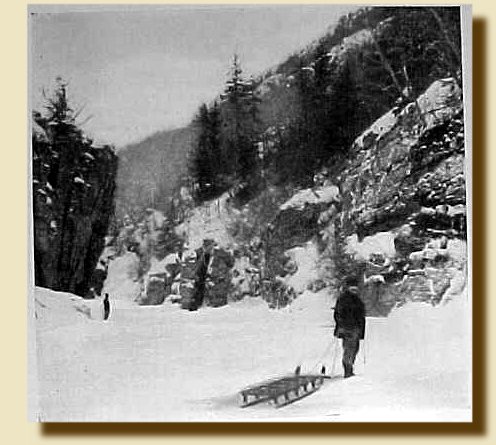
I recently found some photographs of the Dyea Trail that were taken pre-March 1898 and published in Harpers Weekly (March 12, 1898). Not much was written but here is a small sample.

"HOW THE TRAILS LOOK TO-DAY"
"The reading public is familiar with the difficulties which the van of the army of men now seeking fortune in the new gold-fields of the North met upon the trails of Skaguay and Dyea, on their way from the sea-coast to the head-waters of the Yukon River. Improvements have been in progress on these trails, and the on-coming crowds will fare much better than did the pioneers. Although the trails now lie buried in snow, and the men who are crossing are fighting a rigorous winter, yet transportation of freight is an easier matter than ever before...".

(Click images to enlarge)


.

Edwin Gaylord - partner of "Big Ed" Chase


Our friends, Craig and Scott Johnson over at the Blonger Bros. website had a special visitor back in July. Oby Tolman, whose daughter-in-law is descended from Edwin Gaylord contacted the Johnson's. I obtained Mr. Tolman's email address and write him but never received a response, which is sad as Gaylord was  connected to Soapy. I know at least one document has his name on it.

One of Jeff’s notebooks shows Ed Chase’s name with the amount of $125. Other names appear in the same column, such as that of Ed Gaylord with the amount of $150, but it is not clear whether the money was being paid out or taken in. —Alias Soapy Smith.


Craig Johnson posted the following on their site.

7/3/2010   Edwin Gaylord
Just had a most interesting exchange with Oby Tolman, whose daughter-in-law is descended from Edwin Gaylord.
Gaylord might be familiar to close readers of this site as the long-time partner, both in the gambling and bunco businesses, of Denver's gambling king, "Big Ed" Chase. According to Oby, Gaylord was a barkeep, then a cashier, then a proprietor of Chase's Palace Theatre. In 1889-1890, Edwin was manager of the Colorado Policy Association, a position also notably held by Chase. Lou was said to have numerous such shops at the time.
Chase and Gaylord were married to sisters, Frances Minerva Barbour and Adah S. "Addie" Barbour. Addie was an actress.
The relationship between Chase, Gaylord and the Blongers was a rocky one. It's safe to assume that as Tenderloin proprietors they had much in common — common goals, common friends and common enemies, with many opportunities to stand shoulder-to-shoulder — but in the end the Denver Underworld could only have one master. For this position, there were three competitors in the 1890s: Chase-Gaylord, the Soap gang, and the Blonger Bros.
Chase was the old man, a Denver pioneer and pillar of society, head of the City Hall gang, ruler of the gambling houses, saloons and precincts. Upstart Soapy Smith and his brother Bascomb came to prominence in the early '90s, sharing the stage with Chase through several political scandals on the strength of their gambling establishments, the work of their many short con minions, and their burgeoning political influence.
Coming from behind were Sam and Lou, who finally settled in Denver around 1889, but who immediately gave the others a run for their money, establishing a fairly long succession of saloons, gambling rooms and policy shops. Bunco men under the Blonger sway proliferated, and the brothers did what they could to elect friendly politicians. Finally, in 1895, the winds of change gained in strength.
In April of 1895 Soapy and Bascomb Smith made a commotion at 1644 Larimer Street after roughing up the chief of police down the street. Lou was reportedly behind the cigar counter with a double-barreled shotgun. Bascomb Smith was arrested for assaulting bartender Johnny Hughes, and ended up serving a year.
October 17, the Rocky Mountain News described the Chase and Blonger gangs, their influence over municipal officials, some of the current gang members, and their methods.
November 1, gambling is declared open again after the City Hall War and the Crackdown of 1894. On the 11th the RMN insinuates Lou's men may have been paying voters at the polls simply to help Lou win his bets on Webb for sheriff.
On November 15 Sam is arrested, along with May Bigelow of the notorious California Gang — female pickpockets and blackmailers. Lou is their ever-ready bail bondsman.
Sam stands accused of obtaining stolen goods. Smith's men Bowers and Jackson had fleeced S.W. Wolcott of a $600 check, which went to Bascomb, who took it to Sam, who directed him to a cooperative bank teller for cashing — and took twenty bucks for his trouble.
November 18, Bascomb Smith writes a letter to his brother, Soapy Smith, from the county jail, mentioning Sam's predicament and that the DA was pressuring him to testify against Sam.
December 9, Walter Farragher loses over $1000 to some Denver con men. The next day a number of Chase and Gaylord's men, including former Smith man Jackson, are arrested in connection with the incident, but they claim they are in custody to make the guilty party impossible to identify — because the Blonger gang was actually responsible, and the city detectives were assisting Lou. Farragher is in hiding.
The Chase-Gaylord gang is dead sore on the Blonger crowd, and the soreness is intensified now that they have been arrested for an offense from the proceeds of which they have made nothing.
December 12, Ed Chase flexes his muscle and Sam is arrested again, this time to pressure him into ratting out the perpetrators of the Farragher swindle.
Come the 14th, and W. H. Carson is in jail over the Farragher incident, at $3000 bail. Also arrested is Owen Snider. Carson's attorney, fellow Forest Queen owner and assistant district attorney Neil Dennison successfully argues to Justice Cowell that the charge was in fact a misdeanor, not a felony, with a maximum fine of $100 or thirty days. Lou is ready with bail, but a new felony warrant is issued and Carson re-arrested. Lou posts the $2500 bail.
On the 16th the RMN finds Farragher sequestered in a hotel room by Chief Goulding. He expresses fear of the gang, and states he'd be happy with half his money back.
December 21, Farragher has skipped town, and the case against Sam falls apart.
January 27, Sam goes to court over the Wolcott swindle. Despite Bascomb's testimony, solicited by the DA in return for his freedom and a job on the force, the charges are easily overcome. Bascomb accuses the DA of welching.
It would seem that the whole affair gives Sam and pause, and he seems to retreat into the world of horse racing after this. He is rarely heard from again until his death in 1914.
Early in 1896, unable to resolve the legal cloud left by his assault on Johnny Hughes, Soapy Smith leaves Colorado for good. The Blongers' influence — even at the expense of heavy-hitters Chase, Gaylord and Smith — seems to be on the rise. A few years later, with gambling now outlawed for good, Ed Chase transitions into real estate. He finally dies in California about the same time as Lou, in 1924.
With the new century, Lou, now out of the legal gambling business, turns increasingly to the development of the big store con for which his gang would become so famous. What's more his influence over Denver's city hall, police and courts seems nearly complete, and for the next twenty-five years he will grow very wealthy posing as a kindly landowner, without losing a single soul to the penitentiary.

This exchange with Oby has also led me to make a connection we had previously overlooked. Gaylord, as it happens, took a lease on the Blonger's Forest Queen mine, working it from 1915 until his death in 1923, as is evidenced by Lou's letters to partner O.W. Jackson and his widow.
In fact, Gaylord was in charge when a wealthy new vein was discovered just two days after Lou's arrest.
Looks like it's time for the first new inductee to the Grafters Club in quite a while! It does raise the question anew, however; Should Chase, Soapy Smith, and Bascomb, be full members — or on the blacklist? Sometimes it's a fine line...

For the record, curiously, it also appears Edwin rode a gelding named The Abbot to glory, as reported in the NY Times. On September 25, 1900, one Edwin Gaylord of Denver rode the pacer to a new world's record in the mile at 2:03¼ at Terre Haute, Indiana.

-CJ


And more...


7/5/2010   Vaso Chucovitch
More from Oby. He sent along the text of an article on Mayor Speer and Ed Chase, which says of Chase, in part:
One of Chase's gambling and saloon business associates, Vaso Chucovitch, had replaced him as underworld czar before the gambler cashed in his chips. A hefty, red-mustachioed Slav, Chucovitch had courted Speer and taken Chase's place as the broker between the bars and the boss.
Serb Chucovitch has been noted in these pages just once before, in 2006, in reference to a Denver Post article on Denver's Smaldone crime family:
The Smaldones weren't the city's first crime syndicate, not by a long shot. At the end of the 19th century, Vaso Chucovich and his partner, "Big Ed" Chase, ran gambling, saloons and the rackets in the city's lower precincts.
They were succeeded by Lou Blonger, one of the most colorful characters in the city's history. Blonger's game was bunco and stock swindles. His gang lurked near Union Station, picking off "marks" as they stepped off trains and steering them to phony stock-market offices downtown.
Vaso, who on his death in the Thirties left a hefty sum to pay for a memorial to Speer, deserves a closer look...
-CJ


Edwin Gaylord: page 102.


.

September 2, 2010

Great old west gambling video


Our friend, Gary over at Old West History Net has this great YouTube video made by the High Desert Museum on old west gambling that I thought was very well made. There are some neat old-timey film scenes and demonstrations of gaffing (cheating) card equipment, including a card trimmer, corner rounder and a wrist holdout. One mistake that stood out for me was the misleading mention of three-card monte as a seemingly honest game played in gaming houses. I really enjoyed this video and though some of you might as well.

Gary also had a few paragraphs from Charles Jay:


There was nothing conservative about a lot of what went on in the old West - the "Wild Wild West," if you will. This was a time when land was settled and claimed, leading to brand new communities springing up everywhere, and for recreation's sake, a hunger persisted for the kind of "vices" that haven't changed to this day, namely gambling and boozing. If you were at a settlement, old or new, you usually didn't have to look far for whiskey or "female entertainment," not to mention a roulette, craps, Blackjack or poker game.

Gambling was not necessarily an "industry," per se, but something that was set up on an ad hoc basis, and often there were entrepreneurial types who made sure there was a steady supply, and saloons offered games as an amenity. There were also stand-alone structures dedicated to gambling; that's how popular the activity was.

And who was going to stop them? During this wave, gambling was either not outside the law or in a "gray area" that was not necessarily governed, and certainly not regulated. Some of the most colorful gambling stories in history come out of this era, not the least of which was the poker game in Deadwood, South Dakota in 1876, where Wild Bill Hickok, who had his back to the door of a saloon (breaking his own cardinal rule) was shot dead for reasons that are not fully resolved to this day. He was holding a hand of Aces and eights, which has since become known as the "Dead Man's Hand" (although the origin of this has been disputed as well).

The game of blackjack may have originated as "Vingt-et-un" in Europe, but in the United States, it exploded in the old West, and a legendary practitioner took the game over with her from France. One of the card sharps who moved from one camp to another in the old West was Elanore Dumont, known to many as "Madame Mustache," who made much of her living off blackjack winnings, the result, mostly, of dealing and banking the game herself. She won graciously, often giving out champagne to the losing blackjack players. She traveled a great deal, setting up shop in such outposts as Nevada City, CA, Helena, MT, Salmon, ID, Virginia City, NV and others.

One of the things that led to the expansion of gambling to the West was obviously the California gold rush. At one point the San Francisco area was the center for gambling activity, and it then spread to other areas of California and Nevada. Obviously there is a "get rich quick" element to the gambling culture, and a lot of the fortune seekers who came west were veterans of the games on riverboats that sailed up and down the Mississippi River. They brought games with them, notably craps, which might not have been the most popular game in the old West, but became a lot more consumer-friendly when John H. Winn developed new bets such as the "Don't Pass" line.

San Francisco, which was the predominant metropolis in the Golden State, was also the home to many opulent gambling dens, no less extravagant than those that might be found aboard riverboats or at Richard Canfield's establishments in New York. At those venues the game of roulette, of European origin and still largely identified by many with the upper crust, found a foothold. The introduction of this game to the West also brought it into the saloons and other "sawdust" joints, as it involved the element of chance and offered a sizable payoff for straight number bets.

Arguably the most popular game in the old West was not roulette, nor craps, not blackjack, and perhaps not even poker. No, the game that may have caught on strongest was Faro, which was simple, fast-paced, and offered the chance to put an entire stake on the turn of a single card. The game still exists, but not much in the "new" West. It has been replaced by others, not the least of which is the game that is considered to be its direct descendant, baccarat!


.

William Clark Fonda

(Click image to enlarge)
The Prospector
Statue in front of the Alaska Pioneer Home, Sitka

Our friend Marlene over at the Skagway Historical Society blog posted the following story.

William Clark Fonda arrived on the steamer Alki in 1896. He was the one who broke ground for White Pass on October 18, 1897 and he then worked for White Pass as a laborer and was later on the famous "Committee of 101".

He is the model for the statue in front of the Pioneer's home in Sitka which opened in 1913. He sent letters home from 1896-1909.

Skagway Bill was born in 1858 in Glen, New York and died on this day, September 1, 1938 in Olympia, Washington.

fonda.org; Pennington page 350.

Although my book focuses on the verbal leaders of the vigilante committee of 101 as power hungry peers of the Soap Gang, it is obvious that not all of them were bad man bent only on gaining power for their own purposes and or profit.


.

September 1, 2010

Reprints of The End of Soapy Smith painting


Reprints of The End of Soapy Smith by Andy Thomas are now available by contacting Mr. Thomas.

Prices are as follows:
22 x 28 Giclee on paper reproduction $150

30 x 40 Giclee on Canvas reproduction $629

*Plus shipping or sales tax within Missouri.

I own the 30 x 40 Giclee on Canvas reproduction and it is absolutely magnificent!


.