August 5, 2023

Soapy Smith's "STAR" notebook, 1882-83: Part #4 - page 4

Soapy Smith's "star" notebook
page 4 - original
1882-1883
Courtesy of Geri Murphy

(Click image to enlarge)


THIS POST UPDATED
August 24, 2023


OAPY SMITH'S "STAR" NOTEBOOK

Part #4 - page 4

     This is part #4 - page 4, the continuation of deciphering Soapy Smith's "star" notebook from the Geri Murphy's collection.
A complete introduction to this notebook can be seen on page 1.
     The notebook is in Soapy's handwriting, and sometimes pretty hard to decipher. The goal is to transcribe the pages, receiving help from readers to identify words I am having trouble with. Included is the original copy of each page, an enhanced copy, a copy in the negative, and a deciphered copy, as tools to aid in translating the notebook. There are 24 pages and this means that there may be upwards of 24 individual posts for this one notebook. Links to the pages can be viewed at the bottom of the post for ease of research. When completed there will be a sourced partial record of Soapy's activities and whereabouts for 1882-1883.
     Important to note that the pages of the notebook do not appear to be in chronological order, with Soapy making additional notes on a town and topic several pages later.


Soapy Smith's "star" notebook
page 4 - enhanced
1882-1883
Courtesy of Geri Murphy


(Click image to enlarge)


Soapy Smith's "star" notebook
page 4 - negative
1882-1883
Courtesy of Geri Murphy


(Click image to enlarge)


Here is what I believe to be the correct deciphering of the text. Do you agree, or do you see something else? There are some words I have not yet been able to decipher. Do you know what jam races are? Could they be kin to the "jam auction?" All comments, suggestions and ideas are welcome! I will update the new information to this post.

Soapy Smith's "star" notebook
page 4 - deciphered
1882-1883
Courtesy of Geri Murphy

(Click image to enlarge)


Rear of page 3 (top).
  • Line 1: "Oh SuSana don't you"
  • Line 2: "grieve for me"
  • Line 3: "I am going away to"
  • Line 4: "love you"
  • Line 5: "Oh I love that gal"
  • Line 6: "away out west"
  • Line 7: "white folks call"
  • Line 8: "Susanhah"
  • Line 9: "Old Man Cares"
  • Line 10: "he uses snuff tho"
  • Line 11: "factory gals they"
  • Line 12: "ask him roughly"
Interpretation: According to Soapy and his cousin Edwin B. Smith, Soapy played a banjo and sang songs when he was a "cheap John" (kin to a "jam auction") in Round Rock, Texas. It appears that Soapy was inventing his own lyrics. Could the date of this note be an earlier one, 1877-78 when he was still in Texas? Or perhaps Soapy was still playing the banjo?
 
Page 4 (bottom).
  • Line 1: "Hillsboro 1st Sept" [Oregon]
  • Line 2: "McMinnville 2" [Oregon]
  • Line 3: "Independence 4 Sept" [Oregon]
  • Line 4: "Corvallis 5" [Oregon]
  • Line 5: "Albany 6 or 7th" [Oregon]
  • Line 6: "25 gross [thuans? or thuars?] 5.00 125.00"
  • Line 7: "1 O'Leary belt wheel 100.00"
  • Line 8: "2 gross whistles 5.00 10.00"
  • Line 9: "1 Hap Hazzard 15.00"
  • Line 10: "W. A. Ergennan [Eungennan?]"
  • Line 11: "Brighton Beach" [Oregon]
  • Line 12: "race course"
  • Line 13: "New Orleans"
  • Line 14: "Jam races"
  • Line 15: "Mobile Memphis" [Tennessee]
  • Line 16: "Nashville" [Tennessee]
    Interpretation: I believe the year is 1882, but it could also possibly be as early as 1877-78. In those early Texas days he talks of singing songs and playing a banjo. Soapy is traveling through Oregon and purchases an O'Leary gambling belt wheel [gaffed] and some small cheap prizes, the larger primary prizes are cash. People pay to play, in hopes of winning a large cash prize, but only win small junk. Gambling and Gambling Devices by John P. Quinn, 1912. Thanks and credit go to my friend Pete Angelos  for information on the O'Leary Belt Wheel!
         The "O'Leary Belt wheel" that Soapy purchased for $100 is described in the book, Gambling and Gambling Devices by John P. Quinn, 1912 (courtesy of Pete Angelos).
    Like the other swindling devices herein described, the mechanism of this contrivance is easily operated, and, when explained, readily comprehended. It is, however, what is called, in the slang of the street, "a sure winner" for the manipulator. Thousands of dollars have been won through its operation in a single day, and one used on the streets of Cincinnati won $125,000 in six months.

    The O'leary Belt [Wheel]
    Gambling and Gambling Devices
    by John P. Quinn, 1912
    Courtesy of Pete Angelos

     In Order to work it successfully, it is indispensable that the top of the machine be raised high enough above the heads of the surrounding crowd to prevent the bystanders from seeing the interior, inasmuch as such a view would disclose the apparatus by means of which they would be robbed of their money. With this end in view. the operator generally operates it from a buggy, the upper part of the machine standing about three feet above the floor of the conveyance.
     As will be seen in the cut [picture], the device consists of a hoop-wheel, a supporting rod and a box platform, supporting the rod and wheel. The apparatus may be taken apart and neatly placed in this box. On the box is placed a valise containing money. The wheel, or "belt," is made of brass, and is about sixteen inches in diameter and four inches broad. It contains thirty-two compartments, each one containing a card, which is held in position by a small fold of metal on each of three sides. These cards may be perfectly blank, though usually they contain pictures of famous celebrities. The valise, which is shown in the illustration at the foot of the upright rod, contains money. Inside the metal hoop is a leather belt, of which, at equal distances, are pained numbers representing sums of money, so arranged that one will fall behind each alternate compartment. When the cards are raised, the belt is seen through a rectangular opening at the back.
     The driver of the buggy carries a number of whips. As soon as a crowd has gathered around him (which is certain to happen in a very few moments), he informs the spectators that any one or more may, for $1.00, purchase a chance to win a money prize, varying in amounts from $1.00 to $20.00. Some one having expressed an inclination to buy, the proprietor takes his money and hands him a whip, with which to point to any one of the thirty-two sections of the "hoop" which he may select. The purchaser having rested the whip on a compartment, the operator removes the cards which he has touched. Underneath is shown either a blank space on the belt or one inscribed with a certain sum. If it happens to be the latter, the buyer is given the amount indicated; if the former, he receives nothing.
     The name of this device is supposed to be the same as that of the inventor. A well-known confidence operator by the name of O'Leary flourished some years ago, who was recognized among his companions as an expert manipulator of this apparatus, and it is generally believed among the guild of peripatetic gamesters that the idea of its construction was conceived in his fertile brain, through the direct inspiration of the antipodes of Providence.
Pete Angelos also found some information on the "Hap Hazzard," which is correctly spelled with one z in the 1896 Will and Finck catalog listing it, and also calling it the coffee pot or bee hive.
 
Hap Hazard [Bee Hive]
Gambling and Gambling Devices
by John P. Quinn, 1912
Courtesy of Pete Angelos

     The accompanying illustration gives an excellent idea of the general appearance of this device. It consists of two cones, the inner one of which is placed upon circular pieces of wood, around the rim of which are thirty-two compartments, numbered from one to thirty-two, and separated by thin metal plates. Driven into the surface of the inner cone are small nails or metal pegs, the arrangement of which is a matter of comparative indifference, although they are usually rather close together and approximately equi-distant. The outer cone serves as a cap or case.
     An unsophisticated player can never win except through the consent of the operator. In order to encourage the crowd in playing, “cappers” have to be employed, who are always on hand to draw prizes.
     The ball is in sight from start to finish, so that while the player can see the play and know just where the ball stops, it is impossible to detect the secret working of the machine.
     This machine is specially made to catch “suckers” and is full of honey, but the “suckers” don’t get any of the honey; they are lucky to get a piece of beeswax.
“The little bee sucks the blossom.
The big bee gets the honey,
The sucker does the work,
And the gambler takes the money.”
 
 
O'Leary Belt and Hap Hazard
Will and Finck catalogue
1896
Courtesy of Pete Angelos


Special thanks to Art Petersen and Pete Angelos
for their skills in deciphering and historical research.


April 24, 2017
Part #1
Part #2

Part #3

Part #5 
Part #6
Part #7

Part #8
Part #9

Part #10
Part #11

Part #12
Part #13

Part #14
Part #15

Part #16



"There's opportunity in poker.... If Horace Greeley were alive today, his advice wouldn't be 'Go West, young man, and grow up with the country.' Instead, he'd point to that deck of cards on table and say, 'Shuffle up and deal.'"
—Lou Krieger


July 29, 2023

Soapy Smith's "STAR" notebook, 1882-83: Part #3 - page 3

Soapy Smith's "star" notebook
page 3 - original
1882-1883
Courtesy of Geri Murphy

(Click image to enlarge)


THIS POST UPDATED
August 23, 2023


OAPY SMITH'S "STAR" NOTEBOOK

Part #3 - page 3

     This is part #3 - page 3 continuation of deciphering Soapy Smith's "star" notebook in Geri Murphy's collection.
A complete introduction to this notebook can be seen on page 1.
     The notebook is in Soapy's handwriting, and parts have been hard to decipher. The goal is to transcribe the pages and receive help from readers on identifying words I am having trouble with. I am including the original copy of each page, an enhanced copy, a negative copy, and the deciphered copy, as tools to aid in translating and interpreting the notes. There are 24 pages meaning that there may be upwards of 24 individual posts for this one notebook. Links to all of the pages can be viewed at the bottom of this post for ease of research. When completed there will be a sourced record of Soapy's activities and whereabouts for periods in 1882-1883.
     Important to note that the pages of the notebook do not appear to be in chronological order, with Soapy making additional notes on a town and topic several pages later.


Soapy Smith's "star" notebook
page 3 - enhanced
1882-1883
Courtesy of Geri Murphy

(Click image to enlarge)


Soapy Smith's "star" notebook
page 3 - negative
1882-1883
Courtesy of Geri Murphy

(Click image to enlarge)


Here is what I believe to be the correct deciphering of the text. Do you agree, or do you see something else? There are some words I have not yet been able to decipher. Please take a look and see if you can figure out them out? All comments, suggestions and ideas are welcome! I will update the new information to this post.


Soapy Smith's "star" notebook
page 3 - deciphered
1882-1883
Courtesy of Geri Murphy


(Click image to enlarge)


Page 3.

  • Line 1: "First your Business"
  • Line 2: "and manner of"
  • Line 3: "Conducting it"
  • Line 4: "2d [2nd] Zuni Gold and Indians"
  • Line 5: "Its origin and"
  • Line 6: "first discovery."
  • Line 7: "The tests by the"
  • Line 8: "Government chemist ? ? record"
  • Line 9: "Its usefullness [sic]"
  • Line 10: "as armaments"
  • Line 11: "and worthlessness"
  • Line 12: "as money Rail Roads"
  • Line 13: "in old Mexico"
  • Line 14: "only difference in"
  • Line 15: "weight"
  • Line 16: "James E Readan Mfg Co."
  • Line 17: "Providence, RI [Rhode Island]"
  • Interpretation: I believe the year is 1882. Soapy was known for writing stories and poems, several of which were published.
         "Zuni" are a tribe of Indians famous for artistic metal work.
         Is Soapy copying words of wisdom from another individual, or are these his words for others?
         In regards to the "James E Readan Mfg Co.," Soapy might have come across some piece of equipment he wanted to acquire and had written down the name of the manufacturer for later reference.


"I've often thought, if I got really hungry for a good milk shake, how much would I pay for one? People will pay a hundred dollars for a bottle of wine; to me that's not worth it. But I'm not going to say it is foolish or wrong to spend that kind of money, if that's what you want. So if a guy wants to bet twenty or thirty thousand dollars in a poker game, that is his privilege."

―Jack Binion


July 28, 2023

Soapy Smith's "STAR" notebook, 1882-83: Part #2 - page 2

Soapy Smith's "star" notebook
page 2 - original
1882
Courtesy of Geri Murphy

(Click image to enlarge)


THIS POST UPDATED
August 23, 2023


OAPY SMITH'S "STAR" NOTEBOOK
Part #2 - page 2

     This is part 2 - page 2 continuation of deciphering Soapy Smith's "star" notebook in Geri Murphy's collection.
A complete introduction to this notebook can be seen on page 1.

     The notebook(s) are in Soapy's handwriting, and often times hard to decipher. The goal is to transcribe the pages and receive help from readers on identifying words I am having trouble with. I will include the original copy of the page, an enhanced copy, a copy in negative, and then one with my deciphering, as tools to aid in deciphering the notes. There are 24 pages which means that there may be upwards of 24 individual posts for this notebook. Links to all the pages will be added at the bottom of each post for ease of research. When completed there will be a sourced record of Soapy's activities and whereabouts for portions of 1882-1883.
     Unlike page 1 this page has text written on the back of page 1, which is seen when page 1 is turned to page 2. As with page 1, we can see the pencil "staining" sediment from resting on-top of the writings on the bottom page. The deciphering will be separated into two sections ["rear of page #_ (top")] and ["page #_ (bottom)]."
     Important to note that the pages of the notebook do not appear to be in chronological order, with Soapy making additional notes on a town and topic several pages later.


Soapy Smith's "star" notebook
page 2 - enhanced
1882
Courtesy of Geri Murphy

 (Click image to enlarge)


Soapy Smith's "star" notebook
page 2 - negative
1882
Courtesy of Geri Murphy

(Click image to enlarge)
 
 
     Here is what I believe to be the correct deciphering of the text. Do you agree, or do you see something else? All comments, suggestions and ideas are welcome! I will update the new information to this post.


Soapy Smith's "star" notebook
page 2 - deciphered
1882
Courtesy of Geri Murphy

(Click image to enlarge)

Rear of page 1 (top).
  • Line 1: "Tournament"
  • Line 2: "Hollister Cal" [California].
  • Line 3: "Oct 23 + 24th"
Interpretation: These are planning notes. Soapy made plans and then later (in this case on page 5) he wrote the actual dates he was in the location as well as the amounts he made. He had initially planned to be in Hollister, California, on October 23-24, but he writes on page 5 that he was there October 22-23, "2 days work" and making $235.00. The year, determined on page 5, is 1882. The remainder of markings on this top portion is pencil residue from the bottom portion.

Page 2 (bottom).

  • Line 1: "Sherman Circus"
  • Line 2: "Moscow 15th" [Idaho Territory]
  • Line 3: "Colfax 16th" [Washington Territory]
  • Line 4: "Palouse 17" [Washington Terr.]
  • Line 5: "Farmington 18" [Washington Terr.]
  • Line 6: "Spangle 19" [Washington Terr.]
  • Line 7: "Spokane 21st" [Washington Terr.]
  • Line 8: "Sprague 23d" [Washington Terr.]
  • Line 9: "Dalles 25 + 26th" [Dalles City, Oregon]
  • Line 10: "Vancouver 28th" [Washington Terr.]
  • Line 11: "Oregon City 29th" [Oregon]
  • Line 12: "John Taylor" [Soapy's mentor?]
  • Line 13: "216 Wharton St"
  • Line 14: "Phila. Pa." [Philadelphia, Pennsylvania]
  • Interpretation: The month is probably October of 1882. Soapy planned to follow the Sherman Circus spanning through Idaho Territory, Washington Territory and Oregon, but at some point crossed out everything except for "John Taylor" and his address. This is most likely Soapy's mentor talked about in my book, Alias Soapy Smith: The Life and Death of a Scoundrel. These are planning notes. Did he go? There are no other mentions of these plans elsewhere in the notebook.
         All I could find online about the "Sherman Circus" was the newspaper ad below, and a mention that “Educated horses were a highlight of the Sherman Circus, which appeared in San Diego, California in 1881 and 1883."

Great Sherman Circus
The Oregonian
September 12, 1882


April 24, 2017
Part #1

Part #3

Part #4
Part #5 

Part #6
Part #7

Part #8
Part #9

Part #10
Part #11

Part #12
Part #13


Old card players never die, they just shuffle away.
~Author Unknown


July 24, 2023

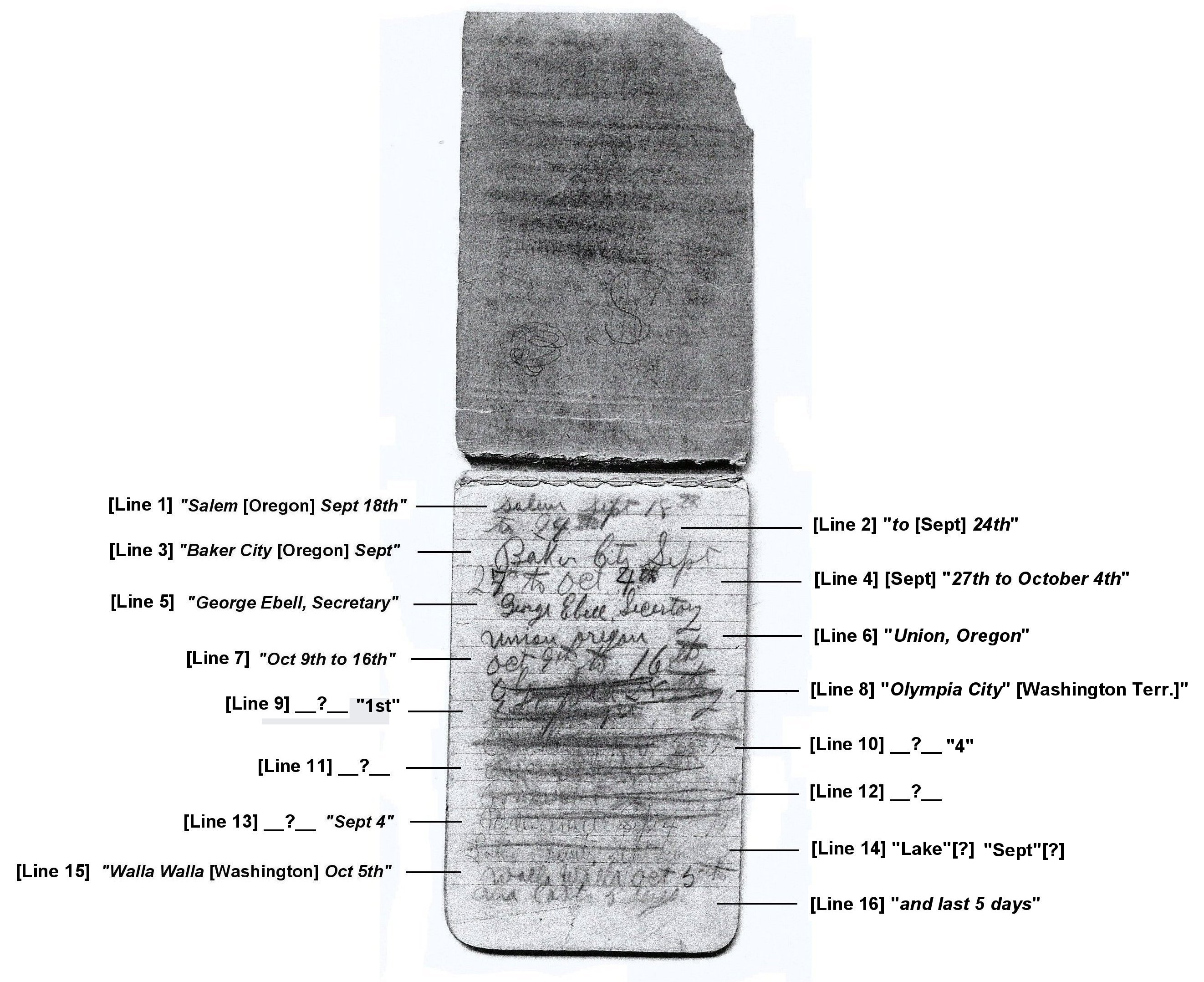
Soapy Smith's "STAR" notebook, 1882-83: Part #1 - page 1

Soapy Smith's "star" notebook
1882-1883
Courtesy of the Geri Murphy collection

(Click image to enlarge)


THIS POST UPDATED
August 23, 2023


OAPY SMITH'S "STAR" NOTEBOOK


     There are several notebooks in the Smith family collection in which Jefferson Randolph Smith II kept personal and business jottings. This one was shared to me by my cousin, Geri Murphy. Naturally, these are a treasure-trove of information as to what city and state (or territory) he was traveling to, the date, his profits, expenditures and the names of some of the individuals he met, while operating his prize package soap sell racket and other bunko games.
     This notebook is identified by the large star on the cover, hence the name "star" notebook. It spans the years 1882 and 1883, when Soapy was still a nomad confidence man traveling around the American West.  
     The notebook pages are written in pencil, in Soapy's handwriting, and sometimes hard to decipher. The goal is to transcribe the pages and to receive help from readers in identifying words I am have trouble reading. I will include the original copy of each page, an enhanced copy, and a copy in negative, as tools to aid with deciphering the notes. There are 24 pages which means that there will be 24 individual posts for this one notebook. Links to the next page will be added at the bottom of each post for ease of research. When completed there will be a sourced record of Soapy's activities for parts of 1882-1883.
     Important to note that the pages of the notebook do not appear to be in chronological order, with Soapy making additional notes on a town and topic several pages later.

"star" notebook cover
1882-1883
Courtesy of the Geri Murphy collection

(Click image to enlarge)


     Let's begin. Note that the top appears to have faint text. A pencil was used in the notebook and throughout the notebook he periodically wrote on the rear of the previous page, as well as on the front of each page. The deciphering will be separated into two sections ["rear of page #_ (top")] when utilized, and ["page #_ (bottom)]." 
     What is seen on the back of the cover is pencil sediment or residue "stain" from the pages resting on-top of one another. There appears to be a dollar sign ($) and some artwork that appears to be two fancy letters, perhaps "JS." Was Soapy playing around making a fancy abbreviation to his name? 
     The next three pictures are page #1: Enhanced, page #1: Negative, and page #1: deciphered. These were made to aid in deciphering the text, and this process will be used in the next 23 pages to come.


Page #1
Enhanced
Courtesy of the Geri Murphy collection

(Click image to enlarge)


Page #1
Negative
Courtesy of the Geri Murphy collection

(Click image to enlarge)


Soapy Smith's "star" notebook
Page 1 - deciphered
1882

Courtesy of Geri Murphy

Click image to enlarge

     Here is what I believe to be the correct deciphering of the text. Do you agree, or do you see something else? All comments, suggestions and ideas are welcome! I will update the new information to this post.

  • Line 1: "Salem [Oregon] Sept 18th"
  • Line 2: "to [Sept] 24th"
Interpretation: These are planning notes. Soapy made plans and then later (in this case on page 5) he wrote the actual dates he was in the location as well as the amounts he made. He had initially planned to be in Salem, Oregon, from September 18 to September 24, but actually operated from September 18 to September 22. the year is 1882, which was determined on page 5.
  • Line 3: "Baker City [Oregon] Sept"
  • Line 4: "27th to Oct 4th"
Interpretation: Though Baker City, Oregon, from September 27 to October 4 is listed, it does not appear in the notebook again. I found no city or county fair in 1882, it may be that Soapy decided to skip Baker City, or upon arrival he did no work.
  • Line 5: "George Ebell, Secretary" [Maybe a fair or city secretary that Soapy met? Online and newspaper search came up with only one reference to a "George Ebell" in regards to water rights in an ongoing court case since 1888.]
  • Line 6: "Union, Oregon"
  • Line 7: "Oct 9th to 16th"
Interpretation: Soapy lists Union, Oregon, as a possible stop. The County of Union did have a fair, but "Union, Oregon is not mentioned again in the notebook, thus it is unknown if Soapy stopped or operated there.
  • Line 8: Appears to be "Olympia City" [Washington Territory]. I cannot read this clearly as Soapy scratched it out. Page 5 does not list "Olympia," but page 8 does. It is not known if he went there. He may have scratched it out as a planned stop.
  • Line 9: [Scratched out] Do I see "1st" on the far right end?
  • Line 10: [Scratched out] I see a "4" on the far right end.
  • Line 11: [Scratched out] Can't decipher.
  • Line 12: [Scratched out] Can't decipher.
  • Line 13: [Scratched out] There is a town name "[Wilsonville? Milwaukie? Winston? Willamina? Williamette?]. Looks like "Sept 4" on the right.
  • Line 14: [Scratched out] "L?" Perhaps "Lake?" [can't decipher the rest, maybe "Falls City?"] I see "Sept" at the end.
  • Line 15:  "Walla Walla [Washington Territory] Oct 5th"
  • Line 16: "and last 5 days" [?]


April 24, 2017
Part #2

Part #3

Part #4
Part #5

Part #6
Part #7

Part #8
Part #9

Part #10
Part #11

Part #12
Part #13

Part #14
Part #15

Part #16


"...but in my humble opinion, I'm no hustler. You see, neighbor, I never go looking for a sucker. I look for a champion and make a sucker out of him."
—Amarillo Slim


July 6, 2023

Soapy Smith shoots up 14th and Glenarm streets in Denver, 1894.


he colonel swore he thought the cartridges were blanks and went laughingly on his way.

      An unknown Denver newspaper, dated "July 1893," clipped out and saved by Soapy Smith himself. This comes from my cousin, Jefferson R. “Little Randy” Smith collection.

WAS SURGEON’S DAY

The Red Fire Cracker Cut Many Red Tricks.

KEPT THINGS GOING WARMLY

Disasters Began Long Before the Fourth Dawned Luridly.

NUMEROUS SERIOUS ACCIDENTS

Colonel Jefferson Randolph Smith Turned Loose for Old Glory at 1 O’Clock A. M. —An Acrobat From Illinois Was Next Heard From—A Plumber at the Gumry and a Boy on Blake Street Patched Up by the Surgeon—The Worst Accident of the Day Happened at Rocky Mountain Lake—A Seven-Year-Old Boy Shot—Cannon, Crackers, Pistols, Explosives of All Description Get in Their Work.

      It was surgeon’s day at police headquarters. Unreliable toy cannons, stray bullets, erratic powder crackers, the booze of patriotism and other things incidental to a proper celebration of “The Fourth” furnished cases in plenty to Drs. Mack and Jarecki. The nation’s birthday anniversary began prematurely, so far as casualties marked it, by the sad death of John D. Mannix on Larimer street, soon after 10 o’clock Wednesday night. From that on the ambulance and …[sentence indecipherable]… to gather rust on their wheels and at midnight they were still making arbitraries. Not many arrests were recorded, owing to the tradition obtaining among police officials that the liberty of American citizens, particularly embryonic citizens, may verge toward license without much check on fire cracker day.
      About 1:15 o’clock a.m. notification that the [?] had been formally opened was telephoned to police headquarters from Fourteenth and Glenarm streets. It was a startling report that a man with black whiskers, a soft hat, a big revolver and a publicspirited jag, who looked like [words indecipherable] insurgent, had turned himself and his armament loose on the residents there.

It Was Only Jeff.

      An officer who went to investigate discovered that the author of the scare was Senor Colonel Jefferson Randolph Smith, amusing himself by shooting 45-caliber bullets through the windows of the Glenarm bar. The colonel swore he thought the cartridges were blanks and went laughingly on his way.

Fantasy depiction of Soapy shooting up the town
 
Apparently, Soapy was not arrested for the offense. Probably drunk, he had disturbed the peace, endangered public safety, and destroyed private property, and yet was seemingly allowed to go on his way. Did he privately recompense the owners of the Glenarm? Probably—unless Soapy thought he owed them the damage.


Shooting up Denver: page 276.


"We must never forget that we are human, and as humans we dream, and when we dream we dream of money."
—"George Lang"
played by Ricky Jay, The Spanish Prisoner