August 5, 2016

"To my old friend Soapy Smith"

Close-up of the note
courtesy of Wayne Selmer
 
(Click image to enlarge)


o my old friend Soapy Smith"


Friend, Wayne Selmer sent me the following photograph regarding a note and some flowers placed on Soapy Smith's grave. The photo is part of a scrapbook in his possession which dates back to 1940. The note reads,

"To my old friend Soapy Smith
From Muligan Gulch Bill
Butte Mont [Montana]"

      Soapy indeed had a very loyal set of friends and admirers, at least one refusing to say anything bad about him in an interview 16 years after Soapy's demise (1914). Could this be an old friend, or one time partner, associate, gang member of Soapy's? It is not an impossibility. If "Bill" was between 20-30 years old in 1898, he would be between 62-72 in 1940.
      Over the decades after Soapy's death numerous people sent money for the upkeep of the grave. It is very possible that a "Muligan Gulch Bill" did send money to grave caretaker Martin Itjen to place flowers on the grave, and Itjen made the wooden "note" capitalizing on the kind act.
      Martin Itjen, the owner and operator of the Jeff Smith's Parlor Museum and primary caretaker of Soapy's grave, is known for such theatrics and the 1940 date aligns with the height of Itjen's business. Still, the sincere sending of flowers may very well be real.
     One question remains... Who is "Muligan Gulch Bill?"


The photograph
courtesy of Wayne Selmer
 
(Click image to enlarge)


"The most infamous of his unique schemes was the prize package soap sell in which he put large-denomination bills inside the wrappers of some cakes of soap and auctioned off the packages for $1 each, then for more as the number of cakes diminished. Only Jeff’s men, who seeded every crowd, ever won the larger bills. From this swindle came the sobriquet “Soapy” by which he came to be known throughout the American West."
—Alias Soapy Smith, Introduction.


OCTOBER 9


1833: The city of Chicago, Illinois is incorporated.
1859: The 6th Infantry leads two officers and 50 enlisted against 200 Mojave Indians near Fort Mojave, New Mexico Territory. Three soldiers are wounded and about 23 Indians killed, with many wounded and captured.
1861: The federal government levies its first income tax. The tax is 3% of all incomes over $800. The wartime measure is rescinded in 1872.
1863: Sioux Indians kill 59 Pawnee Indians in Massacre Canyon, Nebraska Territory.
1864: Union forces led by Admiral David Farragut, move into Mobile Bay, Alabama during the Civil War, 1884: The cornerstone for the Statue of Liberty is laid on Bedloe's Island in New York Harbor.
1889: “The most notoriously corrupt and decrepit municipal organization in the West is that in Denver.” (Rocky Mountain News, August 5, 1889). Bad man Soapy Smith controls the criminal underworld there.


July 24, 2016

Commemorative Soapy Smith rifle

Soapy Smith and the shootout on Juneau Wharf
predominantly engraved
 
(Click image to enlarge)


OAPY SMITH - SKAGWAY HERITAGE RIFLE

Built on a Henry Big Boy .44 Magnum, the Skagway Heritage Rifle is fully-functional and is 24 karat gold-plated! Henry is one of the most trusted firearm manufacturers in the country, and American Legacy Firearms guarantees that each rifle is built to last. Only 10 will be available in the edition! Each engraving is specific to Skagway’s history.


      The artwork shows a bust of Soapy and a scene of the shootout on Juneau Wharf, using the painting by artist Andy Thomas, whom I am proud to have assisted in the historical information. It's a shame it wasn't done on the Winchester Model 1892 rifle.
      My cousin, Jay Douglas Hartzell, ordered one. I'm so jealous!

Price: $2,495.00

For more information and photographs go to American Legacy Firearms.


A favorite saying of his was, “Do unto others what they’d like to do to you, but do it first.”
—Alias Soapy Smith, Introduction.


OCTOBER 9


1847: Mormon leader Brigham Young and his followers arrive in the valley of the Great Salt Lake (Utah).
1847: Richard M. Hoe patents the rotary-type printing press.
1849: Georgetown University in Washington, DC, presents its first Doctor of Music Degree to Henry Dielman.
1858: the first weekly mail to Santa Fe, New Mexico Territory arrives from the east.
1865: Indians led by Red Cloud, Crazy Horse, Young Man Afraid, and Roman Nose, camp near Fort Casper (Wyoming) to plan their next battle.
1866: Tennessee is the first state readmitted to the Union after the Civil War.
1869: William F. Cody is “discovered” at Fort McPhearson, Nebraska by the novelist, Ned Buntline.
1886: Calvin James hangs at Fort Smith, Arkansas for the August 1, 1885 murder of Tony Love, a partner in illegal liquor sales in the Chickasaw Nation.
1890: Soap Gang members John “Reverend” Bowers and others are arrested in Denver, Colorado for operating a mock auction house, designed to sell fake gold watches to unsuspecting victims.
1895: Construction begins at Fort Constantine Yukon by the North West Mounted Police at junction of Forty-mile Creek and Yukon River. It is due to the growing number of whites and gold miners in the area, which will be home to the largest gold rush in history. This rush will draw bad man Soapy Smith north, setting up operation on the American side, at Skagway, Alaska.
1897: Black soldiers of the 25th Infantry Bicycle Corps set out on a 40-day expedition on bicycles, from Missoula, Montana to St. Louis, Missouri to demonstrate the unique means of military transportation.
1898: One-time Soap Gang member, Jeff Dunbar is shot and killed in a saloon by a bartender, Jim Davis, in Dixon, Wyoming.
1899: outlaw Sam Ketchum, brother of Thomas “Black Jack” Ketchum dies from shock due to an arm amputation in the Santa Fe, New Mexico prison. Sam was involved in the robbery of three Santa Fe Railroad trains near Folsom, New Mexico, with his brother’s gang. Sam was wounded by a posse on July 12, 1899, but nor before killing Sheriff Edward Farr and Deputy W. H. Love. Lawman Tom Smith was also killed by one of the outlaws. Sam was shot in the shoulder, but managed to escape. He hid at a ranch owned by Henry Lambert near Ute Park. Gangrene set in and Lambert was forced to amputate Sam’s arm. A few days later, Ketchum was found and taken to prison, where he died within two weeks.


June 18, 2016

Soapy Smith in Skagway, Alaska, May 1, 1898.

SOAPY SMITH'S PATRIOTIC SPEECH
JUST BEFORE SETTING BUTCHER WEYLER ABLAZE
May 1, 1898, Skagway, Alaska
The Ballad of Soapy Smith

Seattle, Washington
 
(Click image to enlarge)


y a common impulse the people turned toward the Hon. Jefferson R. Smith, more widely known as "Soapy," and made him the director-general of the event."

A reporter with the initials J. C. C.  wrote the article Spring in the Far North, dated May 3, 1898, and published in the Morning Oregonian on May 10, 1898. Following is the paragraph in regards to the May 1, 1898 parade in Skagway.

    Skagway swathed herself in tri-colored bunting last Sunday, and made the eagle scream. No sooner did she hear that our ships were blockading Havana than she decided to ratify the action of our government in ordering war against Spain and in a dozen hours she arranged and carried to its completion a demonstration that no town of 10 times her dimensions and a thousand times her age could exceed in patriotic fervor. For the nonce she buried internal dissension, raised social distinctions, and made a unit of herself in honor of the flag. By a common impulse the people turned toward the Hon. Jefferson R. Smith, more widely known as "Soapy," and made him the director-general of the event. Worthily did he meet the occasion. His military company headed a procession of citizens that paraded the principal streets and saluted Old Glory at the government offices, and an outdoor mass meeting concluded the exercises. Fully 3000 people listened to addresses by Dr. A. B. Hornsby, Walter Church, Mr. Wilcoxson, Mr. Kellar, and the indefatigable "Soapy" himself. The enthusiasm was great throughout the entire proceedings. Butcher Weyler was burned in effigy, and patriotic bonfires blazed on almost every street.

Believed to be Skagway May 1, 1898
Fifth Avenue, in front of city hall (on right)
Note: Soapy grey horse in foreground,
flags and signs.
Author's collection
 
(Click image to enlarge)

   
Portion of photograph taken on May 1, 1898
Note the two signs. Are these the same
signs shown in the other larger photograph.


Paper ribbon handed out to people on May 1, 1898.
"Skagway Alaska May 1st 1898."
Soapy wrote on this particular one
and sent it to his wife in St. Louis.
Author's collection
 
(Click image to enlarge)

Epilogue.
 
At least one author/historian has attempted to play down Soapy's involvement, planning, and speaking role during the May 1st celebration, implying that the stories were mostly myths and legends added to over the passing decades. The newspaper clipping above is one of several witnessed accounts written and published days after the event. Unless all of them got together and agreed on the telling of their stories, there can be little doubt that [1] this event took place on Decoration Day (May 1, 1898). [2] Soapy Smith, at the very least had a big hand in planning the celebration. [3] That Soapy did indeed speak on the speakers platform along with the noted speakers of the town.


May 31, 2016, April 1, 2010.


Decoration Day (May 1, 1898): pages 500-502.


"This boy will be a millionaire; there’s only one Jeff."
— Edwin B. Smith
(speaking of Soapy)


JUNE 18


1621: The first duel in America takes place in the Plymouth Colony of Massachusetts. 
1778: Britain evacuates Philadelphia, Pennsylvania during the American Revolution.
1812: The War of 1812 starts as the U.S. declares war against Great Britain. The conflict is blamed on trade restrictions.
1858: Con man William B. “Lucky Bill” Thornton is hanged by vigilantes for the murder of Henry Gordier in Carson County, Nevada.
1861: The first U.S. fly-casting tournament is held in Utica, New York.
1864: Cheyenne and Arapahos Indians are believed to have massacred a family, 25 miles west of Denver, Colorado Territory.
1873: Susan B. Anthony is fined $100 for attempting to vote during the presidential election.
1878: During the Lincoln County War, New Mexico Territory, Alexander McSween and his men head for the hills of San Patrico, just missing Sheriff Peppin and U.S. soldiers who are trying to catch him.
1879: Arizona's first ice plant opens in Phoenix, Arizona Territory.
1880: John Sutter, on whose property gold was found in California in 1848, dies penniless at the age of 77 in Pennsylvania.
1898: Atlantic City, New Jersey opens its Steel Pier.


June 16, 2016

Tom Cady rules over Dyea, Alaska

"Troublesome Tom" P. Cady
Denver Post, March 3, 1902
 
(Click image to enlarge)


roublesome Tom Cady

    Years ago, while researching for Alias Soapy Smith, I came across the name Tom Cady as being Dyea's underworld boss. Previous to the publication of my book some historians gave Cady's name as an indication that Soapy probably had no control in Dyea. None of these historians had connected Cady as a member of the Soap Gang in Colorado, where he was known as "Sure-Shot" and "Troublesome Tom." My book covers quite a bit about Cady, as well as Dyea.
    I came across the following from the Morning Oregonian, May 10, 1898.


A "sure-thing" operator named Keady is held at Dyea on a charge of stealing about $2000 worth of silk and other merchandise while it was in transit to the summit. The marshal is very reticent about the robbery, and it is suspected that other and more reputable persons than Keady are implicated in it.

    The fact that the marshal was said to be "very reticent about the robbery" indicates that he was probably under the pay of the bunco men.

U.S. Marshal's office
Dyea, Alaska
Note sign regarding telephone service between Skaway and Dyea.
 
(Click image to enlarge)


    Tom Cady, sometimes spelled "Kady" or "Keady," was known in Colorado as “Sure-Shot” and “Troublesome Tom.” As a member of the Soap Gang he operated shell games for Soapy. He was known for his nasty temper and habit of carrying a 12-inch dirk. He followed Soapy to Creede, Colorado in 1892 and then back to Denver after that town's silver rush faded. Accompanied Soapy to Mexico in the 1894 in effort to recruit a private army for the President of Mexico. Cady became a prime suspect with Soapy in the 1892 shooting death of gambler Cliff Sparks. He followed Soapy to Alaska and became Dyea’s underworld boss. It is not known when Cady left Alaska, but it surely happened soon after Soapy was killed in July 1898.
  • January 12, 1899: Cady did return to Denver, where he was arrested, along with others in a theft case. 
  • June 9, 1899: Cady is mentioned in Denver newspapers regarding his wager on the Fitzsimmons-Jeffries boxing bout.
  • December 19, 1901: In a Dallas, Texas theft case a "Tom Cady" pleaded guilty. He spent five-days in jail and a $10 fine.
  • February 18, 1902: A comical article published in the Denver Post indicates that Cady plans to return to Denver, using Wolfe Londoner, Denver's old mayor.
  • March 3, 1902: The Denver Post announces Cady's death in San Francisco, California on February 26, 1902. Because it is linked to the same joke from February 18th, this may be a false death report, common among the bunco men running from the law.


Tom Cady (link 1) (link 2)


Tom Cady: pages 79, 210-11, 229, 251-52, 253-57, 260, 264, 362, 450.


I had seen a carpenter pause at Tom’s three-legged stool that day, watch the game for a moment, then slowly slide his tool bag from his shoulder to the ground, put $5 on the table and pounce upon one of the shells. He lost this five and two more, called the shell man a thief and demanded his money back.
     "Yes," said the man, with his cold eyes fixed upon the top of the mountain. "I presume that’s what you wanted with my money—to give it back."
—San Francisco Call, 09/04/1898.


JUNE 16


1858: In a speech in Springfield, Illinois, Senate candidate Abraham Lincoln stated that the slavery issue had to be resolved. He declared, "A house divided against itself cannot stand."
1867: Indians and the 3rd Cavalry do battle in the Gallinas Mountains, New Mexico Territory.
1868: Four members of the 1st Cavalry are killed by Indians while on mail escort in Toddy Mountains, Arizona Territory.
1880: Jim Tyler and Matthew Gray are indicted in Tyler, Texas for their involvement in the Sam Bass gang and the Eagle Ford train robbery of April 4, 1878. Tyler is not captured until July 21, 1881.
1890: The second Madison Square Gardens opens.
1881: John E. Wilcoxon, more commonly known as “Jim Moon,” is shot and killed by gambler, bunco man, Clay Wilson, in the Denver, Colorado Arcade Cafe, saloon, and gaming house.
1897: The U.S. government signs a treaty of annexation with Hawaii.
1898: The first issue of the Klondike Nugget is published in Dawson, Yukon.
1903: The Ford Motor Company is incorporated.
1906: An act of congress is signed by Theodore Roosevelt, which combines Indian Territory and Oklahoma Territory into a single state, called Oklahoma.


June 15, 2016

Soapy Smith and the proposed Corbett-Mitchell boxing bout of 1893.

Mitchell and Corbett fight
January 26, 1894
Courtesy Heritage Auctions
 
(Click image to enlarge)


he most talked-about proposed prize boxing contest of 1893 was the anticipated bout between James "Gentleman Jim" Corbett and English champion James Mitchell. It would be Corbett’s first defense of the heavyweight boxing title since his defeat of John L. Sullivan the previous year.
    Mitchell was widely acknowledged as the best barroom fighter in the world, but despite several attempts he could not entice Corbett to a brawl outside of the regulated boxing ring. The famed fisticuffs match was originally set to take place in December 1893 at the Columbia Athletic Club in Roby, Indiana with a $45,000 purse. Governor Matthews of Indiana had warned the planners that he planned to have them all arrested if they continued with their plans for the slugfest, and that if necessary he would "call out the state militia" to stop the fight. In a boxing contest scheduled at the Club on September 4, 1893, the Chicago Tribune reported (September 6, 1893) that Matthews sent 700 soldiers to surround Roby arena and point a Gatling gun at its front door. In order to assure a peaceful outcome to the situation, the athletic club's president, Dominic O'Malley, agreed to postpone the fight scheduled that week. No fight was ever fought in the club again. By November the Columbia Athletic Club was dissolved and the Roby arena abandoned.
    The Jacksonville Club of Jacksonville, Florida was the next proposed location for the fight. Soapy Smith, Bat Masterson and other major sports of Denver offered up a higher purse of $25,000 if the the prizefighting managers would choose Denver, Colorado as the location for the fistic-exchange. This is just one of several times Soapy worked behind the scenes and just behind the ropes of the sport of boxing. The offer was published in the St. Paul Daily News on November 13, 1893, as follows.

Denver Wants It.
_______

DENVER, Col., Nov. 13—A company of enthusiastic sports have a project started to get Corbett and Mitchell to settle their contest in this city [Denver] for a purse of $25,000.

Among the leaders in the scheme are Bat Masterson, Reddy Gallagher [Denver boxer and occasional tough for the Soap Gang], Bob Austin [Arcade saloon] and “Soapy” Smith. Chief of Police Kellogg was appealed to to allow the fight to take place here, but he refused to commit himself. The police board will be visited to-day to find out what position the will take.

    Although the purse amount was heftier, anything above an "exhibition" about boxing was illegal in Colorado, and it appears that Soapy, Bat and the others were not successful in getting the police board to allow the fight. 
    The gloved fight took place at the Duval Athletic Club in Jacksonville, Florida on January 26, 1894. Jim Corbett won with a knock-out in the 3rd round.

Sources and additional information:
1. Kansas City Stories
2. Box Rec
3. Chicago Tribune


Soapy Smith's Scheme: The Corbett-Fitzsimmons Fight


Soapy's involvement in boxing: pages 97, 194, 275, 406.


"He pretended righteousness as he leveraged to his advantage the greed of his fellow man, who himself awaited the opportunity to cheat him."
—Alias Soapy Smith


JUNE 15


1607: Colonists in North America complete James Fort in Jamestown.
1775: George Washington is appointed head of the Continental Army by the Second Continental Congress.
1836: Arkansas is admitted into the Union as the 25th state.
1844: Charles Goodyear is granted a patent for the process that strengthens rubber.
1846: Great Britain and the U.S. agree on joint occupation of the Oregon Territory.
1864: An order to establish a military burial ground becomes Arlington National Cemetery.
1867: Indians and the 3rd Infantry battle at Big Timbers, Kansas.
1877: Four civilians are killed by Nez Perce Indians at John Day's Creek, Idaho Territory.
1877: Henry O. Flipper becomes the first African American to graduate from the Military Academy at West Point.
1878: A military escort takes Jesse Evans from Lincoln to Mesilla, New Mexico Territory to stand trial for the murder of John Tunstall.
1881: The James-Younger gang robs the Chicago and Rock Island train of $1,000 in Winston, Missouri.
1883: The first eastbound Northern Pacific train arrives in Helena, Montana Territory.
1898: The House of Representatives approves annexation of Hawaii.
1898: The White Pass and Yukon Railway begins laying track rail in Skagway, Alaska.


June 13, 2016

Wink At Crimes: Repeat voting fraud in Denver 1895

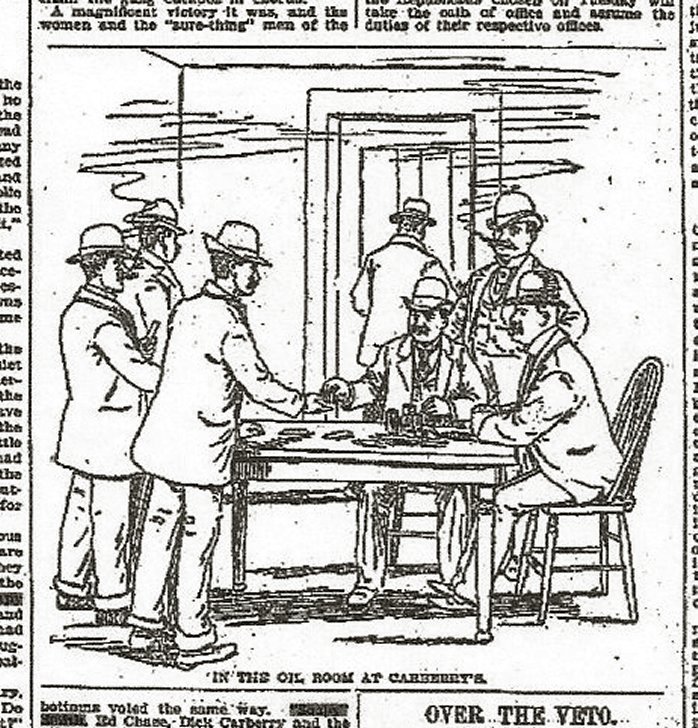
IN THE OIL ROOM AT CARBERRY'S
Repeaters get their names to vote under
Rocky Mountain News, April 4, 1895
 
(Click image to enlarge)


INK AT CRIMES
Repeat voting fraud in Denver, Colorado 1895.

     There may be no other 19th century American city in the west that suffered the bane of political corruption like that of Denver, Colorado. No where in the western states did the criminal underworld openly and outright control and rule unscrupulously, without fear and without punishment, than in the Queen City of the Plains. 
    As a matter of course, the one common presence, the scourge of Denver's exploited election process, is none other than Jefferson Randolph "Soapy" Smith. Following is merely one sampling of his involvement in the misdeeds and desecration of the Democratic voting process.
    On April 4, 1895 the Rocky Mountain News exposed something that most citizens in Denver took for granted, election fraud. The election that took place two days previous, on April 2, 1895, was not an honest one. Worse was the fact that the corruption was not all that careful about hiding their actions as no one in the city or state government seemingly cared to launch a real investigation into the crimes committed.
    The crime most noted was that of repeat voting, the process of one person voting numerous times, using the names of those citizens who were deceased.  


WINK AT CRIMES.

__________

No Prosecution of Repeaters or their Rich Backers.

__________

District Attorney Claims no Official Knowledge of corruption.

__________

Police Board Professes Ignorance of Proceedings at the Polls.

__________

Reform Commissioners Fear the Unseen Force and Will Not Interfere.

__________

Jury Wheel and All the Spoken under the Heel of an Unscrupulous Gang.

__________

    It was announced at the office of the fire and police board yesterday that no effort would be made to prosecute the parties guilty of repeating, voting dead men’s names, bribing voters or for any of the nefarious work that characterized the election Tuesday in the Third and Fourth wards. “We are not the public prosecutors,” is the ultimatum of the board. “I don’t know anything about it,” declares District Attorney Whitford [Greeley W. Whitford].
    This attitude is not entirely unexpected after the decision of the special policeman at the polls in the Third on Tuesday that the fact that a white man was attempting to vote a colored man’s name was not “proof.”
    At the headquarters of the gang in the European hotel everything was quiet when the reporter called yesterday afternoon. The “boys” who had visited the oil room the evening before did not leave the place until an early hour in the morning, and consequently were a little late in showing up. Most of them had accumulated a comfortable jag [drunk] with the corporation money paid them for repeating, and this also accounted in part for their tardiness.
    Those who did come to the rendezvous were dreamy-eyed, and they did not care to talk much. All admitted that they had been treated shabbily, and that the $2 a “plug” promised them by Soapy Smith, Dick Carberry, Jim Connors and others, who had charge of the joint, had been reduced. One brilliant thug suggested that they bring suit for the balance.
    “Why, you bloke,” exclaimed a weary, smooth-faced tough, “you’re a fool. Do we want to bother about being in court?”

The name of Dick Carberry may be Richard D. Carberry of the Carberry and Hanley (saloon?).

Prefers Utter Ignorance.

    The fire and police board does not know that ballot boxes were stuffed, that dead men’s names were voted, that the greatest outrages against the sacred elective franchise have been perpetrated. That is, the commissioners say they don’t know. The men who committed the crime are outspoken and with braggadocio tell the details of their sin. They are frank about the matter, because they have been assured by Soapy Smith and Dick Carberry that the fire and police board will shield the criminals and protect them from prosecution.
    “We’re all right, boys,” said one of the hobos yesterday. “You see we’ve got the police board, the prosecutor, the jury wheel and all the spokes.”
    This philosophical remark met with such favor that one bleary-eyed slugger called for the drinks all around and threw a $20 bill on the counter in such a careless fashion that all conversation stopped right there.
    “See here, Bill,” said one of his cronies, “you’ve been a-holding out on us. This ain’t fair. You’ve been a-knocking down for the cracks the rest of us has made.”
    This grave accusation was indignantly denied by Bill, who said that he “won out” $18 in Soapy’s gambling house, now in full blast.
    Kid Gallagher, the prize fighter was the subject of many congratulations. Times have been rather hard with “the Kid” of late and under and upper cuts that delighted those who gathered about the ring, while very pretty and artistic, have not brought in “the stuff.” As a consequence, the Kid has been obliged to pawn his sweater, his punch-bag and all the paraphernalia that make up the stock in trade of the semi-professional.
    Gallagher shook hands all around when he arrived late in the afternoon. He was quite a hero. He had made a record as a repeater, and had been on the go all election day.
    “How much did you make, Kid?” Was the inquiry.
    “Never you mind,” answered the youth. “You fellers all get to the bar and take something with me.”
    The request was readily readily complied with, and then the Kid unbosomed himself.
    “I don’t say, now mind, what I did, but I tell you fellers that it was a good day. I made enough so that I’ve just got my clothes, my sweater and my punch-bag out of soak,” declared the smasher.

Edward "Red" Gallagher, a Denver boxer, worked as a tough for Soapy. He followed Soapy to Skagway, Alaska in 1898.
Repeaters in Many Names.

    Jimmie Lewis, another prize fighter, among other illegal acts, was given the names of James N. Seper, 1731 Larimer and of George A. Swanson of 1740 Market street, which he is supposed to have voted.
    “Dutch, the expressman,” a swarthy fellow about 20, was lionized to a great extent because he had voted twenty-two times, at the assembly building, at the Winsor hotel and at the polling place on Sixteenth between Larimer and Market streets.
    Eddie Drain, a jockey, was not far behind, as it was said that he had twenty-five slips of dead men and it was announced by his admirers that he voted every “bloke.”
    Billy Lewis was surrounded by a crowd the moment he entered Carberry’s joint. Billy had told the corporation managers that he would obey instructions. When Billy offered his vote in precinct 5 of the Fourth ward, he was challenged. Did Billy weaken? Not he. He wanted to know why he couldn’t vote. He came very near forgetting the name of the person he was impersonating, but as he held the slip of paper given him in the palm of his hand, he glanced at it and his memory was refreshed. On being told that he was challenged, and the only way that he could be permitted to vote was by taking the oath prescribed by law.
    “I didn’t know what the oath was,” said Billy, “but I told ‘em to let her go. I raised my right hand as the judge told me to, and when he got through reading from the book, I said, “all right.”
    Billy voted under the name of William Jewell, It is claimed.
    The general estimate at Carberry’s yesterday was that the joint had cast 1,000 illegal votes. But it’s a small matter, as the Tramway organ maintained yesterday. McMurray would have been elected anyway.

Facts Can Be Furnished.

    Of course it would be impossible for the fire and police board to obtain any information concerning the crime against decency and law. Has the fire and police board tried? Does the fire and police board need any facts other than those already in the possession of the chief of police?
    At Republican headquarters, the matters of repeating and of all manner of election frauds are received in a jocular vein. “When I bet,” said one of the hangers-on, “I bet on the ‘machine’ and on the money that would be used. I didn’t know just how Graham would use the stuff, and I didn’t care.”
    “Why,” said the secretary of the fire and police board. “of course the board doesn’t care about the evidence. The board has nothing to do with the matter. See the prosecuting officer.”
    District Attorney Whitford was found at his offices in the People’s bank building.
    “What are you going to do about the frauds on election day, Mr. Whitford?” was asked.
    “Why, I don’t know anything about them,” was the answer. “This is the first I have heard of the matter. No complaint has been made that I know about.”
    “Are you making any effort to obtain information or to make an investigation?”
    “Not much that I know of.”
    “Is the fire and police board or the sheriff trying to get at the facts?”
    “Not that I know of.”
    “Are you going to prosecute the parties guilty of the outrages?”
    "Why, I tell you that I don’t know anything about the matter.”
    The fire and police board is not the prosecutor; the sheriff is not the prosecutor.
    Looks as though the thug philosopher who remarked, “We have the police board, the prosecutor, the jury wheel and all the spokes,” had about sized the situation correctly.


All Sing in Chorus.

    It was said yesterday that many illegal votes were also cast in the Second Ward. But what does it matter? “McMurray would have been elected anyway,” Exclaim the gang cuckoos in chorus.
    A magnificent victory it was, and the women and the “sure-thing” men of the bottoms voted the same way. “Soapy” Smith, Ed Chase, Dick Carberry and the others knew what they were about. The women who attended the mass meetings to protest against opening the gambling houses voted the same ticket for “party” that Carberry, et al. voted for “business and do stuff.”
    There will be no arrests, no prosecutions of any nature. The men who stuffed the election are of the toughest class in Denver. How can the police board now help assisting their friends who stood by them so nobly on election day?
    All the ballot boxes were deposited yesterday in the office of the city clerk and two officers detailed to watch and “prevent any tampering with the returns.”

Two days later the Rocky Mountain News published the names of the known repeaters

    At the repeaters‘ rendezvous, the following record is given out lawlessness, and the men who did the repeating have been paid by the money of the corporations on the basis of having done this "work:”

1 —Billy Mahan, pugilist, voted thirteen times.
2 —Billy Lewis, pugilist, voted twenty-two times.
3 —Jimmy Lewis, pugilist, voted twenty times.
4 —Kid Lewis, pugilist, voted seventeen times.
5 —"Dutch,” expressman, voted nineteen times.
6 —Ed Train, alias Mayberry, voted twenty-one times.
7 —Jack Verome, machinist, voted six times.
8 —Billy Lerou, blacksmith, voted three times.
9 —Dan Closkey, painter, voted four times.
10—Ike Meyer, bartender, voted three times.
11—John Davis, brakeman, voted five times.
12—Lon Brown, brakeman, voted four times.
13—Billy Ketchin, fireman, voted seven times.
14—Jerry Black, calciminer, voted two times.
15—Joe Martin, clerk, voted two times.
16—Pat Mullene, driver, voted two times.
17—McLeod, “tout,” voted six times.
18—Evans, “tout,” voted three times.
19—Berkley, "tout," voted four times.
20—Robinson, “tout," voted six times.
21—Ed Smith, no occupation, voted eight times.
22—Sam Zeigie, no occupation, voted three times.
23—John Ricker, no occupation, voted six times.
24—Mike Reynolds, no occupation. voted seven times.
25—Dave Patterson, gambler, voted eleven times.
26—Claud Hilder, gambler, voted five times.
27—Baxter, gambler, voted four times.

   
All the parties above named were of those who were assigned to vote electors’ names on Larimer street, at the Windsor hotel, on Arapahoe street and in Jimmy Doyle’s own Precinct on Sixteenth near Market.
   Of course the list is incomplete, but the district attorney, who “doesn’t know,” might with diligence add to the number of those who are now known to have committed election day crimes. Diligence is necessary, as the perpetrators of the outrage have, many at them, already left the city with the “swag” which they received for this day's work.

The list of names contains only one recognizable name, that of Ed Smith, probably the boxer "Denver Ed" Smith, a pugilist working for Soapy. Known for his boxing history, but known to Soapy fans as having had an altercation during the Logan Park riot in 1889. The odds increase a tad as there are four other "pugilists" listed.


(Click HERE for the April 6, 1895 RMN article)


"He devoted his God-given talents and abilities to the pursuit of the fast buck by employing every swindling scheme then known to man."
—Alias Soapy Smith.


JUNE 13


1777: The Marquis de Lafayette arrives in the colonies to help in their war against the British.
1789: Ice cream is served to General George Washington by Mrs. Alexander Hamilton.
1825: Walter Hunt patents the safety pin. He sells the rights for $400.
1865: While in Idaho Territory, Indian Chief Crazy Horse sneaks into the Sioux camp being relocated to Fort Kearney, Nebraska, to plan an escape.
1865: Ex-lawman and camp boss Sumner “old Pink” Pinkham is shot and killed in a duel with con man J. Ferdinand Patterson in Idaho City, Idaho.
1866: The 14th Amendment of the Constitution, designed to grant citizenship to and protect the civil liberties of recently freed slaves, is passed by Congress. It is ratified on July 9, 1868.
1868: The Thirteenth Infantry, under the command of Captain J. L. Horr, with a group of Indian scouts, engaged hostile Indians, killing three, at Twenty-Five Yard Creek, Montana Territory.
1877: Nez Perce Indian Chief Joseph starts off with 250 warriors, 450 women and children, and 2,000 horses, in an attempt to make it to Canada after talks break down when a band of his younger warriors kill eleven settlers.
1878: A posse led by Texas Ranger captain June Peak and Sheriff W. F. Eagan corner the Sam Bass gang near Salt Creek in Wise County, Texas. A gun battle ensues in which Arkansas Johnson is killed and others are wounded. Bass, Barnes, and others manage to escape on foot after the posse captures their horses.
1882: Oscar Wilde speaks at the Tabor Grand Opera House in Denver, Colorado for two nights.
1887: Railroad tracks of the St. Paul and Manitoba Railroad cross the eastern boundary of Wyoming.
1888: Congress creates the Department of Labor.
1898: The Canadian Yukon Territory is organized. The Yukon separates from the Northwest Territories and is given separate territorial status, two years after the discovery of gold in the Klondike. Dawson City, with 30,000 residents, becomes the capital.
1904: Oklahoma City Police Officer Joseph Burnett shoots and kills Edward Capehart O’Kelley during an arrest which developed into a brawl. O’Kelley had been only recently released from prison after serving time for the murder of Robert Ford in Creede, Colorado 1892. It is believed bad man Soapy Smith talked O’Kelley into killing Ford.


June 11, 2016

A glimpse of the Denver underworld, October 1895: Part 2

"Big Mitt"
Friendly poker scam

CLICK HERE TO READ PART ONE?


art two:
A glimpse of the Denver underworld, October 1895


      A previous days expose’ published in the Rocky Mountain News (October 17, 1895) about Denver's bunco activities also uncovered a clear affiliation between the criminals and Denver's police and detective departments revealing that the two main bunco gangs under control of "Big Ed" Chase and Lou Blonger were working the streets unmolested by the police, according to the newspaper. What was probably meant to be a one day article turned into a scandal of epic proportions.
      Following is a condensed version of the Rocky Mountain News article published on October 18, 1895, an addendum to the previous day's publication on the bunco gangs of Denver. Text in bold are important names.

ROBBING THE AFFLICTED.
__________

Latest Schemes of Denver Bunco Steerers.
__________

Steerers Called In.
     Owning to the disclosers of the News concerning the bunco operations carried on by men employed by Ed Chase and Lou Blonger all the steerers working under these two bosses were ordered to discontinue work yesterday morning. The steerers were unable on this account to do any harm to the strangers who are in the city during the early part of the day. Detectives De Lue and Finch were detailed by Chief Goulding to see to it that no tricks were turned by the fraternity on Seventeenth street and last evening the detectives reported that they did not find any of the bunco men about. The bunco bosses expect to put their men upon the streets again before the week has passed and the steerers, although they did not appear upon the streets yesterday were quietly at work as an opportunity equal to the present one of fleecing “suckers” will not be overlooked.
     “I have given my men positive orders,” said Chief Goulding yesterday, “to arrest all bunco men found at work. We won’t have them around. They’re no good and they’ll do up a sucker every time they get a chance.”
     It seems that the officers ordered to arrest the bunco men have played the chief for a “sucker,” for it is a notorious fact that the gangs of steerers employed by Chase and Blonger have not been called to account for the tricks they have turned during the week.  These men, whose names were given in yesterday’s News have not been molested by the police, while “grafters” of the cheap variety have been dragged into the chief’s office and threatened with prosecution for vagrancy unless they at once leave town. This “grand stand play” has not the stamp of sincerity upon its face. While these poor unfortunates are driven from the city courtesies are being extended the gambling and bunco fraternities that would not be tolerated in any other city in the United States, especially at festival times.
“Rubes and Jays.”

     To the victims of bunco steerers. Female pickpockets and gambling games the police have given the name of “Rubes” and “jays,” signifying innocent and credulous persons from the country districts. “He’s a regular Rube,” is an expression often heard at headquarters after some victim made penniless by the duplicity of “grafters” has told his story. Little sympathy is shown this class of complainants.
     The man who played the “Soapy” Smith game on Seventeenth street Wednesday did not show himself yesterday in the capacity of a swindler. Speaking of this man Chief Goulding said yesterday that when he heard that the new fakir was repeating the old “soap” game he ordered his men to run him off the street. The stranger, however, sold his little packages all day and did not quit work until 6 o’clock in the evening. For about eight hours the police and detectives had the opportunity to benefit the populace by taking the swindlers into custody, but they failed to avail themselves of it.
     Yesterday there were a number of gambling games in operation in different shops on lower Seventeenth street. There were the “wheels of fortune” and other small games which did not bring any large sums to their owners. The nickel-in-the-slot machine was to be seen in nearly every saloon and cigar stand in the city.
Lost His Roll.

     About 8 o’clock yesterday morning a man of mystery called at police headquarters and reported to Captain Duggan that $40 had been stolen from him. Without taking the trouble to ask the man’s name Duggan told him to go to the detectives.
     After repeating his story to the sleuths he was accompanied to Noonan and Walker’s saloon at the corner of Eighteenth and Market streets by Detective Gardner.
There is a mystery surrounding Detective Gardner. It is a possibility that this is Robert Gardner, husband of Soapy's sister Emmie Lou. It would certainly explain any alliance with the bunco men.
The stranger claimed that he entered the saloon at an early hour in the morning with several friends and went to sleep upon the floor. When he awoke, he said his “roll” was gone. There was no evidence that anyone connected with the saloon had taken the money and inquiry developed the fact that the “Rube,” as the detectives called him, had visited several resorts of a questionable character.
I have to appreciate the journalism of the era for labeling saloons as “resorts of a questionable character.”
     Detective Gardner, too, failed to get the name of the “Rube,” and the latter will probably never have the satisfaction of seeing the thieves who stole his money brought to justice.
     A case reported to the detectives about noon indicates that pickpockets are busy in the crowds that daily flock to the principal streets to see the parades. The complaint concerning the light-fingered fraternity was made by Mrs. J. W. Bramey of 342 South Thirteenth Street. She was standing at the corner of Sixteenth and Champa streets about 10 o’clock when her gold watch attached to a long chain was snatched from her. As the woman was in the midst of a crowd she was unable to see the thief.
One would believe that with such scalding testimony of police alliance with the bunco gangs, that they would decide that their positions, within the city and social standings, even their very jobs, were in danger and not worth protecting the criminals, but the pay was too good to pass up. This alliance continued for another 35 years, until the Blonger empire was finally toppled in 1929.


"Smith was not strong physically or of commanding appearance but he was always a leading personality in a mining camp and many a man breathed easier when the word came that ‘Soapy’ Smith died here with his boots on and a cigar in his mouth."
—Henry “Yank Fewclothes” Edwards
Alias Soapy Smith, p. 592.


JUNE 11


1776: The Continental Congress forms a committee to draft a Declaration of Independence from Britain.
1865: More than 400 ex-Confederate soldiers under General Joseph Shelby march into Austin, Texas where 40 of them break into the state treasury. Nineteen volunteer guards storm the building to thwart the robbery. One robber is killed and $17,000 is stolen.
1865: 2,000 Sioux Indians are forced to march from Fort Laramie, Idaho Territory to Fort Kearney, Nebraska.
1867: Indians kill a soldier of the 7th Cavalry escorting the mail near Big Timbers, Kansas.
1878: The outlaw Sam Bass shoots it out with Texas Rangers led by June Peak, in Denton County but Bass is able to escape unhurt. Six weeks later eighteen-year-old Soapy Smith witnesses Bass' death in Round Rock, Texas.
1879: Royal Gorge War in Canon City, Colorado, continues since March 25, 1879. Violence between the rival railroads of the Rio Grande of Colorado and the Atchison, Topeka and Santa Fe of Kansas, over ownership and use of the Royal Gorge pass. Bat Masterson and 65 men are hired to defend the Kansas line. Private mercenaries of the Rio Grande fail in their attacks until after 3 p.m. when Masterson’s fortification is surrounded. Masterson and his men are allowed to leave unharmed. Two are killed and two wounded during the fighting.
1880: Jeanette Rankin, the first woman elected to the U.S. Congress, is born.
1882: Soapy Smith purchases a street vendors license in Salt Lake City, Utah, to hawk his prize package soap.
1885: Dick Glass, a black Creek Indian outlaw is shot and killed by Deputy U. S. Marshal Sam Sixkiller near Post Oak in Oklahoma Territory.
1889: The Washington (D.C.) Business High School opens. It is the first school devoted to business in the U.S.
1895: Charles Duryea receives the first U.S. patent granted to an American inventor for a gasoline-driven automobile.
1899: Outlaw Tom “Black Jack” Ketchum, and two men are caught on the run after a botched robbery in the Twin Mountains, New Mexico Territory. Ketchum will eventually hang for his crimes on April 26, 1901 at Clayton, New Mexico Territory.