September 17, 2009

Artist Andy Thomas to paint Soapy Smith

(Click image to enlarge)
Desperate Ride
by Andy Thomas

I have been given permission to announce that fine artist Andy Thomas will soon begin painting the "gunfight on Juneau Wharf" at his Maze Creek Studio in Carthage, Missouri. The title not yet decided upon, which Andy christens at the completion of each of his paintings. This very exciting project has been kept under wraps for weeks while Andy and I poured over the historical information provided in my book, Alias Soapy Smith: The Life and Death of a Scoundrel and my large antique photograph collection. This historic portrayal of the shootout between Soapy Smith and Frank Reid will be the most authentic depiction ever painted. I can hardly contain my excitement!

Andy is known as the "storyteller," and looking around his studio website I know you'll agree. His original paintings are highly sought after. Bad Whiskey, one of his westerns, recently sold for $110,000.


Could this be Frank Reid?

(Click image to enlarge)
The Office saloon
Skagway, Alaska, 1898

Is the man on the far left Frank Reid?

Shellie, an Alaskan researcher and member of Friends of Bad Man Soapy Smith thinks she may have made a significant discovery and I am inclined to agree with her so far. She feels the gentleman on the far left of this photograph just might be Frank Reid. A preliminary judgment on my part by looking at the known photographs of Reid indicates it does indeed look like him.


(Click image to enlarge)
Close-up of man believed to be Frank Reid.


September 16, 2009

Quick Quotes...

(Click image to enlarge)
The site of the duel

Since the man who shot Soapy Smith has followed him, owing to wounds inflicted by the dying gambler, it can only be hoped that Soapy has been so thoroughly reformed that there will be no renewal of the trouble between them. —San Francisco Call, July 28, 1898


Speaking frank about Reid, part 1.


(Click image to enlarge)
Frank H. Reid


No matter what your personal or historic opinions of Frank H. Reid are, be they a hero or cad, there are two facts about him that can no longer be denied. That he was a brave man, and that he did not kill Soapy Smith.

In the decades between 1898 and 1998 Reid has been known in Skagway, Alaska and history in general as the brave vigilante hero who saved Skagway from the tyrant dictator, Jefferson R. Smith. Reid's history was viewed differently within the members of the Smith family, ... his family. During that time period Reid was seen as a co-instigator of a conspiracy to murder Soapy. He was a low-down turn-coat who deserved what revenge the Smith family began enacting in 1977. We urinated on his grave. Funny how time and information can change what had become a town tradition bragged about by descendants, is now something I am embarrassed to admit in writing.

Since 1985 I have been trying to open a line of communication between the descendants of Soapy Smith and those of Frank Reid, the vigilante guard, once thought to have killed Soapy. There were several introductions but none ever developed beyond that. One reason is that the animosity over exchanging lead bullets still lingers in the passing generations. The other obviously has to do with that horrid annual tradition of relieving our frustrations when in Skagway. I could only hope that the families of Soapy Smith and Frank Reid could learn to somewhat get-along with one another as do the descendants of the Earp's and the Clanton's do in modern day Tombstone, Arizona.

In 2008 I received an email from my cousin Tad. In his correspondence he mentioned meeting a descendant of Frank Reid while at work. The two exchanged contact information but unfortunately Tad misplaced the card by the time he emailed me. He promised to send me the information when he again came across the card. Weeks turned into months and I soon forgot the situation. About a year later on August 12, 2009 I received another email from Tad with a sincere apology and the thought lost contact for Mark Reid. Excitedly I immediately placed a phone call and left my phone number with Mark's wife. I heard nothing and feared another lost cause. I tried once more and had the fortune of Mark answering the phone. We exchanged quick pleasantries and email information and ended the call. I set out to open an ongoing email dialogue and finally hit pay dirt. Following are the what I hope to be the start of a long friendship between families who were once foe.


Frank Reid and Soapy Smith talk

A
ugust 22, 2009

Hi, Mark.

A cousin of mine met you some time ago and just now found the phone number and gave it to me. It is my goal to become friends, or at the very least, civilly speak to one another, lol. Although you are a descendant of Frank Reid, of whom my great grandfather killed at the "gunfight on Juneau Wharf" 111 years ago, I am first and foremost a historian. I don't pretend Soapy Smith was a good man, but then again my research shows Frank Reid was not exactly one either. I do have a book coming out very soon which explains all I know about Reid. I would welcome any knowledge you may have on Frank and I will naturally be more than willing to share what I have found over the years if you are interested. Are there other members of your family who are interested in the Frank Reid/Soapy Smith clash?


(Click image to enlarge)
Frank Reid's house
Skagway, Alaska


Most importantly I am not interested in trying to discredit Reid in any way. I am only interested in the truth. When you find some time I am hoping that you might write me what you know about Frank. Are there any family photographs or belongings of his in the family?

I have a website, blog and discussion board. I want you to know that you and your family are most welcome to give your facts, thoughts and opinions. I look forward to hearing from you Mark. In the mean time I suggest you keep an eye on my blog for the latest information that involves Frank Reid.

Sincerely,
Jeff Smith


September 12, 2009

Jeff,

Got your e-mail. Sorry I have not responded until now. Life has been a little hectic. Beside that I found that this whole Frank Reid thing sent me on quite a journey. This e-mail is the result. It's long, so read when you have the time and patience.
Thanks,
Mark Reid

(Click image to enlarge)
Frank Reid, City Engineer ad
Skaguay News, 1898

Odd thing. Totally random. "Weird," I think you'll agree, is the appropriate word if you read on. But I find it has put me a little in a strange position that has taken until now for me to figure out how to deal with. I'll explain.

Checking our groceries out at Trader Joe's here in San Clemente on a Sunday afternoon, my wife paid by check. The check had our name, address and phone printed on it. The bearded man checking us read the name and repeated aloud, as if a question, "Reid?" My wife answered, "Yes?" He brightened and inquired if we were related to Frank Reid. The Frank Reid famous in Skagway, Alaska for killing Soapy Smith in a gunfight back during the Klondike gold rush. I was playing with our six year old, uninvolved in the interchange to this point. My wife looked at me, and he, taking the hint, turned his attention also to me and introduced himself as a descendant of Soapy Smith. He seemed to me in that moment never to have met a person named Reid before in his life and was nearly bowled over with the novelty of it.

Now, not too long before this my parents had taken a cruise to Alaska. I don't recall the exact timing, but it was recent enough for this story to be relatively fresh in my mind. So I was oddly, accidentally prepared for this random interaction. On their cruise, they debarked their vessel in Skagway for a tour of one of the early Klondike gold rush towns and happened to witness the historical re-enactment done there in the streets for the benefit of arriving tourists of a gunfight between Frank Reid (portrayed as the good guy / hero) and Soapy Smith (conman / gang leader). In the re-enactment, both are shot. Soapy is killed in the street. Frank is wounded, but dies twelve days later of his wounds. There is an actual granite monument, a simple obelisk, with the name REID carved into it on Frank's grave. Soapy Smith had a simple small marker, which over the years has sustained the marks of time and vandals and I believe the local historical society or various benefactors have probably replaced the original several times over the 111 years since it was first placed there. Apparently this is the only thing of historical note—or, at least, any value to the tourist trade—that has ever happened in Skagway.


(Click image to enlarge)
The Klondike Saloon ad
Frank Reid, bartender
Skaguay News, 1897

Unfortunately, I only remembered the most vague outline of the story, the major characters, the town, the relative time frame and so on. That was it. I never thought to research any further, or to definitively trace our family relationship to Frank if there was any. I know he died in 1898, which is approximately when my grandfather was born in New Mexico. So the closest relation he could possibly be to me would be Great Uncle (brother of my Grandad's father). But that is simple elimination, not proof of anything. All I thought of the whole thing was that a distant relative was involved in a western-style gunfight in the street of some god-forsaken coastal town in the territory of Alaska. He must have been quite an adventurer, or running from something. Like a movie. Kinda cool, I thought. That's it.

So, fast-forward to Trader Joe's check out line. Soapy Smith's self-claimed descendant is looking into my eyes. His eyes are big, seemingly excited. He is smiling. I can't even begin to write what started running through my mind at that moment. I looked down at the check in his hand with my name, home address, phone number and everything on it.... "You aren't armed are you?" I asked. He smiled, "No! My family is really into the whole Soapy Smith thing. We take trips together, try to find out more—we have taken a couple of trips up to Skagway. Yeah. I have to admit, though, we’ve 'sprinkled' your grandfather's urinal—I mean monument—a time or two. But no hard feelings. It's all in good fun and all." Again, a rising sensation of all kinds of strange new feelings I still have no words for. I gave him a half smile, nodded my head and said, "Wow. Yeah. I don't really know that much about that whole thing... But it is interesting... You know... Life and all. I mean how these two guys are part of Alaskan history and kill each other in a straight up street gunfight so long ago, and now you and I meet here in a Trader Joe's like this. I'm sure they never could have imagined this future, huh? Crazy."

That was it. That was the extent of our interaction. I mentioned it, I think, to my folks later as an interesting follow up to their Alaska story. I have Googled Frank Reid and Soapy Smith occasionally when totally bored and have found conflicting accounts here and there, but I suppose that is normal. Mark Twain made a living as a humorist artfully imitating the yarns, tall tales and outright lies of the uneducated, easily impressed, well-intentioned, gossiping, self-interested and duplicitous of his time. The contemporaries and the issues of Frank and Soapy were the same as Twain's subjects. Why should we expect the stories about them to be any different?

Anyway. A couple of weeks ago—maybe a year or more after our Trader Joe's encounter—you called the house and spoke with my wife. Neither my wife nor I made the connection with our chance encounter at Trader Joe's and wondered how you could have found us as our number is unlisted, and why, if you had the resources and time to find our number, did you not also have the resources to know I am only distantly related to Frank at best—more probably in the third- to forth-removed category if at all, and I have only recently learned of his existence. I am certainly not a direct descendant.

Finally, last weekend when you and I spoke directly on the phone and then I received your e-mail, I realized it was all connected to that chance encounter and probably due to the fact that I was aware of the Soapy/Reid history. I can see how the connections were made, and perhaps hopeful conclusions drawn. You have remarkable tenacity and curiosity. Perhaps it is a Smith family trait. Some might describe it as indomitable. And I mean that in a good way.


(Click image to enlarge)
Frank Reid's Map of Skaguay


Sadly, I will disappoint you. I know less than you do about Frank Reid. And though you have piqued my interest enough that I will probably read your book and continue to stoke an ongoing interest in the subject, I have nothing of any historical note or significance to add from the Reid side of the story. This saddens me, too, a little because there seems to be a real lack of information from his side.

Since I have heard from you, I have sent out an e-mail to every Reid for whom I have an address. I only received one response. Apparently my aunt, recently deceased, had also been to Skagway (apparently a cruise to Alaska is one of those things Reids do in their later years before they die. Perhaps this is a tradition begun by our late Uncle Frank.) She had done some research of her own and had copies of his last Will and Testament, the Jury Inquiry into his murder and his Death Certificate—all available from the Skagway Public Library. A copy of these documents was sent to me, but only helped to create more questions. One has to assume from Frank’s Will that he had no wife or children, as he left everything he owned to the Presbyterian Church and the Women’s Relief Corps of Skagway, executed by his friend Leslie Butler. He directed that enough money be set aside from the sale of his own belongings for a decent burial, so clearly, he expected no help in that way from any family. But he did not direct the type, size or style of his memorial or monument. Oddly, he left the sum of one dollar to his brother D.V.S. Reid in Eugene, Oregon. Can’t say if that was tradition in those days due to distance; wisdom to not give the money over to one of your great grandfather’s phoney telegraph officers; or bad blood between the brothers.

In the meantime, I have perused the Internet several times to find that as far as historical juiciness in lore and legend, the “bad guy” wins by a mile. Just like high school, right?
From a top-level read, Frank H. Reid seems to have been just another nameless face in that crowd of miners, sailors, railroad men, criminals and victims in the muddy streets of Skaguay. Why he was there, where he came from, what his plans were, there is scant word if any. How old was he when he died? Don’t know. He is born and finds his way in the dark oblivion of history until the bright spark of gunfire for a brief moment in which he is found in a clench with your famous great grandfather, and then fades again into darkness. Vicarious fame. Unsought and unwanted.

(Click image to enlarge)
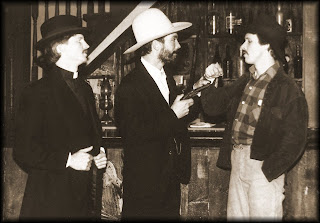
Soapy confronts Reid in Days of '98 Show
Skagway, Alaska

What is interesting is this is all we know of him. This is all history has recorded. But it seems shooting your great grandfather or becoming famous was the last thing on his mind. He had other plans. He left Oregon and came to Skagway for some other reason. But history does not care a fig about what your plans are, where you are going, what you want. History only records what actually ends up happening—usually accidents. No. Scratch that. History only records what other people remember they think happened, accidentally. We are left to put the pieces together. I, unfortunately, have far fewer pieces than you. Clearly, neither Soapy nor Frank wanted to kill or be killed. The risk was clearly there—perhaps always there. But both were doing something else when their ends came upon them in that final awkward grapple over the rifle barrel. Reading Frank’s Final Will and Testament and studying his eyes in a photo I discovered online where he is found looking into the camera lens from his deathbed made me wonder if, during that last 12 days of life, he had time to consider how Soapy was buried and treated in death, and that is what caused him to make that the first consideration in his Will—to be buried “decently.” Perhaps he felt Soapy was treated poorly—perhaps shockingly so—after his death, considering days before he was the Marshall at the head of the 4th of July Parade and had a place next to the Governor that day. At the point of death Frank did not look proud or like a romantic hero. He was only feeble and sick in a frontier hospital, facing his own oblivion with no heirs, no family. Perhaps he felt compassion for Soapy. Who knows? When the dying look to the dead with no one to hold them to life, who is their comforter? Perhaps the person closest to Frank was Soapy during those final days. The whole story makes me sad.

Honestly, though, I don’t know why I should care at all. The more I find, the more I realize I am less and less related to this almost famous Reid. We are related in name only. Another accident. Just like the accident of your cousin and I meeting at Trader Joe’s. What is really crazy is that I even subscribed to ancestry.com for one month to see if I could find out any more. Do you know what I found? Searching all records for the name Frank H. Reid, died July 20, 1898 (none come up for Skaguay, Territory of Alaska, or for Oregon), there are approximately 200,000 names. The name is of Scottish derivation, so many of the names are from immigration lists from British Commonwealth countries, Scotland, Ireland, Canada, Australia, Bermuda, etc., many from New York and many from the South. I was surprised to find a large number of Reids who are black. I did not know this, but apparently it was customary in the South before the Civil War that slaves took the name of their owners. So, there must have been Reids who were landholding slave owners. I began to lose hope of finding any connection to him at all.


(Click image to enlarge)
The Gunfight on Juneau Wharf
Skaguay News, July 8, 1898

So, I quit. I have run the wild chase and I am done. I have come up empty, except in this.
As the thousands of people who have shared my name before me scrolled before my eyes while I searched for this one name, I would occasionally stop, thinking I found him. I would read a bit and realize not. But I would leave that entry with a bit of that person’s life on me—a nick name; rhyming first names of spouses; 18 people living in one house; 4 children dead from a sickness, a photo attached where you could see it in the mother’s eyes. I began to realize that the Frank I was looking for was just like any of these. He came from a place like these in their time. He laughed in a parlor like their’s. He knew children like these. He cared about people with stories like these. He went to church with them. He saw them born. He saw them buried. He was a common man. He had a common name. Not a name like Kennedy or Rockefeller. They owned lands and fame and their names even owned much of the alphabet. His name, only 4 letters. Modest.

In the end I have to wonder why I cared enough to do all this work, almost compulsively, in response to your call and e-mail. I suppose after some reflection I have to confess an ugly bend in my character. Years ago, after hearing the story of Frank and Soapy the way I heard it, it sounded so much more heroic and honorable on Frank’s part. However accurately it may have been told, I heard the story much differently than it sounds in your rendition. And I was proud of “Uncle Frank” and wanted to stand a little closer to the self-righteous “gunfighter” I imagined him to be. Perhaps in reading the bits from your rendition that pride was damaged and I wanted to dispute it on some level. Perhaps I finally did want to find out how closely I was related to him. Hubris, family pride, morbid curiosity—not sure. But the case seems to have been much less glorious and much less attached to me. The way life really is.

Maybe it was the mention both by your cousin and by you in your apology about the Smith family “sprinkling” the Reid grave in Skagway during the “Wakes” that tugged at my family pride. I suppose I felt someone should speak for Frank at least—cool gunfighter or not; direct relative or not. And, after all, my name is Reid. Although looking at his last photograph—which appears nothing like any of his other likenesses—I have to say I can see a striking resemblance to many of the men in my family. So, for the purpose of the following, I will call him Uncle Frank, adopting him in spirit posthumously—not the tourist attraction, but what little I know of the man.

Please know when I write this that I do so with no malice in my heart toward you or your family. In fact, as I reviewed one of your sites, I saw a picture of your father admiring a grave marker of Soapy Smith at, I believe, your home in Anaheim. I was touched by the look on his face. It must be a wonderful thing to be able to share such a cool piece of history and such an interesting character—such an interesting story—with your family, and to be able to pass it from one generation to the next. Quite an unique bond. You are exceptionally fortunate and rich in that regard, and it seems you are not wasting it. Good for you.


(Click image to enlarge)
Bishop Rowe hospital
where Reid was brought
after the gunfight.

But the peeing. Why? That part I don’t get. I mean if one of the black Reids were to tell me they were peeing on their slaver’s grave, I would have no issue. In fact, I would probably buy them the best Scotch Whiskey I could find to help them add to the irony. I like ironic humor, but Frank Reid didn’t actually kill Soapy Smith. He didn’t even draw his gun as Soapy approached, carrying his rifle and basically rifle-whipping two guards before he got to Frank. What Frank Reid did do was stand his ground. He blocked the rifle from splitting his head and only then pulled his own gun. Did he pull his pistol because the barrel end of the rifle was jammed into his own chest? Or did Soapy swing at him with the butt of the rifle and once Frank had hold of that did he realize he had a rare advantage and took it? Based on Frank’s wounds I gotta think Soapy swung with the barrel end and that is what was in Frank’s chest and that is why he drew on Soapy. They both struggled, firing as they did—both in self-defense. Stupid. Even more stupid, Soapy’s men were following and hiding along the wharf. I think that they started firing when they thought he was being attacked by uncle Frank. Problem being, they were shooting at Soapy, too, since Frank and Soapy were locked arm in arm with Soapy between Frank and Soapy’s gang.

The only irony I can find in this is that Uncle Frank died of a gunshot wound suffered at point blank range from a rifle to the groin and pelvis. Ouch. And you guys are peeing on him. Now I understand it is intended as a boyish, jovial, frat house sort of humor, more to celebrate the scoundrel than to defame an innocent man, but, in light of your own research, it seems to me more like a mean sort of irony. The only actual killer between the two men is your great grandfather, yet he is the on-going subject of romantic stories, movies and Internet interest. No one is proposing urinating on his grave. In fact others beside your family have taken an interest in tending his grave for posterity and keeping his old parlor together in Skagway. I am certainly not threatening to buy a ticket to Skagway simply to relieve myself on your predecessor’s remains. Honestly I just don’t care that much. I would only make the modest request that the revelers in your family holster their weapons and hold their fire out of simple respect for the dead. Please party, enjoy your family and celebrate your history. For me, I will celebrate my uncle Frank privately as a man who, like most of us, lived a modest, mostly invisible life, but stood up when the time came upon him. Whether history will sort him out as a romantic hero of the Western Frontier or not, what it will show is that when others laid down, walked away or were victimized, he stood up.

(Click image to enlarge)
Frank Reid lay dying

In this way he is very much a hero. He is a hero of the common man. And the common man is all of us. We all struggle with the same issues of life—sorrow, hope, fear, joy, intimacy, compassion and death. I once visited Jerusalem. There is a church there with two more churches built around it. In the center of the first church, the oldest, is a marble statue of the Virgin. The toes are worn flat on one side from the kisses and tears of the faithful. When I saw that I stopped and wept. How many kisses do you think that is? How many tears? How many fervent hopes, losses, heart-felt thanks were informing each of those kisses over how many generations? The tender lips and breathless prayers that wore those obdurate toes flat are those of the common man and woman, on their knees bearing the difficult weight of life.

So, in the end I find myself standing close to uncle Frank. Very close, by choice. And I suppose I am speaking for him in a way. I am proud of him. I even hope to be like him—not to shoot anyone, of course. But I hope I can stand when standing is required, regardless of the cost. And, having paid the ultimate price, I hope I can acquit myself simply, respectfully and with regard for others. This sort of ethic reminds me of my own father and of my grandfather. Both of them are heroes of mine for similar reasons—uncle Frank no more so than them. But, as uncle Frank had no children, I hope he can somehow know that there is at least one Reid down the line that now considers him a patriarch, and who is proud of him more for who he was than what he may be best known for.

If there is more to find, I hope you find it. If I find more, I will send it along. From my branch of the tree there is no fruit. There are not letters, documents nor any other items of value to your search. As to participating in any re-enactments of the event, my answer is kindly no—not my thing. And I would only be a poser at best. I have given to you all that I could give, and I have given it in all earnestness. That is, I have tried to look at Frank H. Reid in pictures, documents and accounts and see what I could of the story from what I imagine his point of view might have been. Since we share the same name and potentially the same DNA, it is possible there is a narrow chance we may share a similar way of seeing the world. But, in the end, that may have been like trying to squeeze blood from a turnip, and it is definitely of no historical value in any way—admittedly. If there is any value of insight to help in your search or understanding of character, that will be for you to decide. But I can say it has helped me put to rest whatever part of Frank Reid that haunted me. He and I are now at peace. Thank you for that. Or should I thank the accidents of history once again?

Good luck.

Cordially,
Mark Reid


September 14, 2009

Soapy in Salt Lake, Utah 1882.


(Click image to enlarge)
Soapy's license to operate in Salt Lake, Utah, 1882
Geri Murphy Collection

The above merchants license was scanned to me by my cousin Geri, which was saved by Soapy and his wife. It comes from the city of Salt Lake, Utah and is dated June 12, 1882. The license gives Soapy ["J. R. Smith"] permission to "transact business as MERCHANT, at South Temple between East Temple and 1st East Streets ... for the term of 3 months" for the small sum of $2.75, and is signed by Mayor William Jennings, Recorder John T. Caine and Deputy H. M. Wells.


White House Hotel ad

Salt Lake Herald
July 12, 1882
(Click image to enlarge)


The Salt Lake Herald for June 14, 1882 shows that a "J. R. Smith" was listed at the White House Hotel, however his name does not appear in the newspaper again until July 12, 1882 where he again a "J. R. Smith, Denver" checks into the White House Hotel. I continued searching the Herald through August 2, 1882 knowing another license has him in Portland Oregon operating there.

Surely Soapy operated some of his short-con swindles like the shell and pea game or three-card monte but there is no definite provenance. It can be assumed that he played the field in the surrounding towns until he returned to Salt Lake on July 12. It is very probable that he returned to Salt Lake for the July 14, 1882 arrival of John Robinson's famed traveling circus. As a researcher this is where the tedious reading of every page pays off. Had I stuck with the name search device for the newspaper I probably would not have noticed the obvious reason for his return to the city. There is a good lesson there for fellow researchers.


Fair lists


Official route for the Robinson's circus.
unknown date

(Click image to enlarge)

There is a copy of a letter in my collection dated July 1883 from C. C. Lamos to Soapy. Lamos, a Chicago based supplier of goods for the bunco men, including cheap watches and other prizes Soapy sold and auctioned off to his victims. The letter speaks of mutual bunco friends and associates who are doing well and where they are. At the end of the letter Lamos writes, "Fair lists are not ready yet." The obvious meaning is that Soapy and other bunco men purchased lists that gave the location and dates of fairs and circuses which nomad bunco men followed from town to town. Looking at the route list on the left it can be noted that these circuses did not stay more than a couple of days in any one location, a perfect senario for the bunco gangs that followed them. Sometimes bunco gangs were able to pay the fair and circus managers for the previledge of working on the grounds, but were just as successful in buying a city merchants license and perhaps paying off the local law officer to look the other way while they sheared the locals.

"The long-heralded circus and menagerie of the veteran John Robinson made its grand entry into Leadville [Leadville, Colorado?] yesterday morning, and gave a most imposing street parade, in which a score of the cages shone out conspicuously in contrast with the balance. Owing to the fact that they were different from the ordinary style usually seen in the past. The weather was propitious and the crowds on the street very large. ... It is estimated by the management that over 10,000 tickets were sold yesterday." —Salt Lake Herald, July 14, 1882.


When the circus arrived in Salt Lake it


"Almost seemed as if Salt Lake had gone mad on the circus, and about all that could be heard on the streets yesterday was circus, circus, circus. It was the principal topic of conversation, … All day long the neighborhood of the show grounds presented a scene of life and bustle by no means customary in Salt Lake. … Robinson’s show is the largest traveling company that ever witnessed Salt Lake, and their spread of canvas surpasses anything heretofore seen in the city." Salt Lake Herald, July 15, 1882.


The circus arrived into town and left after two days of performances.

"This morning the whole circus was loaded on the cars [train] at a few minutes to 1 o’clock, and started for Ogden [Utah], from which point it takes the Central Pacific, and plays at Corinne [Utah] and some other towns on the west to California. ... Mr. Foster, the energetic press agent, says the circus will play back this way, after it starts eastward. Mr. Foster leaves for Sacramento this afternoon." —Salt Lake Herald, July 16, 1882.


Sacramento is but 481 miles from Portland, Oregon where Soapy purchased another city merchants license. Could Soapy have been following the John Robinson circus?


The shell man works a circus


A little relative History of
the John Robinson Big Show

In the 1870’s the Robinson circus became the one of first circuses in the U.S. to own its own railroad cars. At the zenith of the Robinson circus in the 1890’s, at least thirty-five cars were needed to transport the entire company. This made the Robinson circus a very attractive enterprise for motivated confidence gangs to attach themselves to.

This quickly became a problem for the reputations of the circus managers who allowed bunco men to prey on circus grounds with management permission. In 1870 it was said that

"some circus proprietors were not pleased with all these moths hovering around their candle cannot be doubted. As part of their 1870 advertising, Van Amburgh & Co. inserted this notice in newspapers: 'No sideshows, other than those belonging to Van Amburgh & Co., allowed with this exhibition.' This keeps off dice, cards, jewelry cases, chuck-a-luck, thimble rigging and the thousand other things usually hanging on to . . . a great concern. We’ve got the scoundrels this year, and we are aided by authorities everywhere." —Republican Register (Galesburg, IL), June 21, 1870.


In 1879, during Cooper & Bailey’s stand in Jackson, Michigan, the local paper reported,

"The sheriff and marshal in Jackson arrested twenty-one con men, crooks, etc. . . . who were following the circus. The circus detective pointed them out and they were jailed until the show left town.” —Daily Citizen (Jackson, MI), June 3, 1879.


The fact that local law enforcement and circus management worked in tandem against the bunco men makes Soapy's legal purchase of a merchants license more reasonable and legitimate that he would in most cases be able to continue operating just outside the circus grounds.


Sources

Geri Murphy Collection
Jeff Smith Collection
Circus History.org


(Click image to enlarge)
The John Robinson Big Show tent, 1899.


September 11, 2009

Quick quotes...


Some of the stories about clever robberies perpetrated in Skaguay by "Soapy" Smith should break the monotony by an additional chapter detailing the lynching of that enterprising person. That "Soapy" is engaged in robbery wherever he is may safely be taken for granted.
The San Francisco Call, April 2, 1898


September 10, 2009

(Click image to enlarge)
The Dr. Ira Ellis Smith mansion, 1968

The above photograph shows the original plantation owned and built by Dr. Ira Ellis Smith, Soapy's grandfather, as it looked in 1968. It was taken either by my uncle Joe or his son (my cousin) Jim. Crops can be seen still growing here. Boy would I love to spend a weekend going over this property with a metal detector.

As usual, while looking for something else, I came across a site hosted by Rootsweb called Bits and Pieces that had some interesting information regarding the land auction in which Ira Ellis won the land.

According to the sources I used in the two books from the Newnan/Coweta Historical Society the auction took place on March 25 1828 however the website I found has the year at 1827. Here is some of what the new source says.

Seven times between 1805 and 1832 Georgia used a lottery system to distribute the land taken from the Cherokee or Creek Indians. These lotteries were unique to the state; no other state used a lottery system to distribute land. Lot size varied widely, even in the individual lotteries. The largest lots distributed were 490 acres in the 1805 and the 1820 land lottery. The smallest lots were the 40-acre gold lots distributed during the Gold Lottery of 1832.

Authority: Act of June 9, 1825 Year of Drawing: 1827.
Coweta County: 9 districts
Size of land lots: 202-1/2 acres
Grant Fee: $18.00 per Land Lot
Persons Entitled to Draw:
  • Bachelor, 18 years or over, 3 year residence in Georgia, citizen of United States - 1 draw
  • Married man with wife and/or minor son under 18 and/or unmarried daughter, 3 year residence in Georgia, citizen of United States 2 - drawings
  • Widow, 3 year residence in Georgia - 1 draw
  • Wife and/or child, 3 year residence in Georgia, of husband and/or father absent from state for 3 years - 1 draw
  • Family (one or more) of minor orphans, residence in state since birth - 2 draws
  • Widow, husband killed in War of 1812, or Revolutionary War or Indian Wars, 3 year residence in Georgia - 2 draws
  • Orphan, father killed in Revolutionary War, War of 1812 or Indian Wars - 2 draws
  • Wounded or disabled veteran of War of 1812, or Indian Wars, unable to work - 2 draws
  • Veteran of Revolutionary War - 2 draws
  • Veteran of Revolutionary War, who had been a fortunate drawer in any previous Lottery - 1 draw
  • Child or children of convict, 3 year residence in Georgia - 1 draw
  • Male idiots, lunatics, or insane, deaf and dumb or blind, over 10 years and under 18 years, 3 year residence in Georgia - 1 draw
  • Female idiots, insane or lunatics or deaf and dumb or blind, over 10 years, 3 year residence in Georgia - 1 draw
  • Family (one or two) of minor illegitimates, residence since birth in Georgia - 1 draw
  • Family (three or more) of minor illegitimates, residence since birth in Georgia - 2 draws
Persons Excluded:
Any fortunate drawer in any previous Land Lottery.


September 8, 2009

(Click image to enlarge)
Soapy Smith autopsy
$381.99 on eBay

An interesting auction took place on eBay in which I was tossed between two hopes. On one hand, I wanted to see the photograph sell for a lot of money, which would indicate to me a continuing growth of interest in Soapy Smith. On the other hand I was hoping no one knew what the photograph was so that I might grab it at a low selling price. It sold for $381.99, well out of my range. However, it is a win/win situation as I already own one original print of the photograph.

I believe the 4-1/2" X 6-1/2" photograph was one of many sold to the general public through ads in the Skaguay News and the Daily Alaskan after Soapy Smith's death.

The photograph is a very interesting one as it shows two of the bullet wounds received during the gunfight, the deep graze on the left arm, near the elbow and the entrance wound near the left nipple of the bullet that killed him. The detail of this photograph are thoroughly explained in my book.

Averyl's Slim-Jim Foster

(Click image to enlarge)
"Slim-Jim" Foster
by Averyl Veliz

Here is Averyl Veliz's interpretation of Soap Gang member, W. E. Foster alias "Slim-Jim" for her KLONDIKE STORY. Averyl writes,

I've been debating if I should post Slim but finally decided, why not? For those who know Skagway history, this might be interesting. Slim is one of 2 (as far as my story is concerned) of Soapy's sidekicks. He was also known as J.H., W.E., W.F., and probably many other aliases. Slim probably wasn't half this dorky in life, but his name alone inspired me to portray him this way.


W. E. “Slim-Jim” Foster, a steerer in Skagway. For some reason his full name on court records is only noted as "W. E. Foster." His first name has often been mistakenly recorded as “Jim” due to his alias, “Slim-Jim.” Foster was one of the men who led unfortunate miner John Stewart down the alley beside Soapy's saloon in Skagway to a waiting three-card monte game, in which Foster grabbed Stewart’s gold sack and tossed it to the monte game operator, Van "Old-Man" Triplett who ran away with it.

After Soapy's death Foster was arrested with the other members of the Soap Gang and placed in a room on the second floor of the Burkhard hotel. A blood-thirsty mob was just outside clamoring for a lynching. Fearing for his life Foster escaped by crashing out a second story window where he was nearly hanged by those who caught him. At trial, he was fined $1,000 and sentenced to a year in prison with an additional six months for assaulting Stewart.

Averyl says she expects to have the project completed by December of this year. I wish her the very best of luck, and will continue to cover her progress here.


September 5, 2009

The proof copy of my book.

(Click image to enlarge)
Proof copy (front cover)


My publisher has received the proof for the hardbound of my book, Alias Soapy Smith. In his email to the printer he writes,

I’ll begin by saying that as a whole, to look at and to hold, I find this bound book highly pleasing. The binding appears to be particularly strong and neat. Stitching is hardly noticeable within the gutter, and on top and bottom, not noticeable at all. An attractive book that is also durable and friendly to the hand is, to me, an “object d’art,” a made thing of aesthetic merit. I’m very pleased with this proof.


(Click image to enlarge)
Proof copy (back cover)

In an email to me he writes:

H
i, Jeff.

It really is a nice book! ...

Late as it is in coming, I'm glad to have this proof, proof that production of a very attractive book is about to commence. Makes my Labor Day weekend. Hope it helps yours. A couple of quick pics are attached for your reference.

Yes this does make my Labor Day weekend.


September 3, 2009

More of Averyl Veliz.

(Click image to enlarge)
Averyl Veliz, age 6 or 7.
Gold Rush Cemetery, Skagway, Alaska
The grave of Soapy Smith

Back on August 25 I posted a write up on artist Averyl Veliz's blog. and her wonderful animated project Klondike Story. Today up top I post the photograph Averyl sent me from when her parents went to Skagway, Alaska. In the photograph she is about 6 or 7-years-old. Because the marker shown was replaced in 1997 the photo dates before that. The story line of her project reminds me so much of what Disney or Pixar would be interested in. Watch her blog, I predict this lady has a winner on her hands...


September 1, 2009

Happy Birthday Soapy Smith.


Book update...


Here's the latest regarding publication of Alias Soapy Smith: The Life and Death of a Scoundrel. The printer has sent my publisher the proof for the softbound. As soon as he gives the "ok" the printing will begin and softbound books will begin to arrive 10-14 days later. Hardbound copies will arrive 15-20 days after approval.


August 31, 2009

Did Soapy operate on trains?

(Click image to enlarge)
Railroad letter of recommendation, 1882

A very interesting letter from the collection of Soapy Smith's great-granddaughter Geri Murphy showing that (according to the letter) Soapy Smith worked for the Denver and Rio Grande Railroad. It reads,

DENVER AND RIO GRANDE RAILWAY CO.
Office Superintendent First Division,

South Pueblo, Colorado, May 12, 1882.

To whom it may concern

The barer Mr. Jeff. R. Smith has been in the employ of this company for the last fourteen months in the capacity of train baggag [sic] master. During that time he has served us it has been to the satisfaction of all concerned. He leaves our employ in good standing.

W.H. Bancroft
Div. Supt.

J.H. Walker
T.M. [Train Master]


Bancroft later became president of the line between 1884-1886. Walker was still listed as Train Master in 1895.

Although the letter is on railroad stationary and inked by the Superintendent's office official stamp it is unlikely Soapy worked for the railroad in a legitimate occupation. There are several other possibilities.
  • Soapy may have voluntarily paid for the document in order to be able to operate his short con swindles such as the shell and pea game or three-card monte inside the passenger cars of the Denver and Rio Grande railway. The letter probably could have protected Soapy from being arrested or ejected from a train when caught running games by railroad police or other lawmen.
  • The document could also have been manufactured to get out of a vagrancy charge. The same style of defense was later used by Soap Gang member, John "Reverend" Bowers.
  • The document could have been a part of an elaborate swindle. Later famed boxer, Robert Fitzimmons was conned into believing one of the members of the Soap Gang was actually the president of the railroad.

August 30, 2009

Whose birthday?


Any guess as to whose birthday
is coming up this Wednesday
September 2
?
(hint: he'd be 149)